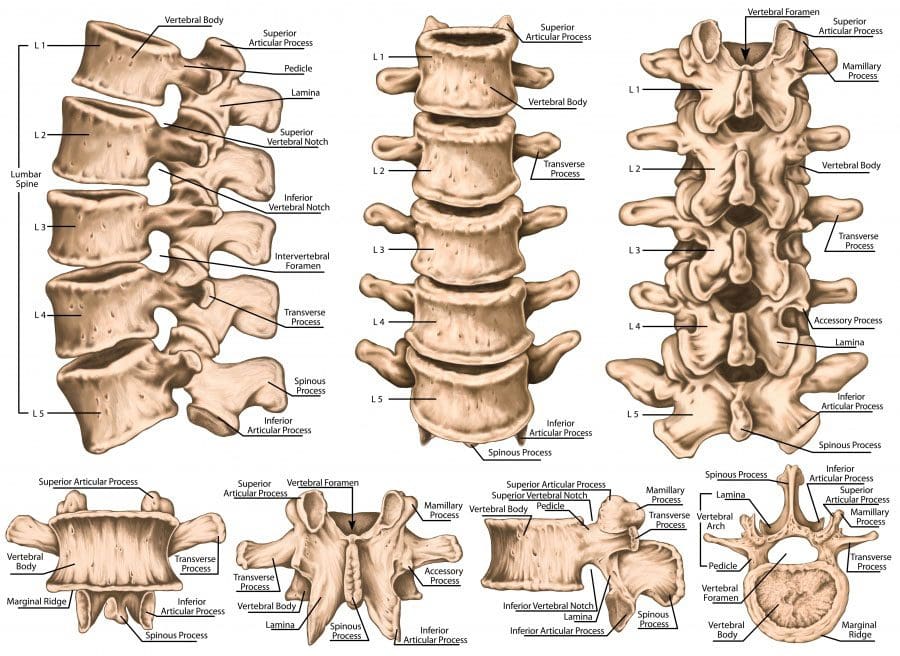
The lumbar spine is the lower back that starts below the last thoracic vertebra T12 and ends at the top of the sacral spine or sacrum S1. Each lumbar spinal level is numbered from top to bottom, L1 to L5, or L6. The low back bodies are larger, and thicker structures of dense bone. From the front or anterior, the vertebral body has a rounded shape.
The posterior bony structure is a different lamina, which is a thin bony plate that shields and protects access to the spinal canal. There are vertebral arches that create the hollow spinal canal for lumbar nerve structures and the cauda equina.
Lumbar Structure Strong Joint Complex
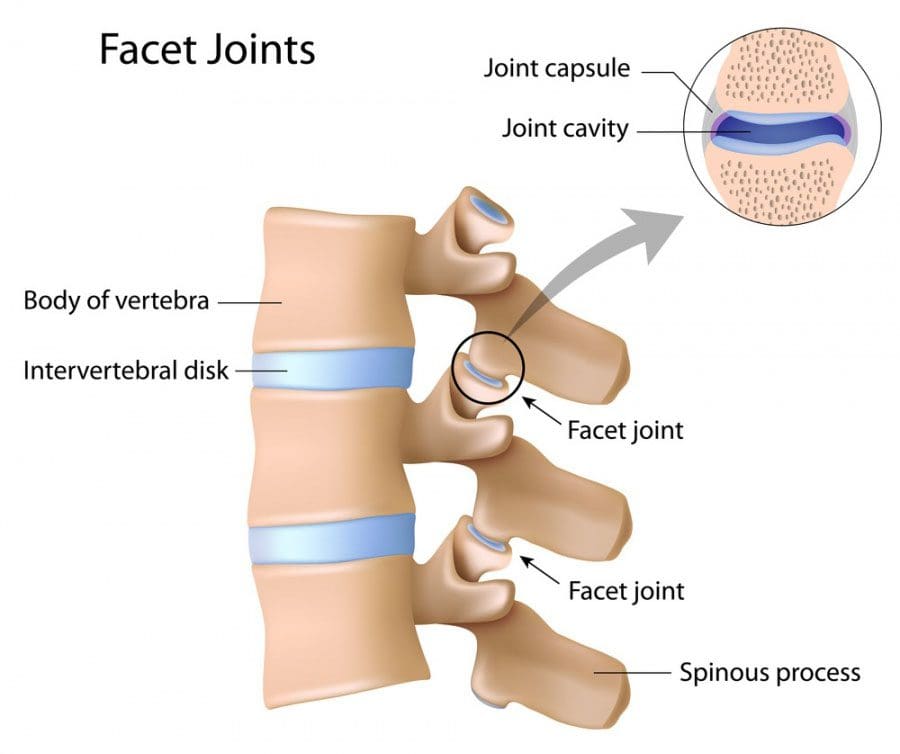
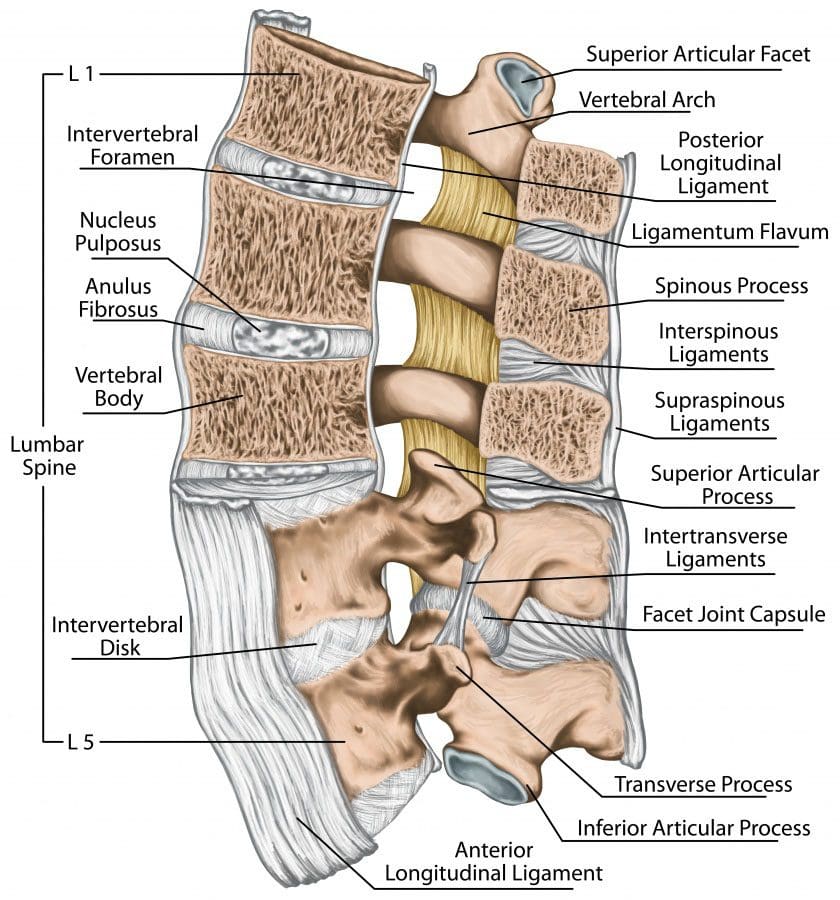
One intervertebral disc together with the facet joints forms a strong joint complex that allows the spine to bend and twist. One pair of facet joints from the top or superior vertebral body connects the lower or inferior set of facet joints. The facet joints are synovial joints, which means they are lined with cartilage and the capsule holds synovial fluid that enables joints to glide during movement. Think of it as hydraulics with smooth fluid motion.
Facet joint syndrome can develop from aging and degenerative spinal changes causing low back pain. The lumbar discs are secured in place by the fibrous endplates of the superior and inferior vertebral bodies.
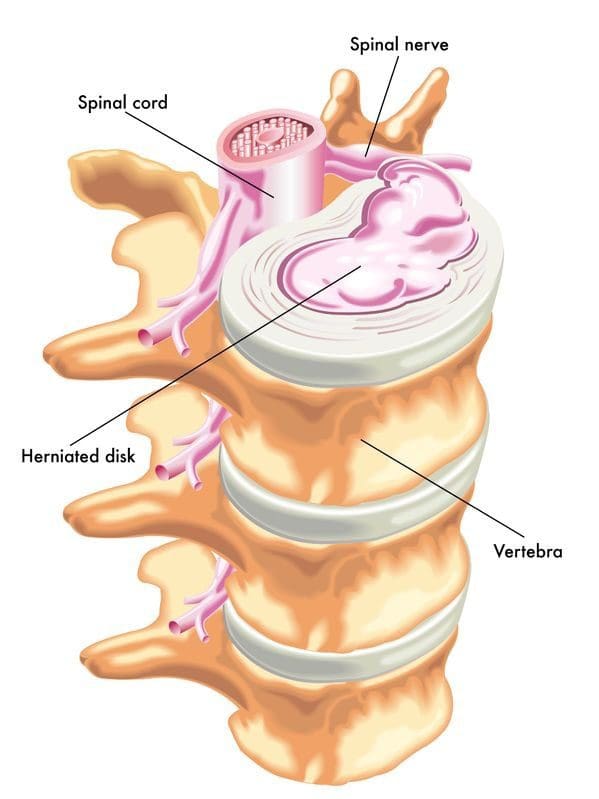
The jelly/gel center of each disc called the nucleus pulposus is surrounded by the annulus fibrosis, which is a tough layer of fibrocartilage that you can think of as a radial tire.
Discs are integral to the joint complex and function to:
Hold the superior and inferior vertebrae together
Take the weight
Absorb and distribute shock and forces when moving about
Create an open nerve passageway called foramen or neuroforamen
The neuroforaminal spaces on either side of the disc allow nerve roots to exit the spinal canal and leave the column.
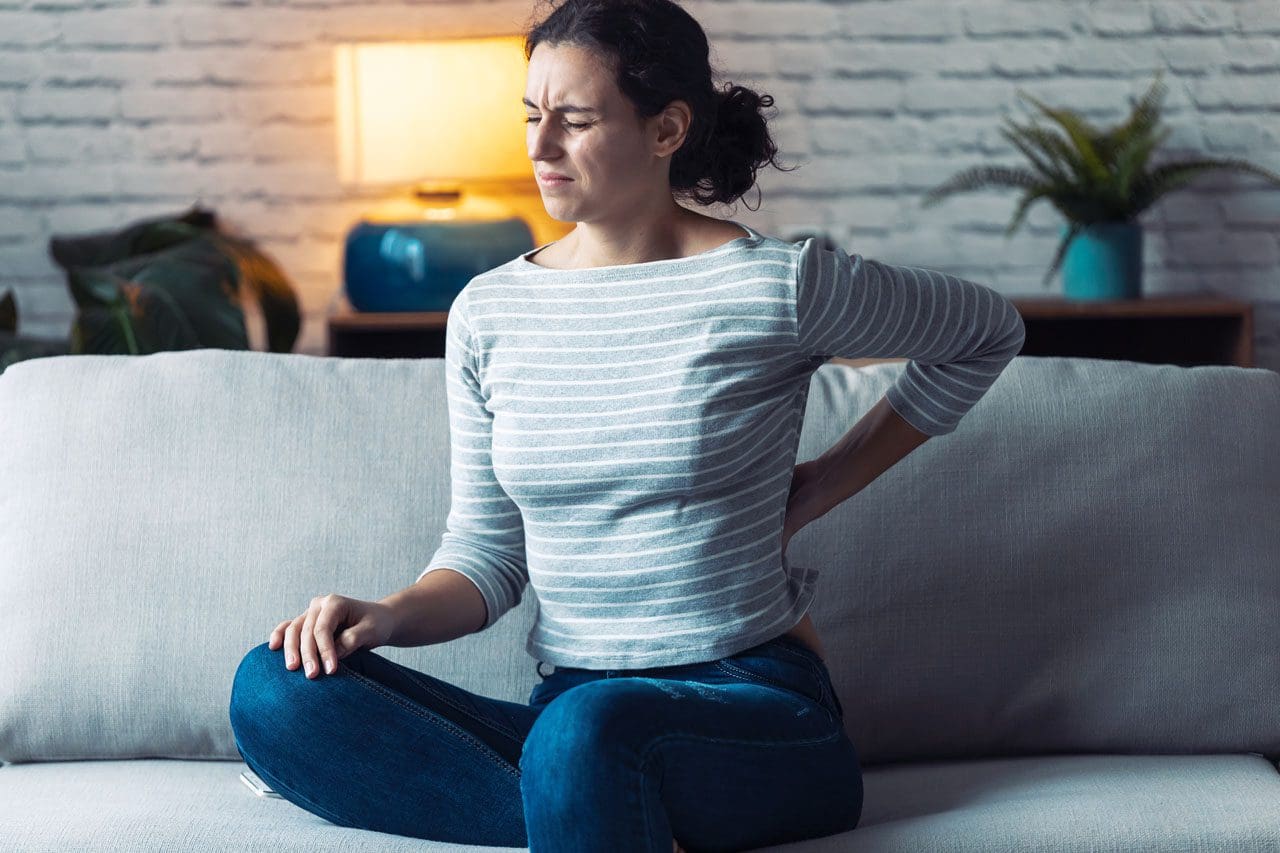
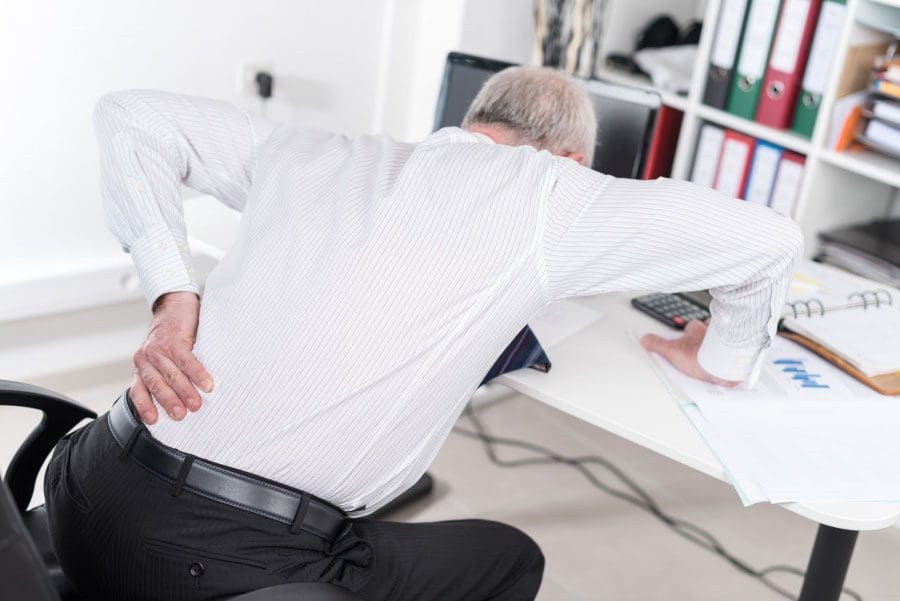
Lumbar disc herniation is a common cause of low back pain that can spread out into one or both legs. This is called lumbar radiculopathy. This condition can develop when the nerves are compressed.
Low Back Support
Lumbar Ligaments
Tendons
Muscles
Systems of strong fibrous bands of ligaments hold the vertebrae and discs together and stabilize the spine by helping to prevent over/excessive movements.
The 3 major spinal ligaments are the:
Anterior longitudinal ligament
Posterior longitudinal ligament
Ligamentum flavum.
Spinal tendons attach muscles to the vertebrae and together work to limit excessive movement.
Lumbar Spine Nerves
The spinal cord comes to an end between the first and second lumbar vertebrae(L1-L2). Below this is the remaining nerves that form the cauda equina which is a bundle of nerves that looks like a horse�s tail. These nerves send messages between the brain and the lower body structures, including the:
Large intestine
Bladder
Abdominal muscles
Perineum
Legs
Feet
Protect Your Back
Around 80% of adults will see a doctor for low back pain at some point. Therefore take care of your lumbar spine to help avoid painful, unnecessary wear-and-tear. You can minimize the risk of a low back injury/pain by:
Losing weight. Even a loss of 5 pounds can help reduce back pain.
Strengthening the core/abdominal muscles. The abdominal and low back muscles work together to form a supportive band around the waist and low back. Stronger muscles help stabilize the low back and reduce the risk of injury.
Stopping smoking. Nicotine reduces blood flow to the spine’s structures. This includes the lumbar discs and accelerates age-related degeneration.
Proper posture and proper body mechanics. When lifting objects keep your spine erect and use your legs. Ask for help with heavy objects. The lumbar spine is can bend and twist simultaneously, try to avoid doing this, as it is a perfect setup for a strain or sprain.
Get Rid of Low Back Pain with Custom Foot Orthotics
When dealing with back pain, it’s not just the pain that has to be dealt with. It is stress, anxiety, and depression that can make coping even harder. Learn how to manage pain and mental health. Dealing with chronic back pain is difficult for anyone.
All-around mental distress can exacerbate pain and worsen the stress you are already experiencing creating a vicious cycle. There are treatments available for mental health and chronic back pain that can help get a handle on both at the same time. What you should know about the connection, along with the therapies that can help.
Dealing with Chronic Back Pain and Mental Health
Back pain is very common and it is estimated that about 90% of Americans will experience back pain. A small portion will develop chronic back pain or pain that continues more than 12 weeks. Chronic back pain can be caused by a variety of medical problems. Injuries to illness are all are pathways to chronic pain. Pain is different for everyone, depending on the cause, the area affected and the individual. For some, the pain might feel like a mild, persistent ache. While others, the pain could be a continual throbbing.
One factor of chronic back pain is the emotional response that happens when it presents. If you stress or fixate on the pain, you are perceiving it to be much worse. This can lead to more stress, and:
Anxiety
Appetite changes
Depression
Fatigue
Mood swings
Sleep issues
These problems then feedback into the pain and together significantly affect relationships, work, ability to function and your quality of life. The single step to take is to reach out to a doctor. They can check for mental health issues, begin treatment for your psychological/physical issues and refer you to specialists.
Therapy
There are many approaches to treating chronic back pain and the psychological issues that come with it. Not every treatment regimen works for everybody. The best approach is usually a combination of techniques. Psychotherapy, specifically the talking therapy can help treat both physical and emotional pain. One of the most-researched forms is cognitive-behavioral therapy (CBT).
During a session, you learn how to identify negative reactions and work to change them into positive thoughts and actions. The idea is to alter the initial response to better manage how the pain affects you. This therapy is directed by a therapist and can be done individually or in a group.
Medication
For many medications are an effective way to manage mental health issues and some can help relieve the pain itself.
While these drugs can be helpful, many can come with side effects. Antidepressants can cause:
Blurry vision
Drowsiness
Dizziness
Bathroom issues
Pain Rehabilitation
Chronic pain rehabilitation programs are another option. With rehab, a team of doctors/physical therapists from different areas of medicine, work together addressing the medical, physical and mental issues that come with the pain. Every treatment program is customized to the patient, and while treatments are usually conducted at a medical clinic, they can also be done online.
Pain rehab includes:
Addressing any underlying conditions
Improving physical function
Reducing reliance on pain medication
Helping you cope with stress, anxiety, and more
Integrative Health
Alternative health approaches can help control back pain and ease the mind. Research has shown that certain alternative practices do work to relieve pain. There is evidence that the following therapies can help reduce chronic back pain, according to the National Center for Complementary and Integrative Health:
Acupuncture
Chiropractic
Low-level laser therapy
Mindfulness-based stress breathing exercises and imagery
Muscle relaxation
Tai chi
Yoga
Other treatments
Electromyography biofeedback is a therapy where low-level electric signals are used to help gain control over muscle movement. Some patients find journaling, massage, prayer and other relaxation techniques to be helpful in coping. Speak with your doctor if you have questions or health issues before beginning complementary treatments.
Lifestyle
A most effective and widely recommended method for relieving stress, anxiety, depression and chronic pain improving physical function is regular exercise and a healthy diet.
Low-impact workouts like:
Stretching
Walking
Swimming
Yoga
These all are helpful for people with chronic back issues. Talk with a doctor about physical exercises that are safe. Proper sleep can help, like poor sleep and sleep deprivation increase stress, which leads to more pain. Adults should go for 7 to 9 hours regularly, according to the National Sleep Foundation. Wake up and go to bed at the same time every night and turn off electronic devices.
Eating healthy can boost mood and help relieve back pain by promoting weight loss. Enjoy complete meals full of lean proteins, whole grains, and vegetables while limiting the intake of processed foods, added sugars, and saturated fats. Avoid excess alcohol and smoking, as both are linked to chronic back pain. Learning and dealing with chronic back pain along with re-searching successful treatment options can be a long and frustrating process. Understanding the condition and cutting yourself plenty of slack can go a long way to helping you feel better.
Reduce stress, reduce pain. Life creates stress, and while some stress can be good, too much causes health problems. Everyone experiences stress. However, now it is becoming a new normal in today�s hectic, fast-paced, high-pressure society. Most individuals equate stress with high blood pressure, heart attacks, or stroke. However, neck and back pain, insomnia, and weight gain can be stress-related, as well. And a lot of stress can make already-existing back/neck pain worse.
73% of individuals report experiencing stress-related psychological symptoms including anxiety and depression. These are not accurate numbers because most do not seek help for their stress issues. Stress symptoms should not be taken lightly. It is important to address the symptoms and find ways to reduce stress. Chiropractic is an effective stress reliever.
Stress
Financial pressures, kids, long work weeks, and medical problems are common anxieties. Prolonged stress can become chronic, which results in muscle tension that can feel stiff, achy and uncomfortable. Stress can develop into neck or back pain.
Stress is the state of:
Emotional
Mental
Pressure
Tension
That results from difficulties, adverse situations, or extremely demanding circumstances. The very nature of stress by definition makes it very subjective. A “stressful” situation for one person might not phase another. This makes it difficult to pin down a precise definition.
More often, the term stress is more often used to describe the set of symptoms that are caused by stress and those symptoms can be as varied as the people who experience them.
Symptoms
Stress symptoms can affect the entire body physically and mentally. Common symptoms include:
Anxiety
Chest pain
Depression
Fatigue
Gastrointestinal problems
Irritability
Lower back pain
Muscle tension
Overeating
Headache
Restlessness
Sleep problems
Unable to focus
Undereating
Health
Technically, stress itself does not have a negative impact on health. Some individuals deal with situations that others would consider to be stressful, yet they never exhibit symptoms. This speaks to the subjective nature of stress. Different people experience different symptoms and are a combination of stress symptoms, how the person handles those symptoms that adversely affect health.
Ultimately, stress symptoms can lead to some very serious conditions including:
Heart disease
Hypertension
Diabetes
Obesity
Cancer/s
Psychologically, it can lead to social withdrawal and social phobias and is directly linked to alcohol and drug abuse.
Tips
These can help you reduce stress, and reduce pain.
Vital Signs
Get a medical checkup if possible through Telemedicine and talk to a doctor/therapist about your stress, along with medical history. Side effects from medications (prescription or over-the-counter), herbal products, or other supplements can cause restlessness, insomnia, and anxiety.
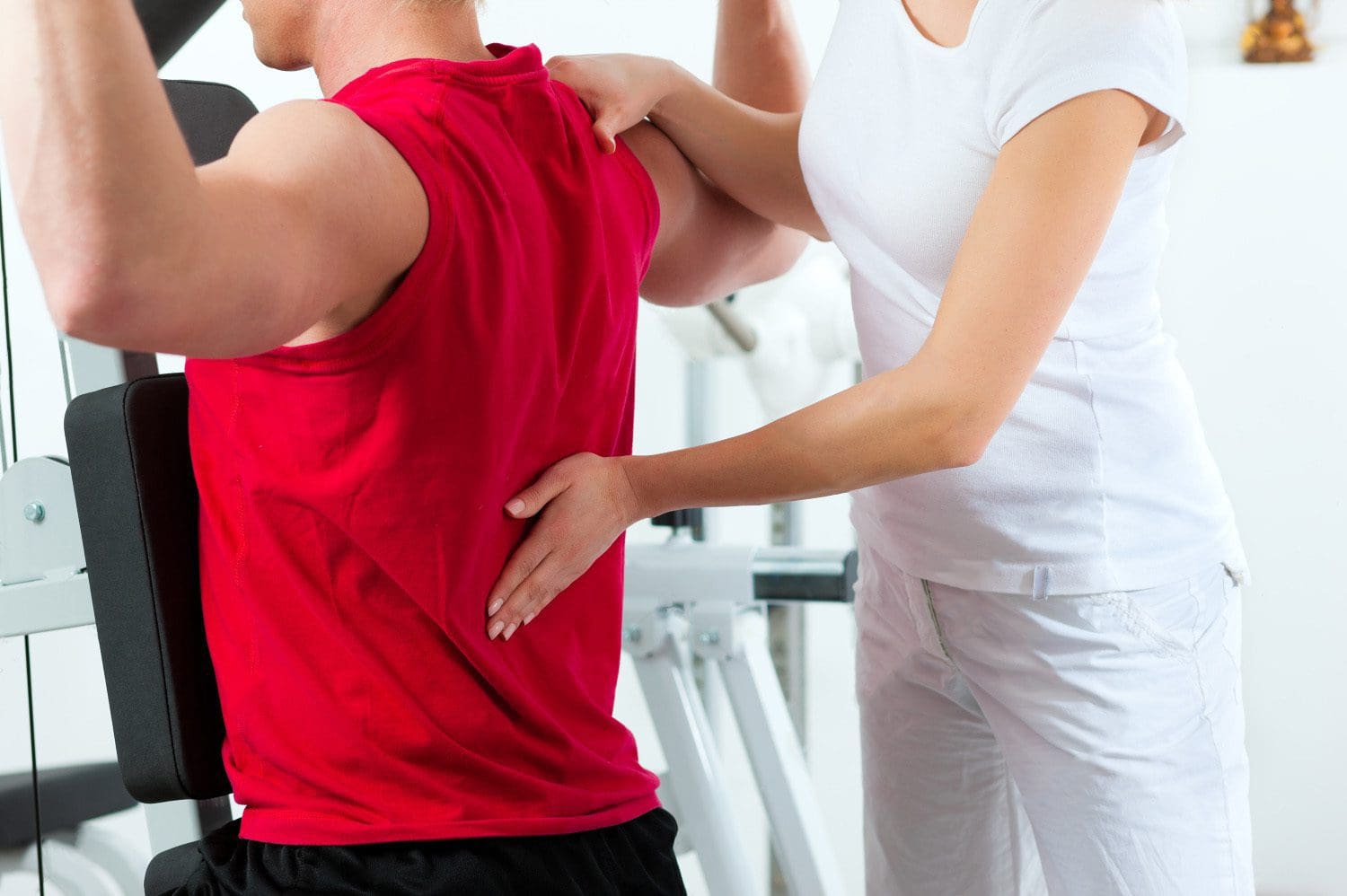
Physical therapy combines pain-relieving non-invasive treatments with therapeutic exercise, posture correction, and preventive body mechanics.
Consider conversational therapy with a stress counselor, psychologist, or support group online.
Get Moving
Yoga and relaxation movements help reduce stress and stretch muscles. Viniyoga blends breathing and movement together to quiet body and mind. These movements are less precise and adapted to a person’s physical condition. Talk to a doctor about trying yoga or other stretches.
Swimming combined with a sauna or steam bathing can relieve stress-induced pain.
Take frequent stretch breaks to loosen up tight neck or back muscles.
Go for short walks at break or lunchtime to get the circulation going.
Learn to Relax
Kick back, put your feet up, and empty your mind of everything.
Wrap an ice pack and hot pack (or hot water bottle) individually in towels. Apply the ice pack for 10 minutes and then the hot pack for 5 minutes. Alternate several times.
Massage, aromatherapy and spa treatments you can do at home.
Aromatic massage oils containing eucalyptus can help ease muscle pain.
Meditation or visualization therapy combines meditation practices that focus on breathing and calming the mind.
Visualization techniques combine imagery with breathing exercises.
Take Control of the Little Things
Break up problems into smaller manageable pieces and work on resolving the easier parts first.
Learn your limits, how to delegate responsibility and not take the entire load on your shoulders so as not to get overwhelmed.
Allow yourself to fail, we all have to fail in order to learn in order to apply what was learned.
Eat and Drink for Life
Make mealtime less stressful. Pick nourishing foods, eat slowly, and savor each other’s company.
Caffeinated coffee, soda, and other drinks do not help reduce stress or promote restful sleep.
Avoid drinking at night because it can make falling and staying asleep a challenge.
Proper sleep or naps can help relieve stress.
Dealing with Stress Is Good for Your Back
We may not be able to control life’s stressors, but don’t let everyday demands interfere with your health. Incorporate exercise, relaxation techniques, and healthy foods to reduce stress and pain and promote stress prevention.
Reduce stress reduce pain with chiropractic
Chiropractic cannot get rid of stress, but it can help relieve stress symptoms. The more stress the body endures, the more sensitive it becomes to pain and physical imbalances. Chiropractic helps by bringing the body back into balance, aligning the spine, and relieving pain.
The simple act of aligning the spine helps relieve stress in the body that you may not even be aware of. The physical stress of a misaligned spine can exacerbate symptoms and make a person more susceptible to stressful stimuli in their environment. Chiropractic helps to improve circulation which is essential in relieving muscle tension and helps shuts down the fight or flight response allowing the body to rest and heal.
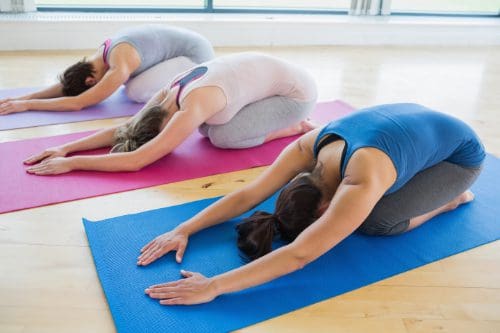
Yoga has gained popularity because of its ability to reduce back pain, relax tight muscles, relieve stress and exercise in a safe calm environment. Developed thousands of years ago, the practice of breathing, posing and stretching offers a variety of important health benefits. As a chiropractor, I�m often asked about the practice of yoga. Those with back pain or have undergone spine surgery want to know if yoga can help them improve their physical and psychological health.
Reduced stress
Improved blood pressure
Increased flexibility
Increased stamina
Greater balance
Improved breathing techniques
In addition to the normal exercise benefits yoga offers, the practice serves as therapy for a variety of injuries and health conditions. Yoga embodies the physical, emotional, and spiritual wellness, and touches upon other forms of traditional exercise. The concept that yoga heals the body in its entirety mirrors chiropractic care. These foundations offer enormous benefits to those dealing with a variety of injuries and conditions. By incorporating yoga, individuals are able to reap amazing rewards.
A regular exercise plan needs to include a little cardio as there are huge benefits from pumping the heart rate up. Minimal loading exercises, like biking, and swimming are great. Pain can be managed by participating in cardiovascular exercises, however, yoga�s gentleness can complement the healing process.
Here are a few reasons:
Prepares the body for healing
Practicing yoga stretches and elongates the body’s muscles, releasing tension and stress. It can serve to warm up the body and clear the mind, so a chiropractor can get to the root problem. Yoga complements chiropractic treatment by preparing the body to heal itself.
Strengthens joints and ligaments
Dealing with a health condition or injury is frustrating and can seem like it takes forever to heal. Implementing yoga into a recovery plan helps strengthen joints and ligaments, which aids in promoting healing and cutting down the time it takes to get better. Yoga works on the body as a whole and promotes greater well-being from head to toe. A stronger body offers more productivity than one that is stiff, sore, and unhealthy.
Increases range of motion
Depending on the individual’s specific condition, individuals may need a few visits to prepare their bodies before the main issue can be addressed. Yoga sessions increase a body’s flexibility and help with the range of motion in the neck, back, hips, and other joints.
Prevents injury/s
Yoga provides a continual way for individuals dealing with chronic conditions to manage and reduce pain, inflammation, and other symptoms. Yoga combined with chiropractic keeps the body aligned, balanced, muscles stretched, de-stressed, and the joints working properly.
Both also serve to keep posture correct, and ligaments strong. All of this creates a body that is less susceptible to future injury, illness, and stress. Individuals enjoy increased mobility for a lot longer without changing lifestyle.
The Best Way to Start
There are many different types of yoga. Most sessions usually last an hour and include breathing exercises, meditation and holding poses/postures that stretch and tone muscle groups.
To help visualize how yoga can help the spine, here’s an analogy:
Think of the spine like a cookie ice cream sandwich with the ice cream in-between and a gummy band wrapped around. The cookies represent the vertebrae, the ice cream is the disc cushion in between and the gummy band represents the ligament and muscles surrounding the area.
The tighter the gummy band is, the more it compresses the cookies and applies pressure to the ice cream.When stretching the gummy band, it loosens the pressure on the cookies and reduces the load/compression of the ice cream.
Exercise is crucial for recovery and rehabilitation. Yoga is a gentle way to get you back on your feet. It promotes circulation, relaxation, strength, and flexibility. Pure plane movements meaning moving forward then backward in basic movements are essential until the body becomes more flexible. Move carefully forward, sideways and cautiously backward.
At the beginning no movements combining bending and twisting.
The muscles need to adapt and become comfortable with these movements at first. Therefore, hold poses for at least 30 seconds without bouncing minimizing potential injury.
Certified instructor
Ask your doctor or chiropractor if they can recommend a certified yoga instructor; preferably with 500 hours of instruction. Search for small class sizes and a teacher that closely monitors movements and poses closely. It is important that the instructor be aware and make gentle adjustments or offer modifications to participants as needed.
Restorative Flow
Start off with a type known as Restorative Flow. It restores the flow from one part of the body to another with slow controlled movements/poses that emphasize stretching and correct breathing.
Listen to Your Body
When healing from injury/s, take it slow. Listen to your body and let it guide your movements so that it feels safe and comfortable. Do not push beyond. For most, a beginner or restorative Yoga class is best. Ask about modifying the poses so that the bending and twisting combinations/advanced postures are taken out so as not to overload the joints.
If you are on a budget consider purchasing an instructional DVD. DVD’s offer program variations of 20 to 60 minutes and are highly educational and easy to follow. Stretching pain/soreness is okay, but sharp pain is not.
Yoga could be an answer to many of the body’s issues, whether dealing with current conditions or just want to stay healthy in a new way check out the basics of yoga. Chiropractic coupled with yoga offers great benefits to those dealing with medical conditions or injury. Ask your chiropractor for an evaluation, and if adding yoga to your health program will help.
Individuals can develop a herniated, slipped or bulging disc in the neck or back.�Too much stress on the disc/s whether from poor posture, being overweight, injury, aging, and an unhealthy lifestyle can increase the risk for disc problems. Herniation can be caused by a combination of factors or physical injury. Several common questions about disc problems are answered.
Can Discs Slip
A slipped disc can mean a ruptured or herniated disc. We use the term slipped disc, however, the discs do not slip. Each disc is sandwiched between two vertebrae that are supported by a system of ligaments that hold the spine together. A bulging or herniated disc is the proper term.
Difference Between a Bulging and Herniated Disc
Disc disorders are categorized as contained or non-contained. Bulging disc is an example of a contained disc disorder.
Bulging
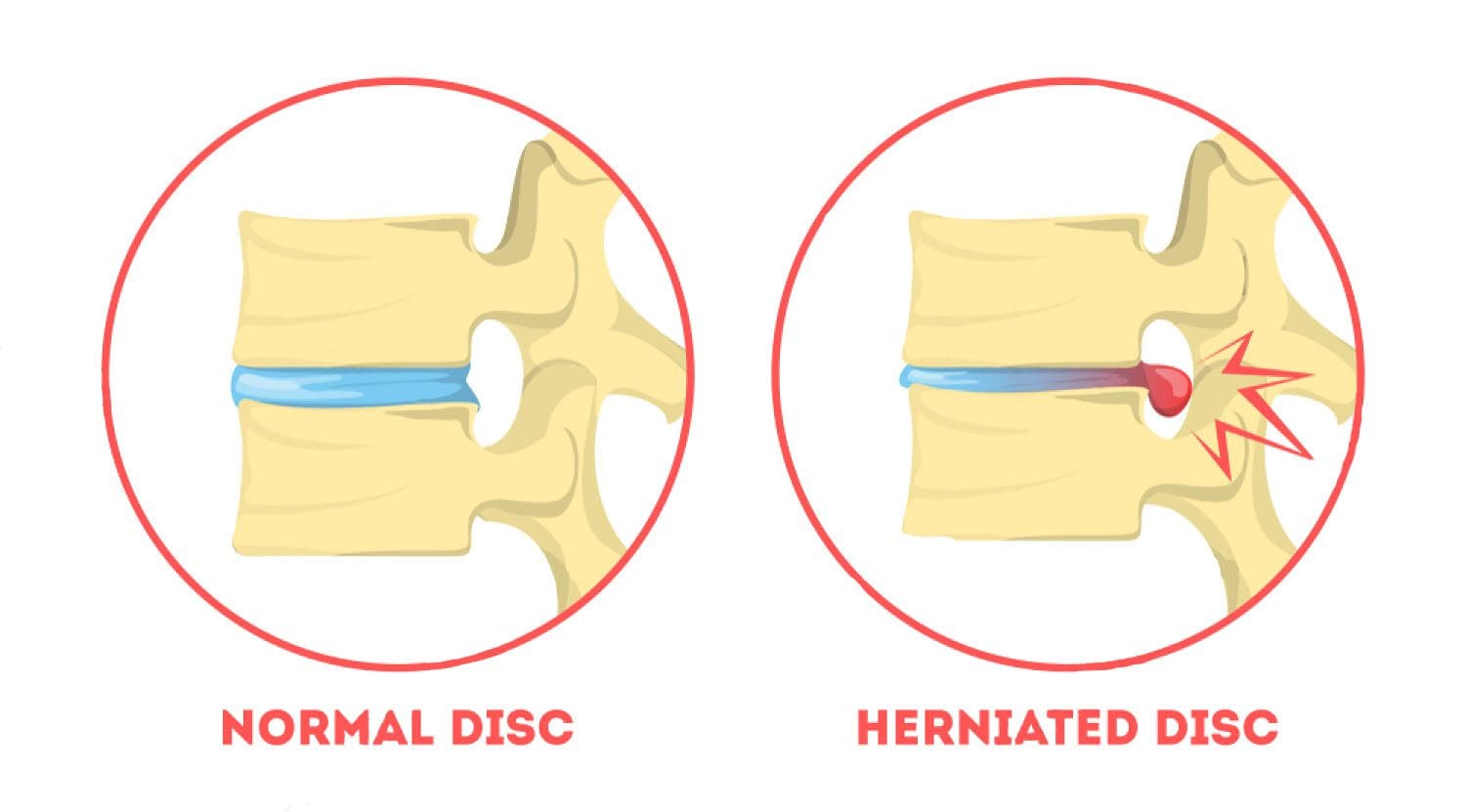
A bulging disc has not broken open meaning the nucleus is still contained inside the annulus fibrosus. The disc could protrude into the spinal canal without breaking open. The gel, the jelly interior does not leak out. The disc stays intact except a small bubble pops out.
Herniated/Ruptured
A non-contained disc has either partially or completely broken open, and that is a herniated/ruptured disc. Imagine a closed tube�being squeezed placed under pressure, which causes the contents to move wherever they can. If a portion of the tube is weak or there is too much pressure, the contents could leak or burst out. When a disc herniates the gel-like contents could spread out to the spinal cord and nerves.
Herniation Can Cause Pain
The disc’s gel-like nucleus has a chemical that irritates the nerves and causes them to become inflamed and swell. The chemical stays and continues to press on the irritated nerves. Sometimes fragments from the disc wall or the tube break off from the disc and drift into the spinal canal causing other nerves to inflame and swell. Based on the type of injury and condition of the discs, more than one disc could herniate, rupture, or bulge. Sometimes injury causes a combination of disc disorders.
Symptoms
Symptoms of a herniated disc can include:
Dull
Shooting pain
Muscle spasms
Cramping
Weakness
Tingling
Referred or radiating/traveling pain
Sometimes, however, a herniated disc does not cause any symptoms at all. When this happens it is called an asymptomatic herniated disc. Disc/s could be bulging or herniated, but if it or they are not applying pressure on the spinal nerve/sor the cord, symptoms like pain may not present. This makes a point about herniated disc symptoms that they are dependent on where you have a herniated disc.
Cervical Herniation Symptoms
With a herniated or bulging disc in the neck, then you could experience:
Neck soreness/pain
Muscle tightness
Cramping in the neck
Pain that travels down the arm/s
Tingling in the arm/s or hand/s
Weakness in the arm/s or hand/s
Lumbar Herniation Symptoms
With a herniated disc in the low back the following symptoms could happen:
Low back pain
Muscle tightness
Cramping in and around the low back
Radiating pain that travels down the leg/s
Tingling in your leg/s or foot/feet
Weakness in the leg/s or foot/feet
Referred Pain
Referred pain means that you have pain in another part of the body from the disc problem. An individual could have a bulging or herniated slipped disc in the low back and have pain in the leg. This is lumbar radiculopathy or sciatica. Usually, just one leg is affected. If you have a herniated disc in the neck, there could be referred pain going down the arm and into the hand.
Chiropractic Cares
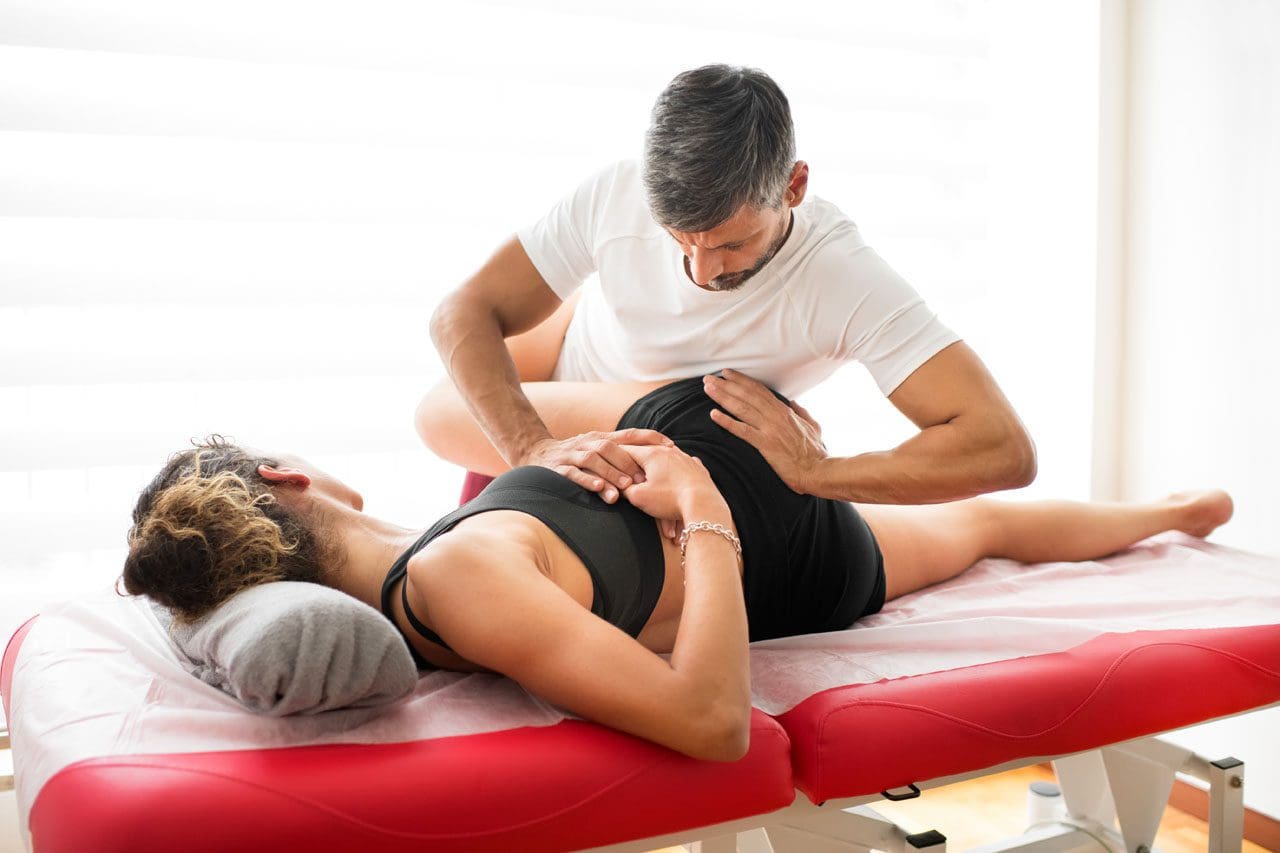
A chiropractor can help relieve back pain and other herniated disc symptoms. A chiropractor will go through your medical history, do a physical exam, and perform orthopedic and neurological tests. They are looking at several things. Orthopedic and neurological exams can help the chiropractor figure out what’s going on.
Are reflexes functioning properly?�Meaning are your nerves sending messages correctly. An example is a reflex test is when a doctor taps the knee with a hammer and the leg kicks.
Is there a loss of muscle strength?
Signs of muscle/s wasting away?
Is there a loss of sensation, tingling or numbness along the nerve/s path?
They will carefully look at posture, and will probably order an X-ray or MRI to help with the diagnosis.
Chiropractors evaluate the entire spine. Even if you only have lower back pain, your chiropractor will examine your neck, too. They want to see how well your spine is functioning overall. Remember what happens to one area of your spine can influence another part of the spine and/or body.
Pain from a herniated disc can make it difficult to enjoy daily life. Walking, sitting, and sleeping normally/comfortably can become a nightmare. You should make an appointment with a doctor or chiropractor if your herniated slipped disc symptoms last for more than two weeks.
Herniated Disc Treatment
NCBI Resources
In the United States alone, acute cases of lower back pain are the fifth most frequent reason for doctor visits and cause 40% of missed days off work. What�s more, it is the leading cause of disability worldwide.
You don’t have to be highly athletic to do back extensions. They’re common in yoga, Pilates, and other stretching and strengthening exercises. Health and fitness begin with the desire to improve oneself. When desire and belief are strong enough, it leads to action. When done properly and consistently, success follows. Considering all that the back goes through in a typical day, it isn’t much of a stretch to think that pain could present at times. This is especially true if the back is not properly aligned.
Strong back muscles can reduce injuries and improve posture. There are some muscles along the length of the spine that support the spine. One of the most important�deep muscle groups in your back is the erector spinae. If this muscle group becomes weak, back pain can start to present.
Back Extension
Back extensions can be done:
Using a machine
With an exercise ball
No equipment or objects at all described below
When beginning it’s a good idea to consult a certified personal trainer that has experience rehabilitating people with back pain. They will also teach proper form, body mechanics and alignment. Before doing any exercises consult your chiropractor or primary doctor.
Three You Can Do
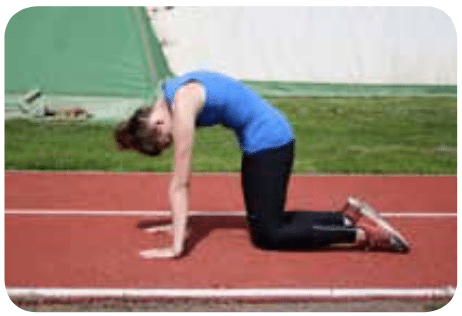
The Cow Pose
Begin on hands and knees.
Hands are shoulder-distance apart and knees are hip-distance apart.
Inhale and arch your spine by rocking your pelvis toward the floor.
Look up toward the ceiling.
As you exhale, move back to your starting neutral back position.
Inhale, and repeat. Link your inhales and exhales with your movement.
Do the cow stretch 5 to 10 times once a day.
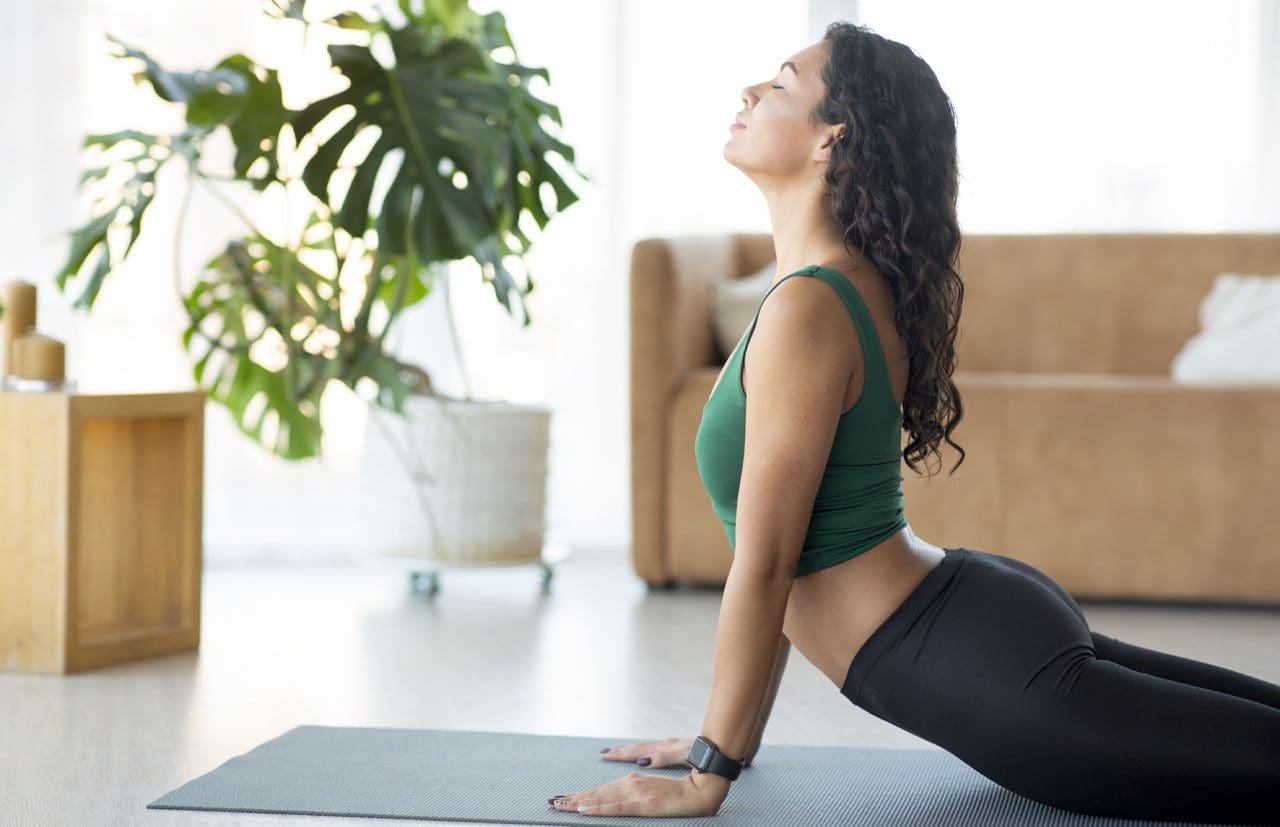
Upper Back Extension
Begin on your stomach with a small pillow or�rolled�towel under your hips.
Arms should be along your sides.
Slowly lift your upper body off the floor and contract your low back muscles.
Hold 3 seconds before lowering back to the floor.
Repeat 10 times.
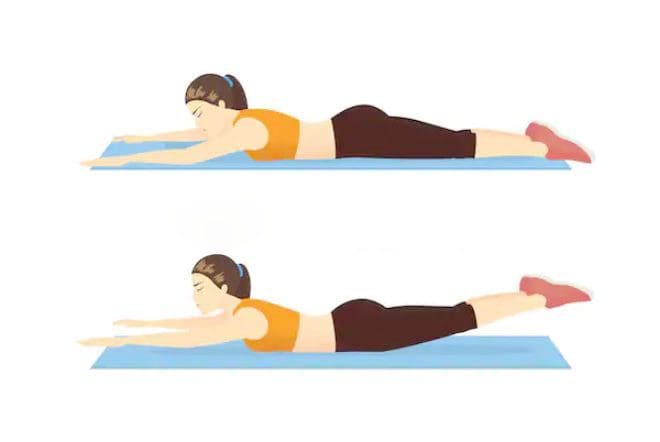
Opposite Arm/Leg Extension
Start on your stomach with legs together and arms stretched in front.
Breathe in and tighten your tailbone as you lift your arms and legs off the floor (about hip height and if you can higher).
Pump the right arm down and left leg down so they just graze the ground, and then bring them back to hip height and pump the left arm and right leg down.
Alternating right arm/left leg and left arm/right leg in small movements. Keep your eyes toward the mat.
Repeat 3 times every day.
These are just a few back extensions that can help you build strong back muscles. Do these exercises regularly to decrease and prevent back pain.
Belief Action Success
All of us want to be living healthy lives.
When realistic, specific and measurable goals are expertly set-up in a health program what really keeps us from getting there is a break in the link that falls between belief and the action. And that is the excuses that seem to pop up at those moments.
Every time I try to exercise or eat healthy, something comes up
Someone or something else is responsible for the situation.
We know what we need to do but just don’t want to do it. We believe that something out of our control prevents us.
Be Proactive
It means more than just taking initiative. It means a responsibility or you can think of it as a response and the ability for our own lives. People that become proactive do not blame circumstances, conditions, etc for their behavior or lack of behavior. It is a product of their own conscious choice. Once you realize the power you have, obstacles become welcome challenges to be overcome. With just a little success, confidence grows and commitment to health and fitness goals becomes a priority.
Back Pain Specialist
NCBI Resources
Dealing with joint or muscle pain can be a daunting experience. It�s important to work on maintaining�mobility and flexibility. The more flexible, the less likely to be injured. One of the best ways to improve flexibility is through stretching. A�chiropractor�can recommend stretches, or you can use some of these basic techniques
Lumbago is a term that means mild to extreme pain in the muscles and joints of the lower spine/back. The pain can be acute or chronic and affects both young and older individuals. The spine is a very intricate structure and when one component fails to function properly it can affect the entire body, causing pain and loss of mobility. Back pain costs about $100 billion in medical bills, disability, and lost workdays.
Tiny bones, known as vertebrae, are stacked on top of each other, which forms the spine. The way these bones are joined facilitates movement, flexibility, and range of motion. In between�each vertebra are small, fluid-filled discs that are the padding/cushions between the bones. When these discs become damaged, injured, or shift out of place it can affect the surrounding nerves, muscles, and ligaments causing pain and making movement difficult.
At some point, an individual will experience some form of back pain. This could be a sore back from yard work, tough manual labor or hard workout, etc. This is a normal occurrence and can be taken care of at home. If you have a sprained or strained back but not a serious injury icing can help reduce swelling, muscle spasms, and pain for the first 24 to 48 hours after the injury. After 48 hours, switch to heat to warm and relax the sore muscle tissues.
Causes
There are a variety of conditions that can cause low back pain. The more common conditions:
Herniated Disc is one of the most common spinal disc issues.
Osteoarthritis or Spondylosis
Osteoporosis
Rheumatoid Arthritis
Scoliosis
Spinal Stenosis
Spinal Tumor
Factors that can contribute to back pain and can exacerbate the pain during episodes of lumbago.
Exposure to a cold damp environment
Poor posture
Sudden movement/s
Coughing
Sneezing
Lumbago Symptoms
Common symptoms of lumbago.
The pain can radiate into the buttocks, thigh/s, and the groin and can cause tingling/numbing/electrical sensations to be felt in the low back, buttocks, and legs and feet.
The pain can be aggravated when moving around. Bending forward, backward and side-to-side can limit mobility.
Spine muscle spasms can cause the back to feel stiff with a constant soreness.
The pain can affect proper posture, which causes individuals to walk bent or hunched to one side.
Lumbago rarely causes serious symptoms that need immediate medical attention.
See A Chiropractor
A chiropractor can help you create a natural, non-surgical treatment/exercise/health plan to control low back pain and prevent future episodes of lumbago. Treatments include physical therapy, chiropractic, supplements, and alternative medicine like acupuncture.
The “LIFE CHANGING” Foot Orthotics | El Paso, Tx (2020)
NCBI Resources
Everyone needs to take care of their back/spine because it is what holds us up as long as we keep it straight and strong.�Strengthening the core�can help prevent a weak and misaligned spine from getting worse�and helps to eliminate pain. Back safety should be priority one, as it affects all aspects of your life. Not only are you protecting your back, but preventing future injury.
IFM's Find A Practitioner tool is the largest referral network in Functional Medicine, created to help patients locate Functional Medicine practitioners anywhere in the world. IFM Certified Practitioners are listed first in the search results, given their extensive education in Functional Medicine