Sport Specific Chiropractic Rehab and Athletic Recovery
Sport-Specific Training & Chiropractic in Back Injury Recovery
Introduction
Back injuries—whether from sports, auto accidents, work accidents, or daily strain—present a unique challenge. The spine supports nearly every movement, and when it’s compromised, strength, mobility, and balance suffer. For patients at a clinic offering advanced back care (like El Paso Back Clinic), the integration of sport-specific training with chiropractic and integrative modalities offers a powerful path toward recovery and long-term resilience.
Sport-specific training—customized drills that focus on strength, agility, and coordination—can rebuild function in a way that general rehabilitation often cannot. Paired with structural alignment, nerve health, soft tissue healing, and holistic support, this combination helps patients achieve more than just pain relief. They regain strength, flexibility, and control.
In this article, we will:
-
Define sport-specific training and its essential components
-
Show how it applies in a back-injury or spinal-rehab setting
-
Explain how chiropractic and integrative care complement and enhance outcomes
-
Illustrate how a multidisciplinary spinal/rehab clinic (such as El Paso Back Clinic) can deploy these strategies for complex cases
What Is Sport-Specific Training?
Sport-specific training consists of exercises and drills designed to mimic or approximate the demands of a particular sport or movement pattern. Rather than simply engaging in general strength training or cardio, the athlete (or rehab patient) practices movements that simulate the activities they actually perform in their sport (or daily life). (Simplifaster, 2023)
For example:
-
A soccer player might do cone drills, direction changes, and sprint cuts.
-
A basketball player might do jump-rebound drills, lateral slides, and shot motion under fatigue.
-
A person recovering from a back injury who intends to return to recreational tennis may benefit from training rotational core stability, hip control, and deceleration drills.
The principle is to condition not just muscles, but neuromuscular coordination, timing, balance, and movement patterns under stress. (Island Sports PT, 2024)
Core Elements of Sport-Specific Training
-
Strength & Conditioning
Focused strength work for sports-relevant muscles. For instance, rotational core strength, hip extensors, and glutes are often critical, especially when the spine is recovering from injury. (Kinetics Performance, 2024) -
Power/Explosive Work
Plyometric movements, medicine-ball throws, jump training. These train fast-twitch fibers and increase force production. (Keiser, 2024; Physio Jersey, 2024) -
Speed, Agility & Quickness
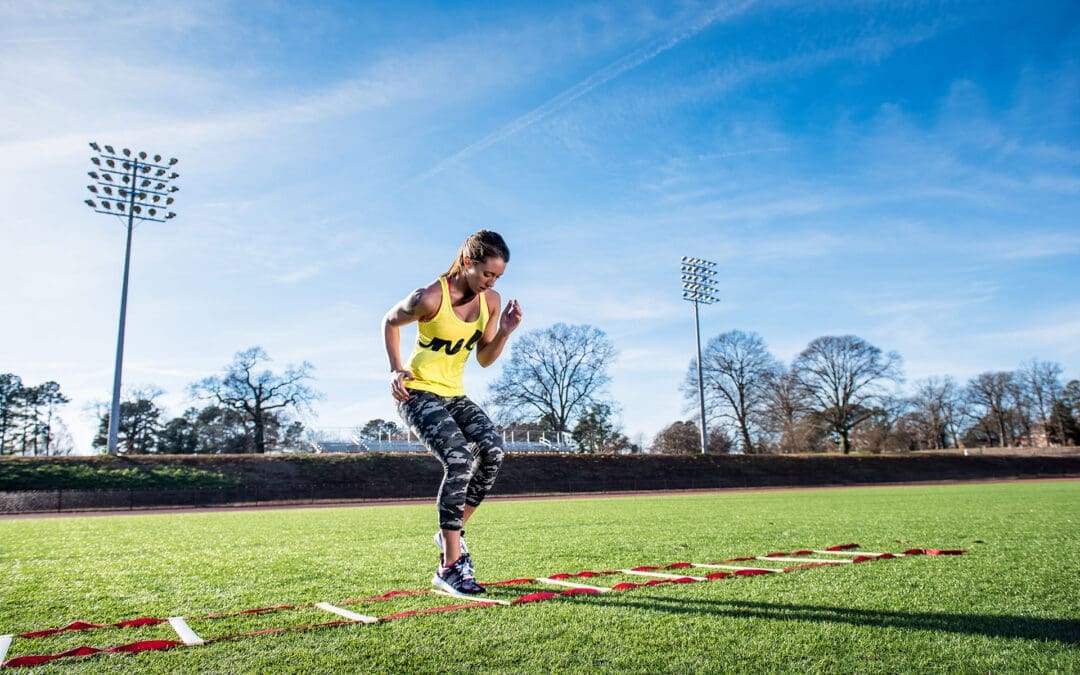
Drills with cones, agility ladders, reaction tasks, shuttle runs—all aimed at improving the ability to change direction and speed efficiently. (Sensory Stepping Stones, 2024; Rockstar Academy, 2024) -
Endurance/Conditioning
Many sports or daily activities require sustained effort. Interval training, circuits, or sport-like conditioning help build stamina. (Adrenaline SPT, 2024) -
Skill/Technical Drills
Repetition of sport-specific moves—shooting in basketball, footwork in soccer, and throwing motion in baseball. (Island Sports PT, 2024) -
Balance, Coordination & Core Stability
Single-leg work, balance boards, unstable surfaces, control drills—all to enhance proprioception and stability (TRX Training, 2024).
Adapting Sport-Specific Training in Back Injury/Spinal Rehab
When someone has a back injury, it is not advisable to immediately engage in high-intensity sports drills. The approach must be staged, cautious, and progress gradually. Sport-specific training in this context helps by:
-
Rebuilding movement patterns in a safe, graduated way
-
Restoring control under load so that the spine can handle complex tasks
-
Bridging rehabilitation and performance so patients return stronger
-
Preventing reinjury by conditioning neuromuscular systems for the true demands of sport
Phased Progression Example
| Phase | Goal | Type of Training | Considerations |
|---|---|---|---|
| Early Rehab | Protect healing structures, restore basic motion | Low-level core stability, isometrics, light mobility drills | Avoid flexion/extension extremes, monitor pain |
| Intermediate | Gradually load spinal and limb muscles | Strength drills, gentle plyometrics, coordination patterns | Monitor for compensations, emphasize form |
| Transition to Sport | Apply sport-specific drills under control | Direction change, agility, weighted movement pattern mimicry | Maintain spinal control, avoid jerky motion |
| Performance/Return | Full sport drills, high intensity | Cutting, jumping, sprinting, full-range sport tasks | Ensure readiness, maintain recovery support |
By layering work progressively, the spine adapts, and the patient regains confidence in movement.
Why Combine Chiropractic & Integrative Care?
Sport-specific training alone is powerful—but when combined with structural and holistic care, the results are far more robust. Particularly for back injuries, the spine, nerves, musculature, and soft tissues must all work in harmony.
1. Structural & Joint Alignment
Spinal misalignments or restricted joints (“subluxations” or hypomobilities) can alter loading patterns, leading to compensations that result in pain or injury. Chiropractic adjustments and mobilizations restore joint mechanics, which help patterns in training translate cleanly into movement (El Paso Back Clinic focus) (ElPasoBackClinic.com, 2024).
2. Soft Tissue Healing & Function
After injury, muscles, ligaments, and fascia often stiffen, scar, or become restricted. Therapies such as myofascial release, instrument-assisted soft tissue techniques, or therapeutic massage break up adhesions, improve circulation, and restore elasticity. This allows better movement and reduces the risk of overuse.
3. Nervous System & Proprioception
The spine is intimately linked to the nervous system. When spinal alignment and joint function are optimal, nerve signals travel more freely, which improves balance, reaction time, coordination, and fine motor control. Chiropractic care supports this neural integrity.
4. Pain Modulation & Inflammation
Manual therapies, acupuncture, electrotherapy, or low-level laser may reduce local inflammation, modulate pain, and speed recovery—allowing patients to train more consistently.
5. Systemic & Functional Health
Recovery is not just local—nutrition, hormonal balance, sleep, metabolic health, and inflammation status all impact tissue healing. Integrative methods (functional medicine, nutritional support, lifestyle modification) optimize these systemic factors, enabling better regeneration.
How El Paso Back Clinic Can Implement This Model
El Paso Back Clinic, as stated in its mission, provides care for back injuries, sports wellness, rehabilitative protocols, chiropractic services, functional medicine, acupuncture, and sports rehabilitation (ElPasoBackClinic.com, 2024). This makes it well-positioned to deploy a combined training and integrative care approach.
Here is how a clinic like this can operationalize the model:
Diagnostic & Assessment Phase
-
Use advanced imaging, postural and movement analysis, orthopedic tests, and functional assessments
-
Identify spinal misalignments, joint restrictions, muscular imbalances, and neuromuscular deficits
-
Use lab panels or metabolic analysis to pick up systemic inhibitors of healing (e.g., inflammation, nutritional deficiencies)
Treatment & Structural Rehabilitation
-
Begin with chiropractic adjustments and soft tissue work to restore alignment
-
Address compensatory tight muscles and weak stabilizers
-
Start with gentle neuromuscular re-education, core work, and movement foundations
Integrative Support
-
Provide nutritional counseling, anti-inflammatory protocols, and supplementation as needed
-
Use adjunctive therapies (acupuncture, electrotherapy, cold laser) to accelerate tissue healing
-
Monitor systemic health: sleep, stress, metabolic factors
Sport-Specific / Functional Rehab
-
When foundational stability is sufficient, introduce sport-specific drills adapted to the patient’s goals
-
Progress through staged phases (as shown above)
-
Monitor compensation, form, pain response, and neuromuscular control
Maintenance & Prevention
-
Even after returning to activity, periodic check-ups, structural tuning sessions, and movement refreshers help prevent recurrence
-
Continued integrative support helps sustain joint health, muscular balance, and systemic resilience
Case Example (Hypothetical)
Patient Profile: A 28-year-old recreational soccer player suffered a lumbar disc strain while pivoting mid-game. After several weeks of pain control and basic rehab, she presents to the clinic wanting to return stronger than before.
Protocol:
-
Assessment: MRI, posture/gait/movement analysis. Detect slight rotational asymmetry in the pelvis and tight hamstrings.
-
Structural phase: Chiropractic adjustments to lumbar and pelvis, soft tissue work along paraspinals and hamstrings, nerve glides.
-
Stability rebuilding: Core, glute activation, neutral spine drills, low-level deadbugs, bird-dogs
-
Intermediate loading: Hip bridges, split squats, controlled rotational medicine-ball passes
-
Sport transfer drills: Side shuffles, agility ladder, simple cuts, controlled acceleration
-
Full application: Simulated soccer drills, jumping, multi-directional change, in-field practice
-
Maintenance: Structural “tune-up” visits, integrative support, movement habit education
Over months, the patient regains performance while minimizing flare-ups.
Benefits & Outcomes
By integrating sport-specific training and chiropractic/integrative care in a back-focused clinic, patients can expect:
-
Faster, more complete recovery
-
Better movement control under stress
-
Reduced recurrence of back pain or injury
-
Enhanced performance in sport or daily tasks
-
A more holistic, systemic healing process
In El Paso Back Clinic’s model, this approach strengthens the spine and the entire neuromuscular system, rather than just patching symptoms.
Conclusion
Back injuries challenge the body’s core systems. Recovery is not just about stopping pain—it’s about restoring function, control, and resilience. Sport-specific training gives patients a roadmap to rebuild movement in a meaningful way. Chiropractic and integrative care corrects structure, optimizes nerve function, treats soft tissue, and supports systemic healing.
At a clinic like El Paso Back Clinic, which already embraces chiropractic, functional medicine, rehabilitative services, and sports wellness, the synergy of these approaches is a natural fit. By walking patients through assessment, structural restoration, staged sport-specific training, and integrative support, the clinic can help them not only return from injury—but come back stronger, more balanced, and more resilient.
References
-
El Paso Back Clinic. (2024). Chronic back pain & chiropractic.
-
El Paso Back Clinic. (2024). Our clinic: injury care, sports wellness, rehabilitation.
-
Island Sports PT. (2024). Sports-specific physical therapy and training.
-
Kinetics Performance. (2024). Baseball-specific strength training vs. traditional lifting.
-
Physio Jersey. (2024). What is power? Exercises that develop power.
-
Sensory Stepping Stones. (2024). What is speed, quickness, and agility (SQA) training?
-
Simplifaster. (2023). How to do sports-specific training the right way.