Everyone needs to take care of their back/spine because it is what holds us up as long as we keep it straight and strong. Strengthening the core can help prevent a weak and misaligned spine from getting worse and helps to eliminate pain.�
Back safety should be priority one, as it affects all aspects of your life. Not only are you protecting your back, but are preventing future injury. From the time you wake until bedtime, here are some tips for changes in sleeping position, and getting in and out of a car.
We all need to pay attention to proper body positioning and body mechanics, as it will pay off in the long run.
Getting In and Out of Bed
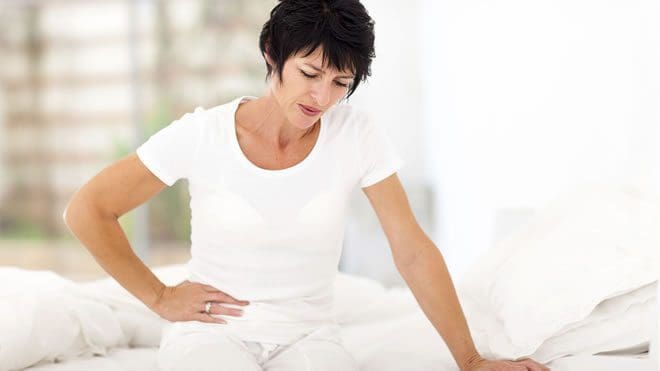
This is usually the time when the pain starts and can make the rest of the day miserable. Here are a few tips that can help.
Lean forward from your hips, not from your back.
Try not to arch your back.
Push your upper body off the bed with your elbows and hands and swing both legs to the floor.
Keep your back straight.
Try not to bend at the waist.
Position for Sleeping
Sleep is very important. Finding a comfortable position while sleeping can be tough, especially with back pain. Using quality pillows in the right way can help provide comfort, support for your neck and back and keep you asleep.
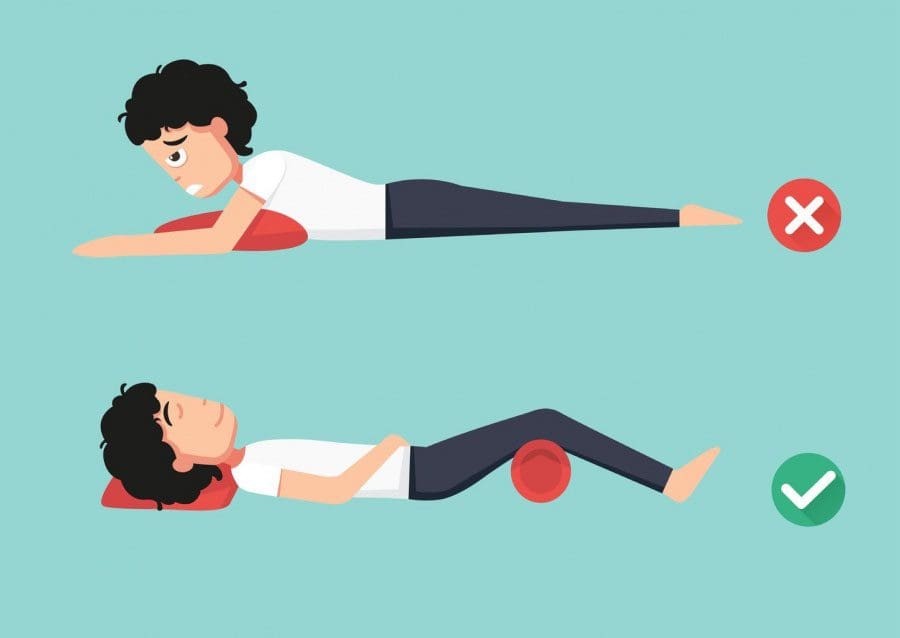
Sleeping on your back is optimal but you should bend your legs and place a pillow under your knees allowing for optimal blood circulation.
Do not sleep on your stomach, as this places pressure on the pelvis and the lower back because there is no support underneath. If you must sleep like this try to keep it for a short while before changing position and place a pillow or two underneath for support.
A firm mattress can help keep your spine in line. But talk to a doctor or chiropractor to find out what style of mattress would benefit your back.
Rotate your mattress every three months and flip it over twice a year.
Take Care When Entering/Exiting an Automobile
Getting in and out of a car can be a tough challenge when dealing with back pain. Here are a few tips to help.
When getting in or out move the seat back as far as it goes, hold onto the side of the car, back of the seat, or the dashboard for support when lifting yourself out or when easing into the seat.
Bend at the knees, not the back and avoid twisting and turning to reach for objects, etc.
The use of proper body mechanics keeps the muscles working properly.
Use both arms and legs when raising and lowering yourself in and out of the seat.
Keep your body aligned and only turn your body as much as needed.
The key is to be aware of your posture and safety awareness.
Daily living including sports and household chores should be done with overall and spinal safety in mind.
Whatever positions work for you and your regular activities bending, retrieving, lifting, and carrying objects, using correct techniques combined with proper posture will take care of your neck and back.
Back Pain Chiropractic Care | El Paso, Tx
NCBI Resources
Chiropractic can take care of your spine which means it is good for your overall health. While many people think that its only purpose is to treat back pain, chiropractic focuses on total body wellness. All too often problems within the body are interrelated. For instance, back pain could be the result of an altered gait due to an ankle injury.� A misaligned neck could cause a headache due to awkward sleep positions (or even the wrong pillow).
You might not think it, but weight lifting and spine strengthening exercises can help reduce back pain. Remember the point of this type of weight lifting is not to build up the muscles like a bodybuilder but is to develop:
Core strength
Spine strength
Body strength
The muscles in the back keep the spine moving and functioning properly. When the spine or abdominal muscles are weak this creates a higher probability of a back strain or injury. Having strong, healthy spine muscles are important because they function in maintaining correct posture, which in some cases, causes chronic back pain because of poor posture.
If�only one part of the body is strengthened like the back is not enough. Therefore strengthening the rest of the body is a must. These include the body’s core and leg muscles. Total body strength will reduce back pain and can help perform regular activities, like lifting heavy objects much easier, with more confidence and with a lesser probability of injury.
Spine strengthening exercises benefits
Most important reasons are they:
Prevents future back injuries
Stabilizes the spine
Helps the spine move properly
Help maintain correct posture
Increases muscle tone
Teaches correct body mechanics
Helps build bone this is especially beneficial for those with osteoporosis or at risk of developing it
A personal trainer or sports chiropractor can help start a spine strengthening regimen. They will teach:
Simple
Specific
Strengthening
Weight lifting exercises.
A physical therapist can also develop a custom weight lifting/strength�exercise�program for optimal spine health and for reducing pain.
Most workout regimens incorporate a combination of weight lifting with actual weights/exercise machines and strengthening exercises/calisthenics with the body’s weight as the resistance for maintaining a healthy strong spine.
Here are a few weight lifting and back strengthening exercises that can help decrease and prevent back pain.
Talk to a doctor or chiropractor before beginning any exercise program. Remember to listen to your body and stop right away if there is something off.
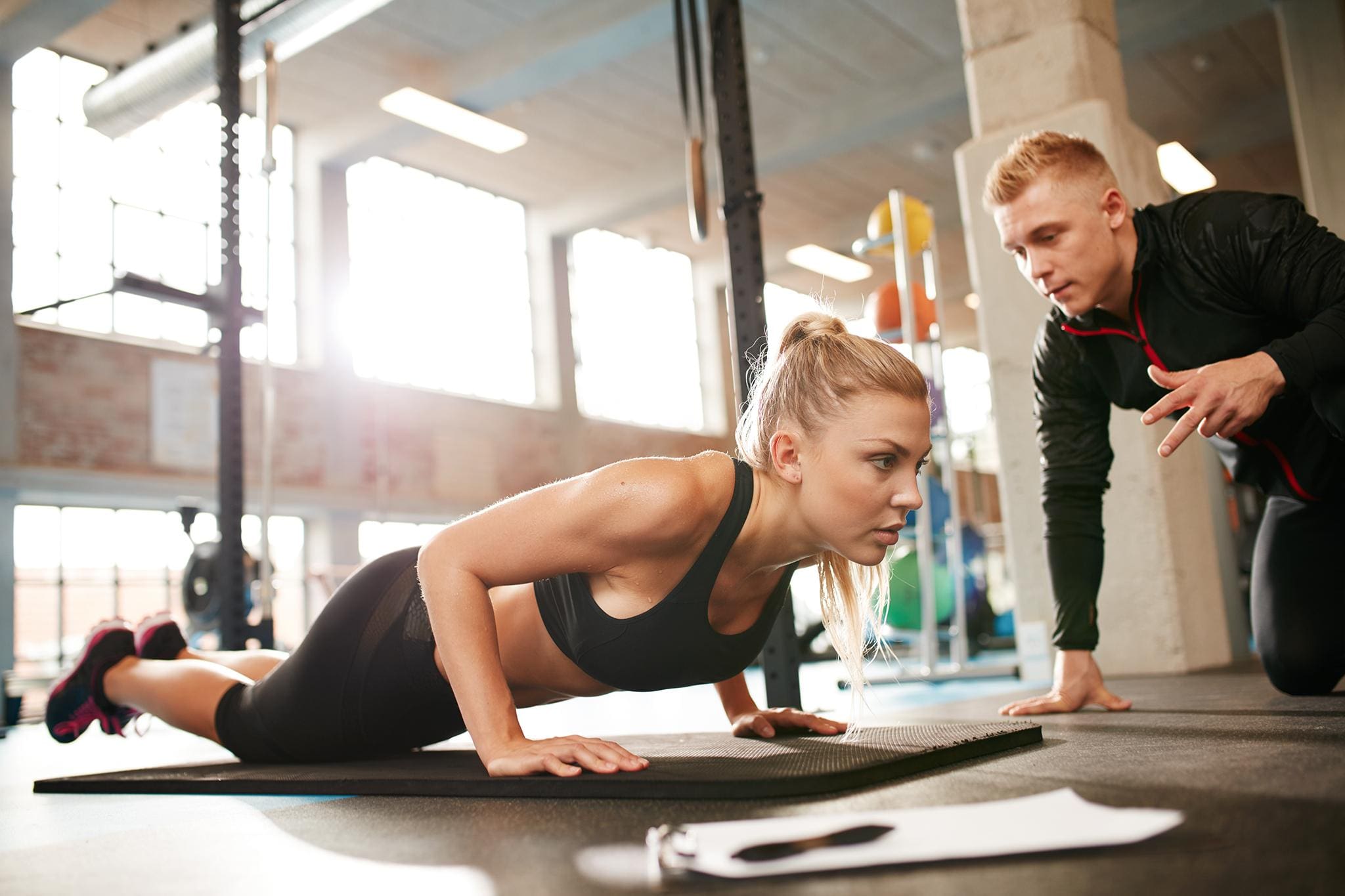
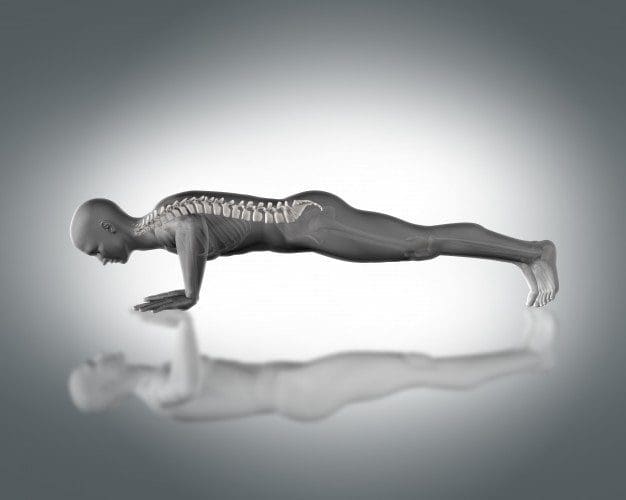
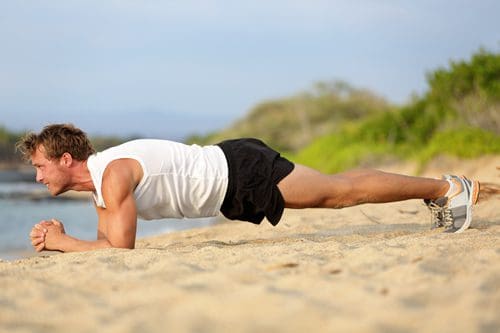
Push-ups
Push-ups help strengthen the:
Back
Chest
Arms
Core muscles
Your own body weight is the resistance.
To do this:
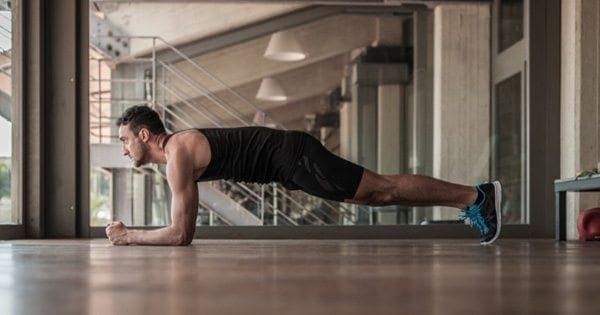
Position the body in a straight line from head to toe, the face looking down.
Hands should be wider than shoulder-distance apart. Walk the hands out so they are slightly higher than the shoulders
Keep the balance on toes and hands, with a straight back, lower the body to the floor by slowly bending the elbows until at a 90-degree angle.
Push up using arm upper back, and chest muscles.
Do 3 sets of 10 every day. As the strength increases do more reps.
Chest Flyes
Chest flies are excellent for building muscle in the:
Upper back
Chest
Dumbbells or a weight machine can be used for this exercise. To do this:
Lie on the floor with the knees bent and the feet flat on the ground.
Extend the arms out to either side of the body, and let them rest on the floor.
With a dumbbell in each hand, raise the dumbbells until they meet at the top at the same time, and keep a slight bend in the elbows.
Lower the hands to the ground, and repeat.
Do this exercise 15 times 3 times a week. With added strength add more reps.
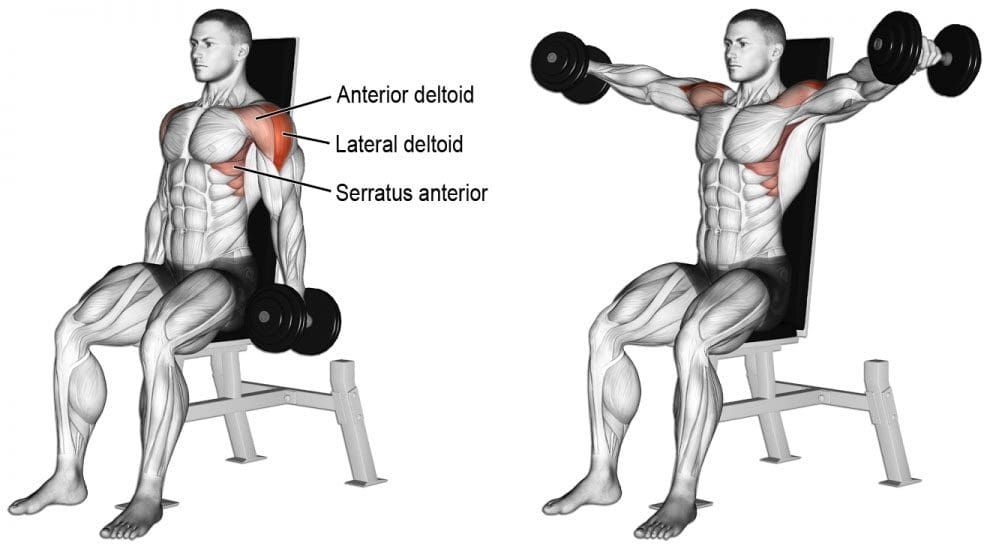
Lateral Raises
Lateral raises help strengthen the entire back. All that is needed is a set of dumbbells. To do this move:
Stand or sit with the feet equal hip-distance apart. Arms are at the side.
With a dumbbell in each hand and a slight bend in the elbows, raise the arms to the side until shoulder height. Keep the core engaged during the movement.
Once at shoulder height, slowly lower the dumbbells, and repeat.
Repeat this exercise 15 times 3 times a week. As strength increases add more reps.
These exercises should be performed slowly with a gradual build-up to more complex movements and adding more weight. Remember to breathe naturally. If you hold your breath during exercise, it can cause tension in the�muscles, which can worsen any pain or create new injuries.�Before adding weight or new spine strengthening exercises, talk to a doctor about exercising with back pain. They will let you know if there are certain movements or positions that should be avoided.
Weight lifting exercises done incorrectly can lead to more back pain and added injuries. If there is any pain while doing these exercises, stop and call a doctor, chiropractor or physical therapist right away.
As El Paso�s Chiropractic Rehabilitation Clinic & Integrated Medicine Center,�we passionately are focused on treating patients after frustrating injuries and chronic pain syndromes. We focus on improving your ability through flexibility, mobility and agility programs tailored for all age groups and disabilities.
Back Pain Chiropractic Care | El Paso, Tx
NCBI Resources
It can be tempting to not exercise with a spinal condition. But remember that if there is no movement at all, you could make the pain worse. Knowing what your body can handle and sticking to a workable schedule, these healthy steps will relieve you and help with back pain.
Back pain can be debilitating, causing immobility, inflexibility, and have a significant impact on a person�s quality of life. It can make even the most mundane daily activities extremely difficult � and even excruciating. Building the muscles that make up your core (abdominals and back) can help support your spine and reduce back pain. In many cases, strengthening these muscles can assist a patient to avoid medication with its unpleasant side effects and even avoid surgery. With just a few smart moves you can significantly decrease your back pain, increase your mobility, and take back your life.
The Role of Abs and Back Muscles
The spine is the supporting structure for the back, but it also is a vital infrastructure for the entire body. It houses the central nervous system, and neural impulses are transferred along what is�a spinal superhighway.
The arms, legs, neck, and head are all connected and stabilized by the spine through an intricate network of ligaments and muscles. The back muscles and abs, or abdominal muscles, are at the center, or core, of this muscle network. They keep the body upright and facilitate movement. When these core muscles are not in good condition, it puts stress on the spine, impacting its ability to support the body. This often results in back pain and even injury in some cases.
Postural Alignment
Postural alignment is a frequent contributor to back pain. This is often due to weak core muscles.
As the muscles fail to do their job to stabilize the spine, the body adjusts structurally to accommodate the weakness. This can result in postures that cause joint pain as well as muscular pain and even headaches.
For instance, stooped or hunched shoulders can cause back pain, but it can also create tension in the shoulders and neck. This, in turn, can cause tension headaches and migraines in patients.
A sway back, where the lower back bows, causing the pelvis to tilt up, can cause severe lower back pain, especially after standing for long periods of time. Swayback can be the result of weakened core muscles or a combination of a weak core, combined with obesity or pregnancy.
The weight in the abdominal area pulls the spine forward so that it curves. A pregnancy sling can sometimes help with the pain, but it is just a band-aid. The real cure is to strengthen the core muscles so that they are better able to support the spine and body adequately.
Foundation Training
Eric Goodman, a chiropractor, developed Foundation Training as a way to help his patients who suffer from lower back pain but are not physically able to do Pilates or yoga. It is also designed to help those who sit for long periods of time to counteract the associated adverse health effects.
Foundation training incorporates powerful yet straightforward movements that work to integrate the body�s muscular chains, increasing strength and realigning the core and spine. It does not require any equipment so the actions can be performed anywhere. The muscles are trained how to move correctly and work together so that you the body learns to move how it is designed to move. The critical, essential exercise can be viewed in this video.
Creating a strong core can help relieve back pain but also have added benefits such as increasing energy, better mobility, and an improved mood. By allowing the body to support itself, it can naturally relieve pain and heal certain conditions without invasive surgery or medication which can have unpleasant or even harmful side effects. When you take good care of your body, it will take good care of you.
Core chiropractor, Dr. Alexander Jimenez continues from part I through the core stability routines.
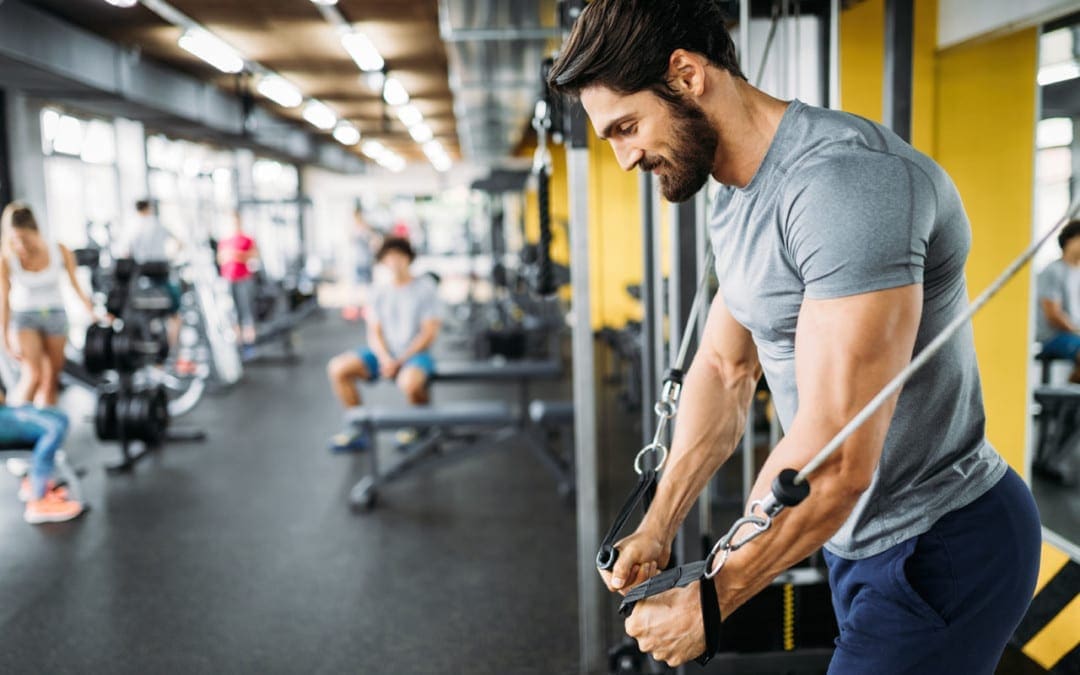
Menu 6: Pulley, Standing
This menu challenges pelvic stability during unilateral standing upper body movements. The kinds of arm movements undertaken in many sports create strong rotational forces that have to be controlled by the trunk and pelvic muscles. The aim of these exercises, therefore, is to develop co-ordination and control of the pelvis.
Research has shown that unilateral exercises increase the recruitment of the core musculature. The core and pelvic muscles will all be using static contractions to hold the required postures, while the upper body muscles will be producing the limb movements. The resistance load on the arm is secondary to the stability challenge of the core. Overall this menu is intermediate.
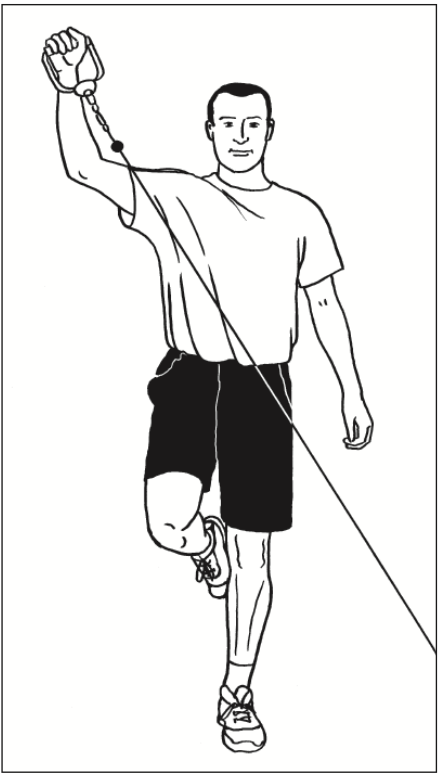
Rear Sling
Overview: The challenge of this exercise and its pair (see opposite) is to establish perfect pelvic alignment, while standing on one leg, against a rotational force from the upper body.
Technique: Stand on one leg to the side of the pulley column. Handle is attached at below-hip height. Grasp the handle with the hand on the opposite side (opposite to standing leg). Set perfect posture and pelvic alignment.
Brace the core and then pull the weight up and around the body, keeping the elbow straight, so that the arm rotates up
and out. Finish with hand above your head and out to the side slightly. The aim is to maintain perfect balance and pelvic
alignment as you raise and lower the arm diagonally. Reposition to repeat exercise for opposite leg/arm.
Perform 10 reps each side increasing to 20 reps; 2 to 3 sets.
Progression: Increase the weight.
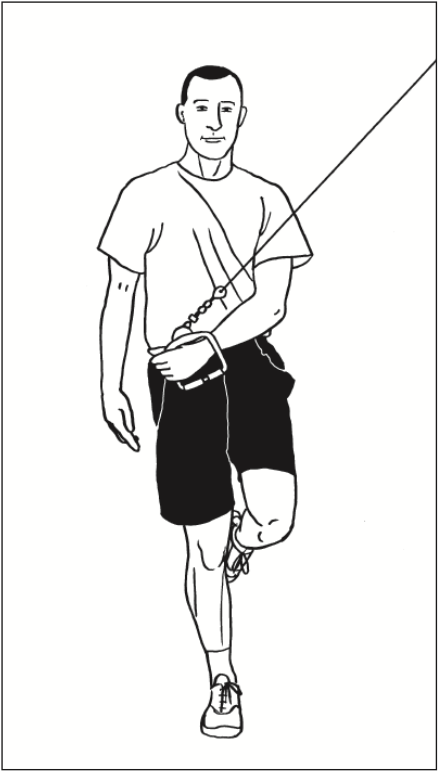
Front Sling
Overview: This is the natural opposite of the rear sling exercise. It involves a forward arm rotation, which must be controlled.
Technique: Stand on one leg to the side of pulley column. Handle is attached at above shoulder height. Grasp the handle with the arm nearest the column (opposite side to standing leg). Set perfect posture and pelvic alignment.
Brace your core; pull the weight down and around the body, keeping the elbow straight so that the arm rotates down and round. Finish with hand next to your hip across your body. The aim is to maintain perfect balance and pelvic alignment as you lower and raise the arm. Reposition to repeat with opposite leg/arm.
Perform 10 reps each side, increasing to 20 reps; 2 to 3 sets.
Progression: Increase the weight.
One Leg, One Arm Rowing
Overview: The challenge of this exercise is to maintain stability while standing on one leg and controlling against a pulling force from the upper body. The pelvis must stay fixed when the upper back and shoulder are pulling backwards.
Technique: Stand on one leg, facing the pulley column. Handle is attached at waist height. Grasp the handle with the opposite arm (same side as lifted leg). Your hand will be out directly in front of you in the start position. Set perfect posture and pelvic alignment, standing tall with shoulders back.
Brace your core; pull on the cable, leading with the elbow in a rowing movement Finish with hand by your side and elbow behind you. The aim is to maintain perfect balance and pelvic alignment as you perform the rowing movement. Reposition to repeat with opposite leg/arm.
Perform 10 reps each side; 2 to 3 sets.
Progression: Increase the weight.
Menu 7: Medicine Ball, Floor
The four exercises in this menu all involve throwing and catching the medicine ball while performing a trunk flexion or rotation movement. The action of throwing the ball during the muscle-shortening phase of each of the exercises increases the force production of the trunk muscles. The action of catching the ball at the start or during the muscle-lengthening phase of each exercise not only increases the force production but also the overall stability challenge.
The impact that the catch has on the upper limb has to be controlled by the trunk. You should be aiming to maintain good spine alignment and correct movement while making the catch. Only use a weight of medicine ball that will allow you to perform the exercises with good technique. If the ball is too heavy, you will sacrifice core stability, irrespective of your arm strength.
Overall these exercises are advanced. However they are also safe and effective for young athletes using light medicine balls to develop dynamic trunk movement and control.
Sit Up & Throw
Overview: An advanced version of a sit-up exercise, in which the throwing action makes the crunch phase faster and the catching action adds load to the return phase.
Level: Advanced
Muscles targeted: Abdominals (Plus upper body)
Technique: You will need a partner to receive and pass the ball. Alternatively perform the exercise in front of a wall and use a medicine ball that will bounce back.
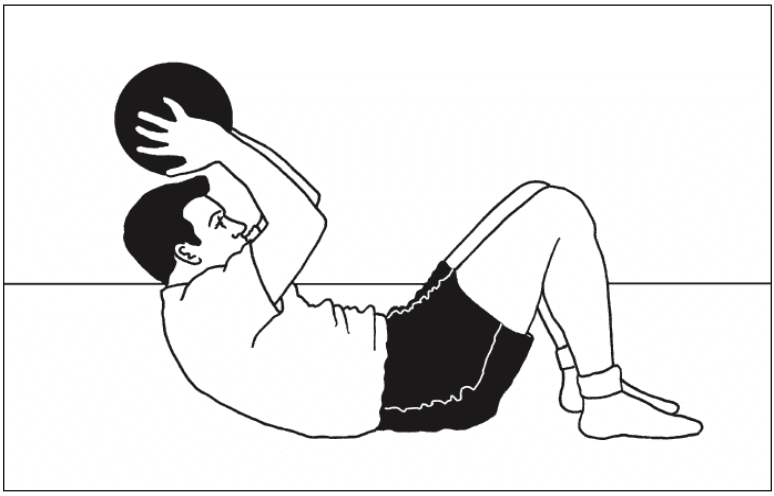
Start in the sit-up position (knees bent) with hands up ready�to receive the ball. Catch the ball and begin to lower back down. Do not collapse back down, control it with the abs and keep hands above the head as you lower down.
Once shoulders are touching the floor (keeping head up and eyes forward), reverse the movement. Throw the ball forward and crunch up at the same time. Follow the throwing action and complete the sit-up as fast as possible. Make sure you crunch as you throw so that the abs contribute to the force of the throw and help you sit up faster. Men should start with a 5kg ball; women with a 3kg ball.
Perform 10 to 20 reps; 2 to 3 sets
Progression: Progress to heavier ball once 3 sets of 20 reps is comfortable
45-degree Sit, Catch and Pass
Overview: A very tough stability exercise that requires massive trunk musculature co-contraction to hold a good spine alignment against the impact of making the catch.
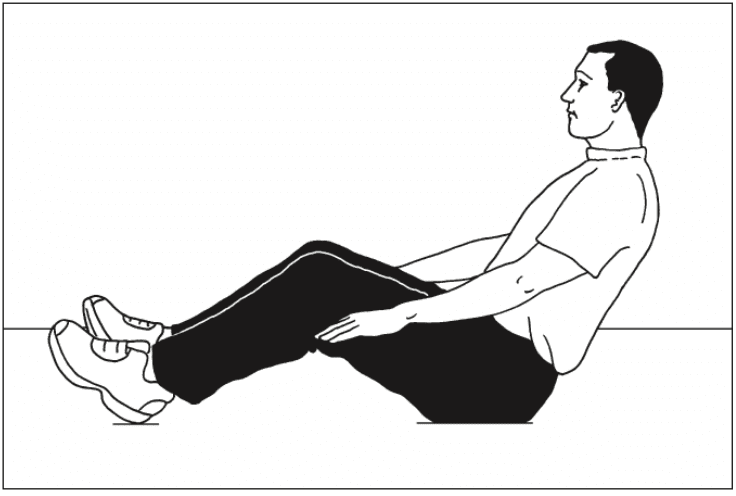
Technique: Sit up with knees bent and lean back at 45 degrees. Aim to hold a �lengthened� spine, with lumbar spine in neutral, shoulders back and neck long and relaxed. It takes a fair amount of control and strength endurance simply to hold this posture perfectly. Aim to get this right before progressing on to the catch and pass.
Raise hands in front of your face and receive a pass from a partner, around this height. As you catch the ball you must hold the long spine position. Do not flex the low back, or become round-shouldered. Gently throw the ball back. Men should start with a 3kg ball; women with a 2kg ball.
Complete a few passes, holding the position for 30 seconds. Perform 2 to 3 sets.
Progression: Raising the hands to above head height makes the stability challenge of the catch significantly harder. Catches made to either side of the head are also more challenging.
Sit & Twist Pass
Overview: A trunk rotation exercise involving catching and passing the medicine ball, which provides a challenge to the obliques to produce powerful rotation, but also pelvic stability, so that the sitting position is stable throughout the movement.
Level: Advanced
Muscles targeted: Abdominals, Obliques
Technique: Sit up with knees bent and lean back at 45 degrees. Aim to hold a �lengthened� spine, with lumbar spine in neutral, shoulders back and neck long and relaxed. Your feet, knees and hips should remain reasonably still throughout this exercise, the rotation coming from your waist and not your hips.
Hold hands to one side ready to receive the ball. Catch the ball to one side and absorb the catch by turning your shoulders further to that side. Reverse the rotation, turning back to the middle and release the ball. Continue rotating to the other side; receive the ball the other side and continue. Ensure you�can hold good posture throughout the movement, with a long spine and wide shoulders. Men should start with a 4 to 5kg ball; women with a 2 to 3kg ball.
Perform 10 to 20 reps.
Progression: Increase the weight of the ball once you can perform a set of 20 reps comfortably with perfect technique.
Kneeling Twist Pass
Overview: To perform the rotation movement in this position demands a greater range of motion, helping to develop strength through the full range of trunk rotation. It may also help to develop trunk rotation range of movement.
Level: Intermediate to advanced
Muscles targeted: Obliques
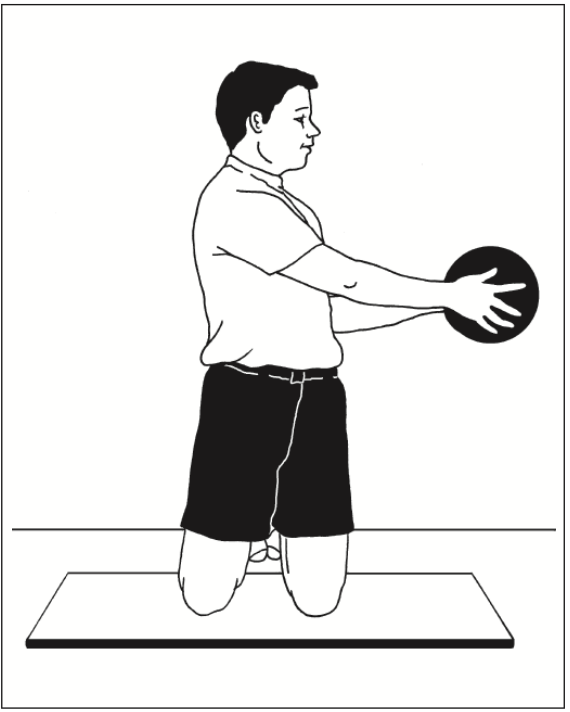
Technique: Kneel upright with good posture (lumbar spine in neutral, chest out, shoulders low). Start with the ball in hands and twist shoulders and head round as far as you can. Then, under control, twist around to the other side as far as possible, and hand the ball to partner. Turn back to the start position, receive the ball again and continue.
The aim of the movement is to rotate through the biggest shoulder turn you have. You can allow the hips to rotate a little with the shoulders, but not too much. You should feel a stretch in the side at the end of each twist.
As you gain greater flexibility and stability you will be able to�fix your pelvis square to the front and rotate through an increasingly full range of motion. Men should start with a 5 to 6kg ball; women with a 3 to 4kg ball.
Perform 10 reps then take the ball to the opposite side and repeat.
Menu 8: Medicine Ball, Standing
The aim of this menu is to perform trunk movements while standing on one leg. This is functional training for balance in sports and daily living activities. These exercises are advanced because of the requirements for lower limb balance and body movement awareness, which makes controlled performance of these trunk movements quite difficult. These moves also use the hip rotator and abductor muscles for control and stability.
One-leg Twist Pass
Overview: A trunk rotation exercise performed on one leg. This requires good pelvic stability at the hip of the standing leg, for the trunk rotation to be dissociated from the pelvis.
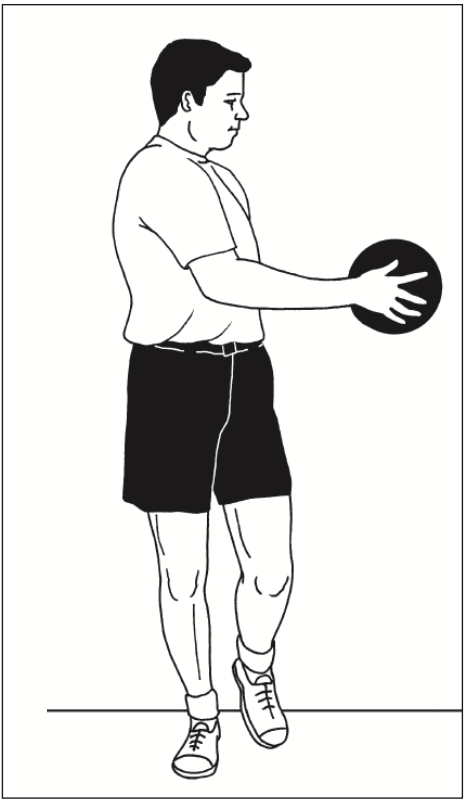
Technique: Stand on one leg with hips facing square to the front. Hold medicine ball slightly out in front. Slowly twist from side to side. The rotation comes from the waist only,�head turning with the shoulders. Keep pelvis fixed square and knee in line with second toe throughout. Men should start with a 5 to 6 kg ball; women with a 3 to 4 kg ball.
Perform 10 slow reps; 2 to 3 sets. Repeat on other leg.
Progression: Swap the ball for a pulley machine and add resistance, once you have mastered the controlled balance on one leg.
One-leg Deadlifts with Rotation
Overview: An advanced exercise for the posterior chain of muscles, which includes rotation to challenge control of pelvis.
Level: Advanced
Muscles targeted: Erector spinae, Gluteals (max and med) Hamstrings, Piriformis
Technique: Stand on one leg. Flex the free leg a little at the knee to lift it off the floor, but do not flex or extend the hip of the free leg throughout the movement, in order to keep pelvis in control. Hold the ball in front of you.
Bend down, flexing at the knee and the hip. Lower down until the ball touches the floor by your foot, all the time keeping your arms straight and without reaching excessively with your upper back (ie, maintain a reasonably flat back). Stand back up, pushing down through the foot to use your gluteals correctly to extend the hips.
Alternate between touching the ball down on the inside and then the outside of the standing foot. This means you are internally or externally rotating the hip on alternate repetitions, challenging control of hip rotation. Keep the knee in line with�second toe as much as possible throughout. Men should use a 5kg ball; women use a 3kg ball.
Start with 5 slow controlled reps, 2 to 3 sets. Build up to 10 reps. Repeat on the opposite leg.
Progression: Increase the weight of the ball or use a dumb-bell as you get stronger.
One-leg Catch & Pass
Overview: The main aim of this exercise is to control the impact of the catch without losing balance or rotating excessively at the hips. It�s all about how effectively you can anticipate the impact and produce the required stiffness throughout the body to retain good posture and control. This is a very useful �reaction�-type stability exercise.
Level: Advanced
Muscles targeted: Everything
Technique: Stand on one leg with good posture (lumbar spine neutral, chest out, shoulders wide) and with hips square to the front. Hold hands up ready to catch. Receive catches anywhere within arm�s reach. Make sure the passes are varied in their placement. Aim to restrict movement to arms and/or turning your shoulders, keeping the pelvis and lower limb stable. Use a 2 to 3kg ball that is not too big, so it is easy to catch.
Start with 30 sec bouts of catch and pass on each leg; 2 to 3 sets.
Progression: Receive more forceful passes so the impact of the catch is greater.
Menu 9: Resistance-Based
Menu rationale
The aim of these three exercises is to progress the loading in order to build high-level trunk muscle strength. These exercises can be performed in the 5- to 10-repetition range with a suitably high weight for this number of reps. As you get stronger, you should prioritize an increase in weight rather than an increase in the number of reps. Overall, these exercises are very advanced.
Crunch with Weight
Overview: The standard isolated abdominal exercise with increased load.
Level: Advanced
Muscles targeted: Abdominals
Technique: Perform the crunch in the usual way: knees bent, low back flat, head up and looking forward. Curl the shoulders up and down using just the abdominals. The weight (medicine ball, dumb-bell or barbell weight plate) should be held above or behind the head. Arms are fixed, all they do is hold the weight in place. Do not use arms to move the weight relative to head as the crunch is performed. Keeping the elbows out helps to achieve this.
Perform 5 to10 reps; 2 to 3 sets.
Progression: Increase weight, maintaining the range of 5 to 10 reps per set.
Reverse Hypers
Overview: An excellent hip and back extension exercise to which it is very simple to add load.
Level: Advanced
Muscles targeted: Erector spinae, Gluteals
Technique: Lie on your front on a horizontal bench, with hips just off the end of the bench. Grasp bench legs firmly for support. Your legs should be straight with a dumb-bell between the ankles for resistance. Squeezing the gluteals, extend hips and lift legs and the dumb-bell off the floor. Stop when your back is slightly hyper-extended and hips are fully extended. Lower slowly until feet are just off the floor and continue.
Perform 8 to 10 reps; 2 to 3 sets.
Progression: Increase weight, maintaining the range of 8 to 10 reps per set.
Reverse Crunch with Weight
Overview: This is a great exercise, as it requires good co- ordination and strength. Research shows that the obliques as well as the abdominals work very hard during this exercise, making it excellent value.
Level: Advanced
Muscles targeted: Abdominals, Obliques
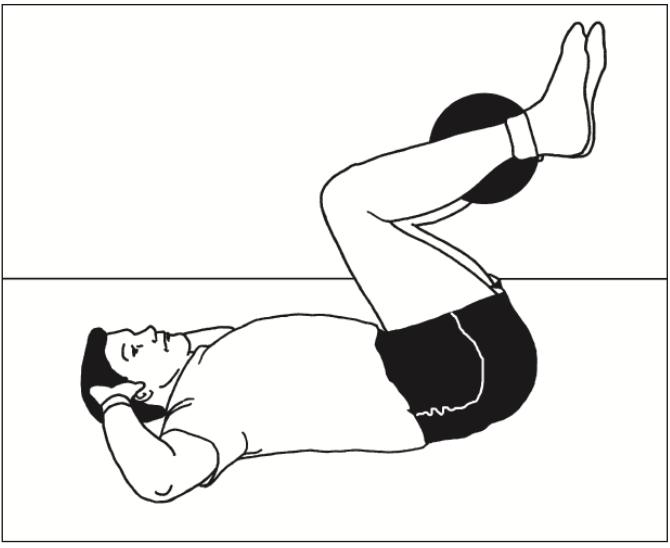
Technique: Lie on back with hands behind head and elbows out to the sides. Knees should be bent and heels close to bum. Hold weight between your legs. Initiate the movement by curling the pelvis upwards (flattening the back into
the floor) and then continue to use the abs to pull the low back and pelvis off the floor. This is the bit that requires good co- ordination, as the temptation is to kick with the legs and pull the hips up with the hip flexors. Learn to focus on the abs before you add weight, as if you do this strictly it is very tough, especially for women (whose pelvises are relatively heavier).
Perform 5 to 10 reps; 2 to 3 sets.
Progression: Increase weight, maintaining the range of 5 to 10 reps per set.
Menu 10: Hanging Bar
Menu rationale
The aim of these three exercises is to work the abdominals as hard as possible with very advanced, gymnastic-style movements. Reasonable upper body strength is required for these exercises.
Hanging Leg Lifts
Overview: This exercise requires you to lift the full weight of your legs and (if possible) your pelvis, while hanging from a bar. Anyone who can perform these movements well through a good range of motion has achieved good strength.
Level: Advanced
Muscles targeted: Abdominals, Obliques, Hip flexors
Technique: Hang from a bar with arms straight. Lift knees, bringing them up as high as possible. At the top of the movement the knees should be near the chest and pelvis should be curled upwards (low back flexed). This extra curl of the pelvis ensures that the abdominals are working maximally. Do not kick legs up or swing the body excessively. Simply draw up knees, crunching as you lift. It is important to feel that the abdominals are doing the lion�s share of the work rather than the hip flexors or front of thigh muscles.
Perform 5 to 10 reps;, 2 to 3 sets.
Progression: Perform the same exercise with straight legs, lifting them up to 90 degrees in front of you, curling the pelvis at the top of the movement.
Windscreen Wipers
Overview: The ultimate ab-buster. Anyone who can do 10 reps of this exercise with good technique has a very strong core!
Level: Super advanced
Muscles targeted: Abdominals, Obliques, Hip flexors
Technique: Hang from bar with arms straight. Lift legs up in the air until feet are at approx head height. Maintaining the height of the lift, take the legs from side to side in an arc. The movement will look like a windscreen wiper, moving from side to side. Aim for at least 45 degrees of movement to each side.
Perform 5 to10 reps; 2 to 3 sets.
Progression: The straighter the legs, the harder the exercise. Increasing the range of movement to each side also makes it tougher.
Candlesticks
Overview: Another beauty! Lots of strength required to control this movement; only for the very strong.
Level: Super advanced
Muscles targeted: Abdominals, Obliques, Hip flexors
Technique: Lie flat and raise yourself up to a shoulder stand position, holding on to a bench/table leg/partner’s leg with your hands above your head. Establish a fully extended hip and leg position and then begin to lower your body down slowly to the floor. The body should move in an arc as a single unit (no sagging in the back, or bending at the hips or knees). Lower under control from vertical to just above horizontal.
Gripping firmly for stability, lift your body back up into shoulder stand, again keeping everything straight and aligned in a single unit.
Slow and controlled movement on the way down will help, and a maximal contraction of everything will get you back up.
El Paso, TX. Chiropractor Dr. Alex Jimenez looks at exercise and fitness from a chiropractic perspective.
The advantages of exercise are plenty: Exercise might help prevent numerous conditions � to osteoporosis � from heart attacks and it can also prevent back pain and neck pain.
Cardiovascular, strength training, and flexibility training exercise all play a significant part in a healthy exercise routine, and each form of exercise contributes to spinal health.
Training &�Stretches
Flexibility is something most people take for granted when they’re young, but growing elderly tends to make the significance of flexibility and stretching training a lot more clear as range of movement begins to fall. Yet, stretching and flexibility training may be incorporated into your fitness routine at any given age, and you may reap the benefits for a long time. Flexibility training can boost your mobility, balance, equilibrium, and posture, which will assist you to avoid back and neck pain. Pilates all, yoga, and flexibility training classes might help you enhance your stretches technique and lead to long-term flexibility.
Weight Training &�Core Strengthening For Back Pain
You could believe strenuous exercise and strength training tend to be more prone to result in a back injury than to prevent one, but your overall spinal health along with function cans significantly enhance. With feeble back and abdominal muscles, on the other hand, you happen to be more inclined to encounter a back strain injury. For the best results, you will want to combine weightlifting with strengthening exercises that use your own personal body weight as opposition to maintain a healthier neck and back. Make sure do not fail core muscles such as transverse abdominals and the external obliques, and to alter your work outs.
Cardiovascular Exercise
Cardiovascular exercise has many health benefits, and it’s also an essential element of a well-rounded workout routine. One of the key advantages to cardiovascular exercise is the way it can simply help with weight reduction. Being obese or overweight can lead to worsening of spinal circumstances and puts extra strain on your back, so discarding some extra pounds with only a little help from cardiovascular activity can mean great things for your back and spine. Cardiovascular exercise also helps you build endurance, which can be essential for long-term health and will help with rehabilitation from spinal and back injuries. Naturally, cardio has wonderful effects on different aspects of well-being too, from enhancing mood and enhancing cholesterol amounts to lowering blood pressure. Because endorphin levels are boosted by cardiovascular exercise, it can also help alleviate outward indications of depression, which may add to the long-term pain experienced by some people. Like that were quality slumber is promoted by cardiovascular activity, and also a good night�s remainder is essential for back and spine well-being.
Exercise &�Aging
It really is particularly important as we age, although exercise is very important at all ages. These deteriorations can impede, although decline of flexibility, range of motion, and function are a part of the natural aging process. Although vigorous action may be hard amongst aged adults, aerobic activity that is light still has tremendous health benefits, specially in comparison to no activity in the slightest. The quantity of exercise one needs so that you can see health benefits might surprise you � you are able to exercise at an intensity level which allows you to carry on a casual conversation and still see health benefits.1 If you have a few other health issues, such as for instance diabetes, high blood pressure, or a heart condition, specific activities may well not be healthy for you. Request your doctor about your planned exercise routine, in case you do not feel comfortable exercising by yourself, and consider exercising in the existence of a physical exercise device. Don’t forget to tune in to your own body, and cease exercise at once should you experience pain aside from muscle soreness that is typical.
The SpineUniverse Exercise Center shows you the top back stretches and neck stretches to maintain your spine powerful and healthy. Discover the crucial advantages of exercise as how to keep healthy as well.
Walk into any gym or health club and you�ll find people exercising�their core. Coretraining has�taken the world by storm, and for good reason, as every DC knows. Strengthening the�core creates stability and better movement and helps prevent lower back pain. To help patients get the most from�their efforts, it�s important they understand what they�re doing. You can explain the difference between the local and global muscles, as I�ve outlined�below, and help your patients�perform core work safely and effectively.
What Is the Core?
I like to tell patients that their core is a shorthand way of referring to all the muscles of their�lower back/pelvis/hip area. It�s where your center of gravity is located and where movement begins. A strong core stabilizes the spine and pelvis and supports you as you move. The core has 29 pairs of muscles that�fall into two categories:
��Local Muscles. Patients can think�of local muscles as the deeper muscles, the ones close to the�spine and responsible for stabilization.�They don�t have much ability to move the�joints. The local muscles are further broken down into primary and secondary categories. The primary local muscles are the transverse abdominus and multifidi (the two most critical muscles for providing stability). The secondary local muscles are the internal obliques, quadratus lumborum, diaphragm and pelvic floor muscles.
��Global Muscles.�The global muscles are the outermost layer of muscle�they�re the ones you can feel through your skin. They�re responsible for moving joints. The global muscles in the core are the rectus abdominus, external obliques, erector spinae, psoas major and iliocostalis.
The core should operate as an integrated functional unit, with the local and global muscles working together to allow easy, smooth, pain-free movement. When the muscles work together optimally, each component distributes, absorbs and transfers forces. The kinetic chain of motion functions efficiently when you do something dynamic, like exercise or run.
Core Injury
An injury to one of the core muscles usually means an episode of lower back pain for your patient. When that happens, the deep stabilizers change how they work as a way to compensate for the injury and protect the area. The stabilizers now have delayed action; they�re turned on only after you move, instead of as you move. Because now they�re not functioning as they should, the�brain recruits the�global muscles to compensate. That causes a core imbalance. The result: pain in the lower back, pelvis and glutes (the big muscles you sit on).
Exercises designed to help get patients� core muscles back in balance are the best way to prevent re-injury and avoid lower back pain. Traditional abdominal exercises are often recommended to strengthen the global muscles. These exercises can actually increase pressure on the lower spine. Similarly, traditional lower back hyperextension exercises meant to stretch out the lower spine also may actually increase pressure on it. A better approach to preventing lower back pain is restoring stability with the core exercises below.
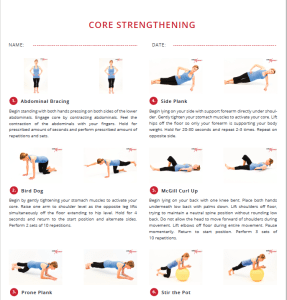
Abdominal Brace
The abdominal brace activates all the contracting muscles in the abdominal wall, without involving the nearby obliques and rectus muscles. This exercise strengthens the connection between the global muscles and the deep local muscles. This helps restore the balance between them and improves spinal stiffness.
To get an idea of how the muscles in your core work, place your thumbs in the small of your back on either side of your spine. Next, do a hip hinge: bend forward from the hips about 15 degrees. You should feel the muscles in your lower back move as you bend and stand back up again.
To do the brace, stand upright and suck in your stomach, as if you were about to get punched. Hold hat for 10 seconds, then relax. Repeat 20 times; do three sets.
You�ll know you�re doing the brace correctly if you poke your extended fingertips right into your side below your ribs and then brace. You should feel the muscles move under your fingertips.
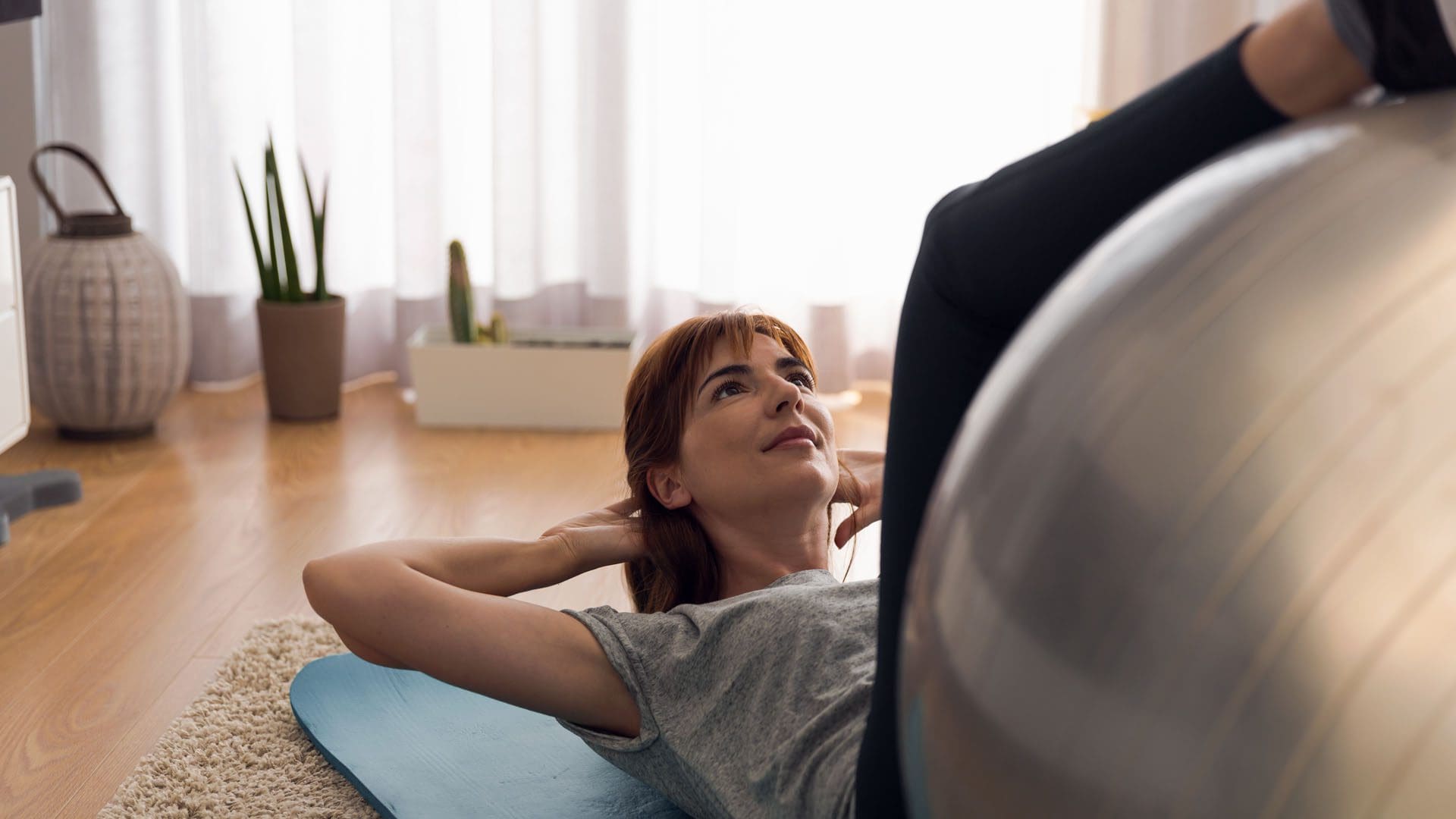
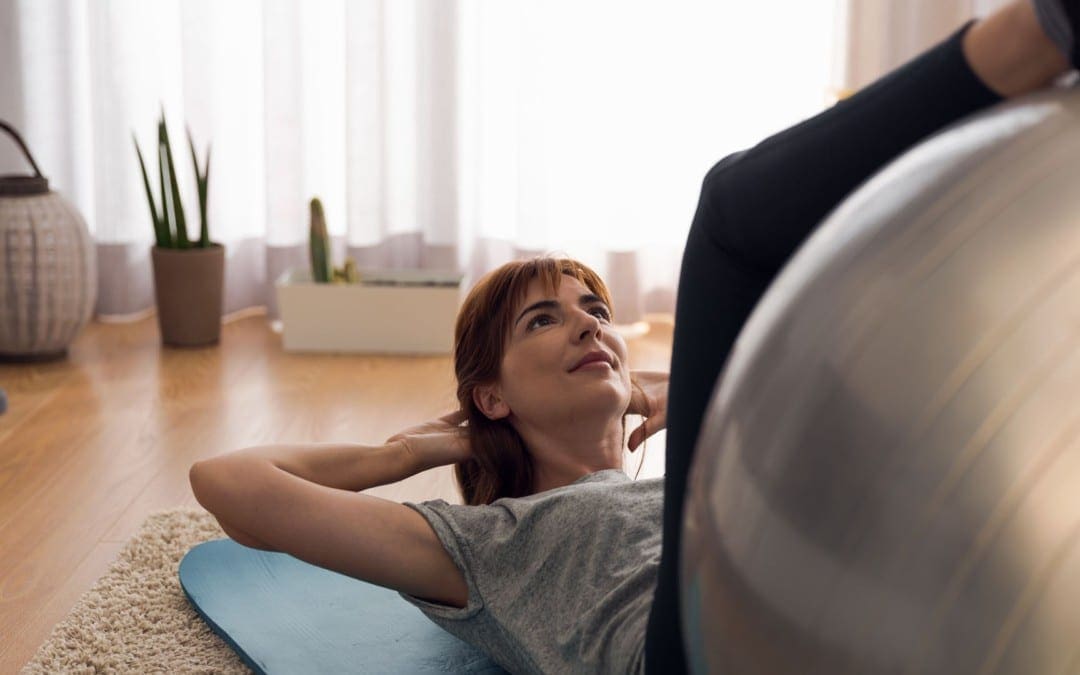
Curl-Ups
Curl-ups train the rectus abdominus, the long abdominal muscle that runs vertically from your breastbone all the way down on both sides of your bellybutton.
Start by lying on your back with your hands palm-up beneath your lower back. Bend one leg and put the foot flat on the floor; extend the other leg. Hold your head and neck stiffly locked onto your ribcage�imagine them as one unit. Lift your head and shoulders slightly off the floor by three or four inches and hold that position for 20 seconds. Your elbows should touch the floor while you do this. Relax and gently lie back again. Repeat 10 times. Switch legs and repeat 10 times gain. Do three sets.
Tip: If your patient has�neck discomfort doing this, have them push their�tongue against the roof of the�mouth�to help�stabilize the neck muscles.
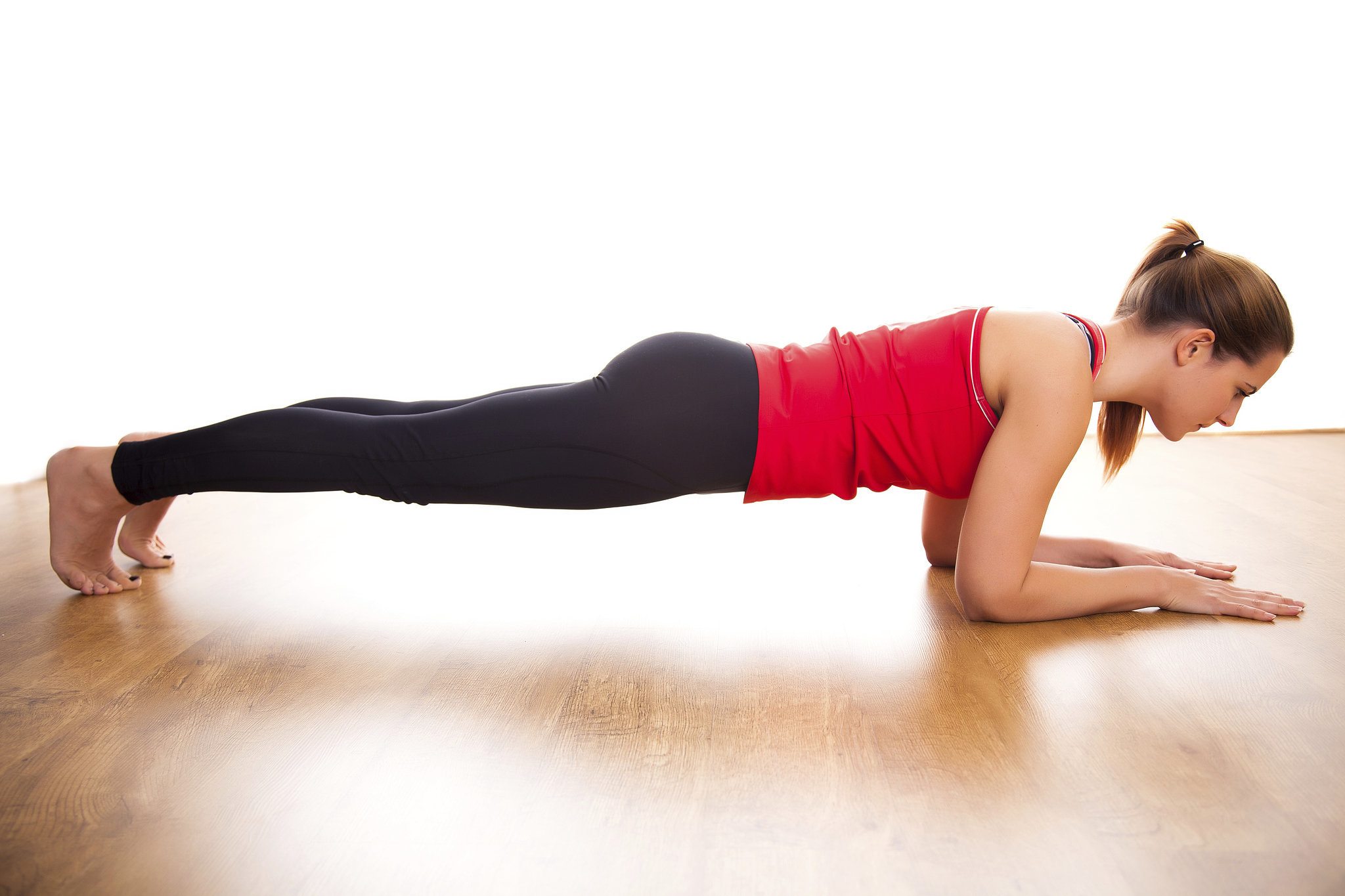
Side Bridge
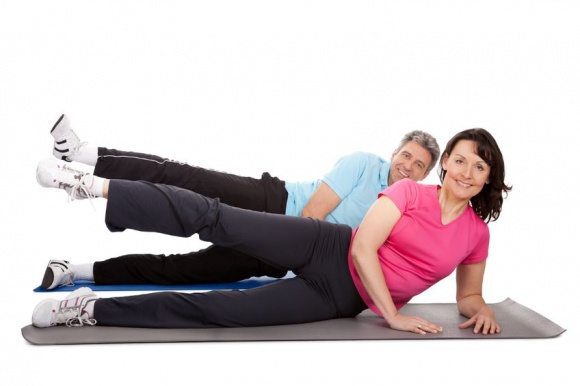
The side bridge, also called the side plank, trains the quadratus lumborum, lateral obliques, and transverse abdominus muscles, all local muscles that help stabilize the�spine.
Start by lying on your side. Place your top leg in front of your bottom leg (the heel of your top foot should touch the toe of the bottom foot). Raise your body using the down-side shoulder and elbow. Cap the opposite shoulder with your free hand. Hold for as long as you can, aiming for 30 seconds. Switch sides and repeat.
Bird Dog
This exercise is great for training the back extensors, including the longissimus, iliocostalis and multifidii.
Start on your hands and knees (quadruped position). Raise and extend the opposite arm and leg simultaneously, like a dog pointing to where the bird is. �Hold or eight seconds, then return to the quadruped position. Repeat eight times, then switch arms and legs and repeat for eight reps. Do three sets.
Conclusion
All the muscles of the�core must work together to produce efficient and effective movement. The core is the center of the�body�s motion�training it is a critical part of any exercise routine. Teaching your�patients proper technique for core training will result in�big benefits for them now and in the future.
Share this Core Strengthening guide with patients, courtesy of WebExercises
Walk into any gym or health club and you�ll find people exercising�their core. Core training has�taken the world by storm, and for good reason, as every DC knows. Strengthening the�core creates stability, better movement and helps prevent lower back pain.
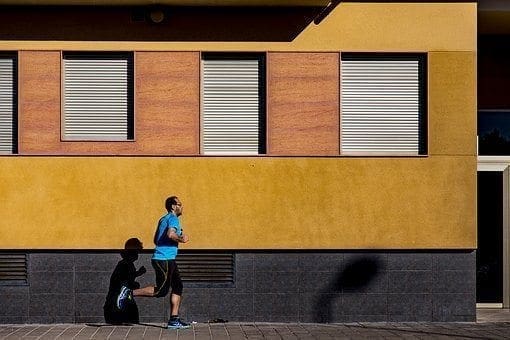
When participating in any sport, core strength is crucial towards an athlete�s overall performance. The body�s core consists of the back and the abdominal muscles and for many athletes, this area can be a weakness.�In runners for example, a strong core can prevent injuries to other joints including the hips and knees.�Essentially, having a strong core helps stabilize the body to allow the�
IFM's Find A Practitioner tool is the largest referral network in Functional Medicine, created to help patients locate Functional Medicine practitioners anywhere in the world. IFM Certified Practitioners are listed first in the search results, given their extensive education in Functional Medicine



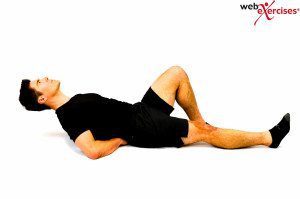 Curl-ups train the rectus abdominus, the long abdominal muscle that runs vertically from your breastbone all the way down on both sides of your bellybutton.
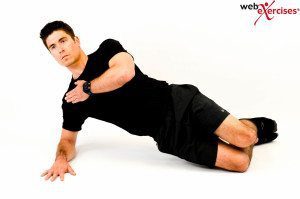 The side bridge, also called the side plank, trains the quadratus lumborum, lateral obliques, and transverse abdominus muscles, all local muscles that help stabilize the�spine.
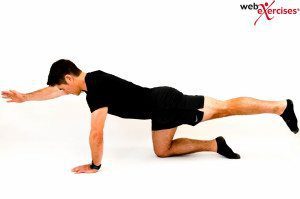 This exercise is great for training the back extensors, including the longissimus, iliocostalis and multifidii.