
Epidural Injection for Sciatica: Effective Solutions
When Leg Pain Is Too Irritated for Rehab: What an Epidural Injection Is Actually Trying to Accomplish
Abstract
When radiating leg pain from lumbar nerve-root inflammation becomes so intense that walking, sitting, sleeping, or starting rehabilitation feels impossible, an image-guided epidural injection may be considered. This post explains radicular pain, why the procedure aims to reduce inflammation rather than repair a disc, how fluoroscopic guidance places medication in the epidural space, what patients typically experience, and how temporary symptom relief can open a practical window for decompression, movement, and active recovery. It also explains when an injection isn’t the right first step.
You finish a long Amazon fulfillment shift, a night of data-center rack work, a full day of programming, or a long drive, and the walk to the car lights the leg up so badly that even the idea of starting rehabilitation the next day feels out of reach. Sitting for more than a few minutes becomes a negotiation. Sleep is broken by position changes. Walking the length of a parking lot or a warehouse aisle turns into a calculated risk. For many adults with significant radiating leg pain, the barrier is not motivation. The barrier is that the nerve is too irritated to tolerate the very movements that would otherwise help.
What Radicular Pain Actually Is
Radicular pain travels along the path of a spinal nerve root. In the lumbar spine, it often follows the sciatic nerve distribution or one of its roots, causing burning, shooting, or electric sensations that can reach the buttock, thigh, calf, or foot. Numbness, tingling, or a feeling of weakness in the leg can accompany it.
A herniated disc, foraminal narrowing, or other structural change can mechanically crowd the nerve root. At the same time, biochemical factors amplify the problem. Degenerated or herniated disc material releases inflammatory mediators such as phospholipase A2, cytokines, and prostaglandins. These substances increase local edema, sensitize the nerve, and can cause ectopic firing even with only moderate mechanical pressure (McLain et al., 2005). The result is a nerve root that is both compressed and chemically inflamed. Pain and limited function often exceed what imaging alone would predict.
Why an Epidural Is Not Trying to “Repair the Disc”
An epidural steroid injection places medication into the epidural space—the area outside the dural sac that surrounds the spinal cord and nerve roots.
- It does not enter the disc.
- It does not shrink, reseal, or surgically remove a herniation.
- It does not enlarge a stenotic canal or reverse degenerative change.
The intended effect is to locally reduce inflammation around the irritated nerve root. Corticosteroids decrease inflammatory mediator production, reduce capillary permeability and edema, and can dampen ectopic nerve firing (Patel et al., 2024). When included, local anesthetic may provide more immediate, temporary relief and help confirm that the targeted root is relevant. The goal is symptom reduction, not structural repair.
Guidelines that synthesize higher-quality fluoroscopically guided trials describe meaningful short- to intermediate-term benefit for lumbar radicular pain associated with disc herniation when the injection is properly placed (Manchikanti et al., 2021). Duration varies widely; some patients get weeks of useful relief, while others experience several months. The injection is best understood as a bridge, not a destination.
Fluoroscopic Guidance, the Epidural Space, and Medication Placement
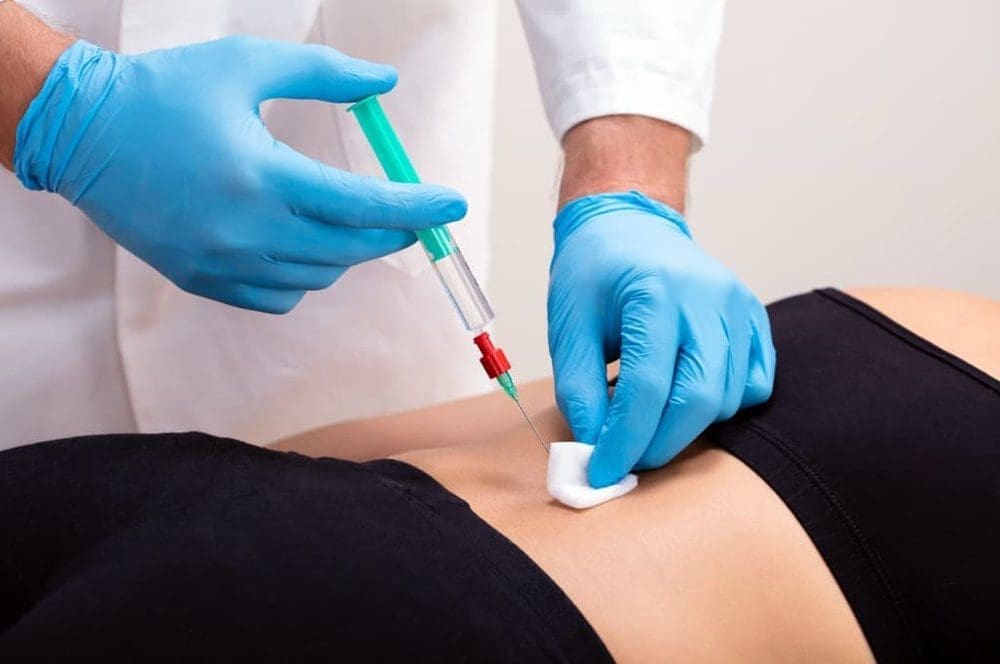
Modern lumbar epidural procedures are performed under fluoroscopic (live X-ray) guidance. The patient is positioned on a table, the skin is cleaned, and local anesthetic is used at the insertion site. A thin needle is advanced toward the epidural space. Approaches include interlaminar (through the ligamentum flavum between the laminae) and transforaminal (more selective placement near a specific exiting nerve root). The physician injects contrast dye under continuous imaging to confirm the medication spreads in the epidural space and does not enter a blood vessel or the subarachnoid space.
Once the physician verifies correct placement, they inject the corticosteroid (often with local anesthetic). The entire procedure typically lasts 10–20 minutes. Patients remain awake or lightly sedated so they can report unusual sensations. After a short observation period, most people go home the same day.
What Patients Commonly Experience
During the injection, some people feel pressure or a brief reproduction of their usual leg symptoms as the medication spreads. Immediate relief from the local anesthetic can last a few hours. The steroid effect usually begins over the following 2–7 days. A temporary increase in soreness at the injection site or a short flare of familiar leg pain can occur in the first day or two as the medication disperses; this is usually mild and self-limited.
Relief is not guaranteed and varies from person to person. When it occurs, patients often notice that they can sit longer, walk farther, sleep with fewer position changes, or tolerate the early stages of guided movement. The practical value is that these improvements create a usable window.
The Window for Movement, Decompression, and Rehabilitation
When chosen, the central purpose of the injection is to lower nerve-root irritation enough that active care becomes possible. Once leg pain no longer dominates every transition, spinal decompression therapy can be introduced or progressed more comfortably. Chiropractic adjustments and mobilization that respect the irritated root can be applied with clearer feedback. Targeted exercises for hip mobility, core control, and walking tolerance can start without an immediate severe flare.
- For Amazon associates, this may mean returning to a modified floor shift with better standing and walking tolerance.
- For data center technicians, it may mean safer ladder and rack work.
- For programmers and drivers, it may mean longer sitting blocks without the same electric build-up.
- For any adult, it may mean restoring sleep and basic daily mobility.
At Injury Medical Clinic PA, we never view the injection as a stand-alone fix. Dr. Alex Jimenez, DC, APRN, FNP-BC, CFMP, IFMCP, works under the collaborative medical direction of Dr. Maria Guadalupe Cardenas, MD, so the procedure, when indicated, is coordinated with structural care, rehabilitation, and any needed functional medicine support. The aim is beneficence: using the least invasive, effective option that serves the patient’s overall recovery and safety.
When an Injection Is Not the Appropriate First Step
Several situations call for a different sequence or urgent evaluation rather than an elective epidural:
- Progressive motor weakness, saddle anesthesia, or new bowel or bladder changes (possible cauda equina) require immediate medical assessment, not a scheduled injection.
- Active infection, uncontrolled coagulopathy, or allergy to the planned medication are contraindications.
- Pure axial low-back pain without a clear radicular pattern is not a classic indication; other sources (facet, discogenic, myofascial) should be considered first.
- Mild or improving symptoms that still allow basic walking, sleep, and a trial of conservative care often respond to decompression, targeted exercise, and activity modification without injection.
- If the clinical pattern doesn’t correlate with imaging, or if a properly placed prior injection fails, the clinic should re-examine the diagnosis rather than repeat the same procedure.
Non-maleficence guides these boundaries. The clinic prioritizes options that avoid unnecessary procedural risk, prolonged high-dose medication, or premature surgery. Autonomy remains central: patients receive a clear explanation of expected benefits, realistic duration, risks, and alternatives so they can decide in coordination with their existing medical team and any group insurance requirements.
A Practical Next Step
If radiating leg pain is currently blocking rehabilitation, sleep, or basic work and home function, an evaluation can determine whether an image-guided epidural is appropriate or whether a different sequence is safer. Many patients with excellent group insurance coverage can coordinate the integrated evaluation, procedure (when indicated), and subsequent rehabilitation plan efficiently.
Watch a brief discussion of sciatica patterns and recovery approaches:
To schedule a visit at Injury Medical Clinic PA in El Paso, call 915-850-0900 or use the online scheduler. The multidisciplinary team—led by Dr. Alex Jimenez, DC, APRN, FNP-BC, and Dr. Maria Guadalupe Cardenas, MD—will review your history, examination, and imaging to develop a plan that supports lasting movement and function.
References
Manchikanti, L., Knezevic, N. N., Navani, A., Christo, P. J., Limerick, G., Calodney, A. K., Grider, J., Harned, M. E., Cintron, L., Gharibo, C. G., Shah, S., Nampiaparampil, D. E., Candido, K. D., Soin, A., Kaye, A. D., Kosanovic, R., Magee, T. R., Beall, D. P., Atluri, S., … Hirsch, J. A. (2021). Epidural interventions in the management of chronic spinal pain: American Society of Interventional Pain Physicians (ASIPP) comprehensive evidence-based guidelines. Pain Physician, 24(S1), S27–S208.
McLain, R. F., Kapural, L., & Mekhail, N. A. (2005). Epidural steroid therapy for back and leg pain: Mechanisms of action and efficacy. The Spine Journal, 5(2), 191–201.
Patel, K., Chopra, P., & Upadhyayula, S. (2024). Epidural steroid injections. In StatPearls. StatPearls Publishing.