El Paso, TX. Chiropractor Dr. Alex Jimenez looks at yoga for back pain.
Yoga increases strength and flexibility, but some find it to be a spiritual experience that brings serenity and delight.
I attended my first yoga class after I was 21 years old. At the time the goal was purely to appease my self so that I really could tell my family, buddies and coworkers that “I do yoga”. In my experience, yogis were “cool” and I enjoyed being linked with that healthy lifestyle. My twenty-something year old mind was in a self absorbed place and that I totally enjoyed the freedom of dedicating myself to yoga and other enjoyable ways to fill my time.
Yoga in its purest form is intended to help the individual’s head and body and is likely to be practiced without ego.
My First Yoga Course
I loved her gentle encouragement. As I visited my weekly yoga classes, bending and twisting and telling myself “I can perform this,” I began to reap the benefits. I was sleeping better. My body felt less angry and I noticed a calmness come over me. I felt more patient coping with the irritations of life, too.
Here is The�Irony
Yoga is not something you do. It’s a thing that you encounter. Because over time, it gets engrained in you it’s called a practice. The teachings of Maureen were put in me like little seeds which didn’t actually completely thrive until much later in my life. To jogging, though I did not intentionally give up my usual yoga practice, around along the way it took a back seat. Those little seeds were there but lay dormant for now.
Running Was Different
I felt free moving swiftly across the road. Being goal oriented, I found monitoring my mileage to be a pleasing achievement. Running was pleasing for another reason, too. My best friend Linda was also a runner, and we’d meet most Sundays for long runs. We’d participated in occasional half marathons and put in 15 to 20 miles each week. Running that distance took time � two hours or even more.
Those small seeds were there all along. Like I mentioned, yoga has a way of becoming engrained in you.
My Back Pain & Yoga
If you’ve been following my site, you understand that I’ve had back pain through most of my entire life. Then, seemingly out of nowhere, my little friend “yoga” softly arrived back on the scene. My pain riddled body seemed to intuitively understand it needed yoga again. I began feeling the requirement to roll over on my back and pull my legs towards my chest, before getting out of bed in the early hours. (The knees-to-chest pose extends your lower back muscles and is a gentle, soothing approach to begin your day.) The reach that was straightforward felt energizing and really good.
There are quite a lot of advantages of yoga, especially for maintaining well-being and managing low back pain. A follow up experiment was conducted after 26 weeks, and those same yoga participants were experiencing increased function and less pain. For me, the continual practice of yoga has relieved my pain to the point that I no more need pain medication to get me.
Other Ways�Yoga Relieves Back Pain
Yoga strengthens abdominal muscles both of which help support the spinal column and builds flexibility in the rear, when practiced regularly.
Holding yoga models, for up to a minute, helps stretch the muscles over time.
Properly stretching�the muscles in the low back reduces stress over the area.
Yoga offers relief from pain, stress and anxiety. All low back pain suffers know this is a vicious cycle. You start with pain that doesn’t go away. You find out there is an anatomical reason for the pain. But, you still have the anxiety, and stress of worrying about how long this may last. Yoga can counter that triple threat.
Yoga improves posture. To maintain a strong, fit, flexible backbone great posture is vital. Seated and standing yoga poses help improve the alignment of the spine and also posture. Proper bearing reduces back pain and removes some of the pressure from your spinal column.
Yoga For Beginners
Thus, let’s get started with a couple of poses which are a cinch to do and great for preserving flexibility in your spine.Try these three poses daily for increased flexibility and your spine will thank you!
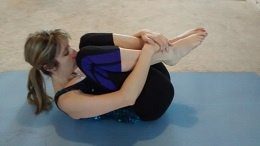
Knees to Chest Pose (Picture below)
Lie on your back with legs and arms stretched
Bring both knees to chest as you exhale. Clasp your hands around legs
Back is flat on the floor (mat)
If it’s comfortable for you, gently rock back and forth, which gives you a little massage
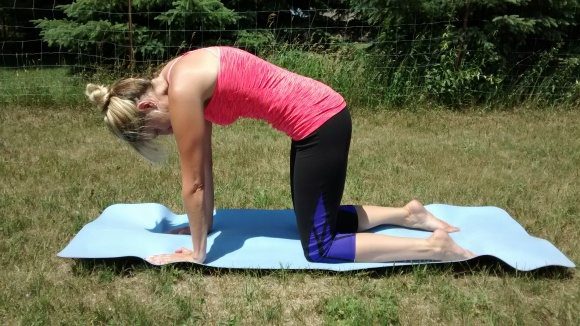
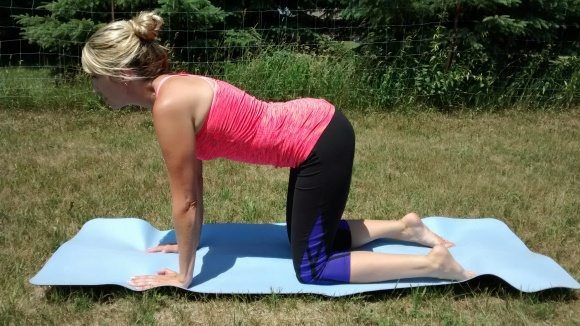
Cat/Cow Pose (Images below)
Begin on all fours in a tabletop�position
Place your hands under your shoulders along with your knees under your hips
Like a cat, round your back up to arch on the exhale
Bring your chin to chest
On the inhale, drop your abdomen and raise your head, extending your sitting bones (sits) back up
Cat Pose
Cow Pose
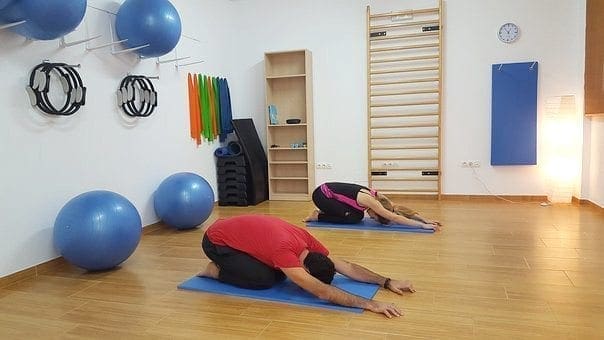
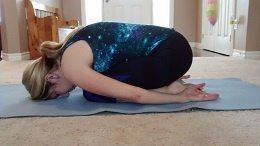
Child’s�Pose (Picture below)
Move from table top to a kneeling position. Rest your arms by your side, press your shoulders down and simultaneously reach your head tall
Slowly lower�your buttocks towards your heels feeling a nice stretch in your lower back/hips.
Let your forehead�rest on the floor
Place arms resting alongside your body
Or you can place�arms above head, gently stretching as they are placed on the floor
If it is easier too, you can widen knees as you stretch out
Those small yoga seeds�put by my first teacher long past � have continued to grow/flourish. I’m a fully certified yoga teacher and revel in sharing my practice with students every week now. May you find peace on your own journey and pain relief too, one pose at a time. Namaste.
There are 3 primary parts of exercise: cardiovascular exercise, strengthening exercises, and flexibility training. And let�s face it�those first 2 typically get more emphasis. Cardiovascular exercise (running, for example�anything which gets your pulse up) and strength training (lifting weights) come with some rather immediate outcomes. They help us build muscle and lose weight , all while helping us be more fit. It takes longer to see those advantages.
But here�s the deal: flexibility becomes more significant as you grow old. Being limber can help battle those aches and pains related to aging; stretching can help you maintain better joint health. It can also make those daily jobs�carrying groceries, going up and down stairs etc. much easier.
However, you can�t wake up when you�re 64 and unexpectedly be equally as adaptable as you were when you were 24. It�s much better and even more efficient to work flexibility training into your workout routine throughout your own life.
(Rest assured: if you are 64 and were hoping to regain some of that youthful flexibility, you can start working it in your workout routine now. Simply be realistic concerning the outcomes. You will, most likely, never be as flexible as you once were, but working on flexibility at any age is rewarding.)
Talk To Your Physician Or Physical Therapist Before Beginning A New Workout Plan
They could help you establish realistic targets and create a plan that best suits your life. You may want to think about working with a personal trainer to assist you ease into the brand new routine.
Flexibility Training Is More than Doing A Few Stretches
After a run is yes, better than nothing, doing a couple of hamstring stretches, but you won�t find as many long-term gains as you’d see from a flexibility plan that is more developed.
To get the most benefit from flexibility training, you should have a personalized program, one that takes into account your body and demands. As stated earlier, a personal trainer or physical therapist is able to help you develop the best plan for you.
And remember: the more time and attention you give to flexibility training, the more gains you�ll see�especially those long term gains.
Take Your Actions Into Account
Think, also, about your daily life: does your job involve a lot of sitting or lifting?
A personalized flexibility training program is able to help you enhance your freedom (how well your joints move) and stability (keeping good posture and body alignment during actions in order for your body isn�t under undue strain). It can allow you to excel in sports or your activities, in addition to help you take good attention to your body on a daily basis.
Give Special Focus To Muscles That Feel Tight
The shoulders, chest, hamstrings, and hips are often tight, but you may find tightness in other regions depending on harms, pressure in your lifetime, or how rough a particular workout was. By tailoring your flexibility training to your body, you�ll prevent overstretching muscles�or muscles that are lost that need consideration.
Your Body Knows What�s Best for It
Listen to your body, and don�t push it too much when you�re stretching. Instead, ease into a stretch when you�ve reached the limit of what you are able to do at that point, and understand.
Also, you need to prevent ballistic stretches�that sort of extending where you bounce in and out of the stretch. That strategy isn�t as successful holding the stretch for about 10 to 30 seconds and then as slowly stretching your muscles.
You Can Be Creative With Stretching
Within the plan that was developed for you, you can use resistance balls, towels, or other props that’ll allow you to go deeper in your stretches. Assortment will also make you more likely to stay with your flexibility training plan.
Warm Up For Stretching
You may be a bit confused�isn�t stretching a warmup? How do you warm up for stretching? This is where a brisk walk or short jog can help: get your heart pumping and your muscles limber before stretching.
Take A Flexibility Course In The Fitness Center
Assess your gym�s class program; it may be that they have a few flexibility or stretching classes. Sometimes these courses combine cardiovascular work, strength training, and flexibility work�all 3 parts of exercise in one class! Or you may take a class that�s exclusively focused on stretching.
Your Mind Can�Stretch
Pilates and yoga are outstanding flexibility training trainings. Plus, they teach you about relaxation, meditation, and other head-body techniques�ways to help calm your body and emotions, which can, subsequently, make your body more receptive to being stretched.
Stretching Is Significant for Everyone
Maybe you’ve got this bogus organization with extending�that only individuals in rehabilitation do it or that it�s only for individuals who aren�t actually in shape (that’s: it’sn�t �real� exercise). Well, it�s time to go past that misconception. Everyone should stretch. Look for inspiration or proof at Olympic and professional athletes: they know that flexibility training is a key section of peak performance.
You Must Be Consistent
It needs to be part of your routine, for stretching to be as effective as possible. This isn�t something which you do for a few weeks and after that move on. Regular stretching and flexibility work�along with cardiovascular exercise and strength training �will assist you to take good care of your own body for years to come.
When you think of a ballerina body, you may picture a petite, slender�physique. But many dancers have rejected that rigid idea of what a ballerina is supposed to�look like�and instead, they’ve led a shift towards�embracing a diverse range of�athletic ballerina bodies. One woman who’s played a major role in that movement is none other than Misty Copeland, the iconic principle dancer at the American Ballet Theater.
�We are real women and ballerinas, muscular, feminine but also strong, lithe but also curvaceous,� Copeland writes in her new book, Ballerina Body: Dancing and Eating Your Way to a Leaner, Stronger, and More Graceful You�($30, amazon.com).�But Copeland doesn�t pretend she always felt so confident in her skin. �None of it was easy. Not my climb in the ballet world, not my arrival at a place of personal contentment and peace, not my journey to the body I stand in.�
Her book is her way of helping other women reach the same state of body confidence that she now exudes to the world. �I dream of sharing what I�ve learned�of showing women everywhere how to reach their body goals and achieve what they see as their best selves,” she says.
For Copeland, that has meant prioritizing exercise, as an integral and positive element of her day.��Working out, so essential to our mental and physical well-being, can and should be woven through every part of our lives,� Copeland says.
Below are four exercises that she incorporates in�her cross-training routine, to help maintain her ideal ballerina body��one that is lean but sinewy, with muscles that are long, sculpted, and toned.� But you certainly don’t have to be a dancer to reap the benefits of these challenging moves. Try them out to�get toned from head to (pointed)�toe.
Relev�
�Relev� means �raised,� or lifted, and describes the position when you rise onto the balls of your feet (demi-pointe) or onto the toes (pointe) of one or both feet.
a. Begin in first position. Demi-pli�, then stretch your knees and rise onto demi-pointe (relev�). Repeat this three times and old on the count of four. When done to music, the counts are to the timing of the music.
b. Repeat once. When you get stronger, you may do four repetitions.
Remember to hold your posture. The flexing and pointing also prepare and strengthen your ankles to allow you to stand on demi-pointe (or en pointe, if you are an advanced dancer).
Balancing Adagio
�Adagio� refers to the slow movement in the ballet technique. As much as the adagio is about flexibility, strength, and fluidity in the movement, learning this exercise on the floor will give you an advantage before approaching it standing. On the floor you acquire a sense of balance and where your weight should be in order to leverage it to make you legs appear higher and more extended in opposition to our upper body.
This exercise should be done slowly to improve balance, alignment, abdominal strength, and stamina.
a. Start by sitting with your legs together on the floor in front of you.
b. Lift your legs into the air by bending your knees, holding the backs of your things with your hands with your legs still bent and parallel to each other.
c. Leaning back, with your back straight and the backs of your thighs (hamstrings) leaning into your hands, slowly lengthen both legs into the air until they are fully straight, making you into a V shape. Bend your knees so the tips of your toes touch the floor. Now do the same with each leg, alone, keeping the tips of the toes of your other leg posed on the floor.
d. Repeat the sequence, beginning with the other leg, when doing the single-leg section.
Seaweed
This exercise is great for freeing and lengthening the spine and for centering and strengthening the core.
a. Begin lying on your back, your legs together and parallel and your feet pointed.
b. Bend your legs slowly, bringing them off the floor, still bent, and lifting your feet off the floor as well, while your back hugs the ground.
c. Keeping your lower back on the floor and your shoulder blades drawn down toward your waist, curl your upper back off the floor, around your lower abs. Your arms should act like seaweed being moved by the motion of the tides, around and behind your lifted legs.
d. Float your upper back and arms down to the floor, legs still bent, body still energized.
e. Repeat four times, bringing your legs gently toward your head as your core and upper body lift, igniting the lower abdominal muscles.
f. After the last time, hold one hand or wrist (depending on the length of your arms) with the other, behind your thighs.
g. Lengthen your legs straight into the air, pressing the backs of your legs into your arms.
h. Propel your legs to the floor, arms still around them, until you get close to the floor. Then open your arms to the sides and move them forward toward your feet, over your head.
i. Your upper back should bend forward over your legs as you transition from lying to sitting, with the backs of your hands on the floor to help stabilize and keep the backs of your legs on the floor.
j. Roll down through your spine until your back is on the floor and you are in the starting position, with your shoulders relaxed. Repeat two to four times.
D�gag�
�D�gag� means �disengaged.� When preparing for d�gag�s in particular, but whenever you�re lying on the floor, you should feel like you are standing or jumping�not lying on the sand at the beach!
This exercise is good for length, strength, and alignment. Be sure to press the parts of your back and body that are touching the surface of the floor to the floor, allowing your working leg to float up, initiating the movement with your inner thighs and the backs of the legs rather than the top of your thighs (quadriceps).
a. Begin lying on your back with your feet in first position (heels together and toes apart, feet pointed).
b. Place your arms at your sides with your palms facing down; you can vary the positioning of your arms depending on what makes you comfortable, as long as your arms don�t go above your shoulders.
c. Keep your legs elongated, straight on the floor.
d. Use your palms and arms by pressing them to the floor. This will help to strengthen ?your core and align the spine.
e. Lift one leg two or three inches from the floor, with your toes still pointed out, by pressing the standing leg (again, whether you�re standing or lying on the floor, the standing leg is the one that is not moving; it helps to maintain balance), your arms, and your head into the floor. This will help you to lift the working leg while maintaining stability throughout your body. Do four d�gag�s with one leg front, then switch legs and do four with the other leg front.
f. Now do four d�gag�s to each side. For these, your working leg stays on the floor, brushing along the floor as it extends to the side. Do not disturb the balance of the pelvis or the back as you move the working leg.
Excerpted from the book BALLERINA BODY by Misty Copeland. Copyright 2017 by Misty Copeland. Reprinted with permission of Grand Central Life & Style. All rights reserved.
Walk into any gym or health club and you�ll find people exercising�their core. Coretraining has�taken the world by storm, and for good reason, as every DC knows. Strengthening the�core creates stability and better movement and helps prevent lower back pain. To help patients get the most from�their efforts, it�s important they understand what they�re doing. You can explain the difference between the local and global muscles, as I�ve outlined�below, and help your patients�perform core work safely and effectively.
What Is the Core?
I like to tell patients that their core is a shorthand way of referring to all the muscles of their�lower back/pelvis/hip area. It�s where your center of gravity is located and where movement begins. A strong core stabilizes the spine and pelvis and supports you as you move. The core has 29 pairs of muscles that�fall into two categories:
��Local Muscles. Patients can think�of local muscles as the deeper muscles, the ones close to the�spine and responsible for stabilization.�They don�t have much ability to move the�joints. The local muscles are further broken down into primary and secondary categories. The primary local muscles are the transverse abdominus and multifidi (the two most critical muscles for providing stability). The secondary local muscles are the internal obliques, quadratus lumborum, diaphragm and pelvic floor muscles.
��Global Muscles.�The global muscles are the outermost layer of muscle�they�re the ones you can feel through your skin. They�re responsible for moving joints. The global muscles in the core are the rectus abdominus, external obliques, erector spinae, psoas major and iliocostalis.
The core should operate as an integrated functional unit, with the local and global muscles working together to allow easy, smooth, pain-free movement. When the muscles work together optimally, each component distributes, absorbs and transfers forces. The kinetic chain of motion functions efficiently when you do something dynamic, like exercise or run.
Core Injury
An injury to one of the core muscles usually means an episode of lower back pain for your patient. When that happens, the deep stabilizers change how they work as a way to compensate for the injury and protect the area. The stabilizers now have delayed action; they�re turned on only after you move, instead of as you move. Because now they�re not functioning as they should, the�brain recruits the�global muscles to compensate. That causes a core imbalance. The result: pain in the lower back, pelvis and glutes (the big muscles you sit on).
Exercises designed to help get patients� core muscles back in balance are the best way to prevent re-injury and avoid lower back pain. Traditional abdominal exercises are often recommended to strengthen the global muscles. These exercises can actually increase pressure on the lower spine. Similarly, traditional lower back hyperextension exercises meant to stretch out the lower spine also may actually increase pressure on it. A better approach to preventing lower back pain is restoring stability with the core exercises below.
Abdominal Brace
The abdominal brace activates all the contracting muscles in the abdominal wall, without involving the nearby obliques and rectus muscles. This exercise strengthens the connection between the global muscles and the deep local muscles. This helps restore the balance between them and improves spinal stiffness.
To get an idea of how the muscles in your core work, place your thumbs in the small of your back on either side of your spine. Next, do a hip hinge: bend forward from the hips about 15 degrees. You should feel the muscles in your lower back move as you bend and stand back up again.
To do the brace, stand upright and suck in your stomach, as if you were about to get punched. Hold hat for 10 seconds, then relax. Repeat 20 times; do three sets.
You�ll know you�re doing the brace correctly if you poke your extended fingertips right into your side below your ribs and then brace. You should feel the muscles move under your fingertips.
Curl-Ups
Curl-ups train the rectus abdominus, the long abdominal muscle that runs vertically from your breastbone all the way down on both sides of your bellybutton.
Start by lying on your back with your hands palm-up beneath your lower back. Bend one leg and put the foot flat on the floor; extend the other leg. Hold your head and neck stiffly locked onto your ribcage�imagine them as one unit. Lift your head and shoulders slightly off the floor by three or four inches and hold that position for 20 seconds. Your elbows should touch the floor while you do this. Relax and gently lie back again. Repeat 10 times. Switch legs and repeat 10 times gain. Do three sets.
Tip: If your patient has�neck discomfort doing this, have them push their�tongue against the roof of the�mouth�to help�stabilize the neck muscles.
Side Bridge
The side bridge, also called the side plank, trains the quadratus lumborum, lateral obliques, and transverse abdominus muscles, all local muscles that help stabilize the�spine.
Start by lying on your side. Place your top leg in front of your bottom leg (the heel of your top foot should touch the toe of the bottom foot). Raise your body using the down-side shoulder and elbow. Cap the opposite shoulder with your free hand. Hold for as long as you can, aiming for 30 seconds. Switch sides and repeat.
Bird Dog
This exercise is great for training the back extensors, including the longissimus, iliocostalis and multifidii.
Start on your hands and knees (quadruped position). Raise and extend the opposite arm and leg simultaneously, like a dog pointing to where the bird is. �Hold or eight seconds, then return to the quadruped position. Repeat eight times, then switch arms and legs and repeat for eight reps. Do three sets.
Conclusion
All the muscles of the�core must work together to produce efficient and effective movement. The core is the center of the�body�s motion�training it is a critical part of any exercise routine. Teaching your�patients proper technique for core training will result in�big benefits for them now and in the future.
Share this Core Strengthening guide with patients, courtesy of WebExercises
Walk into any gym or health club and you�ll find people exercising�their core. Core training has�taken the world by storm, and for good reason, as every DC knows. Strengthening the�core creates stability, better movement and helps prevent lower back pain.
Proven�research is now indicating that receiving Chiropractic adjustments to the pelvis can�increase vertical jump height. �This new research further solidifies the stance of many professional and collegiate teams with providing Chiropractic care for their athletes. In addition to injury prevention this research proves that chiropractic care results in an increase in sports performance.
[Purpose] This study aimed to investigate the effect of pelvic adjustment on vertical jump height (VJH) in female university students with functional leg length inequality (FLLI). [Subjects] Thirty female university students with FLLI were divided into a pelvic adjustment group (n = 15) and a stretching (control) group (n = 15). [Methods] VJH was measured using an OptoGait. [Results] After the intervention, jump height improved significantly compared with the pre-intervention height only in the pelvic adjustment group, while FLLI showed statistically significant improvement in both groups. [Conclusion] Pelvic adjustment as per the Gonstead method can be applied as a method of reducing FLLI and increasing VJH.
Key words:�Pelvic adjustment, Functional leg length inequality, Vertical jump height
INTRODUCTION
The pelvis, a structure located between the hip joint and the lumbosacral spine and attached to several muscles, regulates the movement of the hip joint and lumbosacral spine. The position of the pelvis is the most critical factor determining the sagittal alignment and posture of the human body). Only when the pelvis is in the neutral position can be in the right posture, move the upper and lower body in the dynamic posture, and improve daily movements and ambulatory ability).
Functional leg length inequality (FLLI) worsens due to pelvic tilt in the medial plane and pelvic rotation in the sagittal plane). Therefore, FLLI might be improved by pelvic adjustment. High-velocity and low-amplitude (HVLA) adjustment has been widely utilized as a general chiropractic adjustment method). Many studies have indicated that leg length inequality (LLI) causes posture alteration), limiting exercise and causing tension of the muscles and other soft tissues5). LLI is accompanied by several clinical symptoms6)�such as lumbar pain)�and hip pain). Correcting leg length inequality reportedly reduces pain, increases mobility, and improves posture).
Vertical jumping is practiced to enhance the muscular strength and endurance of the leg and serves as a barometer of muscular strength). There have been studies in which plyometric training was undertaken to improve leg muscle strength), dynamic stretching was applied after jogging for 5 minutes to improve vertical jump height (VJH), or HVLA manipulation was performed for talocrural joint dysfunction). However, there has been no study in which FLLI was corrected and VJH was measured as a barometer for leg muscle strength. Many studies have assessed the effect of pelvic adjustment on FLLI), posture), pressure on the foot, and balance). However, no study has investigated the changes in FLLI and VJH resulting from just a single adjustment. Therefore, this study aimed to assess the immediate effects of a single pelvic adjustment on FLLI and VJH in female university students with FLLI.
SUBJECTS AND METHODS
A total of 30 female university students with an FLLI of more than 10?mm between the left and right legs were selected and randomly assigned to one of two groups: the pelvic adjustment group (adjustment group, n = 15) and control group (stretching group, n = 15). The exclusion criteria were as follows: anatomical LLI; degenerative osteoarthritis; muscle, bone, or nervous system problems; ankle joint, knee joint, hip joint, or lumbar pain; limited range of motion due to burn or postsurgical scarring; and regular leg exercise. This study was approved by Korea Nazarene University�s Institutional Review Board, and the safety of all subjects was protected during all parts of the experiment. All subjects understood the purpose of this study and provided written informed consent prior to participation in accordance with the ethical standards of the Declaration of Helsinki.
The age, height, and weight of the subjects in the adjustment group were 23.5�4.7?years, 163.0�5?cm, and 54.1�5?kg, while those in the stretching group were 22.2�6.3?years, 162.7�6?cm, and 53.1�6?kg, respectively. Gender was analyzed using the ?2�test, while age, height, and weight were analyzed using the independent t-test. As these analyses detected no statistically significant differences (p>0.05), the two groups were deemed identical.
The pelvic adjustment performed in the adjustment group consisted of an HVLA technique administered in the prone posture in accordance with Gonstead�s theory. Subjects were instructed to lie prone, their pelvic height was checked, and the posterior-inferior innominate bone was given an anterior-superior impact while the anterior-superior pelvis was given a posterior-inferior impact. When making these impacts, the therapist put one of his hands on top of the other, placed them on the posterior-superior iliac spine or the ischial spine, and then gave the impact using his own weight, gravity, and acceleration). This adjustment was performed 3�5 times by one skilled physical therapist with more than 10?years of clinical experience. The control group stretched the backbone erector, rectus abdominis, iliac muscle, psoas major, quadriceps muscle, leg adductor, and quadratus lumborum adjacent to the pelvis in order to resolve muscular imbalance that could further the pelvic imbalance. In the process, the therapist assisted the subjects in performing additional height training for each muscle and maintaining each posture at the maximum height for 10�15 seconds. The subjects then resumed the initial posture, rested for 5 seconds, and repeated the stretching one more time. Stretching was done three times per posture for a total of 15 minutes).
For leg length measurement, subjects lay straight on a bed, and the tape measure method (TMM) was used to measure the leg from the anterior superior iliac spine (ASIS) to the medial malleolus. Beattie et al. reported that LLI as measured by the TMM did not show a significant difference from radiological findings. We were therefore confident in the reliability of using the TMM for measuring leg length). The measurement started from the ASIS so that pelvic bone-related problems such as pelvic tilt and pelvic asymmetry could be included.
We used an OptoGait (Microgate Srl, Bolzano, Italy), a system for optical detection, to analyze ambulation and measure VJH. On its signal-sending bar, there are 96 LEDs that communicate via an infrared frequency. The signal-receiving bar has an identical number of LEDs. We installed the signal-sending and signal-receiving bars of the OptoGait one meter apart on a flat surface. When a subject performs a vertical jump between the bars, the bars calculate the time at which the subject touches the floor or stays in the air and communicates this information by sending and receiving 1,000 signals per second, generating accurate data. Based on this basic data, the OptoGait software calculates the precise VJH.
Leg length and VJH were measured before and after the intervention. The measured data were analyzed using the statistics program SPSS 12.0 KO (SPSS, Chicago, IL, USA), and the collected data are presented as averages and standard deviations. The significance of pre- and post-intervention differences was tested using the paired t-test, and the significance of between-group differences was tested using the independent t-test. The p-value ? was set at 0.05.
RESULTS
In the pre- and post-intervention comparison, VJH improved significantly only in the adjustment group, while FLLI improved significantly in both the adjustment group and the stretching group (p<0.05) (Table 1). When comparing the pre-intervention data, post-intervention data, and changes between the pre- and post-intervention data, VJH showed statistical significance only for the changes between the pre-and post-intervention data, while FLLI showed statistical significance for post-intervention data and changes between the pre- and post-intervention data (p<0.05) (Table 2).
Table 1.
Comparison of the Pre- and post-intervention data for VJH and FLLI in each group (mean�SD) (Unit: VJH-cm, FLLI-mm)
Table 2.
Comparison of VJH and FLLI between the adjustment group and stretching group (mean�SD) (Unit: VJH-cm, FLLI-mm)
DISCUSSION
The pelvis supports the abdomen, connects the spine and legs, and is involved in transferring weight from the spine to the legs when a person stands up, maintaining a straight posture and enabling smooth arm movements). Due to their erect ambulation, human beings are exposed to gravity and can thus be subject to a malalignment of the pelvis and legs affecting posture, ambulatory pattern, and balance. LLI is easily observed clinically and causes functional disturbance of normal biomechanics).
Winter and Pinto reported that pelvic obliquity is caused by LLI), and Mccaw and Bates explained the relation between biomechanics and spinal deformity due to LLI). Defrin et al. reported that when a shoe insert was used in 22 chronic back pain patients with LLI of 10?mm and less, pain intensity and muscular weakening were reduced), which appears to be due to reduced pain and muscular weakening attributed to decreased pelvic tilt resulting from LLI adjustment. On the basis of previous studies on pelvic adjustment, Alcantara et al. reported that following adjustments using fast and slow speed amplitudes in patients with sacroiliac joint obliquity, pain was reduced, and patients could resume daily life and work). Park et al. reported that balance in 20 elderly men was improved through pelvic adjustment according to the Gonstead method). In this study, FLLI was reduced after pelvic adjustment, a finding similar to a previous study in which pelvic adjustment helped reduce FLLI and the pressure difference between soles).
In this study, stretching was not associated with increased VJH, while pelvic adjustment was. In a previous study by Ryan et al. in which subjects jogged for 5 minutes in order to improve VJH, a barometer for leg strength, and then performed dynamic stretching, VJH was increased as compared with a control group that only jogged for 5 minutes). In the present study, it is suspected that VJH did not increase because only static stretching was applied. Hedlund et al. reported that VJH showed a statistically significant increase following 3 weeks of chiropractic HVLA manipulation in 22 female handball players with talocrural joint dysfunction, which is similar to the findings of the present study).
Pelvic adjustment balances the left and right pelvic height and left and right anterior and posterior rotation of the hip bones, which, in turn, leads to FLLI improvement. It also balances the left and right muscle lengths of the rectus femoris and sartorius, which are involved in the hip bone�s anterior rotation, and the hamstring and gluteus maximus, which are involved in posterior rotation. This seems to explain the improvement in vertical jump ability. We recommend that pelvic adjustment be applied for decreasing FLLI and increasing VJH, a barometer for leg muscle strength, in the future.
Research now indicates that receiving Chiropractic Adjustments to the pelvis can�increase vertical jump height. �This research solidifies many professional and collegiate teams that�provide chiropractic care for their athletes. In addition to injury prevention this research proves that chiropractic care results in greater athletic performance.
IFM's Find A Practitioner tool is the largest referral network in Functional Medicine, created to help patients locate Functional Medicine practitioners anywhere in the world. IFM Certified Practitioners are listed first in the search results, given their extensive education in Functional Medicine






 2017 by Misty Copeland. Reprinted with permission of Grand Central Life & Style. All rights reserved.

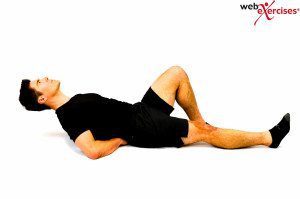 Curl-ups train the rectus abdominus, the long abdominal muscle that runs vertically from your breastbone all the way down on both sides of your bellybutton.
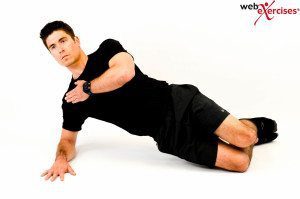 The side bridge, also called the side plank, trains the quadratus lumborum, lateral obliques, and transverse abdominus muscles, all local muscles that help stabilize the�spine.
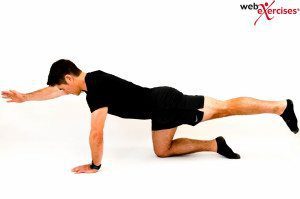 This exercise is great for training the back extensors, including the longissimus, iliocostalis and multifidii.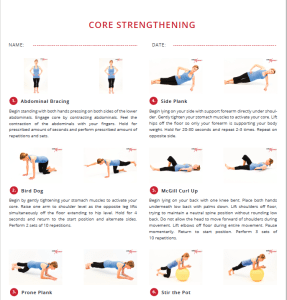

 A total of 30 female university students with an FLLI of more than 10?mm between the left and right legs were selected and randomly assigned to one of two groups: the pelvic adjustment group (adjustment group, n = 15) and control group (stretching group, n = 15). The exclusion criteria were as follows: anatomical LLI; degenerative osteoarthritis; muscle, bone, or nervous system problems; ankle joint, knee joint, hip joint, or lumbar pain; limited range of motion due to burn or postsurgical scarring; and regular leg exercise. This study was approved by Korea Nazarene University�s Institutional Review Board, and the safety of all subjects was protected during all parts of the experiment. All subjects understood the purpose of this study and provided written informed consent prior to participation in accordance with the ethical standards of the Declaration of Helsinki.