Can understanding the nucleus pulposus help in body positioning and prevention for individuals wanting to practice spinal hygiene and protect their discs from injury?
Nucleus Pulposus
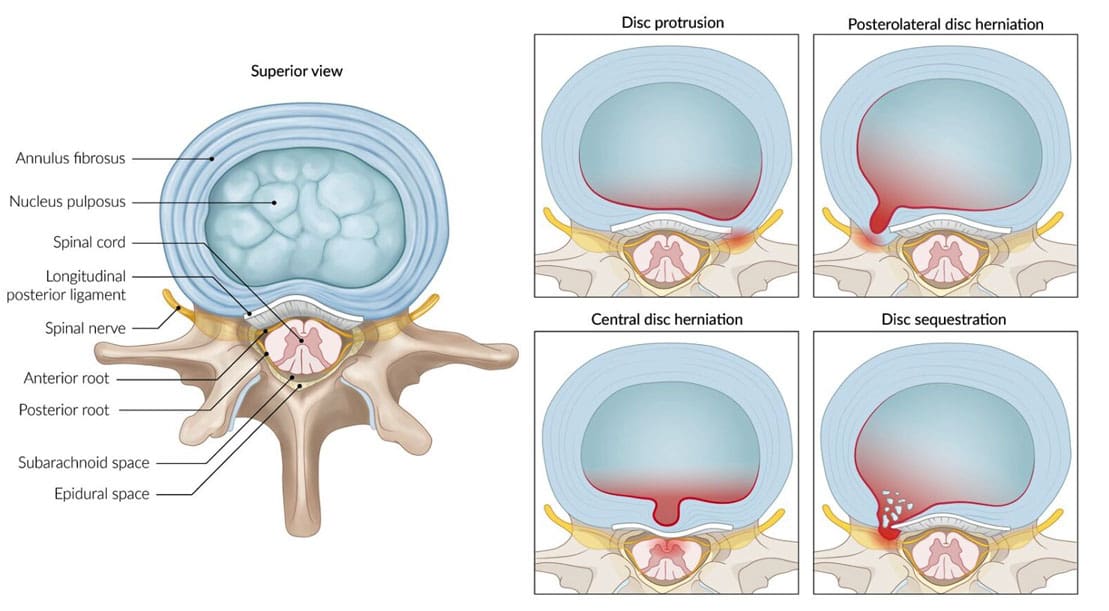
The spinal discs are located between the spine’s vertebrae and are the body’s natural impact and shock absorbers. Within the disc is the nucleus pulposus, which plays a major role in providing the spine with shock absorption during movement. (Zhou Z. et al., 2014) The discs have a tough outer portion and a soft inner core. They are the:
It forms the tough circular exterior and comprises concentric sheets of collagen fibers or lamellae surrounding the inner core.
It has cartilaginous endplates that firmly attach to the vertebrae above and below.
Nucleus Pulposus
The nucleus pulposus is the inner core soft filling of the discs.
It contains a network of fibers suspended in a mucoprotein gel with a water base to maintain strength and pliability.
The near-liquid consistency makes it responsive to movement to handle the body’s axial load.
It helps maintain spinal suspension to prevent pressure on the bones and prevent bone-to-bone contact, reducing the potential for injuries and pain.
Shock Absorber
Each intervertebral disc is a shock-absorbing cushion, with the nucleus pulposus providing shock-absorbing properties (Zhou Z. et al., 2014). The intervertebral discs move as the body moves. For example, when arching the back, the disc moves forward slightly, and when twisting, the disc twists as well.
Spinal Action
The intervertebral disc supports spinal movements. When bending, twisting, arching, or tilting the spine, the nucleus pulposus swivels to accommodate these actions. These repeated spinal actions, which occur throughout the day and night, contribute to shifting positions while sitting, working, playing sports, carrying groceries, performing house chores, etc. An example is bending forward to pick something up. This action involves forward spinal flexion, which is bending the spine forward, flattening, or rounding. When bending using flexion, the spinal bones come closer together, pushing the nucleus pulposus toward the back.
Injuries
The disc can be pushed too far back with persistent or excessive spinal flexion. If the fibers of the annulus fibrosus become weak, they can tear, causing the nucleus pulposus to leak out and disc herniation. Generally, the nucleus pulposus will leak to the side and back; however, this corresponds to the location of the very sensitive nerve root/s with which it can come into contact, causing pain and other symptoms. The most common causes of disc herniation are degenerative wear and tear changes of the disc and trauma. Disc degeneration occurs as the body ages; it weakens the annulus fibers, allowing the nucleus pulposus to distend, bulge, or herniate.
Aging
Disc degeneration occurs with age but can also occur with injuries to the area. In young individuals, the nucleus pulposus is mostly water. For this age group, a herniation from trauma is more likely than in older individuals. (Ucar, D. et al., 2021) But as the body ages, the discs, especially the nucleus pulposus, begin to dry out. This dehydration leads to a significant loss of disc height. (UCLA Health, 2024) By age 60 or 70, the discs may be composed entirely of fiber, which can cause the shock absorption function not to work and disappear.
Chiropractic therapy is among the more conservative treatment options for a herniated disc and may be tried first before proceeding with more invasive treatments. Injury Medical Chiropractic and Functional Medicine Clinic works with primary healthcare providers and specialists to develop an optimal health and wellness solution that fully benefits the individual to get back to normal.
The Science of Functional Healing
References
Zhou, Z., Gao, M., Wei, F., Liang, J., Deng, W., Dai, X., Zhou, G., & Zou, X. (2014). Shock absorbing function study on denucleated intervertebral disc with or without hydrogel injection through static and dynamic biomechanical tests in vitro. BioMed research international, 2014, 461724. https://doi.org/10.1155/2014/461724
Nosikova, Y. S., Santerre, J. P., Grynpas, M., Gibson, G., & Kandel, R. A. (2012). Characterization of the annulus fibrosus-vertebral body interface: identification of new structural features. Journal of anatomy, 221(6), 577–589. https://doi.org/10.1111/j.1469-7580.2012.01537.x
Ucar, D., Duman, S., Bayram, Y., & Ucar, B. Y. (2021). Extruded disc herniations are experienced earlier by inactive young people in the high-tech gaming era. Journal of medicine and life, 14(3), 402–407. https://doi.org/10.25122/jml-2021-1059
After an auto accident that might not have caused serious damage, individuals often believe that they’re fine only to find out later that there is a serious injury. How do these hidden injuries happen? It is because of the body’s fight or flight response that it activates into high gear. It does whatever is necessary to get out of harm’s way. The result is that individuals might not realize/discover that they have been injured until after the dangerous circumstances have passed. Auto accident doctors and chiropractors are very familiar with these types of hidden injuries.
The injuries sustained from non-damage-causing auto accidents are often not visible. This can be internal injuries and joint and muscle misalignments that can often only be seen through extensive x-rays, MRIs, or detailed physical examination. However, a professional chiropractor can determine the root causes of an injury from a single consultation.
Hidden Injuries
Whiplash
Some injuries, like delayed whiplash, do not present immediately because it can take days for symptoms to develop. This is the most common injury caused by an auto accident. This is when the head snaps back and then forward rapidly/violently during a collision. The jolting back-and-forth motion causes muscle strain, sprain, which can stretch and/or tear the tendons and muscles in the neck. The injury can be worsened as the individual does not realize that they have this injury, and they turn, rotate, and crane their necks like normal. Symptoms include:
A stiff/tight neck
Dull neck pain
Upper back pain
Shoulder stiffness, aches, and pain
It is recommended to see a doctor or chiropractor as soon as possible for diagnosis and treatment.
Muscle, Tendon, and Ligament Injuries
Muscle, tendon, and/or ligament injuries can happen due to whiplash, but they can also happen in other parts of the body like the hands, elbows, knees, and ankles.
Contact Injuries Bruises and Swelling
Drivers and passengers can bruise and swell from contact with hard surfaces like the steering wheel, dashboard, and doors. Seat belts can also cause injury from quick/rapid braking or a crash.
Concussion
This is when the brain forcefully makes contact with the skull resulting in bruising/injury to the brain. It is recommended to see a doctor immediately if any of the following are experienced after an auto accident:
Dizziness
Loss of balance/equilibrium when standing and walking
Difficulty concentrating
Difficulty remembering things
Spinal Trauma
The spine can sustain separate injury/s or trauma as a result of an auto accident. This includes:
Dislocation/s
Fractures
Compressed vertebrae
Crushed vertebrae
More symptoms can present after the shock wears off.
This often reveals severe, debilitating injury/s that affect the nerves and muscle control of different organs and body parts.
Bio-Chiropractic Treatment and Rehabilitation
One of the most effective and recommended ways to relieve pain and properly heal hidden injuries is chiropractic treatment and rehabilitation. A professional chiropractor can prevent further injuries from developing while easing and alleviating current pain.
No Medication Necessary
More people are becoming addicted to prescription medications following accidents and other trauma. Chiropractic care treats the cause of pain without medications. This allows the body to heal naturally and for movement to come back naturally.
Reduces Long Term Pain
Many continue to deal with back, neck, and other chronic pain conditions after an accident. Chiropractic gets to the root of the problem. The therapy sessions manipulate the body and help naturally restore the body’s total range of movement. A chiropractor will recommend exercises and stretches to keep the body strong and flexible to help prevent pain.
Reduces Scar Tissue
After the body goes through a trauma like an auto accident, muscles and ligaments can be stretched and torn. This can cause areas of internal scar tissue can develop. This can limit movement. Chiropractic helps reduce scar tissue by keeping the tissues loose and relaxed. This allows a normal range of movement.
Inflammation Alleviation
Auto injury/s can lead to long-term inflammation that can make life miserable. Chiropractors are trained to spot hidden micro-tears that x-rays are not able to scan. However, it is microscopic tears inside the muscles that are often the leading cause of inflammation. With physical manipulation, the body will be able to rerelease IL-6 substances naturally. This is a vital anti-inflammatory.
Healthy Body Composition
Personalized Functional Medicine
Personalized functional medicine is a new model of medicine that considers an individualized approach when making health recommendations. The body works as an integrated system, not as individual parts. This form of medicine combines new technology approaches, including recent gene expression and life and behavioral sciences discoveries. Personalized functional medicine looks at the subject of nutrigenomics. Nutrigenomics is defined as the relationship between nutrients and gene expression. Like identifying individual body composition, nutrigenomics testing can help individuals understand how dietary components influence their genes. This can help prevent the development of chronic diseases.
References
Calil, Ana Maria et al. “Mapping injuries in traffic accident victims: a literature review.” Revista latino-americana de enfermagem vol. 17,1 (2009): 120-5. doi:10.1590/s0104-11692009000100019
Dindi, Kuru et al. “Road traffic injuries: Epidemiology, challenges, and initiatives in India.” The National medical journal of India vol. 32,2 (2019): 113-117. doi:10.4103/0970-258X.275355
Minich, Deanna M, and Jeffrey S Bland. “Personalized lifestyle medicine: relevance for nutrition and lifestyle recommendations.” TheScientificWorldJournal vol. 2013 129841. 26 Jun. 2013, doi:10.1155/2013/129841
Palmnäs, Marie et al. “Perspective: Metabotyping-A Potential Personalized Nutrition Strategy for Precision Prevention of Cardiometabolic Diseases.” Advances in nutrition (Bethesda, Md.) vol. 11,3 (2020): 524-532. doi:10.1093/advances/nmz121
Sims, J K et al. “Automobile accident occupant injuries.” JACEP vol. 5,10 (1976): 796-808. doi:10.1016/s0361-1124(76)80313-9
Please fill out the form below to request more information or schedule your first session with one of our trainers.
If you’d like to reach us directly, please call one of our two locations, Central El Paso (915.203.8122) or West El Paso (915.740.2439), or email us at [email protected]
IFM's Find A Practitioner tool is the largest referral network in Functional Medicine, created to help patients locate Functional Medicine practitioners anywhere in the world. IFM Certified Practitioners are listed first in the search results, given their extensive education in Functional Medicine