Make Your Health Goals Stick in 2026: How El Paso Back Clinic’s Integrative Team Supports Real Change
The patient uses a weight machine for injury rehabilitation under the supervision of a doctor of chiropractic and a nurse practitioner.
Most people don’t fail at New Year’s goals because they “don’t want it enough.” They fail because life gets busy, pain flares up, energy crashes, and stress piles on. When your body hurts or feels stiff, even simple plans—like walking more, lifting weights, or sleeping better—can feel harder than they should.
At El Paso Back Clinic, the goal is to make health changes easier to achieve and maintain through a team-based, integrative approach. That means bringing together the strengths of chiropractic care (movement, structure, mobility, and recovery) with the strengths of nurse practitioner care and wellness coaching (nutrition, sleep, stress, and whole-body support). The clinic describes this as a blend of injury care, wellness strategies, mobility programs, and integrated medicine designed to improve function and quality of life. El Paso Back Clinic® • 915-850-0900+2El Paso Back Clinic® • 915-850-0900+2
This kind of care supports common goals like:
increasing fitness and mobility
managing pain so you can stay active
improving energy and sleep
lowering stress and improving your stress response
“Integrative care” means your plan isn’t built around only one angle. Instead, it connects the pieces that usually get separated:
How you move
How you recover
How you eat
How you sleep
How you manage stress
How do you build habits that fit your real life
El Paso Back Clinic describes integrative chiropractic benefits as going beyond traditional adjustments by combining care approaches that support overall wellness and function. El Paso Back Clinic® • 915-850-0900
Why this matters for resolutions
Many resolutions are difficult to maintain because the plans ignore the real barriers. For example:
You want to exercise more—but your back pain spikes.
You want to lose weight—but your sleep is poor and your stress is high.
You want more energy—but your nutrition is inconsistent, and you’re not recovering.
An integrative plan helps because it aims to reduce the friction that makes healthy habits feel impossible.
The Team Approach: Chiropractor + Nurse Practitioner Mindset
Many clinics talk about how chiropractic care supports goals such as mobility, stress reduction, better sleep, and improved performance. gotcore.net+2Freedom Chiropractic+2 At El Paso Back Clinic, that support is often strongest when chiropractic care is paired with whole-person planning.
The chiropractor’s lane: move better with less strain
Chiropractic care commonly focuses on:
joint motion and spinal mechanics
posture and movement habits
mobility and flexibility
recovery support when you start working out again
helping reduce strain patterns that keep pain looping
The descriptions of services at El Paso Back Clinic emphasize spine-focused care and the restoration of function for back and musculoskeletal concerns. El Paso Back Clinic® • 915-850-0900+1
The NP/wellness lane: build a plan that supports your body from the inside out
A nurse practitioner and wellness-minded team approach can support:
nutrition planning that fits your schedule
sleep improvement routines
stress management strategies
health screening and medical risk review when appropriate
coaching that makes change more realistic to sustain
This matches the habit-focused guidance many health organizations recommend: set realistic goals, build routines, and avoid extreme “all at once” changes. Prism Health North Texas
Dr. Alexander Jimenez’s clinical observations (El Paso context)
Dr. Alexander Jimenez (DC, APRN, FNP-BC) frequently describes a dual-scope approach that connects biomechanics (how you move) with broader health planning (nutrition, functional assessments, and recovery strategies). His published clinic content also highlights the use of assessments and, when needed, imaging and integrated care planning to support recovery and function. LinkedIn+3El Paso, TX Doctor Of Chiropractic+3El Paso, TX Doctor Of Chiropractic+3
Why Resolutions Often Fail (And How an Integrative Plan Fixes That)
Here are common “resolution killers” and what a coordinated plan can do differently:
Pain blocks movement → Address mobility limits and movement mechanics so activity feels doable. National Spine & Pain Centers+1
Low energy → Improve sleep, nutrition consistency, and recovery structure. gotcore.net+1
Stress overload → Add stress skills and routines that calm the system and support follow-through. NIH News in Health+1
No accountability → Regular check-ins and plan adjustments keep you from quitting after a setback. drmmalone.com+1
A key idea in habit-based care is that early wins create a “positive feedback loop”—you feel better, so it becomes easier to keep going. drmmalone.com
1) Increase Fitness and Mobility (Without Getting Injured)
If your goal is to work out more, the priority is often moving well enough to train consistently.
Many chiropractic resources emphasize mobility, flexibility, and injury prevention as people increase activity at the start of the year. 5280 Balanced Health Center+2Freedom Chiropractic+2 El Paso Back Clinic also emphasizes flexibility, mobility, and agility programs to improve ability and quality of life. El Paso Back Clinic® • 915-850-0900
A simple evidence-based target
For general health, adults are commonly advised to aim for 150 minutes of moderate activity per week, plus 2 days of muscle-strengthening activities. CDC+1 That can be split into smaller chunks—like 30 minutes, 5 days a week.
What the integrative plan can look like
Assess mobility limits (hips, spine, shoulders) and address movement friction
Build a realistic weekly schedule
Progress intensity slowly, so you don’t crash or flare
Easy “start small” movement ideas:
10–20 minute walk after meals
2 strength sessions per week (basic full-body)
5-minute mobility routine daily
Progression rules that keep people consistent:
Add time before you add intensity
Keep at least 1–2 recovery days weekly
Measure consistency, not perfection
2) Manage Pain So You Can Stay Active
Pain goals often work better when you focus on function—not “zero pain tomorrow.” A pain-focused plan might aim to reduce flare-ups and increase what you can do safely. National Spine & Pain Centers
El Paso Back Clinic positions its care around helping people with frustrating injuries and chronic pain syndromes improve mobility and function. El Paso Back Clinic® • 915-850-0900
Practical pain goals that tend to stick
“Walk 20 minutes, 4 days/week without a flare.”
“Lift twice/week with pain staying under a 3–4/10.”
NP-style wellness support can focus on sleep, stress, consistency in nutrition, and pacing habits that support recovery. Prism Health North Texas+1
Helpful pacing ideas (simple but powerful):
Use shorter workouts more often
Stop just before your “flare threshold”
Build capacity gradually rather than “weekend warrior” bursts
3) Boost Energy the Smart Way
Energy is not just “motivation.” If you’re tired, your plan needs better recovery.
Many chiropractic sources link better sleep and reduced tension with feeling more capable and consistent over time. gotcore.net+1 El Paso Back Clinic also describes a wellness-focused approach aimed at improving energy, sleep, and overall function. El Paso Back Clinic® • 915-850-0900
It’s common to hear people say they want to “boost immunity.” A safe and practical way to think about this is:
You can support overall wellness by improving sleep, physical activity, and stress management—foundations that matter for health.
Regular physical activity is widely recommended for health. CDC
Mindfulness-based approaches have evidence supporting their effectiveness for stress, sleep, and pain management. NIH News in Health
So instead of chasing extreme detoxes or perfect diets, an integrative plan often focuses on steady basics:
sleep routine
movement most days
nutrition consistency
stress skills
That’s the kind of “quiet consistency” that makes resolutions last.
5) Lower Stress and Improve Stress Response
Stress shows up in the body: tight shoulders, headaches, jaw tension, shallow breathing, gut tension, and poor sleep.
Mindfulness-based treatments have evidence supporting reduced anxiety/depression symptoms and improved sleep, and may help people cope with pain. NIH News in Health Many chiropractic sources also connect care with stress reduction and better sleep as part of overall wellness. gotcore.net+1
Pick one main goal (fitness OR pain, energy, OR stress)
Add two support habits
Track consistency weekly
Adjust every 2–4 weeks
Examples of “support habits”:
protein at breakfast
20-minute walk 4x/week
5 minutes of mobility daily
bedtime routine 5 nights/week
A Simple 4-Week Plan (El Paso Back Clinic Style: Practical, Not Perfect)
This is a general example you can personalize with your provider team.
Week 1: Reduce friction
Identify mobility limits and pain triggers
Set one realistic activity goal
Begin a simple nutrition and sleep routine
Week 2: Build consistency
Add a second strength or mobility day
Keep intensity moderate
Track sleep and energy patterns
Week 3: Progress carefully
Increase walking time or training volume slightly
Add a stress routine you can repeat
Adjust the plan based on how your body responds
Week 4: Lock in your system
Keep what’s working
Simplify what isn’t
Create a “busy week version,” so you don’t fall off
This approach fits the clinic’s overall theme of improving function through mobility, recovery, and whole-person planning. El Paso Back Clinic® • 915-850-0900+1
When to Get Checked Right Away
If you have severe or unusual symptoms, don’t “push through.” Seek urgent medical care for red flags like:
chest pain, severe shortness of breath, fainting
sudden weakness, facial droop, confusion
loss of bowel/bladder control
fever with severe spine pain
major trauma with worsening symptoms
Bottom Line: Your Best Results Come From a Whole Plan
At El Paso Back Clinic, an integrative model supports real-life resolutions by combining:
Faster Recovery After Spine Surgery: Enhanced Surgical Recovery (ESR) Programs at El Paso Back Clinic® in El Paso, TX
The doctor administers a local anesthetic into the patient’s affected area, using ultrasound to visualize the spine’s anatomical components.
Spine surgery can help treat serious back problems, such as pain from injuries, disc issues, or aging. At El Paso Back Clinic® in El Paso, TX, we focus on helping patients recover faster and more safely through modern methods. Enhanced Surgical Recovery (ESR), also called Enhanced Recovery After Surgery (ERAS), is a team-based plan that reduces the need for strong pain medications, shortens hospital stays, and lowers the risk of readmission. Led by Dr. Alexander Jimenez, DC, APRN, FNP-BC, our clinic combines chiropractic care, nurse practitioner expertise, and new tools to support healing. This article explains the main parts of ESR for spine surgery, how it cuts opioid use, shortens hospital stays, and reduces readmissions. We also cover the big roles of integrative chiropractic care and nurse practitioners, plus exciting new tech like virtual reality (VR) for building strength after surgery.
Many people in El Paso face back pain from work, accidents, or daily life. Surgery may be necessary, but traditional methods can make recovery challenging. ESR improves this process by planning care before, during, and after the operation. It uses simple steps, such as teaching patients, eating better, and moving early. Studies show these measures can cut opioid use a lot and help people go home sooner (Dagal et al., 2023). At El Paso Back Clinic®, we work with surgeons to add non-drug options for even better results.
What Is Enhanced Surgical Recovery (ESR)?
ESR is a proven plan to make surgery recovery easier and quicker. It started in other surgeries, but now helps a lot with spine operations, such as fusions or disc repairs. The idea is to lower body stress and speed natural healing. Instead of staying in bed and taking many pain pills, patients move soon and use gentler pain control.
Key parts of ESR include:
Team Approach — Doctors, nurses, chiropractors, and therapists all work together.
Step-by-Step Care — Planning starts before surgery and continues at home.
Personal Plans — Care fits each person’s health needs.
Research shows ESR helps with many spine issues, from small fixes to big ones (Zaed et al., 2023). Reviews find that most programs use around 12 key steps, such as better pain management and early walking (Berk et al., 2025).
Main Components of ESR for Spine Surgery
ESR has steps before, during, and after surgery to make things smoother.
Before Surgery (Pre-Op)
Getting ready early helps avoid problems.
Teaching Patients: Learn what to expect, how to manage pain, and why moving matters. This lowers worry and helps follow the plan (Zaed et al., 2023).
Better Nutrition: Check for low energy or anemia. Eat protein and carbs to build strength. Nutritious food helps healing (Soffin et al., 2022).
Pain Prep: Start gentle meds like acetaminophen. Quit smoking to lower risks (American Association of Nurse Anesthesiology, n.d.).
Prehab Exercises: Build strength with walks or stretches.
These make surgery safer.
During Surgery (Intra-Op)
The team uses ways to protect the body.
Better Anesthesia: Short drugs to wake up fast. Add non-opioid options (Dagal et al., 2023).
Careful Fluids: Just the right amount to avoid issues.
Small Cuts: Less muscle damage for quicker recovery (Dietz et al., 2019).
Pain Blocks: Numb the area for hours after.
Patients feel better right away.
After Surgery (Post-Op)
Focus on rapid healing.
Early Walking: Get up soon and walk daily (Zaed et al., 2023).
Mixed Pain Control: Use non-opioids, ice, and movement.
Quick Eating: Start foods and drinks early.
Checks for Safety: Watch for clots or other issues.
These steps lower risks.
How ESR Reduces Opioid Use
Strong pain drugs like opioids help, but can lead to problems like addiction. ESR cuts its use by at least half (Dagal et al., 2023). At El Paso Back Clinic®, we add chiropractic methods for even less need.
Mixed Pain Options: Non-opioids first, like NSAIDs and nerve meds. Some programs use almost no IV opioids (HCA Healthcare, n.d.).
Teaching Non-Drug Ways: Ice, breathing, and adjustments.
Blocks and Early Move: Numb areas and walk to ease pain.
In fusions, opioids dropped considerably without worse pain (Dagal et al., 2023). This helps avoid side effects and promotes natural healing.
Shortening Hospital Stays with ESR
Long hospital time raises costs and risks. ESR cuts stay by 1-2 days (HCA Healthcare Today, 2022).
Early Movement: Prevents issues and builds strength.
Fast Nutrition: Energy for recovery.
Good Pain Control: Less bedtime.
Team Reviews: Go home when ready.
One example shows noticeable shortened stays (Dagal et al., 2023). Patients heal better at home.
Lowering Readmission Rates
Going back to the hospital is tough. ESR lowers this risk (HCA Healthcare Today, 2022).
Home Care Teaching: Know warning signs.
Follow-Ups: Calls from our team at El Paso Back Clinic®.
Fewer Problems: Better prep means fewer infections.
Full Care: Controls swelling early.
Fewer complications overall (Berk et al., 2025).
Integrative Chiropractic Care at El Paso Back Clinic®
Chiropractic care fits perfectly with ESR. At our clinic, Dr. Jimenez uses hands-on adjustments to align and relieve symptoms.
Before Surgery: Improve posture and movement.
Pain Without Drugs: Soft tissue work eases tension.
After Surgery: Reduce scar tissue and build mobility (New York City Spine, n.d.).
Nerve Help: Better signals for less pain.
We complement therapy for smoother recovery (Active Health Center, n.d.).
Role of Nurse Practitioners
Nurse practitioners (NPs) like Dr. Jimenez coordinate care.
Team Links: Connect everyone.
Teaching and Meds: Focus on safe, non-opioid options.
Tracking Progress: Adjust plans.
NPs help stick to ESR paths (American Association of Nurse Anesthesiology, n.d.).
New Tech: Virtual Reality (VR) for Recovery
VR uses games and guides to make rehab more enjoyable. It helps spine patients build strength.
Fun Exercises: Improves engagement and movement.
Less Pain Feel: Distraction helps.
Strength Gains: Tailored for muscles and focus.
Home Options: Practice alone.
Recent studies show VR speeds recovery after spine issues, like in cervical cases or general neurorehab (Bolton et al., 2025; various 2025 trials).
Insights from Dr. Alexander Jimenez at El Paso Back Clinic®
Dr. Alexander Jimenez, DC, APRN, FNP-BC, leads El Paso Back Clinic® with dual expertise in chiropractic and nursing. He uses team care for pain management and rehab after injuries or surgery. His plans include adjustments, nutrition, and integrative methods for better mobility without heavy drugs. He stresses whole-body healing for lasting results (Dr. Alex Jimenez, n.d.; LinkedIn, n.d.).
Conclusion
ESR programs accelerate spine surgery recovery and make it safer. With education, nutrition, movement, and team support, they reduce opioids, shorten stays, and lower readmissions. At El Paso Back Clinic® in El Paso, TX, we add chiropractic care and NP guidance for full support. New VR tech adds exciting ways to build strength. If facing spine surgery, ask about ESR and our integrative options. Contact us at 915-850-0900 for help.
How Telemedicine Can Assist in the Management of Sciatica (with Integrative Chiropractic Care)
A man at home consults a chiropractor via telemedicine for back pain and sciatica.
Sciatica can make even simple tasks—like getting out of bed, sitting at a desk, or driving—feel almost impossible. When pain shoots down your leg or feels like burning, stabbing, or tingling, the idea of driving across town to sit in a waiting room can be overwhelming.
Telemedicine offers a way to get expert help for sciatica without leaving home. Telemedicine can significantly improve the quality of life for many individuals experiencing limited mobility or frequent flare-ups of pain. Spine specialists and integrative chiropractic teams now use secure video visits to evaluate symptoms, design treatment plans, and follow patients through recovery. UT Southwestern Medical Center+1
Dr. Alexander Jimenez, DC, APRN, FNP-BC, is a dual-licensed chiropractor and nurse practitioner in El Paso, Texas. His integrative model combines medical decision-making (such as imaging and prescriptions) with chiropractic and functional medicine. This blended approach fits perfectly with telemedicine because it allows him to assess nerve pain, guide movement, and adjust treatment plans over time—even when the patient is at home. El Paso, TX Doctor Of Chiropractic
What Is Sciatica?
Sciatica is not a disease by itself. It is a pattern of symptoms caused by irritation or compression of the sciatic nerve. This nerve starts in the lower back, runs through the hips and buttocks, and travels down each leg.
Common symptoms include:
Sharp or burning pain in the lower back, buttocks, and legs
Numbness, tingling, or “pins and needles” in the leg or foot
Weakness when trying to stand, walk, or lift the leg
Pain that worsens with sitting, coughing, or bending
Sciatica is usually caused by:
Herniated or bulging discs pressing on a nerve root
Spinal stenosis (narrowing of the spinal canal)
Degenerative disc disease
Muscle or joint dysfunction in the pelvis and lower back
Less commonly, tumors, infections, or serious conditions
Because sciatica can have many causes, proper evaluation and treatment planning are very important—this is where telemedicine can help you start sooner and stay on track.
What Is Telemedicine and How Does It Work for Back and Nerve Pain?
Telemedicine (also called telehealth) is health care delivered via secure video or phone rather than an in-person visit. You use a smartphone, tablet, or computer to speak with your provider, similar to a video call with family or friends.
Clinics that treat spine and nerve problems have made telemedicine a core part of their care model. They use it for first visits, follow-ups, second opinions, and surgical planning, especially for conditions like back pain, neck pain, and sciatica. UT Southwestern Medical Center+1
During a typical telemedicine visit for sciatica, your provider can:
Ask detailed questions about your pain pattern
Watch how you move on camera
Guide simple movement and strength tests
Review MRI, X-ray, or CT results
Explain treatment options, including chiropractic, physical therapy, injections, or surgery if needed
Many clinics report that they can accurately diagnose spine issues through video visits and that most telemedicine-based surgical plans do not require major changes after in-person exams. UT Southwestern Medical Center
Why Telemedicine Is Especially Helpful for Sciatica
People with sciatica often have trouble sitting, driving, or walking long distances. Telemedicine meets them where they are—literally.
Key benefits for sciatica patients
Less travel and less pain getting to care
No long car rides or sitting in waiting rooms
Easier for patients who have mobility issues or rely on others for transportation Southeast Texas Spine+1
Faster access to evaluation and treatment
Many clinics can schedule telemedicine visits sooner than in-person visits
You can start treatment earlier instead of waiting weeks to be seen
Better continuity of care
Telemedicine makes it easier to attend follow-ups, especially during long recovery plans
Providers can adjust medications, exercises, and activity limits in real time Southeast Texas Spine+1
Home-based evaluation of your real environment
Your provider can see your work setup, couch, bed, or home office
Straight-leg raise or seated leg raise while on camera
Heel and toe walking to assess nerve strength
Balance and gait observation
Imaging and tests
Your nurse practitioner or physician can order MRI, X-rays, or CT scans when needed
They may also recommend nerve tests (EMG/NCS) through in-person referrals
Spine centers and orthopedic clinics report that telemedicine visits can help determine when conservative care is sufficient and when urgent in-person care or surgery is needed. UT Southwestern Medical Center+1
Integrative Chiropractic Telemedicine for Sciatica
Integrative chiropractic telemedicine combines:
Medical care—history, diagnosis, imaging orders, prescriptions, and referrals
Chiropractic care—movement analysis, spinal and pelvic mechanics, and guided home-based therapies
Dr. Jimenez’s dual-scope role as a chiropractor and nurse practitioner is a strong example of this model. In his practice, he uses telemedicine to:
Review MRI and other imaging results with patients
Coordinate conservative care (chiropractic, physical therapy, massage, acupuncture, and functional medicine)
Monitor nerve symptoms and red flags that require fast in-person intervention
Looks for patterns of dysfunction in the lower back, pelvis, and hips
Guides you through gentle tests and movements
Designs a home exercise and stretching plan
Educates you about ergonomics, sleep positions, and movement habits
Even without hands-on adjustments, chiropractic expertise is used to understand mechanics and guide safe self-care at home. Evolve Chiropractic+2HealthCentral+2
Telemedicine and Medication Management for Sciatica
Telemedicine is also useful for medication oversight and pain management. Virtual pain management services can:
Review current medications and supplements
Start or adjust anti-inflammatory drugs, muscle relaxers, or nerve pain medications when appropriate
Help taper short-term medications to avoid long-term dependence
Coordinate with other therapies like physical therapy and chiropractic care Everlywell+1
This is important because the goal is not just to reduce pain for a few days but to manage it safely while addressing the underlying cause.
Guided Home Exercises and Self-Care for Sciatica via Telemedicine
A large part of sciatica management involves what you do every day at home. Telemedicine allows your integrative provider to coach you in real time.
Types of exercises a provider may guide over video
Always follow your own provider’s instructions. The list below is for education, not a personal prescription.
An integrative chiropractor, such as Dr. Jimenez, will often blend chiropractic reasoning (how joints and muscles are moving) with physical therapy-style exercise progressions to build strength and reduce nerve irritation over time. Integrative Medical of DFW+1
Telemedicine and Physical Therapy for Sciatica
Physical therapy is a key part of long-term sciatica care. Telemedicine makes it easier for your team to coordinate and supervise this care.
An NP–chiropractor team can:
Refer you to in-person physical therapy when you need hands-on manual work
Work with therapists to align goals: pain reduction, nerve mobility, strength, and posture
Review PT progress notes with you by video
Add or modify home exercises between in-person therapy visits
Modern integrative clinics describe physical therapy as treatment focused on your goals, your function, and your time—whether you are recovering from an acute episode of sciatica or managing long-term spine issues. Integrative Medical of DFW+1
Telemedicine for Office Workers and Remote Workers with Sciatica
Many people with sciatica sit for long periods at desks or work remotely at kitchen tables, couches, or beds. Poor ergonomics can worsen nerve pain.
Telemedicine allows providers to see your real work setup and give specific advice.
They may help you:
Adjust chair height, screen level, and keyboard position
Chiropractic-based telemedicine visits for office workers often focus on spinal alignment, hip position, and load sharing between joints — even if the provider cannot physically adjust the spine during the visit, they can teach you how to move better and reduce pressure on the sciatic nerve. tigardchiropracticautoinjury.com+1
How to Prepare for a Telemedicine Visit for Sciatica
Preparing well can make your telemedicine visit smoother and more helpful.
Before your appointment
Check your technology
Test your camera, microphone, and internet connection
Charge your device and have a backup (like a phone) ready
Choose your space
Find a quiet, private room
Make sure you have enough room to stand, walk, and lie down if needed
Gather information
List your current medications and supplements
Have your medical history and imaging reports handy
Dr. Jimenez’s clinical experience shows that when patients feel seen and supported—through regular check-ins, education, and coordinated care—they are more likely to stay consistent with their home program and achieve better long-term outcomes. El Paso, TX Doctor Of Chiropractic+1
Practical Tips for Getting the Most from Telemedicine for Sciatica
Here are some simple strategies to make telemedicine work for you:
Treat the visit like an in-person appointment
Show up on time and minimize distractions
Have a notebook handy for instructions
Be specific about your goals
“I want to sit for 30 minutes without pain”
“I want to walk around the block again”
Clear goals help your provider design better plans
Use photos or videos
Take a short video of how you walk or how you get out of a chair during painful times
Share this with your provider if their platform allows
Stay consistent with home exercises
Put reminders in your phone
Tie exercises to habits (after brushing teeth, after lunch, etc.)
Ask for a written or emailed summary
Many clinics send a visit summary through the patient portal
This can include your diagnosis, exercise plan, and red-flag symptoms
The Future: Telemedicine, Sciatica, and Integrative Care
Telemedicine is no longer just an emergency backup plan—it is a core part of modern spine and pain care. Spine centers, pain clinics, and integrative practices across the country use telemedicine to: UT Southwestern Medical Center+2NJ Spine & Orthopedic+2
Speed up diagnosis and treatment
Improve convenience for patients in pain
Coordinate care between specialists, therapists, and primary providers
Support long-term recovery with flexible follow-ups
For people with sciatica, this means you can:
Get expert guidance without leaving your home
Partner with an integrative chiropractor and nurse practitioner who can see both the nerve problem and the whole person
Combine remote consultations, at-home exercises, and lifestyle changes into a comprehensive plan
Under the care of a dual-licensed provider like Dr. Alexander Jimenez, telemedicine becomes more than a video call. It becomes a bridge between medical science, chiropractic biomechanics, and day-to-day life—helping you move from intense nerve pain toward safer movement, better function, and long-term relief. El Paso, TX Doctor Of Chiropractic+2Evolve Chiropractic+2
Integrative Chiropractic Therapy Meets Telemedicine: A Path to Better Pain Relief
A doctor of chiropractic and a nurse practitioner show a patient an X-ray image of the spine post-slip and fall injury
In today’s fast-paced world, many people deal with ongoing pain or injuries that disrupt daily life. Neck aches from desk work, throbbing headaches that won’t quit, or sore muscles from weekend sports can make simple tasks feel overwhelming. That’s where integrative chiropractic therapy steps in, blending hands-on adjustments with modern tools like telemedicine and nurse practitioner support. This approach lets patients get expert care without always leaving home, making treatment easier and more effective.
People often search for ways to manage these issues without relying solely on pills or surgery. Integrative chiropractic therapy combines spinal alignments and muscle work with virtual check-ins and personalized plans from nurse practitioners. Telemedicine adds the convenience of video calls and app-based tracking, allowing real-time tweaks to exercises or lifestyle tips. This mix eases symptoms and builds long-term habits for staying healthy (Mayo Clinic, 2023).
Dr. Alexander Jimenez, a chiropractor and board-certified family nurse practitioner, has seen this firsthand in his practice. With over 30 years of experience, he notes that patients with busy schedules love how virtual sessions keep them on track without missing work. “By linking chiropractic adjustments with remote monitoring, we address the whole person—not just the pain,” Jimenez shares on his professional site (Jimenez, n.d.a).
What Is Integrative Chiropractic Therapy?
Integrative chiropractic therapy goes beyond basic back cracks. It pulls together different health tools to resolve problems at their source. Think of it as a team effort: chiropractors handle spine and joint fixes, nurse practitioners check meds and overall health, and telemedicine keeps everyone connected from afar.
This method shines for everyday woes like stiff necks or lower back twinges. Patients receive in-person tweaks when needed, along with online follow-ups to track progress. Studies show this blend cuts pain faster than solo treatments, thanks to better teamwork among providers (Dallas Accident and Injury Rehab, n.d.).
Key Parts of the Approach
Chiropractic Adjustments: Gentle pushes to realign the spine, easing nerve pressure and boosting movement.
Nurse Practitioner Input: Pros who review symptoms, adjust plans, and spot when extra tests are needed.
Telemedicine Tools: Apps for logging pain levels, video chats for quick advice, and wearables that share data like steps or posture.
One big win? It fits real life. A working parent with chronic neck pain can chat virtually with a nurse while doing home stretches guided by a chiropractor. This setup has grown popular since the pandemic, with more clinics offering hybrid options (National Academy of Medicine, 2023a).
Dr. Jimenez often highlights that his dual role as DC and FNP-BC enables him to spot links between spine issues and factors such as poor sleep or diet. In one case, he used telemedicine to guide a patient through posture fixes after a car accident, blending virtual coaching with occasional office visits (Jimenez, n.d.b).
The Rise of Telemedicine in Health Care
Telemedicine has changed how we think about doctor visits. No more long waits in stuffy rooms—just a quick video link from your couch. For pain and injury care, it’s a game-changer, letting experts review your form during exercises or adjust plans based on daily logs.
This tech isn’t new, but its use exploded during COVID-19. Now, it’s standard for follow-ups, especially when travel is tough. Clinics use secure portals for sharing X-rays or symptom updates, making care feel seamless (Mayo Clinic, 2023).
Benefits for Busy Lives
Saves Time: Skip the drive; log in from anywhere with Wi-Fi.
Better Tracking: Devices send real-time info on pain or activity, helping pros spot patterns early.
Safer Access: Great for those in rural areas or with mobility limitations, cutting infection risks, too.
Research backs this up. A review found that telemedicine boosts patient adherence to pain plans, leading to quicker relief (Alhowimel et al., 2024). Plus, it teams up well with chiropractic work, where virtual sessions reinforce hands-on gains.
In Dr. Jimenez’s view, telemedicine shines for ongoing issues like sports strains. “We can watch a patient’s squat form live and correct it on the spot, preventing re-injury,” he posts on LinkedIn (Jimenez, n.d.c).
How Nurse Practitioners Fit In
Nurse practitioners (NPs) are like bridges in health care. Trained in both nursing and advanced practice, they handle exams, prescribe meds, and team with specialists. In integrative setups, NPs monitor how chiropractic tweaks affect overall health, like checking blood pressure after neck adjustments.
Their role grows as telemedicine expands, with them leading virtual visits. This means faster answers on whether pain signals something bigger, plus tweaks to home routines. NPs also focus on prevention, suggesting diet changes or stress tips alongside spine work (Health Coach Clinic, 2023).
Ways NPs Enhance Care
Full Check-Ups: Review history and symptoms via video, and order tests as needed.
Med Management: Adjust anti-inflammatories or pain relievers based on progress.
Holistic Advice: Link pain to lifestyle, like how poor sleep worsens migraines.
This teamwork cuts errors and boosts results. For instance, an NP might flag inflammation from lab results, while a chiropractor eases the joint strain. Dr. Jimenez, as an FNP-BC, uses this daily: “My nursing background lets me see the full picture, ensuring safe, rounded care” (Jimenez, n.d.a).
Conditions That Thrive with This Integrated Approach
This combination of chiropractic, NPs, and telemedicine directly addresses common pain points. It works best for issues where movement, monitoring, and mindset all play a part. Let’s break down key ones.
Cervical and Lumbar Pain
Neck (cervical) and low back (lumbar) pain hit millions yearly, often from slouching at desks or heavy lifting. Integrative care starts with adjustments to straighten the spine, easing nerve pinches. Telemedicine follows up with posture videos and exercise demos, while NPs track inflammation via apps.
Patients see big wins: less stiffness, better mobility. A study showed that VR-guided exercises via telehealth reduced low back pain by 30% in 4 weeks (Alhowimel et al., 2024). Home setups let folks practice daily, with virtual nudges keeping them motivated.
Dr. Jimenez notes, “For lumbar issues like sciatica, we blend decompression therapy with remote nerve checks—patients report walking easier sooner” (Jimenez, n.d.b).
Quick Tips for Home Relief:
Gentle neck rolls during video calls.
Lumbar stretches tracked via phone apps.
NP-guided heat packs for flare-ups.
Chronic Migraines
Those pounding headaches can sideline anyone. Triggers like tension or poor alignment respond well to chiropractic neck work, which cuts attack frequency by up to 75% in some cases (El Paso Back Clinic, n.d.). Telemedicine adds migraine logs and trigger alerts, with NPs suggesting meds or hydration plans.
Virtual sessions teach relaxation techniques, such as audio-guided breathing exercises. This mix not only douses the fire but also prevents sparks. Research links it to fewer ER trips (Mayo Clinic, 2023).
In practice, Dr. Jimenez uses functional assessments to tie migraines to gut health, adjusting diets remotely: “Telemedicine lets us fine-tune triggers without delay” (Jimenez, n.d.c).
Athletic Injuries
From twisted ankles to pulled hamstrings, sports mishaps need quick, smart fixes. Chiropractors realign joints, NPs handle swelling with meds, and telemedicine coaches rehab moves. Wearables track healing and flag overdoing-it moments.
This approach speeds the return to play. For sudden strains, virtual evals spot issues early and blend with in-person therapy (Health Coach Clinic, 2023). One review praised telerehab for muscle recovery, noting that it matched the results of in-office treatment (Alhowimel et al., 2024).
Dr. Jimenez, working with athletes, says, “Post-game video reviews catch imbalances fast, keeping injuries from lingering” (Jimenez, n.d.a).
Rehab Musts:
Balance drills via app timers.
Strength logs shared with NPs.
Gradual return plans discussed live.
Chronic Pain Management
Lingering aches from old injuries or daily wear demand steady care. Hybrid models combine relief adjustments with telehealth monitoring to detect patterns. NPs weave in non-drug options like mindfulness apps, cutting reliance on opioids (National Academy of Medicine, 2023a).
Outcomes? The results include improved sleep, elevated mood, and enhanced function. Studies show hybrid care halves pain scores over time (National Academy of Medicine, 2023b).
Osteoarthritis Woes
Joint wear, like knee or hip osteoarthritis, stiffens life. Chiropractic eases alignment, physical therapy builds support via virtual guides, and NPs manage flare meds. This trio slows progression, boosting daily ease (Grace Medical Chiro, n.d.).
Dr. Jimenez adds nutrition tweaks: “Anti-inflammatory foods, tracked remotely, pair perfectly with joint work” (Jimenez, n.d.b).
Daily Joint Helpers:
Low-impact walks with step counters.
Heat therapy reminders from apps.
NP check-ins for supplement fits.
Dizziness and Balance Blues
That woozy feeling from neck kinks or inner ear glitches? Adjustments free nerves, exercises via telehealth, steady steps, and NPs rule out other causes. Integrated plans restore confidence fast (Grace Medical Chiro, n.d.).
Real-Life Wins: Patient Stories and Expert Insights
Meet Sarah, a teacher with lumbar pain from hauling books. Traditional visits clashed with her schedule, but switching to hybrid care changed everything. Weekly video tweaks to her stretches, plus NP med reviews, dropped her pain from 8/10 to 3/10 in two months. She describes the experience as having a personal coach at her side.
Or take Mike, an avid runner sidelined by shin splints—an athletic injury classic. Dr. Jimenez’s team used telemedicine for gait analysis, blending chiropractic realigns with home drills. NPs monitored swelling remotely. Back on track in weeks, Mike credits the seamless flow.
These aren’t rare. Clinics report 80% satisfaction with hybrid models, thanks to flexibility (Dallas Accident and Injury Rehab, n.d.). Dr. Jimenez’s observations align: “In my El Paso practice, we’ve treated thousands via this method, seeing faster heals and happier lives” (Jimenez, n.d.a). His LinkedIn shares cases like TBI recovery, where posture videos aid brain rehab (Jimenez, n.d.c).
Challenges and How to Overcome Them
No system is perfect. Tech glitches or spotty internet can be frustrating, especially in rural areas. Plus, not all pains suit screens—some need hands-on feels (National Academy of Medicine, 2023b).
Solutions? Start with simple audio calls for low-bandwidth spots. Training helps patients navigate apps, and hybrid options ensure in-person when key. Policies that promote fair access, such as subsidy programs, level the field (National Academy of Medicine, 2023a).
Dr. Jimenez directly addresses this issue by providing loaner devices and step-by-step guides to ensure that no one is left behind (Jimenez, n.d.b).
Common Hurdles and Fixes
Tech Barriers: Use voice-only options; provide tutorials.
Privacy Worries: Stick to HIPAA-secure platforms.
Equity Gaps: Partner with community groups for device loans.
The Future: Smarter, Wider Reach
Looking ahead, AI could predict flare-ups from app data, while VR amps up the fun of exercise. More states are approving cross-border telehealth, thereby expanding its reach (Alhowimel et al., 2024).
For chronic pain and injuries, this means fewer hospital stays and more empowered patients. Equity pushes, like audio-only coverage, ensure everyone benefits (National Academy of Medicine, 2023a).
Dr. Jimenez envisions: “With functional medicine at the core, we’ll prevent more than we treat, using telehealth to scale wellness” (Jimenez, n.d.c).
Wrapping Up: Your Next Step to Pain-Free Days
Integrative chiropractic therapy with NPs and telemedicine isn’t a fad—it’s a smart, proven path to handling cervical pain, migraines, injuries, osteoarthritis, dizziness, and more. It blends the best of touch and tech for real relief.
Ready to try? Chat with a provider about hybrid options. Small steps, like logging daily aches, can spark significant changes. As Dr. Jimenez puts it, “Healing starts with connection—virtual or not” (Jimenez, n.d.a).
References
Alhowimel, A. S., Alodaibi, F., Shirazi, S. A., Alharthi, S., Alqahtani, B., & Alrawaili, S. (2024). Innovative applications of telemedicine and other digital health solutions in pain management: A literature review. Journal of Pain Research, 17, 2563–2583. https://doi.org/10.2147/JPR.S473619
The Role of Telemedicine in Integrative Injury Care at El Paso Back Clinic: Providing Full Support for Car Accident, Work, and Sports Injuries in El Paso, TX
A doctor of chiropractic and a nurse practitioner review the MRI of a patient following a motorcycle collision.
In El Paso, TX, getting injured in a car crash, at work, or during sports can be tough. But at El Paso Back Clinic®, a top wellness chiropractic care spot, new tools like telemedicine make getting help simpler. Telemedicine uses video calls and online apps to let health experts care for you from home. This article explores how the clinic’s integrative nurse practitioner (NP) and chiropractor team up with telemedicine to provide comprehensive injury care. This covers virtual check-ups, treatment planning, and long-term help. It’s super useful for folks who can’t easily move or get to the clinic. The team also shares tips on eating, working out, and daily habits to speed up healing. They keep everything organized and documented for the best outcomes.
El Paso Back Clinic® focuses on functional medicine and holistic healing. Led by Dr. Alexander Jimenez, who is both a chiropractor (DC) and a family nurse practitioner (FNP-BC), the clinic combines conventional medicine with natural approaches to treat injuries. Telemedicine here means you can get exams, diagnoses, and follow-ups without leaving home. This is great for busy El Paso residents or for those who are hurting too much to travel. The clinic’s approach considers your whole body, with the NP and chiropractor working together to create plans that fit your life.
What Is Integrative Care at El Paso Back Clinic?
At El Paso Back Clinic®, integrative care means a team of doctors, therapists, and nutritionists working together to fully heal you. For car accident injuries like whiplash or back strains, the chiropractor adjusts your spine while the NP manages pain and checks for deeper issues. They make custom plans using evidence-based methods.
Common Injuries Treated: Neck pain from crashes, work lifts causing strains, or sports-related twists leading to sprains.
Why Choose Integrative?: It targets the cause, not just pain, blending adjustments with lifestyle changes.
Telemedicine’s Role: Allows remote care, so you start healing right away from home.
This method helps with lasting health. For sports fans in El Paso, tips on better nutrition can speed up recovery (Dallas Accident and Injury Rehab, n.d.).
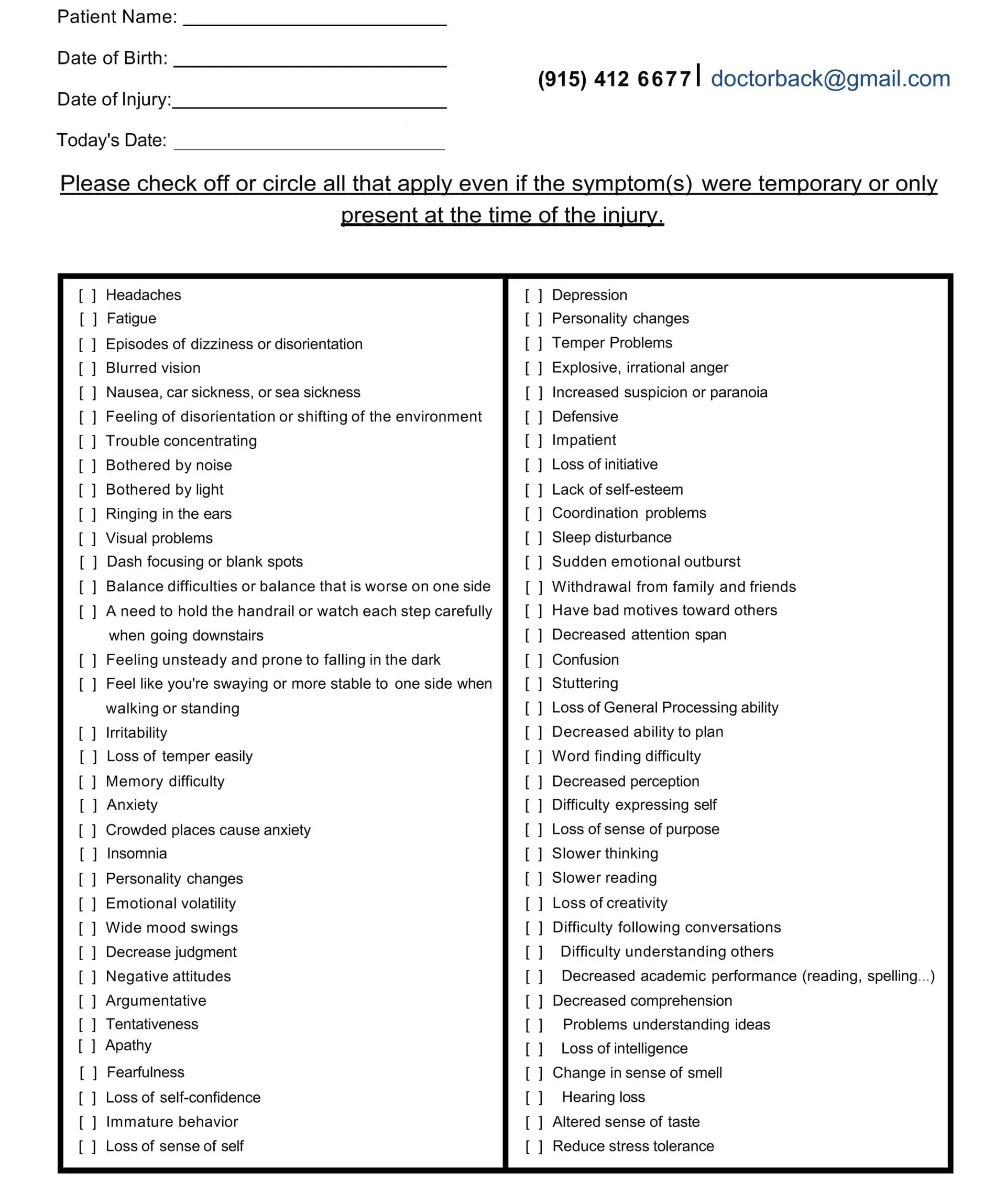
Head Injury/Traumatic Brain Injury Symptom Questionnaire
Virtual Examinations: How El Paso Back Clinic Does It Remotely
Telemedicine at El Paso Back Clinic® starts with virtual exams. You connect via secure video from your phone or computer. Dr. Jimenez or the team talks to you about your injury.
For a car accident, they ask about the crash and pain spots. They watch you move, like bending or walking, to check for swelling or stiffness. Even without hands-on involvement, they spot many problems, such as muscle pulls or nerve issues (Personal Injury Firm, 2025).
Work injuries, like slips, get quick virtual checks to stop things from getting worse. The chiropractor guides home tests, such as balance checks.
Tools in Virtual Exams: Video for movement, apps for sharing photos of injuries, or devices for vital signs.
When It’s Not Enough: Some need in-person touches, so they schedule clinic visits at their El Paso locations.
This remote setup makes getting checked easy, especially in El Paso, where traffic can be a hassle (CK Firm, 2024).
Diagnoses Through Telemedicine at the Clinic
After the exam, the team at El Paso Back Clinic® diagnoses remotely. Common ones from car accidents include whiplash or disc problems. The NP might order X-rays or MRIs, which are performed locally and shared online.
Chiropractors like Dr. Jimenez spot spinal shifts that can cause leg pain, such as sciatica. They explain it clearly on video. The NP assesses whole-body health, including whether swelling worsens.
All sessions are recorded for official documents, insurance keys, or personal injury claims (ChiroMed, n.d.).
Diagnosis Examples: Work-related back pain, sports-related nerve hits, and crash-neck strains.
Team Collaboration: NP handles meds; chiropractor does adjustments.
Tips for Accuracy: Describe pain and show motions well.
This reduces wait times, allowing you to start your El Paso recovery sooner (Complete Care, n.d.).
Managing Treatment Plans Remotely from El Paso Back Clinic
The NP and chiropractor create a treatment plan together, updated via telemedicine. For a sports knee sprain, it might include rest, ice, and shown exercises.
Dr. Jimenez demonstrates stretches on camera. The NP monitors pain and adjusts treatments.
They coordinate to avoid overlaps. For work injuries, plans cover safe job returns. Everything’s online for easy tracking.
Plan Essentials: Pain relief, movement work, and prevention advice.
Integrative Touches: Diet tweaks to cut swelling, like more omega-3 foods.
Telemedicine Updates: Regular video calls to tweak based on progress.
This saves time and money for El Paso patients (Jimenez, n.d.-a).
Ongoing Support and Follow-Up Care at the Clinic
Recovery needs steady help, and El Paso Back Clinic® uses telemedicine for easy follow-ups. Log in to chat about how you’re doing.
For car crash back pain, they check therapy effects and offer encouragement. Support includes mental health tips, as injuries can stress you.
Chiropractors guide home exercises on video. NPs watch for treatment side effects.
Support Types: Mood talks, progress logs, specialist referrals.
How Often: Weekly, early on, then less.
For El Paso Athletes: Safe return-to-play tips, like warm-ups.
This prevents pain from lasting, helping you get back to life fast (Prescient National, n.d.).
Benefits for El Paso Residents with Mobility or Access Issues
Injuries make moving hard, especially in spread-out El Paso. Telemedicine brings care to you.
No travel needed, perfect for remote areas or difficult days. For work injuries, it means less downtime. See pros from home.
Who Gains Most: Those pained by walking, without transport, or packed schedules.
Access Help: Shorter waits than office visits.
Legal Benefits: Docs care for claims without hold-ups.
This makes healing equal for all in El Paso (CK Firm, 2024).
Integrative Advice on Diet, Exercise, and Lifestyle from the Clinic
El Paso Back Clinic® shines with holistic telemedicine tips. They suggest anti-inflammatory foods, such as fruits, to aid healing.
Exercise advice includes easy yoga for pain, demonstrated online. Lifestyle shifts cover better sleep or stress cuts, like apps for calm.
For sports, they teach form to prevent re-injury.
Diet Ideas: Omega-3 for nerves, antioxidants for fixes.
Workout Suggestions: Stretches for range, walks for build-up.
Life Changes: Posture tweaks, drop bad habits.
This addresses root causes for better long-term health (Dallas Accident and Injury Rehab, n.d.).
Coordination and Documentation Between NP and Chiropractor at El Paso Back Clinic
The team shares notes easily on telemedicine platforms. Dr. Jimenez, as both NP and chiropractor, bridges the roles seamlessly.
Records from calls build your file, showing progress for insurance or courts.
Therapies align, like adjustments with rest plans.
Coordination Methods: Shared digital files, joint calls.
Record Value: Shows timely, excellent care.
Your Part: Update honestly for the top plans.
This leads to smooth recoveries in El Paso (Jimenez, n.d.-b).
Insights from Dr. Alexander Jimenez at El Paso Back Clinic
Dr. Alexander Jimenez, DC, APRN, FNP-BC, shares hands-on views from over 30 years at El Paso Back Clinic®. He uses telemedicine for same-day injury exams, like after crashes or sports.
He stresses integrative care for body and mind. For head injuries, he advises sleep, diet, and exercise. His dual license allows him to prescribe medications and adjust spines remotely when possible.
Jimenez highlights tests, such as MRIs, shared online. He combines adjustments in nutrition with other interventions for issues like gut health post-trauma.
Main Observations: Injuries are linked to overall health, like nerves and digestion.
Telemedicine in Practice: Quick virtual help for accidents, with shipped braces.
Tips: Use posture drills and supplements for healing.
His approach shows how the clinic’s NP-chiropractor team excels (Jimenez, n.d.-a; Jimenez, n.d.-b; Jimenez, n.d.-c).
Challenges and Future of Telemedicine at El Paso Back Clinic
Telemedicine has limits, such as the need for touch for some exams. Tech glitches can happen.
But the future is promising. Better apps and AI will improve diagnoses. More insurance covers it.
The clinic trains in remote teamwork.
Fixing Issues: Have in-person backups, help with tech.
Coming Trends: Wearables for live data.
Importance: Makes care more accessible and affordable in El Paso.
Conclusion
At El Paso Back Clinic® in El Paso, TX, telemedicine transforms injury care for car, work, or sports-related injuries. The integrative NP and chiropractor team, led by Dr. Jimenez, offers virtual exams for ongoing support. It includes holistic advice for better living. Ideal for mobility challenges. As Dr. Jimenez proves, this leads to quicker, fuller healing. If injured, reach out to El Paso Back Clinic® for easy, top-notch care at 915-850-0900 or visit their site.
Sports and Activities for TBI Recovery: The Role of Nurse Practitioners and Integrative Chiropractic Care
aquatic rehabilitation class for various injuries, including traumatic brain injuries
Traumatic brain injuries, or TBIs, happen when a sudden bump or blow to the head damages the brain. These injuries can come from car crashes, falls, or even sports accidents. Recovering from a TBI takes time and involves many steps to get back strength, balance, and clear thinking. One great way to help is through sports and activities tailored to a person’s needs. These are called adaptive sports. They can boost physical health and also lift moods by making people feel connected and strong. Along with that, healthcare experts like nurse practitioners and chiropractors play big parts in guiding recovery. Nurse practitioners help manage overall health and meds, while chiropractors focus on fixing spine issues and easing pain. This team approach, often called integrative care, mixes different treatments for better results.
In this article, we’ll look at sports that support TBI recovery, such as adaptive basketball and swimming. We’ll also cover calming activities such as tai chi and hiking. Then, we’ll explain how nurse practitioners and chiropractors fit into the picture, drawing on expert perspectives such as Dr. Alexander Jimenez, who combines chiropractic and nursing skills. By the end, you’ll see how these elements work together to create a comprehensive recovery plan.
Understanding TBIs and the Need for Active Recovery
A TBI can mess with how you move, think, and feel. Mild ones, like concussions, might cause headaches or dizziness. Severe ones can lead to long-term problems with balance or memory. The brain has a cool ability called neuroplasticity, which means it can rewire itself to heal. Activities that get you moving help spark this process by building new connections in the brain.
Doctors say rest is key right after a TBI, but then it’s time to add gentle exercise. Starting slow prevents more harm and builds up skills step by step. For example, light walking can improve blood flow to the brain, helping it heal faster. As you get better, more fun activities like games or outdoor adventures can keep things exciting and motivating.
Why activities matter: They improve strength, coordination, and mood.
Start small: Begin with easy tasks at home, like puzzles or stretching.
Build up: Move to group activities for social support.
Research shows that staying active after a TBI lowers the risk of depression and helps people get back to daily life sooner.
Adaptive Sports for Physical and Mental Healing
Adaptive sports are regular sports modified with special tools or rules so everyone can join, regardless of their limitations. For TBI survivors, these sports target balance, hand-eye skills, and thinking on your feet. They also build confidence by letting you achieve goals in a safe way.
Many groups offer adaptive sports programs, making it easy to find local options. Here’s a look at some top ones for TBI recovery:
Adaptive Basketball: Played in wheelchairs or with lower hoops, this sport boosts coordination and teamwork. It helps with quick decisions and arm strength, which TBIs often weaken. Groups like the National Wheelchair Basketball Association run events where players connect and stay motivated.
Cycling: Use adaptive bikes with extra wheels for stability. Cycling improves leg strength and heart health while being low-impact on joints. It’s great for building endurance without straining the brain too much.
Swimming: Water supports your body, making movements easier. Adaptive swimming uses floats or lanes for safety. It enhances balance and breathing control, plus the calm water reduces stress.
Canoeing: In adaptive versions, boats have seats or handles for support. Paddling builds upper body strength and focus. Being on water also calms the mind, helping with anxiety from TBIs.
These sports aren’t just exercise—they create social bonds. Playing with others fights loneliness, a common issue after brain injuries. Studies note that adaptive sports like these keep people active and linked to their communities. One review found that they improve gait and balance in patients with brain injury.
Other Rehabilitative Activities to Enhance Balance and Well-Being
Not all recovery needs to be high-energy. Slower activities like tai chi or hiking can rebuild skills without overwhelming the brain. These focus on mindful movement, which also supports mental health.
Tai Chi: This gentle martial art uses slow, flowing movements to improve balance and focus. For TBI patients, it reduces falls by strengthening core muscles. Classes often adapt poses for sitting if standing is difficult.
Hiking: Adaptive hiking uses trails with smooth paths or walking sticks. It increases heart rate and provides a refreshing change of scenery. Nature-based activities like this restore energy both physically and emotionally.
Adaptive Water Sports: Beyond swimming, try kayaking or water aerobics. These use buoyancy to reduce pressure on the body while improving coordination. Special gear, like life vests, ensures safety.
Home activities can start the process. Activities like balloon tosses or chair yoga build hand-eye coordination and flexibility. Online videos make it easy to try. As skills grow, add group classes for more challenge. Experts say even simple mobilizing, like walking circuits, aids recovery.
Special tools might be needed based on your strengths. For example, use bigger balls in games or stabilizers in cycling. Always check with a doctor to match activities to your healing stage.
The Role of Nurse Practitioners in Coordinating TBI Care
Nurse practitioners (NPs) are advanced nurses who can diagnose, treat, and manage health issues. In TBI recovery, they act as coordinators, making sure all parts of care fit together smoothly.
NPs monitor your overall health during activities. They check for signs like fatigue or headaches that might mean you’re pushing too hard. They also manage meds for pain or mood, adjusting doses as you improve. For instance, if swimming causes dizziness, an NP might suggest changes or add rest days.
In integrative teams, NPs work with other experts to create safe plans. They ensure activities like canoeing don’t clash with your meds or other treatments. Their focus on whole-person care includes emotional support to help with stress during recovery.
Dr. Alexander Jimenez, a chiropractor and family nurse practitioner, notes that NPs play a key role in linking brain health to daily wellness. His observations show they help with sleep and nutrition, which in turn boost activity benefits. This approach ensures activities are effective and safe.
Integrative Chiropractic Care: Supporting Spine and Pain Management
Chiropractors specialize in spine health, which is crucial after a TBI since head injuries often affect the neck. Integrative chiropractic combines adjustments with other therapies, such as exercises, for full recovery.
Chiropractors realign the spine to ease pressure on nerves, reducing headaches and improving balance. For TBI patients, this can help with dizziness from vestibular issues. They also manage pain without heavy meds, using hands-on techniques.
In recovery plans, chiropractors include exercises such as postural training and balance drills. These complement sports by building a strong base. For example, after an adaptive basketball session, a session might address any spine shifts from play.
Dr. Jimenez’s clinical work highlights how chiropractic aids brain healing. He uses gentle adjustments to improve blood flow and nerve function, key for TBIs. His teams integrate this with nutrition and rehab activities, such as light walking, to prevent reinjury. One method he supports is vestibular rehab, which pairs well with sports for better coordination.
Benefits of integrative chiropractic:
Reduces inflammation and pain.
Improves mobility for activities.
Prevents future issues through education.
Combining chiropractic with NP care creates a strong support system. NPs handle meds and monitoring, while chiropractors focus on physical fixes.
Combining Sports, Activities, and Professional Care for Best Results
The best TBI recovery programs combine adaptive sports, calming activities, and expert guidance. Start with a plan from your healthcare team. For example, begin with tai chi for balance, then add cycling as strength grows.
Community outings, like group hikes, apply skills in real life. These build confidence and social ties. Equine therapy, like therapeutic riding, is another option—horses’ movements aid gait and emotional health.
Dr. Jimenez observes that nutrition supports this, like anti-inflammatory foods for brain repair. His work shows that stress management is key, as it affects outcomes.
Track progress with tools like journals or apps. Adjust as needed with your NP or chiropractor. Over time, this leads to independence and joy in activities.
Challenges and Tips for Success
Recovery isn’t always smooth. Fatigue or setbacks can happen. Tips include:
Listen to your body—rest when needed.
Use adaptive gear for safety.
Join support groups for motivation.
With patience, most people see big gains. Studies show stepwise returns to activity, like in sports protocols, work well.
Conclusion
Recovering from a TBI through sports like adaptive basketball or activities like hiking builds both the body and the mind. Nurse practitioners coordinate safe care, while integrative chiropractic handles pain and alignment. Experts like Dr. Jimenez show how this blend speeds healing. Stay active, seek help, and celebrate small wins to pave the way for a brighter path ahead.
Tests Used for Brain Injuries at El Paso Back Clinic® in El Paso, TX
Doctor of Chiropractic and Nurse Practitioner show the imaging result to the patient post-auto-injury rehabilitation with mild brain injury
Brain injuries can strike without warning, from a simple slip at home to a tough hit during sports or a car crash on El Paso’s busy roads. At El Paso Back Clinic® in El Paso, TX, our team of wellness chiropractic care experts knows how vital it is to spot these issues early. We blend chiropractic skills with modern tools to help patients heal and get back to life. Led by Dr. Alexander Jimenez, DC, APRN, FNP-BC, our clinic focuses on whole-body wellness, using safe, non-invasive methods to check for head injuries.
This article dives into the tests we use at El Paso Back Clinic® to find brain injuries. We cover hands-on checks, brain function tests, and high-tech scans. Our goal is to give you clear info so you can seek help fast. Early detection means better recovery and fewer long-term problems.
The Importance of Spotting Brain Injuries Early at Our Clinic
Traumatic brain injuries (TBIs) happen when a bump or jolt shakes the brain. Mild ones, like concussions, might cause short-term headaches or dizziness. Serious cases can lead to lasting memory issues or mood changes. At El Paso Back Clinic®, we see many patients from local accidents or sports-related injuries, and we emphasize prompt action.
Our integrative approach mixes chiropractic care with nurse practitioner expertise. Dr. Jimenez uses his dual training to create custom plans. We check the spine, nerves, and brain together because a head injury often affects the neck as well.
Common signs: Headaches, confusion, nausea, or trouble balancing.
Why act fast: Stops swelling or bleeding from getting worse.
Our edge: Our wellness focus means we look at lifestyle and nutrition, too.
Research backs our methods—early tests lead to stronger outcomes (Pickett et al., 2024). At our El Paso, TX clinic, we guide you through every step.
Starting with Neurological Assessments for Head Injuries
At El Paso Back Clinic®, every brain injury check begins with basic neurological tests. These quick exams help us see how the brain responds right away. No need for big machines; it’s all about skilled observation.
We rely on the Glasgow Coma Scale (GCS) to grade injury severity. The Glasgow Coma Scale (GCS), which scores from 3 to 15, assesses eye opening, verbal response, and motor response. High scores mean mild issues; low ones signal urgency. Our team, including Dr. Jimenez, uses GCS to quickly decide on next steps (Bussières et al., 2022).
We also use the Standardized Assessment of Concussion (SAC). This tests memory and focus with simple questions. For athletes, the Sport Concussion Assessment Tool 5 (SCAT5) adds balance and neck checks. Kids receive the Child SCAT5 version.
GCS breakdown:
Eyes: 1 (none) to 4 (spontaneous).
Verbal: 1 (silent) to 5 (oriented).
Motor: 1 (none) to 6 (obeys commands).
SAC quick tips: Asks things like “What month is it?” or repeats word lists.
SCAT5 extras: Includes symptom checklists and coordination drills.
Dr. Jimenez notes that these tests often reveal neck problems linked to head injuries. At our wellness clinic, we adjust spines to ease related pain.
Hands-On Physical Exams to Uncover Hidden Issues
Physical checks are key at El Paso Back Clinic®. We touch and move areas to find pain, weakness, or limits. This builds on your story about how the injury happened.
Reflex tests tap spots, like the knees, to check nerve pathways. Odd responses might point to brain trouble. The Balance Error Scoring System (BESS) tests stability—stand in poses and count errors. It’s useful for detecting dizziness associated with TBIs (Sillevis et al., 2018).
We measure how far you can move your neck or head without pain. Strength tests have you push against our hands. These help link head injuries to spine misalignments.
BESS poses:
These include the double-leg stance, single-leg stance, and tandem pose.
Perform the exercises on both firm ground and foam to increase the challenge.
The errors to avoid include having hands off the hips, keeping eyes open, and falling.
Reflex checks: Hammer taps for quick reactions.
Motion tests: Gentle turns to spot restrictions.
For El Paso locals in car wrecks, these exams guide our chiropractic adjustments. Dr. Jimenez observes that early physical checks prevent chronic issues.
Cognitive Testing to Measure Brain Function
Head injuries can fog thinking. At El Paso Back Clinic®, we use cognitive tests such as ImPACT to assess memory and reaction time. This computer-based tool is perfect for concussion assessment, as it allows you to compare your scores to norms or baselines.
ImPACT includes modules for word recall, symbol matching, and symptom rating. It’s objective and tracks progress over time. We use it for return-to-work or play decisions (ImPACT Applications, Inc., 2023a).
Our nurse practitioners add deeper checks if needed, like repeating stories or drawing shapes. These rule out other causes.
ImPACT features:
Visual memory: Recall designs.
Reaction time: Click on the colors fast.
Symptom scale: Rate 22 items like fatigue.
Baseline testing: Ideal for athletes before seasons.
Retesting: Every 7-10 days to monitor healing.
Dr. Jimenez integrates ImPACT with chiropractic care, noting better results when spine health supports brain recovery.
Advanced Imaging for Clear Views of Injuries
Imaging lets us see inside. At El Paso Back Clinic®, we start with X-rays for bone alignment and fractures. They’re fast and help plan adjustments.
For deeper looks, CT scans catch bleeds quickly. MRIs show soft-tissue damage, such as bruising or tears—no radiation involved. We order these through our network for full pictures (NYU Langone Health, n.d.).
Digital Motion X-ray (DMX) is a favorite here—it films spine movement to spot instability from whiplash.
X-ray basics: Views bones in still shots.
CT strengths: 3D slices for emergencies.
MRI details: Magnets reveal hidden swelling.
DMX unique: Real-time video of neck motion.
Dr. Jimenez uses imaging to confirm diagnoses, ensuring safe, targeted care at our El Paso wellness clinic.
We love tools that avoid invasives at El Paso Back Clinic®. Surface Electromyography (sEMG) measures muscle activity via skin sensors. It identifies imbalances related to nerve issues post-head injury (Injury 2 Wellness Centers, 2023a).
Our INSiGHT scanners combine scans: Thermal for inflammation, Core for posture, Pulse for stress via heart rate. These insights help us create personalized plan maps (CLA Insights, 2023a).
sEMG benefits:
Detects tense muscles around the neck.
Guides gentle adjustments.
INSiGHT scans:
Heat patterns show hot spots.
Muscle scans check symmetry.
No risks: This procedure is safe for individuals of all ages.
These tools reduce the need for pokes or cuts, aligning with our wellness focus (Injury 2 Wellness Centers, 2023b). Dr. Jimenez says they boost patient involvement.
Nurse Practitioners’ Role in Comprehensive Testing
Our nurse practitioners at El Paso Back Clinic® expand options. They order blood tests for markers like inflammation or clotting risks. This rules out serious issues.
They incorporate a comprehensive approach by integrating chiropractic care into their holistic plans. If scans show problems, they coordinate referrals.
Blood work perks:
Checks for hidden infections.
Monitors healing proteins.
Team integration: NPs and chiros share findings.
Patient plans: Include rest, nutrition, and adjustments.
Dr. Jimenez, with his NP background, ensures seamless care.
Chiropractic Perspectives on Brain Injury Diagnosis
Chiropractors at our clinic see the spine-brain connection. Head hits often shift vertebrae, worsening symptoms. We use tools like Sigma for motion analysis (Kawa, n.d.).
Vestibular tests check eyes and balance. Does the patient experience pain during head movements? The source of the pain could be either the inner ear or the brain.
Spine focus:
Palpate for misalignments.
Grade Whiplash: 0-4.
Red flags: Send to ER for severe signs.
Recovery steps: Adjustments plus exercises.
Dr. Jimenez’s observations show that chiropractic care eases concussion symptoms more quickly.
Collaborative Care for Optimal Recovery
At El Paso Back Clinic®, teamwork rules. NPs order MRIs; chiros use them for adjustments. Shared tests like SCAT5 build complete views.
Plans cover therapy, diet, and follow-ups. Patients return stronger.
Benefits:
Full body healing.
Cost-effective.
Customized to you.
Success stories: Less pain, better function.
Dr. Jimenez’s integrative style shines in El Paso cases.
Insights from Daily Practice at the Clinic
We adapt tests to each patient. A work injury requires X-rays and ImPACT. Follow with BESS for balance gains.
Dr. Jimenez shares how INSiGHT scans catch early nerve stress, preventing long-term woes.
Patients love visual reports—they understand and stick to plans.
Overcoming Challenges in Brain Injury Detection
Access and cost can hinder. But our clinic offers affordable options and education.
Future tools, such as blood biomarkers, promise quicker diagnoses. We stay up to date for the best care.
Hurdles:
Rural limits in TX.
Insurance gaps.
Advances: AI for scan reads, more non-invasives.
Dr. Jimenez pushes for community awareness.
Final Thoughts: Seek Care at El Paso Back Clinic®
Brain injuries need prompt attention. At El Paso Back Clinic® in El Paso, TX, we use GCS, ImPACT, scans, and more for wellness-focused recovery.
If you’ve had a head hit, visit us. Our team, led by Dr. Jimenez, is here for you.
References
Bussières, A., et al. (2022). Concussion knowledge among North American chiropractors. Journal of the Canadian Chiropractic Association, 66(1), 17–26. https://pmc.ncbi.nlm.nih.gov/articles/PMC8791549/
Pickett, W., et al. (2024). Expanding concussion care in Canada: The role of chiropractors and policy implications. Journal of the Canadian Chiropractic Association, 68(2), 145–156. https://pmc.ncbi.nlm.nih.gov/articles/PMC11418793/
Sillevis, R., et al. (2018). Survey of chiropractic clinicians on self-reported knowledge and recognition of concussion injuries. Journal of the Canadian Chiropractic Association, 62(2), 84–95. https://www.ncbi.nlm.nih.gov/pmc/articles/PMC6000952/
IFM's Find A Practitioner tool is the largest referral network in Functional Medicine, created to help patients locate Functional Medicine practitioners anywhere in the world. IFM Certified Practitioners are listed first in the search results, given their extensive education in Functional Medicine