Contents
If Spinal Decompression Relieves Back Pain, Does That Prove a Herniated Disc Caused It?
A patient finishes a course of motorized spinal decompression, stands up, and reports that the familiar ache across the low back has eased. The relief feels clear. It is natural to conclude that the treatment “worked on the disc,” and therefore the disc must have been the structure generating the pain. In personal-injury and clinical settings, this reasoning appears often. It is also incomplete.
Symptomatic improvement during a carefully supervised treatment program is valuable information. It tells clinicians and patients that a non-invasive approach can change symptoms and function. It does not, by itself, identify the single anatomical structure that was producing the pain. Clinicians must read disc pathology, nonspecific low-back pain, examination findings, and imaging findings together. Treatment response is one data point among many, not a diagnostic test that names the pain generator.
Disc Pathology Is Common and Often Silent
Intervertebral discs change with age, load, and prior stress. On MRI, disc bulges, protrusions, and even frank herniations appear in people who have never reported meaningful back or leg pain. Systematic reviews of asymptomatic adults show that disc herniations and degenerative findings are present in a substantial fraction of the population, and the prevalence rises with age (Brinjikji et al., 2015). A herniated disc visible on imaging is therefore a morphological observation. The North American Spine Society nomenclature emphasizes that the terms “herniated disc” or “protrusion” describe location and morphology; they do not, by themselves, establish etiology, symptom correlation, or the need for any particular treatment (Fardon et al., 2014).
Even when a disc herniation is present and the patient has pain, the relationship is not automatic. Chemical irritation from annular fissures, mechanical loading of the facet joints, muscle guarding, and altered movement patterns can all contribute. In many patients, more than one structure is sensitized at the same time. A treatment that reduces intradiscal pressure or unloads the posterior elements may improve symptoms by affecting several of those structures simultaneously. The improvement does not isolate which structure was dominant.
Nonspecific Low-Back Pain Remains the Most Common Presentation
Most episodes of low-back pain are classified as nonspecific. That label means that no single, clearly identifiable pathoanatomical source accounts for the symptoms after a careful history and examination. Large clinical guidelines and evidence reviews consistently note that a specific structural diagnosis is established in only a minority of patients presenting with axial low-back pain (Chou et al., 2007; Maher et al., 2017). Nonspecific pain can still be real, functionally limiting, and responsive to mechanical care.
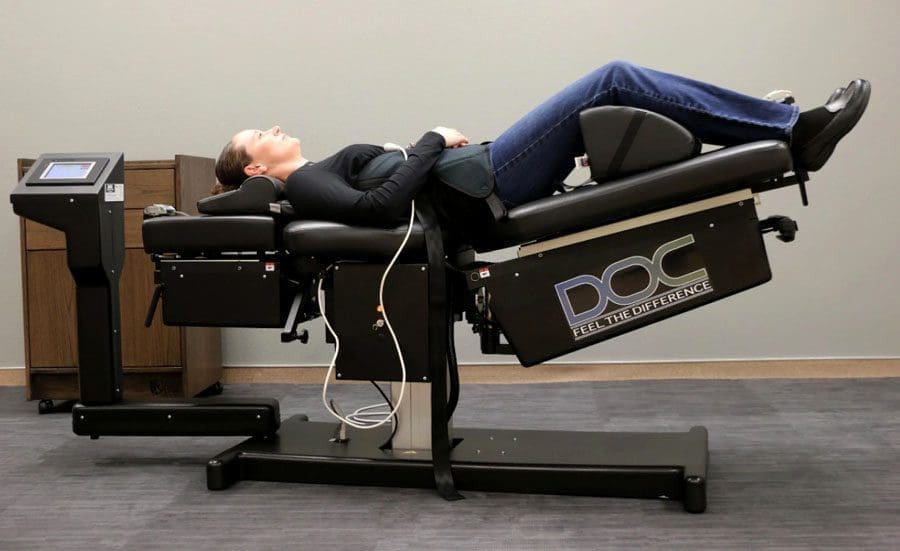
Spinal decompression therapy creates a controlled reduction in intradiscal pressure and can increase intervertebral height temporarily. Those mechanical effects may reduce load on irritated discs, facet joints, and surrounding soft tissues. Patients often report less pain and better tolerance for standing or walking. The same patients may also improve with targeted exercise, manual therapy, or simple activity modification. When multiple interventions that unload or stabilize the lumbar region produce similar relief, the response supports the idea that mechanical loading is relevant. It does not prove that a particular disc herniation seen on one MRI slice was the sole generator.
What the Examination and Imaging Can and Cannot Show
A thorough examination looks for directional preference, symptom changes with repeated movements, neurological findings, and functional limitations. Digital range-of-motion measurements, straight-leg-raise responses, and segmental motion testing provide objective data that clinicians can track over time. These findings help clinicians decide whether a trial of decompression is reasonable and later document whether function changed.
Imaging adds morphological detail. Flexion-extension radiographs can demonstrate altered motion-segment integrity when translation or angular motion exceeds established thresholds used in impairment systems. MRI can show disc contour, annular high-intensity zones, and nerve-root contact. However, none of these studies reliably identify the pain-generating structure in every patient. Studies comparing imaging findings with clinical outcomes show only modest correlations; many patients with clear disc herniations improve without any change in herniation size, and some patients with modest imaging findings remain symptomatic (Chou et al., 2011). Provocative discography was once used to try to link a disc to pain, yet its diagnostic value is limited by high false-positive rates and the fact that it is an invasive procedure whose results do not automatically dictate treatment.
The Limits of Treatment-Response Reasoning
Reasoning that “the treatment relieved the pain; therefore, the structure the treatment targeted must have been the cause” is a form of post-hoc attribution. It is common in everyday clinical conversations and sometimes appears in medical-legal arguments. Several factors make it unreliable as proof of the original pain generator:
- Many lumbar structures share innervation and can respond to the same unloading force.
- Natural history and concurrent changes in activity, posture, or inflammation can improve symptoms independently of the treatment.
- Placebo and contextual effects are well documented in musculoskeletal care; some improvement occurs even when the mechanical intervention is minimal.
- Patients often receive more than one intervention. Without a controlled comparison, you cannot assign improvement after a package of care to a single component.
In a medical-legal file, treatment response is most useful when it is documented alongside objective baseline and follow-up measures—range of motion, functional questionnaires, neurological status, and, when indicated, serial imaging. The response then becomes part of a longitudinal narrative rather than a stand-alone diagnostic claim. Attorneys and clinicians reviewing the file can see that mechanical care produced measurable functional change; they cannot, based on the response alone, conclude that a particular disc herniation was the exclusive cause of the original pain.
An Integrated Approach That Respects These Limits
At Injury Medical Clinic PA in El Paso, we begin evaluating lumbar complaints with a dual-scope assessment. Dr. Alex Jimenez, DC, APRN, FNP-BC, documents soft-tissue and biomechanical findings, including digital range-of-motion and segmental testing. Dr. Maria Guadalupe Cardenas, MD, provides medical direction, reviews comorbidities, and coordinates any indicated laboratory or imaging work-up. When spinal decompression is chosen, it is applied within a broader plan that may include targeted exercise, soft-tissue work, and education on load management. Clinicians record symptom change but form the clinical impression from the full set of findings, not improvement alone.
This approach aligns with three practical principles. Beneficence is served by selecting interventions that address modifiable mechanical and inflammatory contributors without assuming a single structure is responsible. Non-maleficence is served by preferring non-invasive unloading and movement strategies before considering more aggressive options. Autonomy is served by explaining to the patient, in plain language, what the imaging shows, what it does not show, and how treatment response will be interpreted as one piece of information rather than proof of a specific diagnosis.
What makes the clinic distinct in El Paso is the combination of a board-certified internist serving as medical director and a dual-licensed nurse practitioner who specializes in soft-tissue and biomechanical injury. Few clinics in the region integrate these scopes under one roof while also offering advanced mechanical decompression, digital motion analysis, and coordinated medical oversight. The result is documentation that describes both the morphological findings and the functional response without overclaiming that one proves the other.
Patients and attorneys who need a clearer picture of how disc findings, examination data, and treatment response fit into a causation narrative can review related discussions on lumbar disc nomenclature, imaging correlation, and the broader process of establishing medical-legal causation. Those resources appear on the clinic’s educational site and reinforce the same principle: relief is welcome, yet the structure that generated the pain is identified only when history, examination, imaging, and longitudinal function are considered together.
Symptom relief after spinal decompression is a positive clinical outcome. It supports the continued use of non-invasive mechanical care for many patients with lumbar pain. It does not, by itself, prove that a herniated disc was the pain-generating structure. That determination still requires the full clinical picture.
References
Brinjikji, W., Luetmer, P. H., Comstock, B., Bresnahan, B. W., Chen, L. E., Deyo, R. A., … Jarvik, J. G. (2015). Systematic literature review of imaging features of spinal degeneration in asymptomatic populations. American Journal of Neuroradiology, 36(4), 811–816.
Chou, R., Qaseem, A., Snow, V., Casey, D., Cross, J. T., Jr., Shekelle, P., & Owens, D. K. (2007). Diagnosis and treatment of low back pain: A joint clinical practice guideline from the American College of Physicians and the American Pain Society. Annals of Internal Medicine, 147(7), 478–491.
Fardon, D. F., Williams, A. L., Dohring, E. J., Murtagh, F. R., Gabriel Rothman, S. L., & Sze, G. K. (2014). Lumbar disc nomenclature: Version 2.0. The Spine Journal, 14(11), 2525–2545.
Maher, C., Underwood, M., & Buchbinder, R. (2017). Non-specific low back pain. The Lancet, 389(10070), 736–747.
Cross-links for further reading:
https://dralexjimenez.com/lumbar-disc-nomenclature/
https://dralexjimenez.com/herniated-bulging-discs-back-pain-and-mri/
https://dralexjimenez.com/decompression-discogenic-low-back-pain/
https://dralexjimenez.com/el-paso-injury-causation-connecting-accidents-to-injuries/
General Disclaimer, Licenses, and Board Certifications *
Professional Scope of Practice *
The information herein on "Spinal Decompression Does Not Prove Cause of Pain" is not intended to replace a one-on-one relationship with a qualified health care professional or licensed physician and is not medical advice. We encourage you to make healthcare decisions based on your research and partnership with a qualified healthcare professional.
Blog Information & Scope Discussions
Welcome to El Paso's Premier Wellness and Injury Care Clinic & Wellness Blog, where Dr. Alex Jimenez, DC, FNP-C, a Multi-State board-certified Family Practice Nurse Practitioner (FNP-BC) and Chiropractor (DC), presents insights on how our multidisciplinary team is dedicated to holistic healing and personalized care. Our practice aligns with evidence-based treatment protocols inspired by integrative medicine principles, similar to those on this site and on our family practice-based chiromed.com site, focusing on naturally restoring health for patients of all ages.
Our areas of multidisciplinary practice include Wellness & Nutrition, Chronic Pain, Personal Injury, Auto Accident Care, Work Injuries, Back Injury, Low Back Pain, Neck Pain, Migraine Headaches, Sports Injuries, Severe Sciatica, Scoliosis, Complex Herniated Discs, Fibromyalgia, Chronic Pain, Complex Injuries, Stress Management, Functional Medicine Treatments, and in-scope care protocols.
Our information scope is multidisciplinary, focusing on musculoskeletal and physical medicine; wellness; contributing etiological viscerosomatic disturbances within clinical presentations; associated somato-visceral reflex clinical dynamics; subluxation complexes; sensitive health issues; and functional medicine articles, topics, and discussions.
We provide and present clinical collaboration with specialists from various disciplines. Each specialist is governed by their professional scope of practice and licensure jurisdiction. We use functional health & wellness protocols to treat and support care for musculoskeletal injuries or disorders.
Our videos, posts, topics, and insights address clinical matters and issues that directly or indirectly relate to our clinical scope of practice.
Our office has made a reasonable effort to provide supportive citations and has identified relevant research studies that support our posts. We provide copies of supporting research studies upon request to regulatory boards and the public.
To discuss how these matters can assist in a specific care plan or treatment protocol, please contact Dr. Alex Jimenez, DC, APRN, FNP-BC, or reach out to us at 915-850-0900.
We are here to help you and your family.
Blessings
Dr. Alex Jimenez DC, MSACP, APRN, FNP-BC*, CCST, IFMCP, CFMP, ATN
Email: [email protected]
Multidisciplinary Licensing & Board Certifications:
Licensed as a Doctor of Chiropractic (DC) in Texas & New Mexico*
Chiropractic Licenses:
Texas DC License #: TX5807, Verified: TX5807
New Mexico DC License #: NM-DC2182, Verified: NM-DC2182
Nurse Practitioner Licenses:
Texas APRN License #: 1191402, Verified: 1191402 *
New Mexico CNP License #: 90560, Verified 90560
Florida APRN License #: 11043890, Verified: APRN11043890 *
Colorado License #: C-APN.0105610-C-NP, Verified: C-APN.0105610-C-NP
New York License #: N25929, Verified N25929
Georgia APRN License #: GAA-NP005701
Multi-State Advanced Practice Registered Nurse (APRN*) Texas & Multi-States
Multi-state Compact APRN License by Endorsement (43 States)
Compact Status: Multi-State License: Authorized to Practice in 43 States*
Nursing Licensure Compact: Updated Here
DEA Registration: (Drug Enforcement Agency Registered)
All medical (MDs) and family practice providers (FNP-APRN) are registered and licensed to offer various levels of medication.
Verify Providers Here
License Verification Link: Nursys License Verifier
* Prescriptive Authority Authorized (DEA Registered Providers). Call if Required
Board Certification:
ANCC FNP-BC: Board Certified Nurse Practitioner*
Education:
Graduate with Honors: ICHS: MSN-FNP (Family Nurse Practitioner Program)
Degree Granted. Master's in Family Practice, MSN Diploma (Cum Laude)
Dr. Alex Jimenez, DC, APRN, FNP-BC*, CFMP, IFMCP, ATN, CCST
(Board Certified: Family Practice Nurse Practitioner—Multistate)*
(Licensed Nurse Practitioner & Chiropractor - Multistate)*
Clinical Director
DC & FNP License (Review Above)
Digital Business Card
NPI: 1205907805
Dr. Maria Cardenas, MD
(Board Certified: Internal Medicine)
(Licensed Medical Doctor)
Medical Director, Clinical Director & Collaborative Physician
NPI # 1164426748
MD License #: J2933
Licenses and Board Certifications:
MD: Medical Doctor
DC: Doctor of Chiropractic
APRNP: Advanced Practice Registered Nurse
FNP-BC: Family Practice Specialization (Multi-State Board Certified)
FNP-BC: Family Practice Across Life Span (Neonatal to Geriatrics)
RN: Registered Nurse (Multi-State Compact License)
CFMP: Certified Functional Medicine Provider
MSN-FNP: Master of Science in Family Practice Medicine
MSACP: Master of Science in Advanced Clinical Practice
IFMCP: Institute of Functional Medicine
CCST: Certified Chiropractic Spinal Trauma
ATN: Advanced Translational Neutrogenomics
Family with Primary Care Focus (Family Nurse Practitioner or FNP)
- The Family Nurse Practitioner (FNP) promotes, maintains, and restores health for individuals and families across the lifespan. FNPs also identify health risks, promote wellness, and diagnose and manage acute and chronic illness.
- The FNP focuses on comprehensive primary care, promoting healthy lifestyles for patients across the lifespan in settings such as private practice, physician offices, and community health centers.
Memberships & Associations:
TCA: Texas Chiropractic Association: Member ID: 104311
TNA: Texas Nurse Association: Member ID: 06458222
TNP: Texas Nurse Practitioner Association ID: 2025091511
AANP: American Association of Nurse Practitioners: Member ID: 2198960
ANA: American Nurses Association: Member ID: 06458222 (District TX01)
| Primary Taxonomy | Selected Taxonomy | State | License Number |
|---|---|---|---|
| No | 111N00000X - Chiropractor | NM | DC2182 |
| Yes | 111N00000X - Chiropractor | TX | DC5807 |
| Yes | 363LF0000X - Nurse Practitioner - Family | TX | 1191402 |
| Yes | 363LF0000X - Nurse Practitioner - Family | FL | 11043890 |
| Yes | 363LF0000X - Nurse Practitioner - Family | CO | C-APN.0105610-C-NP |
| Yes | 363LF0000X - Nurse Practitioner - Family | NY | N25929 |
| Yes | 363LF0000X - Nurse Practitioner - Family | NM |
90560 |
| Yes | 363LF0000X - Nurse Practitioner - Family | GA | GAA-NP005701 |
Dr. Alex Jimenez, DC, APRN, FNP-BC*, CFMP, IFMCP, ATN, CCST
(Board Certified: Family Practice Nurse Practitioner—Multistate)*
(Primary Care Across Lifespan—Neonatal / Pediatric / Adult / Geriatrics)
(Licensed Nurse Practitioner & Chiropractor - Multistate)*
Clinical Director
Digital Business Card
NPI: 1205907805
Dr. Maria Cardenas, MD
(Board Certified: Internal Medicine)*
(Licensed Medical Doctor)*
Medical Director, Clinical Director & Collaborative Physician
NPI # 1164426748
MD License #: J2933
📆 Schedule Appointment: Schedule 24/7 (Click Here)