Doctor of Chiropractic, Dr. Alexander Jimenez reveals what the popping sound is during a spinal adjustment.
Chiropractic Care &�Back Pain
Has this happened to you? You are at the chiropractor getting treatment for your own back pain, and during a spinal adjustment, a sizable popping sound is heard by you. It seems somewhat alarming, does not it? Rest assured, though: That pop within a chiropractic spinal adjustment is totally ordinary.
During a back adjustment, your back experiences rapid, mild stretching of the spinal joint, which means you may hear a snapping or popping sound. This really is brought on by little pockets of air or bubbles, which are in the fluid that surrounds your joints. When joint tissues are extended throughout a chiropractic adjustment, the pockets of atmosphere “pop,” which creates that cracking sound you hear.
Following this treatment, you could feel in your back for more movement. But, the muscles may still be raw and tight.
Your chiropractor might also incorporate other chiropractic care treatments like muscle therapy. You must notice more back pain relief with each session.
Your chiropractor could also advocate preventive care, including specific exercises, and he/she might give you ergonomic tips on the best way to accurately bend and lift, in addition to how to take good care of your back while at your desk (if you work in a office). Doing specific exercises and maintaining good posture might help keep movement that is healthy in your back.
Is Chiropractic Care Right For You?
It is crucial that you consider that chiropractic care is not a cure all for all conditions that are back. Some backbone conditions that cause back pain may require a combination of treatments, or other treatments, for example surgery and drugs.
But in the event you have a condition that causes pain back and you need to test a non-operative treatment, chiropractic care can be an excellent treatment choice for you personally. But remember, you need to not be alarmed by a popping noise during a spinal adjustment�it’s ordinary in chiropractic care.
Doctor of Chiropractic, Dr. Alexander Jimenez breaks down how pinched nerves cause back and neck pain.
You hear people say it a lot:
�I have a pinched nerve, and wow, it hurts.�
But what exactly is a pinched nerve? How does it cause back pain or neck pain? What are the symptoms of a pinched nerve�beyond pain? And most importantly, what can you do about a pinched nerve? Learn the basics of pinched nerves here.
Pinched Nerves: A Common Cause of Back & Neck Pain
What Is A Nerve?
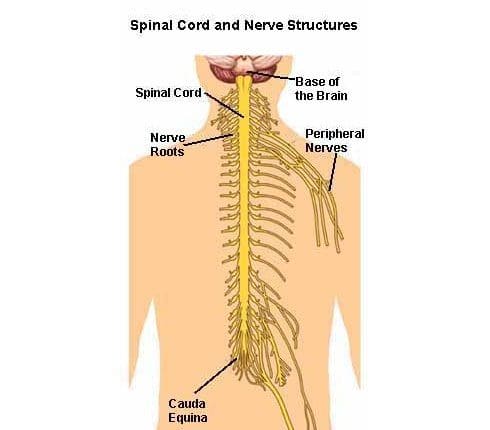
Nerves are your body�s messengers. They transport signals to and from your brain�messages like �Move this toe� or �Ouch, that cactus needle really is sharp.� You have a central nervous system, which is made up of your brain and spinal cord. You also have a peripheral nervous system, which is the system of nerves that branches off the brain and spinal cord.
What Do Nerves Look Like?
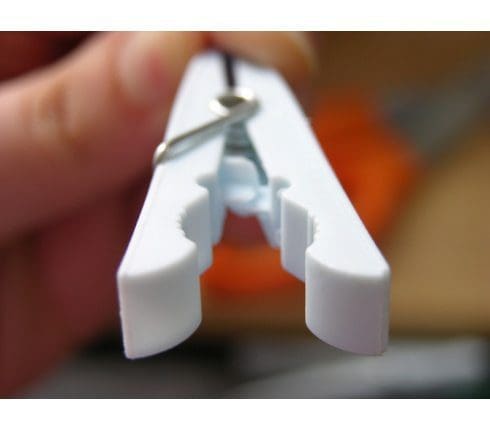
If it helps, think of nerves like a garden hose (except they aren�t green). They have an outside membrane that transports those electrical messages. Inside nerves, there�s a fluid that nourishes and replenishes the outer membrane.
You�re Getting on My Nerves
When a nerve gets pinched, the messages and the nourishing fluid don�t flow quite as well as they should (still helpful to think of a garden hose here). A pinched nerve can start sending the �Ow, pain� message to the brain, and it can also have trouble communicating clear messages, possibly leading to weakness, numbness, or tingling.
What Can Pinch a Nerve?
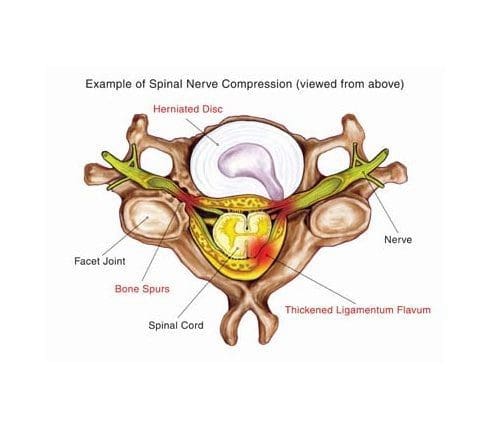
As a nerve exits the spinal canal, it can be pinched by a herniated disc or a bone spur. Bone spurs, also known as osteophytes, are bony bumps that can develop on a spinal joint over time. They can push into the spinal nerve, as you can see in this illustration (red = pain generator, of course).
What Does a Pinched Nerve Feel Like?
A pinched nerve mostly feels like pain. If you have a pinched nerve in your low back, it can cause pain to travel (or radiate, in doctor-speak) down your leg. You may also know that as sciatica. A pinched nerve in the neck can create pain that shoots down your arm. Other symptoms of pinched nerves include muscle spasms, burning, tingling, and a hot/cold sensation.
Now the Good Stuff: Pinched Nerve Treatments
Pinched nerve treatments fall into two categories: what you can do at home (self-care) and what your doctor may prescribe for you.
Pinched Nerve Self-care #1: Heat and Ice
Heat and ice can work wonders on a pinched nerve. Switch between 20 minutes of heat and 20 minutes of ice�and remember that you shouldn�t put the heat and ice packs directly on your skin.
Pinched Nerve Self-care #2: Get a Massage
The muscles around a pinched nerve can become tight, so having a professional massage therapist work the painful area can bring pain relief. You may also consider a handheld massager.
Pinched Nerve Self-care #3: Take a Walk
Let�s say it�s your low back�a pinched nerve in your low back�that�s hurting you. A nice, easy stroll is a good way to stay active and address your pain. Gone are the days of extended bed rest for back pain: doctors now are more likely to recommend you exercise and stretch to help relieve your pain.
When Should You Call a Doctor?
If you try the self-care thing and yet your pinched nerve pain persists, you should consider calling the doctor. If you�ve been in pain for more than a couple of days, schedule an appointment. You should also call the doctor if you experience a very sudden onset of weakness, or if you experience profound numbness. Losing bowel and/or bladder control is also a good reason to call the doctor.
How a Doctor Treats a Pinched Nerve
The doctor will try to diagnose the cause of your pinched nerve, and then the doctor will be able to develop a treatment plan. That plan may include prescription pain medications, physical therapy, or cortisone injections. But keep this in mind: the treatment plan will be specifically tailored for you, and it�s in your best interest to follow it closely.
Chiropractor, Dr. Alexander Jimenez gives insights into the most common questions about whiplash.
What Is Whiplash?
Whiplash, although not technically a medical term, can be quite painful and is quite serious. We call it whiplash because, within an accident, your neck actually can whip back and forth�first backward (hyperextension) and then forwards (hyperflexion). Doctors call whiplash a neck sprain or strain. Whiplash is an injury to the soft tissues of your neck and upper back that occurs when ligaments and your muscles get overstretched in the strength of an accident.
What Causes Whiplash?
The most common source of whiplash is car accidents. Nonetheless, you can even get whiplash from a sports injury or a fall. It’s also possible to get whiplash when you are hit or shaken.
What Are Some Non-Surgical Ways To Take Care Of Whiplash?
Time is just one of the greatest non surgical treatment options for whiplash. Most instances of whiplash recover by themselves to some months in several weeks. Your doctor may also indicate: wearing a cervical collar, cervical traction, chiropractic adjustment, physical therapy, and pain drugs as you heal.
Will I Need Surgery?
Patients with whiplash quite, very rarely need surgery. If, nevertheless, you’ve been through wide-ranging non-operative treatments and also you have pain, surgery may be considered by you. There are several kinds of surgery useful for whiplash
Corpectomy:
Sometimes whiplash induces the spinal canal to narrow because of how a soft tissues (muscles, ligaments, and tendons) and bones moved throughout the first injury. By removing area of the vertebra and the intervertebral disc using a corpectomy, the surgeon is wanting to make more room in your spinal canal.
Discectomy:
The surgeon will remove section of the intervertebral disc, which may be pressing on your own spinal cord or alternative nerves and causing pain. Sometimes, the surgeon will have to do a spinal fusion at the same time as the discectomy. The fusion plans to permanently stabilize that region of your spine, although not everyone who has a discectomy will need a fusion.
Foraminotomy:
As with a corpectomy, a surgeon uses a foraminotomy to make more room for your nerves that could have gotten pinched and compressed throughout the harm. In this process, the foramina (the place where the nerve roots leave the spinal canal) is removed to boost the size of the nerve pathway.
Doctor of Chiropractic, Dr. Alexander Jimenez looks at four ways of reducing back pain.
1. Understand The Way Your Spine Works
The best approach to take care of your spine and prevent back pain is to begin with a superb understanding of how the spine works. By understanding how your backbone works when you’re performing jobs that are day-to-day or moving during your day, you may be able to take care of your spine and keep it working for a long time with fewer problems and less back pain.
2. Incorporate Safe Body Mechanics Into Activities
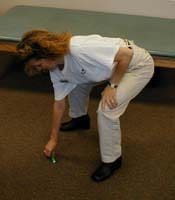
Use good body mechanics during day-to-day jobs at home and work. What does that mean? Good body mechanics means while you go, keeping your back in a safe posture that is balanced. You can help to prevent back pain and injury, by remembering several easy notions. You should employ your leg and arm muscles when lifting and stooping �not your back muscles. Second, keep your back straight when bending and lifting. And last but not the very least, be sure to bend at your hips and knees, not at your waist.
An example of correctly bending at the hips and knees
3. Exercise On A Regular Basis
Regular care of stuff we possess helps to keep them working efficiently, with less effort and safely. Exactly the same is true of the back.
Exercising on a regular basis really helps to keep up long term to a healthy back.
Regular exercise helps to increase endurance and reduces fatigue.
But Don’t I Get Enough Exercise At Work?
Many people believe their occupations provide enough exercise�specially occupations which are physical and could include manual labor. Regrettably this really isn’t accurate. Individuals need daily exercise to state and strengthen their muscles to perform job tasks safely and efficiently.
Exercise could be fun! There are lots of types of exercise. One method when selecting to start a workout program to ensure success would be to pick some form of exercise that fits into your lifestyle. If exercise is accessible and convenient, you’ll be prone to continue exercising on a longterm basis. As an example, determining to swim daily or do water aerobics without easy use of a pool year round would make success less likely and consistency difficult.
A typical exercise that a lot of people start successfully with is walking. Walking just takes a superb pair of walking shoes, may be done any day of the year, and is usually simple to fit right into a daily program.
Remember, whatever type of exercise you decide on, always start out small (10 minutes vs 60 minutes), and slowly increase your own exercise time. This may help to make sure your success at getting started and sticking with a fitness plan. Add two or one stretching exercises, like a calf stretch, for your routine for one more benefit.
An example of a calf stretch
4. Fuel Your Body With Proper Nutrition
Eating a healthy diet supplies the fuel your body has to make energy. And energy must do work, meaning the jobs we do throughout the day, like work tasks and exercise. Appropriate nutrition also helps to maintain your ideal body weight. Weight management is a great way to restrain stress on the joints in your body, including the spine.
Unsure where to start to understand about proper nutrition and establishing a healthier diet for you personally as well as your lifestyle? Then take a look at Introduction to Nutrition. By integrating these suggestions into your everyday life, you’ll be able to promote a healthier back�and lifestyle�for a long time.
Cycling is on the rise. Bike shares�are popping up in cities across the country. An increasing number of workers are commuting�on two wheels. And�more folks are pedaling for fresh air and fitness. The number one concern among all of them? Traffic�specifically staying safe when navigating streets busy with cars.
The good news is that a few bits of bike safety knowledge go a long way in keeping you out of harm�s way. Here�s how to avoid common causes of car-bike collisions.
Bike & Rider Visible
When a driver hits a cyclist, the first words out of his mouths are inevitably, �I didn�t see her!� Though the onus is on drivers�to be aware of their surroundings, you can take a few easy steps to make them aware that you�re there. This is especially important in low-light conditions, when accidents are most common. Stats show serious accidents happen most often between 6 p.m. and 9 p.m.
Get daytime running lights. The latest trend in cycling is to run daytime running lights�white in the front and red in the rear�just like motorcycles and many cars. Portable, rechargeable lights like Bontrager�s Ion 100 are intense enough that cars can see you from nearly a quarter mile away.�They also have a flashing mode, which gets the attention of distracted drivers. One study found that the incidence rate of bicycle accidents with personal injury to the rider was 19%�lower for riders using permanent running lights.�Well worth the 40 bucks they cost!
Wear reflective clothing.�It�s easy to blend in with the surroundings when you�re pedaling a skinny bike along the roadside. Create a contrast by wearing �hi-viz� clothing or accent pieces like vests, a helmet, and gloves that make you easier to see. Research shows it can lower your risk of run-ins with cars by 40%. When the light is dim, wear cycling-specific reflective accessories.
Be Predictable
Follow the rules of the road. Flow with (never against) traffic. Obey street signs, traffic signals, and road markings. Hold a straight line as much as possible (obviously skirting around obstacles like potholes and storm grates) and avoid weaving in and out of parked cars. Signal your intentions to turn�simply put your arm out and point�so cars know which direction you�re going.
Mind The Intersections
The majority of accidents happen in intersections. The most common scenario is a car turning right turns into you without seeing you. Other common scenarios include an oncoming car turns left into you as you�re going straight. Or a car simply pulls out into the intersection directly in front or into you. To avoid these, you can do the following:
Ride further left. Riders often hug the edge of the road as far right as possible. But in traffic, especially when you�re moving about the same rate of speed as the cars, it�s safer to move into the lane where you are fully visible. Riding in the lane is also smart when the road is simply too narrow for cars to pass you at a safe distance.
Stay out of the blind spot. When coming to a stop at a traffic light or stop sign, avoid stopping right next to the car to your left. The driver�can�t see you and may turn right into you. Stop behind the car�so you can see its blinkers. If the driver fails to use her blinkers, you’ll also be able to see the car turning before it turns into you.
Be cautious passing on the right. When you�re riding to the right of traffic, especially if you�re in a bike lane, you will likely find yourself occasionally passing cars on the right hand side, especially when traffic is slow. It�s best to avoid passing on the right. But if you do, be vigilant and keep your eye out for intersections, driveways, parking lots, and other places cars may be turning right (or crossing traffic and making a left from the opposite direction), so a driver doesn’t�inadvertently turn right into or in front of you.
Make eye contact. When at an intersection with cars coming in from either side, make eye contact with the drivers to be sure they see you before pulling into the intersection. If they don�t appear to see you, wave an arm to get their attention. (Lights help a lot here, too.)
Check our our sister site: Biking Experts to learn more…
Give Yourself A Door Buffer
When riding past parked cars on your right, give yourself ample space to avoid being �doored� by someone opening their car door into traffic. It helps to keep an eye on side view mirrors, as well, since you can see cars that are occupied, where someone may step out without looking.
Doctor of Chiropractic, Dr. Alexander Jimenez looks into Tai Chi for back pain.
Q&A with Tai Chi Specialist Dr. Paul Lam
While lots of people take a �no pain, no increase� approach to work out, that�s for handling back and neck pain not always safe or effective. That�s where tai chi comes in. This low-impact, slow moving form of exercise delivers results without the sweat and soreness. Though it�s tender and meditative tai chi promotes strength, flexibility, and balance�the trifecta to get a healthier spine.
In case you have back or neck pain�or you�re looking for methods to prevent it in the first place �tai chi may be worth investigating. To help answer common questions and shed light on lesser-known facts relating to this ancient Chinese mind and body practice, we reached out to Dr. Paul Lam, manager of the Tai Chi for Health Institute in Australia.
Tai Chi Can Help
Q: During your research, what has become the most insightful finding you�ve found about tai chi as it relates to back pain?
A: The most insightful finding in my research concerning tai chi involved the mental impact and the deep stabilizer muscles to back pain.
Ninety percent of men and women have back pain at some period in their own lives, and more than 60 percent of that is continual. I discovered that nearly all individuals with back pain, no matter what the cause, have poor stabilizer muscles. Research has shown that strong stabilizers will prevent back pain and hasten healing.
Reinforcing the stabilizer muscles that are back is quite similar to tai chi training. The main element is an erect pose, exercising the stabilizers through the pelvic floor along with the transverse abdominus muscles, and using abdominal breathing. This really is among the important reasons why tai chi works so well for back pain.
One other insight I�ve discovered involves your head. Anxiety makes pain worse. Oftentimes with the continuing and persistent back pain, the cause of the pain might have gone, but the pain continues. Like a phantom pain, the thoughts�s ingrained custom proceeds to provide pain signals to the brain. Tai chi trains body and the mind, making both integrated and more powerful. It is but one of the utmost effective tools to greatly help with the mental aspects of back pain.
Q: What�s your best advice for somebody who’s apprehensive about beginning tai chi?
A: The reason why they are apprehensive about beginning tai chi, it depends. I can guarantee them it is safe, simple to understand, and proven effective, if people believe tai chi is a martial art and might be overly hard to learn. Millions of people around the globe have learned and profited from it, although the other consideration is the fact that individuals might believe tai chi is too tough to learn.
Q: How do individuals get the most?
A: I advocate people to practice tai chi for 30�40 minutes daily (it may be performed in separate sittings) most days each week. You will gain significant improvement in your quality of life and relief from back pain.
Q: Do you have some success stories that are personal which you can share regarding the benefits of tai chi for back pain?
A: Thousands! But to pick on only one, I�ve comprised a letter below written by a woman named Amatullah from Saudi Arabia.
“In 2009, I ‘d back pain for quite a while. Nothing worked, although I attempted many types of therapy. My friend said, �Try tai chi, it’s a gentle exercise.� Because my back was sore, I refused at first, but I attempted it. It was really surprising to me how people from 35 to 80 years old could do the movements, when I couldn�t. I found to be able to steadfastly keep up their health, some of them had been practicing for up to 35 years. I understood they were much fitter and much more flexible than my parents, therefore I decided to learn it. I practiced in all weather, in the park every day. My back pain vanished and has never return.”
Q: Are there tai chi resources you can recommend?
A: Yes, the Tai Chi for Health Institute web site has many resources, including a summary of accredited educators around the planet.
El Paso, TX. Chiropractor Dr. Alex Jimenez takes a look at chiropractors and�how they can act as an antioxidant through their practice.
The practice of chiropractic truly works on the grounds the work removes blockages to the body�s natural health and healing abilities, although most folks link chiropractors with pain management. This consists of removing pressure from nerves that relay signals from the brain to the organs and systems of the body.
Chiropractic Care Benefits
In 2005, a landmark study published in the Journal of Vertebral Subluxation (JVSR) found evidence that chiropractic care can reduce oxidative stress within the body.
Oxidative stress is the damage occurring when free radicals outnumber the body�s antioxidants. Oxidative stress damages all body cell components: lipids, proteins and DNA.
Oxidative stress plays a job in a whole host of diseases and ailments: Alzheimer�s rheumatoid arthritis, atherosclerosis, chronic fatigue syndrome, diabetes, heart problems, Parkinson�s disease, disease and many others.
Thiols are compounds within the body that act as antioxidants, reacting with free radicals to neutralize them. Serum amounts of thiols report scientists of Biomedical Diagnostic Research, Inc reflect DNA�s ability to mend itself, and can be used to measure aging and disease status.
In a 2003 study published in the Journal of Anti Aging Medicine, the scientists found low serum thiol levels with nine distinct categories of disorder and human disease in people.
The study published in JVSR consisted of 76 participants: one group received short-term chiropractic care; a second group received long term chiropractic care; and the 3rd group received no chiropractic care.
After qualifying for age, gender as well as the usage of nutritional supplements, the participants that received chiropractic care for 2 or more years that were healthy had higher serum thiol levels than people that have disorder. Some of the chiropractic patients had serum thiol levels higher than what is linked with wellness that is ordinary.
Chiropractor Dr. Christopher Kent explained: �Oxidative tension, metabolically creating free radicals, is a broadly accepted theory of how we age and grow ailment.�
�Going through life,� we experience chemical, physical and psychological stress. These pressures change the function of the body’s nervous system. We hypothesized that oxidative stress could affect and DNA repair on a cellular level.�
�Chiropractic care seems to improve the power of the entire body to adapt to anxiety,� concluded Kent.
IFM's Find A Practitioner tool is the largest referral network in Functional Medicine, created to help patients locate Functional Medicine practitioners anywhere in the world. IFM Certified Practitioners are listed first in the search results, given their extensive education in Functional Medicine














 What Causes Whiplash?