El Paso, TX. Chiropractor Dr. Alex Jimenez discusses clean eating.
When it comes to eating clean, it�s often much easier than you think. Plus,�you rarely�have to alter the essence of your favorite dishes to achieve a cleaner plate. The key to turning them�into �a �clean� dish is to start from the root�the ingredients.
To build a cleaner plate, it first starts in the market where you choose your produce, whole grains, dairy, proteins, and other items. Look for ingredient lists that are short and contain no preservatives, artificial colorings, added sugars, and other processed ingredients.
Make sure you balance your plate by filling at least half with fruits and veggies, choosing whole grains for a fourth of your plate, and lean, clean meat for the remaining fourth.
To Convert A Recipe To Clean Recipe Look At The Ingredients & Substitute
Protein > Choose leaner meat, and limit meat portions such as pork and red meat to 3 ounces and chicken to 4.5 ounces per day. Seafood and plant-based proteins are encouraged. Look for meat that is grass-fed and raised without antibiotics or hormones.
Condiments, dressings and salsas >�Make your own, and nix the added sugars and excess salt.
While this recipe is almost completely clean, the marinade calls for brown sugar. For a cleaner sugar, replace 1� teaspoons of maple syrup for the 1 tablespoon of brown sugar.
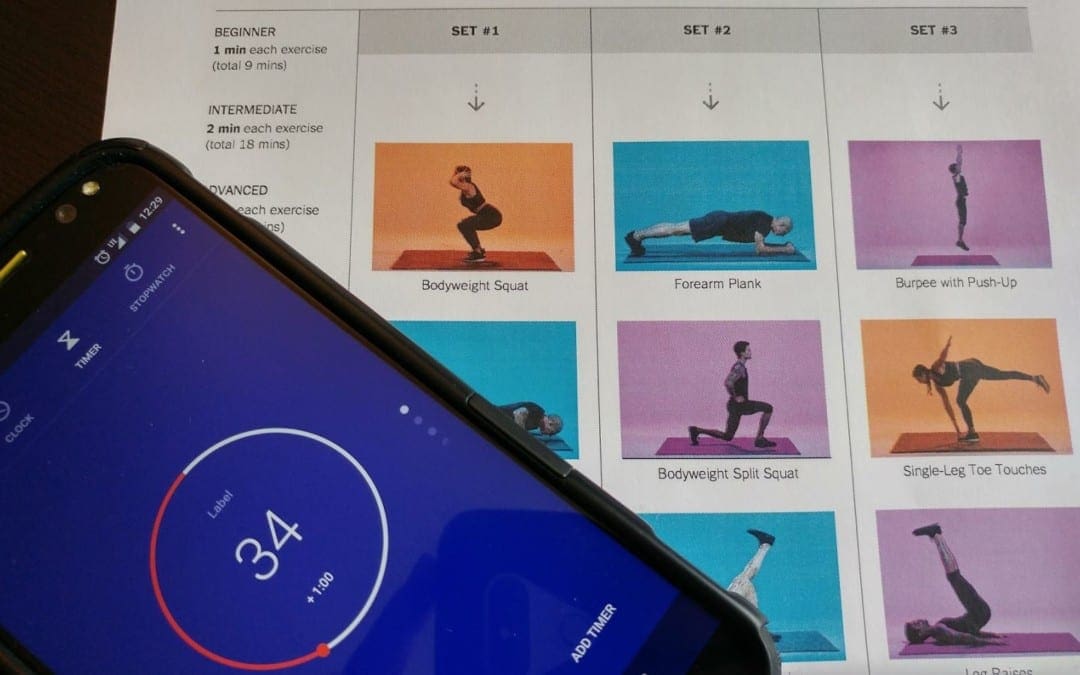
�Lets take a look at the 7 minute and 9 minute workout.
The New York Times has a new super quick workout routine that you can do anywhere, even if you can�t make it to the gym today. I tried it, though, and… hey, wait, am I the only one actually doing these?
Short, intense workouts seem like a good idea on paper. If you�re not already working out, it�s probably because you feel like you don�t have time to get to the gym. But does anyone do these short workouts? Sure, I have nine minutes and some floor space, but do I want to get my work clothes sweaty? And if I�m going to the trouble of changing, why wouldn�t I just head out the door for a run, or turn on Sworkit or Nike Training Club and get something a little closer to a full workout?
After all, the seven-minute workout that got the New York Times started on their repertoire of super short workouts has an odd history. It was published in a scientific journal, but that doesn�t mean any scientists tested whether it was easy to stick to or whether it gave the promised results. Instead, it was designed using hints from previous research, aiming to give people a mini strength workout at a fast enough pace to count as cardio. The designers were coaches at a corporate wellness institute. In other words, people that your boss pays to make you exercise.
We love to talk about these short workouts, but I�m not seeing any evidence that people care to get in a quick couple of minutes of strength or circuit training. The new nine-minute workout dropped earlier this month, but I�ve scoured social media and found almost nobody enthusing or complaining about what it�s like to do this workout�just post after post sharing the fact that it exists.
So, How Is the Nine Minute Workout?
First of all, the nine minute workout actually takes 11 minutes. I just want you to know that going in. There are nine exercises, though, and you do each for one minute. Here�s the structure:
Advertisement
One minute of squats, one minute of push-ups, one minute of mountain climbers.
Rest one minute.
One minute of forearm plank, one minute of jumping split squats, one minute of single-leg hip bridges.
Rest one minute.
One minute of burpees with push-ups, geez, hardcore. One minute of single leg toe touches. One minute of leg raises.
This seems like an exercise program that doesn�t know what it wants to be. The NYT touts it as a strength program, but then says it�s designed according to the �principles of high-intensity interval training�known as H.I.I.T.�
It ends up being a hybrid that doesn�t accomplish either. If you want to build strength by fatiguing your legs doing split squats, you�ll be done before the minute is out. But if you try to stretch out the exercises to fill a full minute, you�ll have to do them at a slower pace than HIIT requires.
And that�s exactly how this workout went. One minute felt way too long for some exercises, too short for others, and overall it didn�t really feel like a strength session or an interval workout. It was fine for what it was, though! A little something that challenges your body in a much better way than sitting at your desk or on your couch for the same amount of time. Still, if that�s your goal, you can find better exercise plans than this awkward one.
A new study hints that young blood may harbor clues to a “fountain of youth” for older brains.
Researchers say blood from human umbilical cords appears to have helped reverse memory loss in aging mice.
The findings suggest that something in young blood is important in maintaining mental acuity.
No one, however, is saying that cord blood could be a magic bullet against Alzheimer’s or other forms of dementia.
For one, any effects seen in elderly rodents may fail to translate to humans.
Instead, the findings might set the stage for new drugs that target the dementia process, said study lead author Joseph Castellano. He’s an instructor in neurology at Stanford University School of Medicine.
“Part of what makes this exciting is that it suggests there’s more communication between the blood and brain than we’ve thought,” Castellano said.
The study builds on earlier work by the same Stanford team. There, the researchers found that old lab mice benefited from infusions of plasma (the liquid portion of blood) from young mice.
Specifically, the old mice showed improvements in learning and memory. This was measured by the ability to accomplish tasks like navigating a maze or building a nest.
The aim of the new study, Castellano said, was to see whether injections of human plasma given to mice could have similar effects.
It turned out that they did — at least when the plasma came from umbilical cords. Plasma from young adults had less of an impact. And plasma from older adults, ages 61 to 82, had no benefit at all.
That led to a critical question: What is it about umbilical cord blood that’s special?
The researchers found evidence that it might be a protein called TIMP2. It is present in high levels in cord plasma, they said, but declines with age.
What’s more, injections of TIMP2 benefited older rodents’ brains in the same way that cord plasma did.
Castellano said it was “surprising” that a single protein had such effects.
But, he noted, TIMP2 could be “upstream” of many biological processes. It belongs to a family of proteins that regulate other critical proteins. Those proteins, in turn, have the task of “chopping up” yet more proteins that exist in the matrix surrounding body cells.
But researchers know little about how TIMP2 acts on the brain, Castellano said.
“Now, we really need to get a better understanding of what it’s doing in the brain,” he said. “We are not saying we’ve found the protein that’s responsible for brain aging.”
Dr. Marc Gordon is a professor at the Litwin-Zucker Center for Alzheimer’s Disease and Memory Disorders at the Feinstein Institute for Medical Research in Manhasset, N.Y.
He agreed that the study identifies a protein “target” that should be studied further.
“But this is not saying that cord blood is a cure for aging,” Gordon stressed.
And it’s probably unrealistic to use cord blood as a dementia treatment, said Castellano.
Nor can anyone predict whether TIMP2 will point researchers toward new drugs for dementia. Findings in lab animals often fail to pan out in humans.
Plus, Gordon said, this study involved mice that were old, but did not have an “animal model” of Alzheimer’s. That refers to lab mice that are genetically modified to have Alzheimer’s-like brain pathology.
“What this could mean for human disease is purely speculative,” Gordon said.
Drugs for age-related brain disease have so far been “elusive,” Castellano said. The available medications for dementia symptoms have limited effects, and cannot stop the disease from progressing.
“We’re excited,” Castellano added, “about this knowledge that there are proteins present in the blood that evolve over the life span, and may affect brain function.”
The need to take a daily run might be something that spreads person-to-person, new research shows.
How much people run can depend to a certain extent on their responses to other people’s running, according to the findings from the analysis of social network data worldwide, The New York Times reported.
The results of the study in the journal Nature Communications also suggest that if you want to improve your running performance, it might be a good idea to become virtual friends with people who are a bit slower.
The researchers concluded that “running can be socially contagious,” said study leader Sinan Aral, professor of management, MIT, The Times reported.
“In general, if you run more, it is likely that you can cause your friends to run more,” Aral said.
For many people, eating healthy means eating organic whenever possible. But choosing only organic foods can take effort and be costly. So when does it make the most sense?
Experts from the University of Texas suggest feeding young children organic foods whenever possible to limit their exposure to pesticides. Adults should make their primary goal to eat healthy in general. In other words, make sure you’re getting enough fruits and vegetables in your diet before worrying about whether they’re organic.
Next, add in organic foods as your budget allows. Some organic fruits and vegetables are only slightly more expensive than non-organic varieties, so focus on them before the more expensive ones. You might also look for foods on which organic has the most impact. Generally, produce that you peel before eating will have less pesticide residue so it makes more sense to spend money on organic cherries than on organic bananas.
However, aside from limiting your exposure to pesticides, there’s little conclusive evidence that organic foods are healthier.
But there are other reasons — from taste to the idea of putting fewer chemicals in the soil — that might influence you to go organic. In the end, it’s often a very personal decision.
People who cycle to work have a substantially lower risk of developing cancer or heart disease or dying prematurely, and governments should do all they can to encourage more active commuting, scientists said on Thursday.
In a study published in the BMJ British medical journal, the researchers found that cycling to work was linked to the most significant health benefits – including a 45 percent lower risk of developing cancer and a 46 percent lower risk of heart disease compared to non-active commuters.
Walking to work was linked to a 27 percent lower risk of developing heart disease and a 36 percent lower risk of dying from it, though it also appeared to have no effect on cancer risk or overall premature death risk, the study showed.
The research involved 264,377 people with an average age of 53 whose data forms part of the UK Biobank – a database of biological information from half a million British adults.
Since the study was observational, no firm conclusions can be drawn about cause and effect, the researchers said. Its findings could also be affected by some confounding factors, they added, including that the mode and distance of commuting was self-reported, rather than objectively measured.
However, “the findings, if causal, suggest population health may be improved by policies that increase active commuting, particularly cycling”, they said.
These would include creating more cycle lanes, introducing more bike buying or hiring schemes, and providing better access for cyclists on public transport.
Lars Bo Andersen, a professor at the Western Norwegian University of Applied Sciences, who was not directly involved in the research but wrote a commentary on it in the BMJ, said its findings “are a clear call for political action on active commuting”, saying this had the potential to significantly improve public health by reducing rates of chronic disease.
“A shift from cars to more active modes of travel will also decrease traffic in congested city centers and help reduce air pollution, with further benefits for health,” he said.
IFM's Find A Practitioner tool is the largest referral network in Functional Medicine, created to help patients locate Functional Medicine practitioners anywhere in the world. IFM Certified Practitioners are listed first in the search results, given their extensive education in Functional Medicine