Fractures of the cervical spinous processes are considered to be rare injuries. Isolated spinous process fractures are even rarer instances, some of which are rare injuries in rare case reports. Approximately xixteen percent of isolated process fractures of the cervical spine involve more than one level. Isolated cervical spinous process fractures are in fact, commonly referred to as clay-shoveler’s fractures.
The term “fracture” can be employed in medical scenarios that deal with a broken bone. This can vary from acute breaks to small fractures, or anything which will impact the integrity and stability of the bone.
Bone fractures could result from numerous distinct situations. Women in particular that suffer from osteoporosis or other conditions, or older people, may lose strength in their bones, making them more fragile and vulnerable to breaks and cracks, even with minimal impact. As the bones have not fully grown, young children are also vulnerable to bone fractures, particularly because they frequently participate in activities that heighten the risk of injury.
However, falls, automobile accidents, and also a number of other dangers can lead to bone fractures, and depending on the severity, these may often require a range of short and long-term treatment options.
What is a Clay Shoveler’s Fracture?
A clay shoveler’s fracture is an avulsion fracture of the spinous process. It happens with flexion of the head, like that reported with automobile accidents, diving, or even wrestling injuries. It also occurs with repeated stress caused by the pulling of the trapezius and rhomboid muscles on the cervical and thoracic spinous processes. Repetitive and forceful muscle contraction breaks the spinous process and pulls the avulsion segment away from the original spinous process.
A clay shovelers fracture commonly occurs from the cervical and upper thoracic spinous processes C6, C7, and T1. The avulsion and fractures are caused by damage or injury from direct blows to the base of the neck. This is usually a stable fracture and doesn’t create any additional deficits.
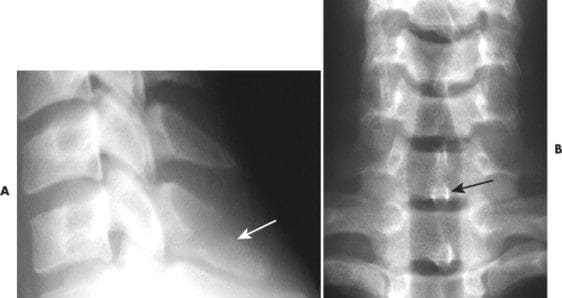
X-ray examination of the spine can help diagnose a clay-shoveler’s fracture. On the lateral side (side view) x-rays, an oblique radiolucent fracture line could be seen through the base of the spinous process. It’s more likely to maintain the trunk or distal tip of the lower cervical and upper thoracic spinous process. Serrated edges or rough margins are generally seen with the fractures, which distinguishes it from nonunion of this secondary growth centre of the process. Additionally, bones from the head and neck would not be displaced or have the serrated margins. The distal portion of the fractured spinous process is often displaced downward (caudally or poor). This is due to the pull on the avulsion segment of bone.
Chiropractic Care for Clay Shoveler’s Fractures
Chiropractors can help alleviate some of the long-term and immediate concerns associated with bone fractures, such as clay shoveler’s fractures. A chiropractor may not perform treatment procedures to the fracture until the damage or injury has started to heal and inflammation is reduced. A chiropractor can help with compression techniques which are beneficial in maintaining the bone in place for healing. A chiropractor may also advocate wellness techniques, such as appropriate diet, and this will optimize the body’s ability to restore its original health and wellness. Chiropractors may also educate a patient on a variety of exercises and stretches to reduce the likelihood of complications and which, if done properly and at fixed intervals, will promote quicker recovery.
The advantages of seeing a chiropractor for wellness and health are many and well documented, but chiropractors are particularly effective as first line and treatment practitioners for bone fractures of any sort. When many kinds of fractures and acute breaks may require immediate therapy, a chiropractor can help rebuild strength and ensure proper recovery, which makes the chiropractic procedure an excellent cure and ensuring long-term good health.
The scope of our information is limited to chiropractic and spinal injuries and conditions. To discuss options on the subject matter, please feel free to ask Dr. Jimenez or contact us at 915-850-0900 .�
By Dr. Alex Jimenez
Additional Topics: Automobile Accident Injuries
Whiplash, among other automobile accident injuries, are frequently reported by victims of an auto collision, regardless of the severity and grade of the accident. The sheer force of an impact can cause damage or injury to the cervical spine, as well as to the rest of the spine. Whiplash is generally the result of an abrupt, back-and-forth jolt of the head and neck in any direction. Fortunately, a variety of treatments are available to treat automobile accident injuries.
Fractures in the cervical spine may occur with severe or repetitive trauma. Clay shoveler’s fracture is an avulsion fracture of the spinous process. It happens with abrupt flexion of the head, most commonly from a variety of accidents. It also occurs with stress caused by the pulling of the muscles around the thoracic and cervical spinous processes. The process breaks up and pulls on the avulsion segment from the original spinous procedure.
Clay shoveler’s fracture most frequently results in the lower cervical and upper thoracic spinous processes, namely C6, C7, and T1. Fractures and spinal avulsion can also be brought on by damage or injury as in direct blows to the neck’s base. This is a fracture that is stable and doesn’t produce any neurologic deficits. This part of the bone isn’t near nerve roots or the spinal cord, although patient’s are alarmed when they hear the term fracture or fracture in the neck.
Clay shovelers fracture derives its name from a common event among clay miners in Australia during the 1930s. The workers were digging deep ditches and tossing clay 10-15 feet above their heads with long handled shovels. Instead of having the clay come off the shovel, it would stick. The sticking clay produces a contraction of the trapezius and rhomboid muscles in reaction from the weighted shovel. The muscles react forcefully and immediately, contracting to stabilize the spine and shoulders. The Australian clay shoveler’s will hear a pop and feel a sharp contrast between the shoulder blades. They would feel sharp pain, making them unable to continue working because every time the trapezius or rhomboid muscles could contract. The mechanism of injury is believed to be caused by powerful and abrupt muscle contraction transmitting pressure via the ligaments. The enormous force is concentrated round the spinous processes and creates an avulsion fracture over the cervical and upper thoracic spine’s spinous processes.
Plain Film X-rays and Examination
Regarding lateral (side view) x-rays, a triangular radiolucent fracture line can be seen via the base of the spinous procedure. It is more likely to maintain the distal or trunk tip of the lower cervical and upper thoracic spinous procedure. Rough margins or serrated edges are commonly seen with the acute fractures, which differentiates it from this secondary expansion center of the process.The distal part of the fractured spinous process is frequently displaced down (caudally or inferior). This is due to the pull on the segment of bone.
Frontal x-rays (anterior to posterior) may demonstrate the look of two spinous processes at a single vertebrae, which can be called the “double spinous process sign.” Especially when the cervicothoracic junction is visualized on the view this signal is helpful for determining a clay shoveler’s fracture. An MRI (magnetic resonance imaging) or CT (computed tomography) is not typically required. A bone density scan could be indicated in a person who has undergone prior avulsion, thoracic, or lumbar spinal compression fractures. A bone density scan can evaluate and measure lumbar and cervical spine t-scores; which gauges relative risk of spinal compression fractures if bone density is in question.
Symptoms of Clay Shoveler’s Fracture
Clay shoveler’s fracture can occur with almost any repetitive and forceful activity utilizing the trapezius and rhomboid muscles. It might occur with automobile accident injuries for traumatic blows to both sides and top of the spinous procedure. Generally, pain is associated immediately after the injury and can be described as a burning or “knife-like” traumatic pain. Other symptoms include muscular stiffness and pain which increases with repeated action, similar to muscle strain at the top back joints or muscle strains. The broken spine is very tender, as are the muscles.
Treatment of Cervical Spine Avulsion Fractures
Most cases resolve in a few weeks. Pain or aggravation to the area could be associated with the tendon and muscle junctions that insert on the spinous process or avulsion segment. Some patients do not require treatment apart from remainder or NSAIDS (non steroidal anti medication). Others may benefit from pain medicine or muscle relaxers.
Medications could be applied at the neck and upper back into the muscles to ease soreness and possible rhomboid muscle strains. Bones and ribs shouldn’t be influenced or produce back pain. Some individuals require physical therapy or massage therapy, including chiropractic care, to help decrease muscle pain and stiffness. Ice, heat ultrasound, mild stretching, and range of motion exercises can help relieve neck and upper back pain. Some individuals respond to course IV cold laser treatments (low level laser treatment) to help reduce pain and inflammation in the muscles and tendons. Others might benefit from muscle treatments like Active Release Technique or Graston Technique to break up scar tissue or adhesions associated with years of repetitive activities. Patients may expect some discomfort for several weeks during the healing process.
Symptoms may worsen at the the front of the body with arms and the head, such as driving or working in the computer. With time and some therapy, symptoms will decline with time. Exercise and strenuous activity might need to be avoided for 1-2 months post injury. For patient’s having a history of stress fractures or avulsion fractures, a bone density scan could be indicated. Some kinds of fractures need immediate attention and could be unstable. Fractures must be assessed to make sure they are stable and tracked by an orthopedic surgeon.
The scope of our information is limited to chiropractic and spinal injuries and conditions. To discuss options on the subject matter, please feel free to ask Dr. Jimenez or contact us at 915-850-0900 .�
By Dr. Alex Jimenez
Additional Topics: Automobile Accident Injuries
Whiplash, among other automobile accident injuries, are frequently reported by victims of an auto collision, regardless of the severity and grade of the accident. The sheer force of an impact can cause damage or injury to the cervical spine, as well as to the rest of the spine. Whiplash is generally the result of an abrupt, back-and-forth jolt of the head and neck in any direction. Fortunately, a variety of treatments are available to treat automobile accident injuries.
Clay-shoveler’s fracture is a breakage of the vertebrae in the spine as a consequence of stress in the neck or upper back. It is often described as a steady fracture during the process of a vertebra happening at C7 or C6, classically at some of the cervical or thoracic vertebrae.
Clay-shoveler’s fracture usually occurs in laborers who engage in tasks involving lifting weights with the arms stretched. Examples of these actions include physical activities like shoveling soil, rubble or snow up and over the head backwards, using a pickax or scythe, and pulling out roots.
Back in Australia in the 1930s, men digging deep ditches tossed clay 10 to 15 feet above their heads using long handled shovels. Rather than separating, the clay would stick to the spade; the employee would hear a pop followed by a sudden pain between the shoulder blades, making them unable to continue working.
Mechanism of Injury: Clay Shoveler’s Fracture
The mechanism of injury is thought to be secondary to reflex and muscle strain through the supraspinous ligaments with force transmission.
The spinous process is pulled on by the enormous force. The fracture is diagnosed by plain film examination. The shear power of the muscles (trapezius and rhomboid muscles) yanking on the spine at the bottom of the neck actually tears from the bone of the spine.
Symptoms of clay-shoveler’s fracture include burning, “knife- like” pain in the level of the fractured spine between the top shoulder blades. The pain may increase with repeated action that strains the muscles of the upper back. The broken spine and muscles that are nearby are exquisitely tender. Often these injuries found incidentally years later when the cervical spine is imaged for other explanations and only are unrecognised in the time.
Acutely, they tend to be associated with:
Motor vehicle accidents
sudden muscle contraction
Blows into the spine
Radiographic Features
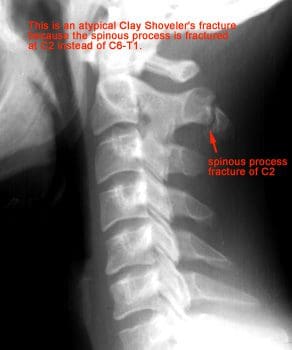
The fracture is seen on lateral radiographs as an oblique through the spinous process, usually of C7. There’s usually substantial displacement. Other radiographic characteristics of the fracture include ghost signals on an AP view (i.e. double spinous process of C6 or C7 caused by displaced fractured spinous process).
Clay Shoveler’s Fracture
Atypical Clay Shoveler’s Fracture
While the extreme pain slowly subsides in days to weeks, the region may intermittently develop burning pain with certain activities that involve prolonged extending of their arms (such as computer function).
No therapy is required for most patients. Physical therapy, pain drugs, and massage can be of help. Surgical removal of the suggestion of the spine is performed for anyone who have pain.
The scope of our information is limited to chiropractic and spinal injuries and conditions. To discuss options on the subject matter, please feel free to ask Dr. Jimenez or contact us at 915-850-0900 .�
By Dr. Alex Jimenez
Additional Topics: Automobile Accident Injuries
Whiplash, among other automobile accident injuries, are frequently reported by victims of an auto collision, regardless of the severity and grade of the accident. The sheer force of an impact can cause damage or injury to the cervical spine, as well as to the rest of the spine. Whiplash is generally the result of an abrupt, back-and-forth jolt of the head and neck in any direction. Fortunately, a variety of treatments are available to treat automobile accident injuries.
IFM's Find A Practitioner tool is the largest referral network in Functional Medicine, created to help patients locate Functional Medicine practitioners anywhere in the world. IFM Certified Practitioners are listed first in the search results, given their extensive education in Functional Medicine