If you are among the 45 million Americans who suffer headaches regularly, you are undoubtedly familiar with the traditional methods that people use to treat them, including taking some type of over the counter medication that is supposed to eliminate the pain and reduce any associated swelling. There are many other types of treatment that you may have attempted as well, including taking pharmaceutical concoctions designed to treat pain. However, none of these solutions provide permanent relief that addresses the problem at the core.
In the past few decades, there have been an increasing number of patients throughout the country that have begun to seek alternative forms of therapy for all types of conditions, including headaches. One form of treatment that is very promising for physical as well as other types of pain is chiropractic.
This form of alternative care has been used successfully for over a hundred years and has become a regular part of the American healthcare delivery system. In fact, there are an increasing number of insurance providers that are willing to pay for chiropractic because of its effectiveness.
When a person goes to school to learn about chiropractic, they begin by studying the human anatomy in great detail, just like other medical professionals. However, in addition to looking at how all of the parts work together physically, their training primarily revolves around the diagnosis and treatment of misalignments in the spine known as subluxations.
Theses subluxations compress nerve tissue that affects organ function, soft tissue like muscle, ligaments and tendons and can eventually manifest as other health problems if not treated.
Once the nerves are disrupted pain will result. While it usually manifests itself as physical pain, this is not always the case. In some instances, the person may experience difficulties with sleep or other routine habits.
On the first visit with a chiropractor, a review of previous health issues will be completed, including x-rays (if needed) to determine what types of nerve blockage may be occurring. They will listen to the patient attentively and make an assessment, including determining what types of treatment will best suit the patient.
In the case of headaches, the patient usually has misalignment (subluxations) in the cervical spine. This may be accompanied by muscles that are unduly tight in the neck, shoulders and nearby areas. Pressure on the nerves may cause sharp stabbing pains or there may be a continual dull throb in the region.
The chiropractor will assess the area and then move forward with treatment known as a chiropractic adjustment in order to relieve the pressure and pain. The relief is usually instantaneous, with an increase in positive symptoms for the following few hours.
However, chiropractors don�t just focus on relieving symptoms but rather correcting the problem; therefore, additional treatments will follow to help correct the cause. In addition, the chiropractor will take the time to educate you on the importance of chiropractic, especially if you�ve never been to one before.
If you need further help with your headaches or are ready to see how beneficial chiropractic care can be to your overall health, please give us a call so that you can schedule an appointment with our Doctor of Chiropractic.
This article is copyrighted by Blogging Chiros LLC for its Doctor of Chiropractic members and may not be copied or duplicated in any manner including printed or electronic media, regardless of whether for a fee or gratis without the prior written permission of Blogging Chiros, LLC.
Migraine headaches, a clinical study involving 11 migraine patients and NUCCA care was recently conducted. Let’s take a look at the results and reveal the benefits of NUCCA care and how the study was conducted.
Method Of Study: Migraine Headaches
The 11 patients in the study had never experienced upper cervical chiropractic care before. All were subject to having migraine headaches and were required to have at least 10-26 days with a headache for the previous four months. Additionally, at least eight of those headache days per month required a 4 out of 10 or higher for pain. While many candidates had either a concussion, auto accident or both, candidates who experienced trauma in the past year were excluded.
NUCCA professionals used various kinds of testing to evaluate the patients. Supine Leg Check Screening tested patients� for visible signs of one leg being shorter, which may indicate atlas misalignment. Gravity stress analyzers were used, as well as, calipers for detecting asymmetry in the pelvis were used. A typical NUCCA radiograph series also includes three x-rays a lateral cervical film (side view), a nasium film (back view), and a vertex film (top view) to identify specific misalignments.
According to these diagnostic methods, the practitioner then prepares an alignment specifically designed for the patient involving the patient’s position, the stance of the practitioner, and the suitable force vector for atlas correction. Patients were given between one and five corrections.
Outcome: Migraine Patients
Headache days per month decreased for patients on average. 14.5 headache days per month was the norm. After one month of NUCCA treatment, patients experienced 11.4 headache days per month. At the conclusion of the two-month study, patients were down to 8.7 headache days per month.
Quality of life measurements in three categories also improved radically within the course of two months:
Restrictive enhanced from 38.4 to 73.5
Emotional improved from 53.3 to 81.2
Physical improved from 54.1 to 86.8
MIDAS score (which measures migraine headaches in the form of level of disability caused) improved from a mean of 46.7 to only 14.6.
While further studies are necessary to offer a quantifiable method of documenting the physiological changes which take place because of the corrections, the results speak for themselves as to the advantages of NUCCA for migraine headaches, especially those with a history of neck or head trauma.
Chiropractic & Headaches
Eliminate Headaches And Migraines Juice Recipe
Headaches and migraines. The only thing you want is for it to vanish. Here is a juice that immediately eliminates headaches and migraines! Try this juice recipe out, in addition to getting an adjustment!
Headaches and migraines are often the result of stress, poor diet, poor posture, emotional tension or exposure to environmental toxins. People reach for over-the-counter medications to help ease the pain, but there are much safer and natural ways of getting rid of headaches.
This juice is loaded with minerals such as magnesium and calcium, two crucial components in helping prevent and alleviate headaches. A juice as opposed to these foods in solid form will help nutrients reach the bloodstream faster, alleviating headaches and migraines in a jiffy!
5 stalks celery
1 cucumber
1 cup parsley
2 granny smith apples
3-4 cups leafy greens (ex. spinach, arugula)
Two inches ginger root
1 lime
METHOD:
Blend all ingredients in a juicer, blender, food processor and enjoy immediately to preserve freshness and antioxidants!
Title: The Efficacy of Chiropractic Adjustments in the care of Migraine Headache with patients presenting with cervical disc bulge.
Abstract: Objective: To explore the efficacy of chiropractic adjustments, and non-surgical spinal decompression in the treatment of cervical spine disc conditions presenting as neck pain, migraine headache, dizziness and visual disturbances. Diagnostic studies included physical examination, computer aided range of motion, orthopedic and neurological examinations, plain film x-ray studies, brain MRI, cervical spine MRI examinations.� Treatments included specific spinal adjustments, low level laser therapy and spinal decompression.� The patient�s outcome proved excellent in reduction of neck pain, headache severity and frequency as well as elimination of dizziness and visual disturbances.
Introduction: On 11/19/13 a 37-year-old female presented for examination and treatment of neck pain, migraine headaches with associated dizziness and visual disturbances.� The patient denies and recent injuries.
Presenting Concerns of Research Study
The patient reports neck pain in the cervical occipital region as a 4 on the Verbal Analog Scale of 0 meaning the complete absence of pain and 10 being unbearable pain.� The duration of the current symptom picture is 2 years and 1 month.� The patient further reports episodic migraine headaches starting at the upper cervical region and progressing into her occipital area.� These episodes are accompanied by dizziness and visual disturbances described as kaleidoscope vision.� At the time of the initial consultation these episodes were occurring 2-3 times per week.� The patient reports being afraid to drive her car due to concerns about headache onset.� The patient reports past consultations with her medical doctor who diagnosed her with vertigo and previous chiropractic care without results.� The records from both consultations were reviewed personally.
Clinical Findings:��The patient presents with complaints of neck pain, headaches, dizziness and visual disturbances of 2 years duration.� The patient is a 37-year-old female who is a mother of 2.� The ages are 16 and 3.
Her vital signs are:
Height – 5 ft. 0 inches
Weight – 130 lbs.
Handedness – R
Blood Pressure – L – 107 systolic and 78 diastolic
Radial Pulse – 75 BPM
The patient�s Review of Systems and Family History were unremarkable.
Palpation/Spasm/Tissue changes:� The patient was evaluated by palpation and observation with the following findings: Bilateral cervical spine spasms rated at +2 in the cervical-occipital region.� Orthopedic testing was unremarkable.� Range of motion examination revealed mildly decreased left lateral flexion, moderately decreased flexion, right lateral flexion and extension. No pain was produced during range of motion examination.
Neurological Examination: Biceps, Triceps and Brachioradialis reflexes were rated at a +2 bilaterally.� Sensory examination revealed normal sensation bilaterally for dermatomes C-5 through T1.� Motor/Muscle testing revealed 5 out of 5 bilaterally for Deltoids, Biceps, and Triceps, Forearm and Intrinsic Hand muscles.
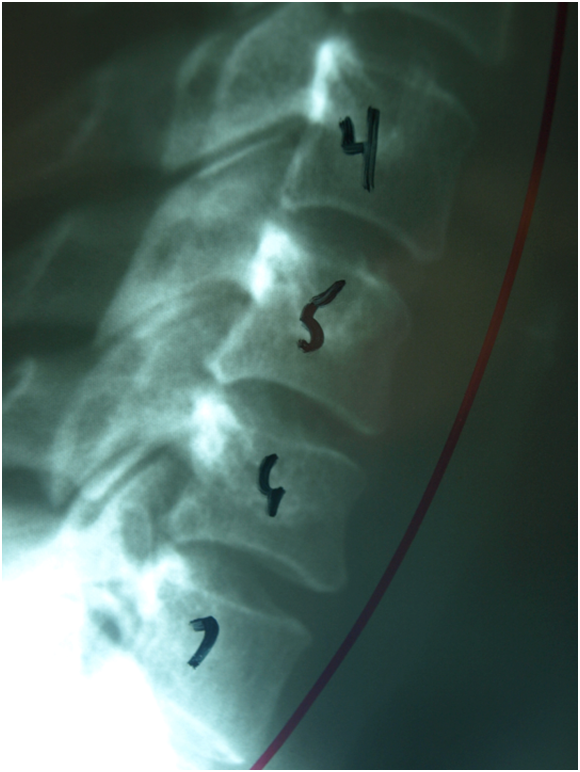
Radiographic findings: reversal of the cervical curve with altered C5/C6 disc space is noted. (Fig. 1, (A) (B) A small osteophyte is observed on the posterior inferior body of C5.� Flexion malposition of C5 is also noted.� (Fig. 1, (B).
Fig. 1,� (A), (B) show loss of the cervical lordosis, flexion malposition of C5, partial collapse of C5/6 anterior disc space.
Fig. 1. (B) shows upon magnification a small posterior-inferior osteophyte.
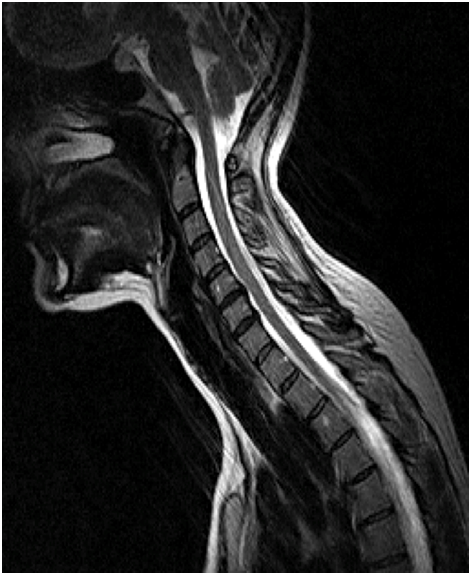
Fig. 2,� (A), (B) shows in T2 MRI images (A) is Sagittal and (B) is Axial a
C5/6 central disc herniation contacting the ventral cord.
Diagnostic Focus and Assessment:�Diagnoses considered are: Brain Tumor, Cervical Disc Displacement, and Cervical-cranial syndrome.� A brain MRI was ordered and produced normal findings.� Diagnostic reasoning included the C5/C6 disc/osteophyte complex and the encroachment into the ventral aspect of the central canal and contact with the cervical spinal cord. (1)�Peter�J. Tuchin, GradDipChiro, DipOHS, Henry Pollard, GradDipChiro, GradDipAppSc, Rod Bonillo, DC, DO.� Received 29 June 1999.��Another consideration was the treatment schedule because the patient lives 60 miles west of the clinic and 2 treatments was the ordered therapeutic schedule.
Therapeutic Focus and Assessment:��Assessment of the cervical spine MRI both sagittal and axial views of the C5/C6 and C6/C7 segmental levels revealed adequate space between the cervical cord and posterior vertebral elements.� It was determined that conservative management of this patient was appropriate.� Therapeutic focus was reducing the pressure of the C5/C6 disc/osteophyte complex on the ventral cord.� Promoting healing of damaged nerve tissue and restoring more favorable position and motion of vertebral segments C5/C6.� The modalities used to treat this patient were:
1.�����Specific Spinal Adjustments: utilizing a Sigma Precision Adjusting Instrument to introduce a percussive force of 20 lbs. with a maximum of impact number of 50.
2.�����Spinal Decompression: A Hill Spinal Decompression table was utilized with 8 lbs. of pull maximum and a cycle of 5 minute at maximum and 5 minutes at reduction to 50% over a 25 minutes treatment session.� The patient completed 18 sessions in total.
3.�����Low Level Laser Therapy was used to promote healing on a cellular level using a Dynatron Solaris system.� Treatments consisted of 30 seconds of exposure to an 860-nanometer beam at C5/C6 and C6/C7 levels.
Follow-up and Outcomes
The patient�s compliance to the treatment schedule as rated at 9 of 10.� Completion of the recommended 18 treatments required 1 week longer than anticipated.� For personal reasons the patient missed 2 treatment sessions but made them up by adding a week to the estimated completion date. Upon discharge examination the patient reports her neck pain on the Verbal Analog Scale a 2 of 10 with 0 being the complete absence of pain and 10 being the worst pain imaginable. She further reported her headaches as a 1 on the Verbal Analog Scale.� Both symptoms were constant since 10/01/11.� This is duration of 25 months prior to her first visit. Her symptoms of dizziness and visual disturbances have been absent since 12/13/13.
Discussion:�Headaches and Migraine Headaches are a big health problem. It has been estimated that 47% of the adult population have headache at least once within last year in general.��More than 90% of sufferers are unable to work or function normally during their migraine. American employers lose more than $13 billion each year as a result of 113 million lost workdays due to migraine. (2)�Schwartz BS1, Stewart WF, Lipton RB. J Occup Environ Med. 1997 Apr; 39(4): 320-7.
This case report is very limited because it represents the experience and clinical findings for just 1 patient. However a study of the references included with this report as well as reports by care providers as well as testimonials from patients indicates that more study should be invested in the relationship of the cervical spine, its structures and biomechanics during the diagnostic workup on headache and migraine patients.
Informed Consent:�The patient provided a signed informed consent.
Competing Interests:�There are no competing interests writing of this case report.
De-Identification:�All the patient�s related data has been removed from this case report.
The scope of our information is limited to chiropractic and spinal injuries and conditions. To discuss options on the subject matter, please feel free to ask Dr. Jimenez or contact us at 915-850-0900 .�
References:
1. Schwartz BS1, Stewart WF, Lipton RB.
J Occup Environ Med. 1997 Apr; 39(4): 320-7.
Lost workdays and decreased work effectiveness associated with headache in the workplace.
2. Vernon, H., Humphreys, K., & Hagino, C. (2007). Chronic mechanical neck�pain in adults treated by manual therapy: A systematic review of change scores in randomized clinical trials,�Journal of Manipulative and Physiological Therapeutics, 30(3), 215-227.
3.�Peter J. Tuchin, GradDipChiro, DipOHS, Henry Pollard, GradDipChiro, GradDipAppSc, Rod Bonillo, DC, DO.� Received 29 June 1999
A randomized controlled trial of chiropractic spinal manipulative therapy for migraine?
4.Mark Studin DC, FASBE (C), DAAPM, DAAMLP, William J. Owens DC, DAAMLP Chronic Neck Pain and Chiropractic. A Comparative Study with Massage Therapy.
5.�D�Antoni AV, Croft AC. Prevalence of Herniated Intervertebral Discs of the Cervical Spine in Asymptomatic Subjects Using MRI Scans: A Qualitative Systemic Review. Journal of Whiplash & Related Disorders 2006; 5(1):5-13.
6.��Murphy, D. R., Hurwitz, E. L., & McGovern, E. E. (2009).�A nonsurgical approach to the management of patients with lumbar radiculopathy secondary to herniated disk: A prospective observational cohort study with follow-up.�Journal of Manipulative and Physiological Therapeutics, 32(9), 723-733.
Additional Topics: Chiropractic Helps Patients Avoid Back Surgery
Back pain is a common symptom which affects or will affect a majority of the population at least once throughout their lifetime. While most back pain cases may resolve on their own, some instances of the pain and discomfort can be attributed to more serious spinal conditions. Fortunately, a variety of treatment options are available for patients before considering spinal surgical interventions. Chiropractic care is a safe and effective, alternative treatment option which helps carefully restore the original health of the spine, reducing or eliminating spinal misalignment which may be causing back pain.
A cervicogenic headache begins in the cervical spine, or the neck. Sometimes these headaches mimic migraine headache symptoms. Initially, discomfort may start intermittently, spread to one side (unilateral) of the individual head, and become nearly continuous. Furthermore, pain can be exacerbated by neck movements or a particular neck place (eg, eyes centered on a pc monitor).
Possible Causes of Cervicogenic Headaches
The trigger of a headache is often associated to extreme tension to the neck. The headache may be a consequence of cervical osteoarthritis, a broken disc, or whiplash-type movements that irritates or compresses a cervical nerve. The neck’s bony structures (eg, aspect joints) and its delicate tissues (eg, muscles) can give rise to the improvement of a cervicogenic headache.
Nervous System Function
Certain nerves structures are involved in several cervicogenic headaches. Spinal nerves are signal transmitters that allow the body via the spinal cord and communication between the brain. At each level of the cervical spine is one on the right of the spine and a set of nerves; one on the left side. C1, C2 or C3 may be involved in development of cervicogenic headaches because these nerves permit function (motion) and feeling of the head and neck. Compression can cause pain and inflammation.
Cervicogenic Headache Symptoms
A cervicogenic headache provides in base and the back of the skull as a steady, non-throbbing pain, sometimes extending downward into the neck and between the shoulder-blades. Pain could be felt behind forehead and the brow, although the problem originates in the cervical spine.
Pain usually starts after a sudden neck movements, such as a sneeze. Along with head and neck discomfort, signs may include:
Stiff neck
Nausea and/or vomiting
Dizziness
Vision
Sensitivity to light or sound
Pain in both arms or one
Risk facets that will be engaged in headache on set or irritate cervicogenic headaches include:
Fatigue
Sleep difficulties
Disc problems
Current or neck injuries that are preceding
Poor posture
Muscular stress
Diagnosis of Cervicogenic Headaches
The analysis of a headache commences using a thorough medical background using a physical and neurological evaluation. Diagnostic testing may include:
X-rays
Magnetic resonance imaging (MRI)
CT Scans (rarely)
Nerve block injections to validate the diagnosis, cause
Treatment for Cervicogenic Headaches
Initially, your doctor may advise an over-the counter nonsteroidal anti inflammatory drug (eg, aspirin, Aleve). If this is ineffective, then a prescription anti-irritation and pain reliever might be prescribed. Other treatment options, outlined in purchase of from non-invasive to invasive, include:
Spinal manipulation or alternative manual therapies
Behavioral methods (eg, bio feedback)
Acupuncture
Trigger level injections
Prolotherapy
Facet joint blocks (a type of spinal joint injection)
Nerve blocks (this is generally of the medial branches of the nerves that provide you with the the facet joints)
Radiofrequency pulse ganglionotomy of the nerve root (eg, C 2, C-3)
Spine surgery to reduce nerve or vascular compression (this is rarely necessary)
The scope of our information is limited to chiropractic and spinal injuries and conditions. To discuss options on the subject matter, please feel free to ask Dr. Jimenez or contact us at 915-850-0900 .�
By Dr. Alex Jimenez
Additional Topics: Cervicogenic Headache and Chiropractic
Neck pain associated with whiplash-associated disorders resulting from an automobile accident are reportedly the most prevalent cause for discomfort along the cervical spine. The sheer force of an impact from a rear-end car crash or other traffic incident can cause injuries or aggravate a previously existing condition. While neck pain is commonly the result of damage to the complex structures of the neck, cervicogenic headaches may also result due to neck issues. Chiropractic care can help carefully restore the alignment of the cervical spine to relieve headaches and neck pain.
Manual manipulations and spinal adjustments have been demonstrated to be successful treatment alternatives for patient’s with headaches.
Chiropractic’s capability to correct bio-mechanical dysfunctions can help eliminate common factors which may lead to head and neck pain. A majority of headaches are associated with neck pain and other cervical spine issues, best known as cervicogenic headaches. These headaches are musculo-skeletal in nature and are related to tension headaches, which may also relate to migraines.
According to some research studies, there’s less risk of further injury or aggravation of a previous condition through chiropractic adjustments than with popular medical remedies. Additionally, newest research indicates that nine percent of men and 12 percent of women in the United States experience at least one to two headaches per month, with four percent of the population experiencing more regular headaches.
Prevalence of Head Pain & Neck Pain
Two-thirds of all adult males and greater than 80 percent of females in developed countries suffer from persistent headaches, according to the World Wellness Organization (WHO). Headaches are just as harmful in developing nations as well, primarily because such are not considered to be a symptom of disease. WHO estimates that about half of the individuals who experience headaches never receive any treatment for them.
People who suffer from chronic, everyday headaches amount to about four or five percent of the world’s population, surpassing the percentage of several other common illnesses. Experts genuinely believe the connection of headache victims to those with disabilities is approximately the same.
Headaches are so frequent that Americans pay more than one billion annually to get alleviation from them. Medical expenses plus lost-work time and productivity accounts for an estimated $50 billion in losses for American companies. Just as troubling: The discomfort associated with headaches and migraines might be so extreme, it’s often reported that mental illness follows soon after.
Approximately 95 percent of headaches are categorized as stress, migraine, or cervicogenic, originating in the neck. Symptoms include head pain on either side of the head or a stiff feeling in the neck, along with tightness and soreness. A small percentage of headaches is on the array that is more hazardous and it’s possible for these to need further referral to appropriate healthcare professionals to treat them as necessary.
Treatment for Headaches Associated with Neck Pain
By utilizing risk-free and beneficial treatment protocols, many doctors of chiropractic, or DCs, effortlessly help many individuals reduce the symptoms of headaches. A spinal adjustment can certainly help lessen the strain being placed on the spine and its surrounding structures, such as muscles, tendons, ligaments and blood vessels, diminishing the signs of a headache and allowing for better function.
Particularly as it relates to neck modifying, many people have worries about chiropractic manipulation. Atlas Orthogonal chiropractic is a different kind of chiropractic treatment which is performed without manipulation of the head or neck. The �snap,� �crack,� or �pop� sound usually associated with chiropractic or osteopathic manipulation is not necessary to move a vertebra, especially the atlas or upper cervical joint complex.
Chiropractors in general are perhaps not taught aggressive, forceful techniques; the type that’ll injure vessels or tissues. Chiropractors are taught to use speed and finesse as an alternative to pressure. When the physician performing the procedure compensates for slow-pace by increasing pressure in the manipulation, problems can occur.�Chiropractors provide by far the greatest number of manipulations to the spine than any other profession, but other healthcare professionals can also perform manipulation and mobilization techniques.
Chiropractic health practitioners have had the same simple coaching as any other primary care physician. The variation between DCs and MDs lies in their treatment protocols for certain types of injuries and/or conditions.
Conclusive Findings
The need to seek assistance in emergencies is essential, if all other choices happen to be explored. When seeking specific treatment for cervicogenic headaches as well as neck pain, it’s suggested to seek medical attention with Atlas Orthogonal chiropractic, followed closely by other actions that are less-invasive. Surgery is often suggested and recommended to be used as a last option unless otherwise necessary.
Most people that have had an Atlas Orthogonal chiropractic adjustment report feeling as either a puff of force or nothing at all. They hear a tiny tap and they describe feeling the neck’s tightness and soreness decrease. Some explain the experience as initially underwhelming.� Others report a wave like feeling rushing through the body, especially after various treatments. The healthcare professional�may determine substantial changes between his objective findings from before the adjustment and those he finds afterwards in the patients.
About the Atlas Orthogonal Chiropractic Technique
Atlas Orthogonal chiropractic therapy could be an excellent instrument in the prevention of headaches, accidents and several other problems and includes a calming outcome for many individuals.
The scope of our information is limited to chiropractic and spinal injuries and conditions. To discuss options on the subject matter, please feel free to ask Dr. Jimenez or contact us at 915-850-0900 .�
By Dr. Alex Jimenez
Additional Topics: Cervicogenic Headache and Chiropractic
Neck pain associated with whiplash-associated disorders resulting from an automobile accident are reportedly the most prevalent cause for discomfort along the cervical spine. The sheer force of an impact from a rear-end car crash or other traffic incident can cause injuries or aggravate a previously existing condition. While neck pain is commonly the result of damage to the complex structures of the neck, cervicogenic headaches may also result due to neck issues. Chiropractic care can help carefully restore the alignment of the cervical spine to relieve headaches and neck pain.
The most useful rule-of-thumb for headache and migraine treatment is: Have a program. See your doctor and produce a treatment strategy together. Your program will help you identify and handle migraines or your headaches early, sparing you some discomfort.
Tension Headache Treatments
When you get a pressure-type headache, it’s usually because of a change in neck, your mind, or encounter. Other tissues, nerves, blood vessels, and the muscles are experiencing distress. Treat the change, and you will reduce your headache.
It may build up unwanted stress, in case you have already been hunched over a laptop at work. Or perhaps a new medicine was started by you, or had minor neck injuries.
Take a minute curl up to stretch, or massage head your face, and neck. Consider a nap, a shower, or utilizing pack or ice pack on your own head or neck.
Tension Headache Medications
For tension headaches, you’ve numerous over-the-counter medicine alternatives. Naproxen ibuprofen, acetaminophen, and aspirin are successful. If you suspect your headache is vascular (associated to your own blood vessels), consider a pain-reliever that includes some caffeine.
Get in touch with your doctor for more tips if your headache does not react to to your own behavioral techniques and medications. In the event the headache becomes severe or lasts for more than 10 days, see your doctor. Your headache might be a signal of another condition.
Cluster Headache Treatments
Inhaling 100% oxygen right when a cluster headache starts can help lessen the pain considerably. Your doctor can help you get a portable oxygen unit to carry in a bag or briefcase.
A mainstay migraine medication, sumatriptan, is effective for cluster headaches. Learn to inject yourself right when you sense the first signs of your cluster headache. Other cluster headache medicines that are useful are dihydroergotamine, administered via an I-V, and octreotide sent as an injection.
Migraine Headache Prevention
Over the past 2 decades, health practitioners have realized effective treatments for decreasing the frequency of migraines. Avoid migraine triggers, take preventive medicine, alter your nourishment, and improve your rest.
One of numerous migraine triggers, several are foods, by avoiding so you can reduce your migraine risk:
Beans, legumes, and nuts
Fermented and pickled foods like pickles and olives
Dairy and cheese that is aged
Avocados
Onions
Cured or ag ed meats
Items containing brewer’s yeast
Chocolate, cocoa, and carob
Aspartame
Beverages
Caffeine
Other frequent migraine triggers include:
Stress
Weather changes
Poor diet
Hormonal changes
Nicotine
Physical activities that are intense
As you pay focus on what triggers your migraines, you are able to learn better what to avoid�??this is just a starting listing.
Your doctor will consider other medicines that prevent migraines. He/she might prescribe:
The blood-pressure drugs propranolol or timolol
Anti-depressants such as amitriptyline or fluoxetine
The seizure medication valproate
While these drugs came to market to handle other conditions, they are also efficient for migraine prevention.
Migraine Treatment
Migraine remedy is a race from the clock. You can take steps to reduce the intensity of the assault when you sense the warning signs of a migraine. That is the time to lie down, relax, and simply take your drugs.
Non-steroidal anti-inflammatories (NSAIDs), aspirin, and acetaminophen relieve some migraines. However, many migraine sufferers need stronger medicines for example sumatriptan or a different medication from your triptan family. In a few extreme circumstances, you may be treated by your physician with an opioid.
Treatments such as ice packs or cold compresses on your forehead rush instant reduction. Massaging your scalp and rubbing your temples may also help reduce the intensity of the migraine.
The scope of our information is limited to chiropractic and spinal injuries and conditions. To discuss options on the subject matter, please feel free to ask Dr. Jimenez or contact us at 915-850-0900 .�
By Dr. Alex Jimenez
Additional Topics: Cervicogenic Headache and Chiropractic
Neck pain associated with whiplash-associated disorders resulting from an automobile accident are reportedly the most prevalent cause for discomfort along the cervical spine. The sheer force of an impact from a rear-end car crash or other traffic incident can cause injuries or aggravate a previously existing condition. While neck pain is commonly the result of damage to the complex structures of the neck, cervicogenic headaches may also result due to neck issues. Chiropractic care can help carefully restore the alignment of the cervical spine to relieve headaches and neck pain.
Should you have occasional headaches which can be mild in nature, you probably have tension headaches. On the other extreme, in the event that you’ve intense headaches with pounding pain you are incapacitated by that, it is probably a migraine diagnosis.
It’s hard to be sure what kind of headache it’s if your headache is moderate, as well as your headache diagnosis may be more complex. You as well as your doctor may need some time to know in case your headache that is moderate is a symptom of another health condition, a strong tension headache, or a mild migraine.
Symptoms of Head Pain
Headaches are caused by another illness, plus they disappear when that illness goes away. They often accompany colds, the flu, and injuries. By producing a headache, in case you start or stop a medication, your body may complain.
In certain situations, your headache is a sign of a serious illness. In case your headache is accompanied by you should call your doctor, or visit an emergency room or urgent care clinic:
Any combination of nausea, sluggishness, confusion, or a head injury
A fever with pain when you bend your head
blurry vision
severe pain in one eye
Pain and sensitivity around your cheeks and eyes
Diagnosis: Types of Head Pain
You and your doctor can distinguish between a light migraine along with a strong tension headache. Your visit will start using a physical exam that includes capturing or updating your health history.
Together, your doctor and you will explore the symptoms that separate migraines from other headaches with questions such as:
Can you experience a pre-headache period where you are abnormally fatigued or feel strange?
What would you experience when you feel the headache coming on?
What makes your headaches worse?
Would you vomit or get nauseated with your headaches?
How often have you been experiencing headaches?
How long do your headaches typically last?
How do your headaches affect your vision? What do you really see?
Do your headaches make you sweat or give you the chills?
What would you experience or feel throughout your headache, especially in the rest of your body?
If these questions lead you to describe migraine symptoms, your doctor will probably treat you for migraines with self-help strategies and a triptan medication. If the treatments reduce your migraine pain and discomfort, you’re able to be confident of a migraine diagnosis. If your answers don’t fit the migraine headache profile, your doctor may conclude that you suffer from strong tension headaches.
She or he might refer you to a neurologist for additional exams and tests, to be sure your headaches aren’t related to a different health condition.
The scope of our information is limited to chiropractic and spinal injuries and conditions. To discuss options on the subject matter, please feel free to ask Dr. Jimenez or contact us at 915-850-0900 .�
By Dr. Alex Jimenez
Additional Topics: Cervicogenic Headache and Chiropractic
Neck pain associated with whiplash-associated disorders resulting from an automobile accident are reportedly the most prevalent cause for discomfort along the cervical spine. The sheer force of an impact from a rear-end car crash or other traffic incident can cause injuries or aggravate a previously existing condition. While neck pain is commonly the result of damage to the complex structures of the neck, cervicogenic headaches may also result due to neck issues. Chiropractic care can help carefully restore the alignment of the cervical spine to relieve headaches and neck pain.
IFM's Find A Practitioner tool is the largest referral network in Functional Medicine, created to help patients locate Functional Medicine practitioners anywhere in the world. IFM Certified Practitioners are listed first in the search results, given their extensive education in Functional Medicine



 The 11 patients in the study had never experienced upper cervical chiropractic care before. All were subject to having migraine headaches and were required to have at least 10-26 days with a headache for the previous four months. Additionally, at least eight of those headache days per month required a 4 out of 10 or higher for pain. While many candidates had either a concussion, auto accident or both, candidates who experienced trauma in the past year were excluded.
 Headaches and migraines. The only thing you want is for it to vanish. Here is a juice that immediately eliminates headaches and migraines! Try this juice recipe out, in addition to getting an adjustment!