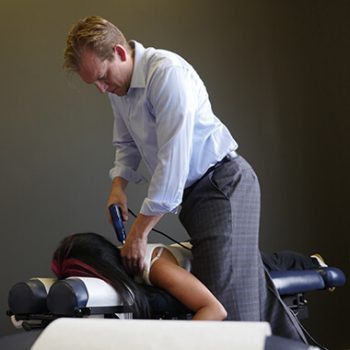
Through the use of our specific, gentle adjusting techniques, we�re able to effectively correct spinal alignment patterns, helping to create comfort and stability as it relates to spinal mechanics and function. We also offer custom-made orthotics.
Here are some of our more common adjusting styles that can be tailored to the individual preferences of each practice member
Activator Methods�: Through the use of a handheld instrument, this technique delivers a light, low-force adjustment to the spine. We use this method primarily for those patients who are more delicate or sensitive, along with a similar instrument device called The Impulse. Diversified: This is a classic chiropractic technique that uses hands-on, manual adjusting. Thompson Drop Table:�This is an effective technique for those practice members that prefer a light-force style of adjusting. The specialized table features neck, chest and pelvic pieces that have the capacity to drop during the adjustment. We Honor Your Feelings
Chiropractic care is safe and gentle with a stellar track record of successful outcomes for newborns, moms-to-be, athletes, parents, aging seniors and children of every age.
Despite its successful history, we understand that sometimes practice members have some anxiety before their first treatment due to fear of the unknown. We promise to make sure that you�re comfortable and relaxed before your first adjustment.
It�s important to us that you have a positive and enjoyable experience as you work toward achieving optimum health. We put that focus into action hundreds of times a week with our practice members. We can assure you that after your first adjustment, you�ll experience one of three things:
Many will feel an immediate shift to feeling looser with less tension. Some will take longer to notice a difference if the problem has been there for a long time. A little bit of soreness or stiffness the following day for some people. However this will subside, and almost all practice members experience an array of unexpected benefits as they continue with their care plan, including better sleep, calmer digestion, improved alertness and enhanced immune system function. One of Our Favorite Success Stories
Dr. Don has a favorite story about one of the longtime members of the practice. As he walked into the room to adjust her for the first time, the woman glanced up at him and burst into tears. Her fear was palpable.
After Dr. Don gently reassured her, she received her first adjustment. Her response? �Wow, that wasn�t bad at all!�
These words are familiar to us, and this particular woman has been a part of our South Side Chiropractic�family now for almost a decade, returning to an active life that she believed was lost to her.
We work hard to obtain your trust, and nothing makes us happier than to partner with you in achieving your health goals.
Dr. Alex Jimenez D.C.,C.C.S.T’s insight:
Chiropractic�Care�is�safe, gentle and has a superior�record of successful outcomes for moms-to-be, newborns, athletes, parents, aging seniors and children of every age.
Chiropractors who provide care for children � and families � can attest to the many benefits of a healthy spine to a growing child. However, this relatively new area of focus for chiropractic is susceptible to many misconceptions, among the public and the health-care community.
Many of the public perceptions about chiropractic care for children, however, are far from the truth. We explore these misconceptions and spoke to the experts to get the real facts about this thriving chiropractic focus area.
Myth #1 Chiropractic care of children is new.
When some individuals first learn that DCs treat children as well as adults, they may get the wrong idea that chiropractic for kids is new � which is to say untested, experimental and dangerous.
That isn�t the case. Sure, the modern era of this field dates only as far back as the 1980s. But the fact is, the practice actually has much older and stronger roots. �If you go back to 1910, [founder of chiropractic] D.D. Palmer indicated how important it is to check a child�s spine from birth and throughout life,� notes Jeanne Ohm, CEO of the International Chiropractic Pediatrics Association (ICPA), a non-profit organization in Philadelphia.�
By the 1980s, many DCs had developed their practices to treat adults specifically. In 1986, Dr. Larry Webster in the U.S. helped re-establish chiropractic care for children as a legitimate area of focus. He started teaching his child-friendly techniques, and he created the ICPA to further help chiropractors treat children.
Webster passed away in 1997, but his legacy continues. The ICPA now has more than 4,000 members and hundreds of DCs are studying to become chiropractors with a special focus on kids.
Myth #2 Children don�t need chiropractic care.
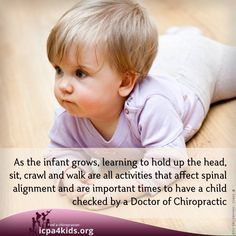
DCs who treat kids often hear questions along these lines: Why in the world would a child need to see a chiropractor? What good does chiropractic do for a toddler, or even a newborn?
Chiropractors have a few good answers.
�We may see a one-week-old child who is already showing signs of favoring, turning her head to one side versus the other,� says Dr. Judy Forrester, owner of Synergea Family Health Centre, a multidisciplinary clinic in Calgary, Alta. �That may seem minimal� but if we can determine any imbalances or asymmetry with the muscular function or the joint alignment, and we address it early, it�s better. Once those postural patterns and habits develop as they grow, they can be much more difficult to change.�
Dr. Liz Anderson-Peacock is a Barrie, Ont., chiropractor who focuses on care for children. She notes the link between the central nervous systems and various childhood afflictions.
�Children may have symptoms like ear infections, difficulty breathing, colic, attention deficit. We do not treat those things per se. We see those as expressions of the body not interpreting the world properly,� explains Anderson-Peacock, who also serves in the editorial board for the Journal of Maternal, Pediatric and Family Health.
�The organizing system for us to respond to the world is the nervous system. The questions we ask are: if there is something going on with the nervous system, what is it, and can chiropractic care help?�
Anderson-Peacock now spends most of her time travelling around the world doing lectures and other speaking engagements. She also conducts seminars for the ICPA about chiropractic care for children and families.
Ohm from the ICPA links chiropractic to the very moment a child emerges from the womb. �Birth can be traumatic,� she says. The event could cause physical damage that leads to difficulties later. So if a baby develops breathing trouble, �the real cause may simply be a misalignment to the spine from the birth process. Parents who get that will stop at the clinic on the way home from the birth centre to make sure everything is OK.�
Chiropractic & Children
Myth #3 Chiropractors use the same techniques on children as adults.
�That�s what terrifies a lot of chiropractors about adjusting children, as well as parents,� Anderson-Peacock says. �They think we�re going to adjust them like an adult.�
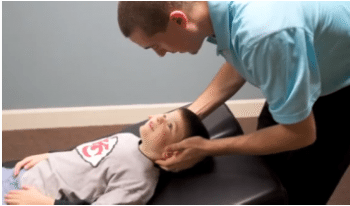
But DCs who treat children do not apply heavy pressure. �Often, it�s a matter of moving the child into a position of ease, holding that position and things will reset quite nicely on their own,� Anderson-Peacock says. Care, she points out, is nowhere near as forceful as it may be for adults.
�That�s why extra training is so crucial. These children are not like miniature adults. For example, spines are primarily cartilaginous until the age of six, and we know cartilage will deform when we have abnormal function. So we want to make sure that function is restored normally. And since the bones are immature, the alignment issues are different. We want to minimize rotations and traction, because children have different needs, due to the immaturity of their musculoskeletal and ligamentous structures.�
The ICPA aims to validate techniques for chiropractic care for children, particularly to help dispel the idea that DCs use the same pressure on kids as they do on adults, Ohm notes. The organization is working with Walter Herzog, co-director of the Human Performance Laboratory at the University of Calgary, to study the pressure required when caring for children. The report should be out by the end of 2015.
Chiropractic & Children with Chronic Conditions
Myth #4 There are no real experts in chiropractic care for children.
In Canada, chiropractic care for children is not a recognized area of specialty, which leads some people to think there are no genuine experts in the field. But that isn�t true.
Many DCs follow accredited courses to develop child-specific skills. Anderson-Peacock spent three years studying at the International Chiropractors Association�s Council on Chiropractic Education (CCE)-accredited program in pediatric chiropractic. She achieved her Diplomate in Clinical Chiropractic Pediatrics (DICCP) in 1996.
Dr. Stacey Hornick is owner of Market Mall Family Chiropractic in Saskatoon, Sask. She attended McTimoney College of Chiropractic, operated by BPP University � a post-secondary institution in London, England. Over three years, she took courses by correspondence and traveled to Thailand, Hong Kong and Australia to complete the residency portion of the program. Having succeeded in her studies last year, she was granted a master�s degree in Chiropractic Paediatrics.
Hundreds of DCs have taken the ICPA�s programs. The ICPA Diplomate Program involves a total of 400 hours of learning and achieved through the successful completion of two levels of study.
The first part � a 200-hour certification program � involves 14 classroom modules, participation in two ICPA Practice Based Research Network projects, and successful completion of the comprehensive certification� final exam.
The second part is a 200-hour advanced competency program. It requires 200 hours of work with more emphasis on research, including either a published research case study or a publishable thesis, as well as clinic work. Enrollment in the first level (200-hour certification program) is a prerequisite to enroll in part two.
Chiropractic care for kids may not be a recognized specialty in Canada, but chiropractic associations recognize it as a legitimate area of focus.
In a statement, the Alberta College and Association of Chiropractors (ACAC) has acknowledged, �chiropractic treatment is as beneficial to children as it is to adults and that the efficacy and benefits of the delivery of chiropractic care to individuals 18 years of age and under are well supported by a body of ongoing research and documented case histories.�
Chiropractic & Teens with Back Pain
Myth #5 Chiropractors don�t collaborate with pediatricians and medical doctors.
Hornick says this simply isn�t the case.
�I often refer pediatric patients to their medical doctors and to medical specialists, and we communicate clearly in the best interests of the child. I see our roles as complementary.�
Forrester also says she has good ties with medical doctors. �The majority of them are very much in favor of working together. Every once in a while you run into someone who thinks we�re all a bunch of quacks and they�re not up to date with the sorts of things we do. But by far the relationship with pediatricians is healthy and puts the patients� best interests first.�
Reality recap
Chiropractic care for kids is not new. Children benefit from chiropractic care. Techniques for children are safe and nowhere near as forceful as they may be for adults. Many DCs are qualified experts, and many child-focused chiropractors establish strong connections with medical doctors. The truth is, DCs can and do share the benefits of their profession with patients across the entire age spectrum.
Mastering pediatrics
Late last year, Dr. Stacey Hornick, a Saskatoon, Sask.-based DC focused on chiropractic care for children became one of the first Canadians to attain a Master�s of Science in Chiropractic Paediatrics.She studied at McTimoney College of Chiropractic, operated by BPP University, a post-secondary institution in London, England. The McTimoney program is the only pediatric chiropractic program that meets the academic requirements for entry into doctoral studies (PhD) in the specific content area of chiropractic pediatrics, an opportunity never before afforded the chiropractic profession, she says.
�For me, it was important to seek out a highly respected qualification in pediatric care,� Hornick says. �There were no university-accredited courses in pediatrics in North America that I was aware of at the time. I liked the idea of studying abroad and at the same time becoming an expert in pediatric-specific assessment, and adjusting techniques that were gentle yet neurologically precise.�
It takes stamina and smarts to get into and complete this tough three-year course. Read on for the requirements. Do you have what it takes?
To enter the program, a candidate must have: a professional qualification in chiropractic and registration with a relevant chiropractic governing body
In each of the first two years of the program, the student must complete:
Work at two residential schools � Hornick explains that usually, students complete their residencies at U.K. chiropractic facilities, but McTimoney also gives students the chance to practice outside of the U.K. For her part, Hornick completed her first-year residency in Thailand, which was memorable. �We stayed at the Children of the Golden Triangle Training Center. It�s a safe haven when kids can go to school and avoid the whole child-trafficking danger, which is a heart-wrenching reality in that part of the world. Many of the children at the facility were orphans � 450 of them. We got to stay with them, and between five chiropractors, we adjusted all of them in three days.�
Online course work � Subjects range from the fundamentals of chiropractic pediatrics to specific requisite topics. Hornick says first-year courses include substrates of chiropractic pediatrics, physical assessment in chiropractic skills and pediatric neurology. �The second year is more application of knowledge.� Courses include normal and variant radiology anatomy in pediatrics, clinical research methodology, and four clinical pediatrics programs.
Structured clinical education, directed and self-directed
Objective structured clinical exam
In the third year of the program, students must complete a research project, including project design, implementation and report at a publishable standard. Hornick�s dissertation: The Effect of Chiropractic on Cortisol Levels in Infants with Colic. The investigation aimed to help doctors understand why chiropractic adjustment has a positive influence on colicky infants. Hornick found that infants with colic who receive chiropractic care demonstrate salivary cortisol release patterns similar to those seen in infants with no colic.
Public�Perceptions about chiropractic care for children are far from the truth. Let’s�explore these misconceptions and speak to experts in order to get the real facts about chiropractic care for children.
Sciatica is a frequent diagnosis among the general population of individuals who report low back pain as well as pain and discomfort along their buttocks, thighs, and legs. While these set of symptoms are the most prevalent cause for painful symptoms in the thighs of athletes and others alike, thigh pain can also be attributed to other factors and causes. As a matter of fact, injury or complications affecting the tensor fascia latae muscle found within the thigh has been known to cause issues among the population.
The tensor fascia latae, or TFL, is a well-known hip muscle among healthcare professionals and rehabilitation specialists. Because of its function, this muscle may be responsible for pain and dysfunction in the lower extremities, pelvis and spine. Research studies conclude however, that this muscle is poorly understood and needs further examination. Furthermore, the majority of research which has been already conducted have in fact simplified the accurate anatomy of, not only the TFL, but also its anatomical relationship to the iliotibial band, or ITB.
The TFL, or tensor fascia latae, is a complex muscle which is intricately arrangement anatomically with the ITB, or iliotibial band, and it performs various essential functions, such as allowing hip mobility as well as transmitting fascial tension through the fascia latae located in the thigh and the iliotibial band. The TFL also provides postural support during one-legged stance and limits the tensile stress on the femur caused by the combination of bodyweight, ground reaction force and how these create individual bending forces against the femur.
Anatomy of the Tensor Fascia Latae and the ITB
When one discusses the anatomy of the TFL, the anatomy of the ITB should also be discussed as these serve a conjoined role in order to function. A study conducted to compare the TFL and ITB in humans to other primates and mammals determined that human beings are the only mammals to have a defined ITB. The study also further regarded the anatomy and function of both the tensor fascia latae and the iliotibial band. Additional studies via cadaveric and biomechanical modelling research added a substantial amount of knowledge about this often misunderstood muscle, the TFL, and its relationship to the ITB.
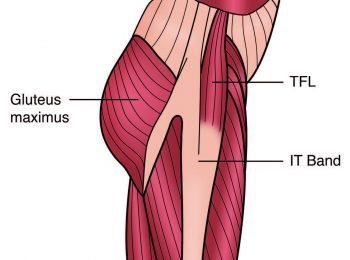
The general agreement is that the tensor fascia latae begins on the iliac crest which starts just lateral to the origin of the sartorious, or ASIS, and extends posteriorly along the iliac crest to combine several types of tissue into the iliac crest and onto the gluteal fascia. It�s been highlighted that the muscle provides multiple functions and contains anatomically distinct heads: the anteromedial, or AM, and the posterolateral, or PM, head.
Available research describes that the muscle has both a bony insertion onto the femur and a fascial insertion onto the iliotibial band, or more specifically, onto the region of the middle longitudinal layer of the fascia latae of the thigh, the iliotibial band.
Early studies perceived the ITB to be a ligament that connected the ilium with the knee in order to help maintain the balance of the body while in motion or when standing. Later studies demonstrated that human beings are the only mammals to own a distinct fascial lateral band down the thigh, indicating that the ITB may play a role in bipedal balance and stance.
Other studies demonstrated that the fascia latae of the thigh contains a multifaceted array of layers which all attach. The middle longitudinal layer, or MLL, of the fascia latae is a thick, connective tissue that originates on the iliac crest and extends downwards into various insertions. A large part of the MLL blends with the inner transverse layer of the fascia latae and is introduced directly onto the femur. The middle longitudinal layer also has superficial fibres that extend all the way down and insert into the knee.
Anteriorly at the hip, the MLL surrounds the TFL to ensure the muscle is effectively joined between the superficial and deep middle longitudinal layer. It also contains fibres which directly combines the superficial fibres of the gluteus maximus The MLL is joined in part to the gluteus maximus and in part to the TFL. As well as being enveloped by the middle longitudinal layer, some of the distal fibres of both heads of the TFL then insert into the MLL. The anteromedial fibres of the TFL fuse with the MLL and course down the thigh to introduce onto the lateral patella retinaculum. This is believed to influence the position of the patella in relation to the femoral trochlear groove.
Nevertheless, none of these tissues cross the knee joint, therefore they have no effect on motion at the tibia. According to research, the primary function of the muscles and tissues appears to be at the hip. Some of the fibres of the posterolateral tensor fascia latae together with the tissues of the gluteus maximus, contribute function for the MLL and attach all the way down onto the lateral tubercle of the tibia. These do cross the knee joint and may ultimately help stabilize the pelvis and the lower extremities.
Essentially, the MLL travels down the thigh and heavily combines with the inner transverse layer of the fascia latae as it is largely developed and dense within the upper third of the thigh. These transverse fibres run obliquely to anchor strongly to the femur, making up the deep and thick intermuscular septum of the femur. The septum effectively forms an osteo-fascial wall between the anterior quadriceps muscle group and the posterior hamstring muscle group.
Fibres from the inner transverse layer also allow the superior fibres of the gluteus maximus to develop an ascending tendon. The part of the tensor fascia latae that did not combine with the middle longitudinal layer of the tissue also combines with this rising tendon to insert directly onto the intermuscular septum and the femur. In other words, the majority of the TFL indirectly inserts onto the femur via the ascending gluteal tendon and indirectly via the blending of the MLL to the thick transverse layer.
Further down the thigh, the iliotibial band continues as a thickened section of the fascia latae, creating the fascial barrier between the anterior quadriceps and the posterior hamstrings. It then completely envelops the thigh, holding to the distal lateral femoral shaft through strong obliquely directed fibrous strands and follows the patellar retinaculum. Because these fibrous tissues divide the ITB into a proximal tendinous portion and a distal ligamentous portion, it�s been concluded that the tensor fascia latae has very little involvement in the mobility of the tibia and knee and its primary function is directed at the hip.
Function of the Tensor Fascia Latae
Anteromedial fibres (AM)
The main function of the anteromedial fibres is to flex the hip during open kinetic chain movements, such as hip flexion over the swing phase of gait, as confirmed through EMG and electrical stimulation experiments. The muscle is restricted upon heel strike which suggests that the muscle is required to be inactive to allow hip extension to occur during stance phase. The muscle is most active during the acceleration phase of running which also demonstrates its main role as a powerful hip flexor.
During pure open kinetic-chain movement, the AM fibres are most active in hip flexion movements as well as in abduction movements. It becomes restricted though, if the hip is externally rotated whilst abducting. This should be an important consideration when a healthcare professional is recommending specific hip rehabilitation exercises for the gluteal muscles and other hip external rotators.
Posterolateral fibres (PL)
The posterolateral fibres are most active during the stance phase of gait. This suggests that the muscle acts as a major hip stabilizer during single leg stance as it activates its role as a hip abductor. In this process, the superior portion of the gluteus maximus is also active during walking phase. Considering that the PL head has fibres that join the tendon from the superior gluteus maximus, this proposes that the posterolateral fibres and superior gluteus maximus cooperate to control the stability of the pelvis during stance phase.
Both the tensor fascia latae and gluteus maximus apply their role as a hip muscle through the contribution they have with the MLL, the deep transverse layer of the fascia latae and the intermuscular septum. They effectively insert onto the femur through this complex system of fascia and are considered muscles which begin at the pelvis which are introduced onto the femur. In pure open kinetic chain movements, the PL, or posterolateral fibres, are active in all hip internal rotation movements and in abduction movements. Similar to the AM fibres, the PL fibres remain restricted if the hip is abducting whilst in external rotation.
Function of the TFL at the Knee
A majority of the comprehensive studies examining the role of TFL in relation to the movements of the knee and the stability of the patella find it challenging to identify a direct function for the TFL in knee function. It almost certainly does not contribute to knee extension, flexion or rotation. As a result, all previous descriptions of the TFL being a synergistic knee extender with the quadriceps or an externally rotator of the tibia can almost certainly be rejected. It�s also been concluded that the TFL does not play an active role in pulling the patella laterally. The most likely role the TFL has in knee patella stability is indirectly, through maintaining the tension in the fascia latae and the distal portion of the ITB that combines with the patella retinaculum.
The TFL as a Fascial Tensioner
Several studies have demonstrated that the tensor fascia latae also functions to maintain fascia tension during movement. This is primarily due to a complex arrangement of fascial planes of various thicknesses which have development over the thigh. It has a loose anterior and posterior layer which cover the quadriceps and hamstrings. The loose anterior superficial layer of the TFL would gather during knee extension movements if there did not exist some manner of tensioning system for the fascia to maintain the fascial envelope. In the same manner, the posterior fascia latae would most likely gather during knee flexion movements.
Based on their anatomical arrangement with the fascia latae, the muscles which can maintain this fascial tension during knee movements include the TFL anteriorly and the superior gluteus maximus posteriorly. The TFL must then become slightly active during knee extensions to progressively shorten the fascia upwards whilst the knee is extended, to prevent the anterior fascia from creasing and twisting. Similarly, the gluteus maximus can maintain fascial tension during knee flexion movements.
The Tensile Force of the Femur
One of the most extraordinary roles assigned to the ITB is the role it has in reducing the bending and tensile force on the lateral femur. Humans walk on two feet, which means that during a section of the gait cycle, they are in a one-leg stance. This can create large lateral femur tensile forces and medial femur compression forces which, if not properly monitored, could develop a varus effect of the femur and essentially bend the femur.
During a study, researchers investigated the function of the ITB and concluded that the varus bending forces on the femur could be partially relieved by tensioning the iliotibial band. Other studies analyzed the stresses on the femur caused by the varus force on the bone and also found that by increasing the tension in the ITB, the lateral tension force and the medial compression force on the femur would both ultimately limited. The study also suggests that the TFL and gluteus maximus may add further tension to the ITB and lessen this lateral tension force on the femur.
TFL Complications
For all the TFL issues that affect many individuals, almost nothing exists in the literature that highlights the role this muscle has in dysfunction. All theories and ideas are based on clinical reasoning and assumptions. The most interesting observation regarding TFL complications is the role it has in causing hip internal rotation/flexion during the stance phase of gait.
Frequently, many individuals who report lower limb injuries caused by overuse or low back and sacroiliac joint pain are commonly diagnosed with an exaggerated hip flexion/internal rotation position during the functional movements of a single extremity. The stance suggests an internally rotated and flexed position.
This complication then develops what is known as a valgus collapse at the joint of the knee, directly affecting the Q angle of the knee. With an increase in the Q angle, the patella often tends to drag laterally and compress against the lateral femoral condyle. This may then lead to patellofemoral pain at the knee. This is believed to occur because the TFL maintains the stability of the pelvis during one-leg stance by beginning its abduction role. The tensor fascia latae may also display its hip flexion/internal rotation role. The gluteus maximus, and other hip external rotators, should provide and equal opposite external rotation/extension role.
The gluteus medius and minimus primarily function on the hip joint by contributing a compressive and stabilizing role. These work little to assist in maintaining a stable pelvic position. Instead, this role is assigned to the tensor fascial latae and gluteus maximus.
The TFL is a significant muscle in pelvic dysfunction because it has the greatest mechanical advantage to influence the pelvis and hip joint. It is the most anterior muscle at the front of the hip, as a result, it�s believed to have the greatest leverage advantage to encourage a flexion posture or an anterior tilt of the ilium. Observing the hip from the front, the tensor fascia latae is also the most lateral muscle on the hip. Therefore, it has the greatest leverage to affect abduction of the hip. This explains how such a small muscle can have such a large influence.
Furthermore, because the complex structures surrounding the lower back, buttocks, hip/pelvis and leg can become directly affected causing pain, irritation and inflammation as a result of TFL complications, other structures of the body can be greatly affected as well. The sciatic nerve is the largest single nerve found in the body and it runs through, the lower back, buttocks and leg. The nerve is tightly surrounded by muscles and other tissues. When these surrounding tissues are altered, the sciatic nerve can be easily compressed, causing symptoms of sciatica. Sciatica is described as a set of symptoms rather than a single condition. The most common symptoms of sciatica include: lower back/buttock/hip/leg pain, burning and tingling sensations, and numbness.
While the following tests can be used to determine the presence of TFL complications, a proper diagnosis can help differentiate whether the individual is experiencing sciatica as a result of tensor fascia latae dysfunction or due to another serious complication. Chiropractors are healthcare professionals who specialize in musculoskeletal and nervous system injuries and conditions. Chiropractic care offers a form of alternative treatment which uses spinal adjustments and manual manipulations to carefully diagnose a variety of injuries or conditions and decrease or eliminate the symptoms of sciatica which may also be associated with TFL. In addition, an individual may follow through with chiropractic treatment to also find relief from their tensor fascia latae dysfunction after determining its presence with the next set of tests.
Chiropractic for Sciatica Symptoms
Assessing TFL Issues
To properly assess the tightness in the TFL, utilizing an Ober Test or a Thomas test can help.
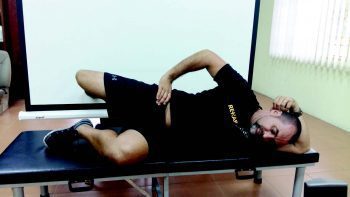
Ober test
Start position
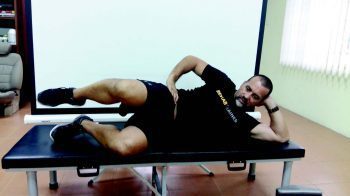
The individual must be positioned on their side with the unaffected side facing down. The pelvis and spine should be in neutral alignment with the bottom leg flexed for support. The uppermost leg is extended above the horizontal. The hip is then laterally rotated and extended, as long as no lumbar extension occurs.
Movement
The individual must actively flatten their waist towards the floor and hold their leg in slight abduction and lateral rotation. The individual will then be instructed to slowly and carefully lower their leg towards the floor until the tensor fascia latae and the iliotibial band hangs on the greater trochanter and cannot lower any further. The key to an accurate test is to not allow the pelvis to move, either into a lateral tilt, anterior tilt or rotation. As the leg lowers, the hip should not flex or medially rotate. It�s essential for the individual to maintain the laterally rotated position of the hip. Ideally, the leg should lower into at least 10 to 15-degree adduction without losing the proximal control of the pelvis or hip. The tensor fascia latae and iliotibial band may lack elasticity if the leg does not adduct sufficiently.
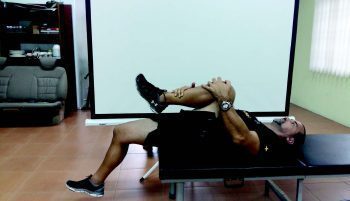
Thomas test
On a plinth, the individual should lie supine with the untested leg held in hip flexion. The tested leg is then forced into extension and adduction. If the tested leg is unable to attain a horizontal alignment and is held in flexion and/or abduction, this is indicative of tightness in the tensor fascia latae.
Managing TFL Issues
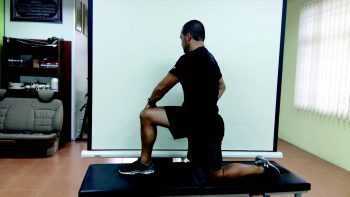
To manage the overactive or tight tensor fascia latae, 2 important criteria must be met. First, it must be stretched and then, it must be massaged and manipulated. The most effective stretch for the TFL is the knee-down hip flexor stretch.
To stretch the left TFL, first, the individual should kneel on the left knee with the right leg at 90-degrees hip flexion and knee flexion. Second, the individual must push their left hip forward until the slack is taken up. Third, by placing the hands on the right thigh, the individual will follow by twisting the trunk around to the right whilst the pelvis remains facing forward, inducing an external rotation of the hip to add to the rotation component of the stretch. Then, if the individual has any slack left, they must push their left leg outwards. Finally, the individual must isometrically contract the right hamstring by attempting to drag the left heel backwards. To stretch the right TFL, the same procedures should be followed but using the opposite leg.
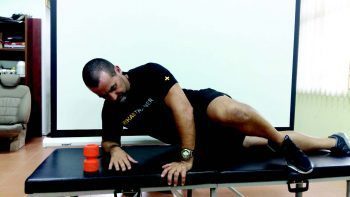
To self-massage or trigger the TFL, the individual should lie on their side and place a trigger ball/Muscle Mate/Posture Pro under the tensor fascia latae in order to apply gentle pressure. The hip, knee and ankle should remain in a straight line with the body. This can be performed as a rolling type movement or as sustained pressure to relieve the trigger points within the muscle, ultimately helping to reduce the painful symptoms associated with TFL dysfunction, among other serious complications which may need medical attention as soon as possible.
Treating Sciatica
They symptoms of sciatica can greatly restrict an individual’s ability to function properly throughout their everyday lives and, as for athletes who participate in rigorous training and competitions, healing the symptoms can be utterly important in order for them to perform effectively in their specific sport or physical activity. There are numerous ways to treat sciatica, however, chiropractic care is among one of the most popular and effective forms of alternative treatment to help individuals recover from their specific injuries and/or conditions.�
For more information, please feel free to ask Dr. Jimenez or contact us at 915-850-0900 .
Chiropractic Adds Vitality to Life! It is safe and gentle with a stellar track record of successful outcomes for newborns, moms-to-be, athletes, parents, aging seniors and children of every age.
Despite its successful history, we understand that sometimes practice members have some anxiety before their first treatment due to fear of the unknown. We promise to make sure that you�re comfortable and relaxed before your first adjustment.
It�s important to us that you have a positive and enjoyable experience as you work toward achieving optimum health. We put that focus into action hundreds of times a week with our practice members.
We can assure you that after your first adjustment, you�ll experience one of three things:
1. Many will feel an immediate shift to feeling looser with less tension.
2. Some will take longer to notice a difference if the problem has been there for a long time.
3. A little bit of soreness or stiffness the following day for some people. However this will subside, and almost all practice members experience an array of unexpected benefits as they continue with their care plan, including better sleep, calmer digestion, improved alertness and enhanced immune system function.
Chiropractic & Pregnancy
Chiropractic & Athletes
Chiropractic & Seniors
Chiropractic Care
Through the use of our specific, gentle adjusting techniques, we�re able to effectively correct spinal alignment patterns, helping to create comfort and stability as it relates to spinal mechanics and function. We also offer custom-made orthotics.
Here are some of our more common adjusting styles that can be tailored to the individual preferences of each practice member
Activator Methods�: Through the use of a handheld instrument, this technique delivers a light, low-force adjustment to the spine. We use this method primarily for those patients who are more delicate or sensitive, along with a similar instrument device called The Impulse.
Diversified: This is a classic chiropractic technique that uses hands-on, manual adjusting.
Thompson Drop Table:�This is an effective technique for those practice members that prefer a light-force style of adjusting. The specialized table features neck, chest and pelvic pieces that have the capacity to drop during the adjustment.
One of Our Favorite Success Stories
Dr. Don has a favorite story about one of the longtime members of the practice. As he walked into the room to adjust her for the first time, the woman glanced up at him and burst into tears. Her fear was palpable.
After Dr. Don gently reassured her, she received her first adjustment. Her response? �Wow, that wasn�t bad at all!�
These words are familiar to us, and this particular woman has been a part of our South Side Chiropractic�family now for almost a decade, returning to an active life that she believed was lost to her.
We work hard to obtain your trust, and nothing makes us happier than to partner with you in achieving your health goals.
Having a chiropractic treatment is one of those options that are not usually covered by your medical insurance. This leads to people being shy of this practice and usually fearing the doctor�s bills, they avoid getting a treatment as a whole. This should not be the case at all. Keeping yourself healthy is very important and nothing should stop you from leading a good, active life.
When a patient wants to give up on the treatment he or she is getting due to some issue, for their affected area, it does influence the doctor as much as it disturbs the patient�s recovery process. A doctor has put a lot of effort in making the patient feel better and to leave the treatment midway will also impact the patient adversely. It can result in the patient�s wellbeing going back to where it was before. Just so the patient can take care of themselves even if a doctor is not readily accessible , here is a list of exercises that they might do just to keep the condition from getting bad again.
These exercises will not only help you relax and unwind but also avoid the unnecessary weight gain. All of these exercises are easy to do and even a few can be done in your office, in between classes, or while spending a few minutes at the park.
Low Back Pain Exercises:
Table top. The table top exercise requires you to kneel on all fours, and then lift one of your legs as straight as you can go. The more you do it the more you will be able to lift your leg straighter. Extension exercise.� While lying head down, you must move your head upward but not let your back bend. Do this stretching, until you feel a stretch on your hamstrings. That is as high as you should go. Child�s pose. �Lay yourself in the position that your knees are wider apart than your hips. Turn your toes into touch and push your hips backwards as if in a bow and then stretch your hands forward in a relaxing position. Neck Pain Exercises:
These following neck exercises provide you with a relief for neck pain. In fact, they are so easy to do that they can be done during your office or classes. This workout will definitely help anyone trying to increase their productivity during a long day.
Trap-stretch exercise. All you have to do is lie or stand or sit and bend your head to one side and use your hand on the same side to touch your ear of the other side from over your head. Head Drop. You must take your head as back as possible with your chin pointing towards the ceiling. Don�t bend your back. And don�t stress your neck too much. Turn your head in the way that your nose touches your shoulders, but do not move your shoulders. Do it both sides. Shoulder Pain exercises:
Shoulder Shrug. As the name suggests, you shrug your shoulders. While you are standing or sitting up straight, you lift your shoulders up to your ear length and then while exhaling you let them down. Shoulder blade Pinching. Either standing straight or sitting straight, take your arms to the back and inhale. When you feel your back skin pinching that is when you exhale and bring your arms forward. Here you have it, a few exercises that will get you through your day and will help you in overcoming the pain. If you have any difficulty in figuring out whether you really have chiropractor then you must consult a specialist. However, it is also recommended that you must see a chiropractor regularly if you want to get full recovery.
Dr. Alex Jimenez D.C.,C.C.S.T’s insight:
Chiropractic�Exercises�can help you relax, unwind and help with�unnecessary weight gain. All of these exercises are easy to do and can be done in your office, in between classes, or while at the park.
Whiplash-associated injuries can occur in a variety of settings where any form of accelerated motion may cause the head and neck to jerk back-and-forth with tremendous force against the entire body. Trauma from a slip and fall or an accident from sports or physical activities have been demonstrated to result in neck injuries such as whiplash, however, automobile accident injuries are the most prevalent cause of whiplash-associated injuries.
The sudden thrust of the head can damage or injure the complex structures which surround the cervical spine, often leading to the severe irritation and inflammation of the tendons and ligaments in the neck. In addition, other tissues as well as the tendons and ligaments of the cervical spine may become overly stretched and torn.
A neck injury can be identified if the victim involved in an automobile accident experiences symptoms such as: neck pain and stiffness; worsening pain with movement; loss of range of motion in the neck; headaches, most generally originating at the base of the skull; tenderness or pain in the shoulder, upper back and/or arms; tingling or numbness in the upper extremities, fatigue and dizziness. Other symptoms include: blurred vision; ringing in the ears; sleep disturbances; irritability; difficulty concentrating; memory problems; and even anxiety and depression. While these are some of the most frequently reported symptoms associated with a whiplash injury, these symptoms may also suggest the presence of another type of injury or condition.
Therefore, it�s fundamental to seek immediate medical attention from a qualified auto accident injury specialist who can properly identify a whiplash or neck injury and follow with the recommended treatment to eliminate the painful symptoms and restore the individual’s overall health and wellness.
Dr. Alex Jimenez D.C.,C.C.S.T’s insight:
Chiropractic care has been utilized as an alternative treatment option for injuries or aggravated conditions resulting from an automobile accident. Aside from property damages and lost wages from missed days at work, an auto condition can have serious effects on an individual’s health if left untreated. Chiropractic focuses on restoring the victim’s original state of well-being as well as promoting a faster recovery. For more information, please feel free to ask Dr. Jimenez or contact us at (915) 850-0900.�
Having a chiropractic treatment is one of those options that are not usually covered by your medical insurance. This leads to people being shy of this practice and usually fearing the doctor�s bills, they avoid getting a treatment as a whole. This should not be the case at all. Keeping yourself healthy is very important and nothing should stop you from leading a good, active life.
When a patient wants to give up on the treatment he or she is getting due to some issue, for their affected area, it does influence the doctor as much as it disturbs the patient�s recovery process. A doctor has put a lot of effort in making the patient feel better and to leave the treatment midway will also impact the patient adversely. It can result in the patient�s wellbeing going back to where it was before. Just so the patient can take care of themselves even if a doctor is not readily accessible , here is a list of exercises that they might do just to keep the condition from getting bad again.
These exercises will not only help you relax and unwind but also avoid the unnecessary weight gain. All of these exercises are easy to do and even a few can be done in your office, in between classes, or while spending a few minutes at the park.
Low Back Pain Exercises:
Table top. The table top exercise requires you to kneel on all fours, and then lift one of your legs as straight as you can go. The more you do it the more you will be able to lift your leg straighter.
Extension exercise.� While lying head down, you must move your head upward but not let your back bend. Do this stretching, until you feel a stretch on your hamstrings. That is as high as you should go.
Child�s pose. �Lay yourself in the position that your knees are wider apart than your hips. Turn your toes into touch and push your hips backwards as if in a bow and then stretch your hands forward in a relaxing position.
Neck Pain Exercises:
These following neck exercises provide you with a relief for neck pain. In fact, they are so easy to do that they can be done during your office or classes. This workout will definitely help anyone trying to increase their productivity during a long day.
Trap-stretch exercise. All you have to do is lie or stand or sit and bend your head to one side and use your hand on the same side to touch your ear of the other side from over your head.
Head Drop. You must take your head as back as possible with your chin pointing towards the ceiling. Don�t bend your back. And don�t stress your neck too much.
Turn your head in the way that your nose touches your shoulders, but do not move your shoulders. Do it both sides.
Shoulder Pain exercises:
Shoulder Shrug. As the name suggests, you shrug your shoulders. While you are standing or sitting up straight, you lift your shoulders up to your ear length and then while exhaling you let them down.
Shoulder blade Pinching. Either standing straight or sitting straight, take your arms to the back and inhale. When you feel your back skin pinching that is when you exhale and bring your arms forward.
Here you have it, a few exercises that will get you through your day and will help you in overcoming the pain. If you have any difficulty in figuring out whether you really have chiropractor then you must consult a specialist. However, it is also recommended that you must see a chiropractor regularly if you want to get full recovery.
Chiropractic�Exercises�can help you relax, unwind and help with�unnecessary weight gain. All of these exercises are easy to do and can be done in your office, in between classes, or while at the park.
IFM's Find A Practitioner tool is the largest referral network in Functional Medicine, created to help patients locate Functional Medicine practitioners anywhere in the world. IFM Certified Practitioners are listed first in the search results, given their extensive education in Functional Medicine




 �We may see a one-week-old child who is already showing signs of favoring, turning her head to one side versus the other,� says Dr. Judy Forrester, owner of Synergea Family Health Centre, a multidisciplinary clinic in Calgary, Alta. �That may seem minimal� but if we can determine any imbalances or asymmetry with the muscular function or the joint alignment, and we address it early, it�s better. Once those postural patterns and habits develop as they grow, they can be much more difficult to change.�