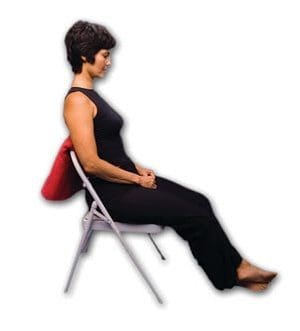
Thousands of Americans work in jobs that afford them the privilege of sitting for the majority of the day. But being on your rear all day comes with some health concerns.
Unsurprisingly, the best way to counteract these issues is to get up and move � as frequently and for as long as you can. When you do have to be in your seat, however, good posture is key to preventing the sore muscles, strained eyes, and poor circulation that frequently accompany a desk job.
According to the Cleveland Clinic, which is considered one of the world’s top hospitals, there’s an easy way to find a healthy sitting position. It involves four basic steps that, assuming you’re reading this on a tablet, phone, or computer screen, you can try right now:
Finding a Healthy Sitting Posture
First, sit at the end of your chair (that’s right, don’t rely on your backrest). Let your body go into a slouching position. Now, try to sit up straight, accentuating the curve of your back as much as possible. Hold this position for a few seconds. Next, release the position a little bit � Cleveland specifies that you shouldn’t move more than about 10 degrees. This should be your sitting position!
Now that you’ve got it, make sure the rest of your body is in the proper alignment to ensure you’re not cutting off your circulation or straining any other joints. Make sure your body weight is evenly distributed across your seat. Then, check your knee position. They should be bent at roughly a right angle, uncrossed, with your feet flat on the floor.
If you’re in an office, you can adjust your chair height and desk so that you sit fairly close to your screen. Your elbows and arms should rest either on your desk or your chair’s armrests, and your shoulders should be relaxed. If you’re on a rolling chair, you should avoid twisting at the waist and pivot your whole body instead, the Clinic adds.
Doing this every day will help protect your joints, ligaments, bones, and muscles, and can also help you feel more energized throughout the day, since your muscles are being used more efficiently.
The scope of our information is limited to chiropractic and spinal injuries and conditions. To discuss options on the subject matter, please feel free to ask Dr. Jimenez or contact us at 915-850-0900 .
Additional Topics: Preventing Spinal Degeneration
As we age, it’s natural for the spine, as well as the other complex structures of the spine, to begin degenerating. Without the proper care, however, the overall health and wellness of the spine can develop complications, such as degenerative disc disease, among others, which could potentially lead to back pain and other painful symptoms. Chiropractic care is a common alternative treatment option utilized to maintain and improve spine health.
In ballet training, the barre is the horizontal handrail dancers grip while perfecting their technique. Barre-style workouts take those classic ballet warm-up exercises and reimagine them for a much wider audience.
While it may seem like a recent phenomenon, barre strength and flexibility training have been in vogue since the times of Louis XVI, says Ginny Wilmerding, a research professor at the University of New Mexico. The modern-day version is primarily a leg-and-butt workout; from your ankles and calves up through your knees, hips and glutes, barre movements are all about improving range of motion, strength and flexibility in your lower half by forcing one of your legs to perform graceful and precise movements while the other supports and stabilizes you, she says.
The sales pitch for all of that excruciating precision is that if you want a dancer�s body, you should train like a dancer. �I mean, who doesn�t want to look like a prima ballerina?� says Michele Olson, a professor of exercise physiology at Auburn University, Montgomery. �You�re talking about nice, lean muscle tone and perfect posture.�
But just as going to football practice won�t make you look like a linebacker, barre training is more likely to help you achieve a ballerina�s muscle endurance and balance than her body shape.
Those are valuable assets that do not come with every workout. Unlike muscle strength, endurance determines your muscle�s ability to work for long periods of time. (Strength may allow you to lift a weight, but muscle endurance dictates how many times you can lift it.) Barre is also effective at targeting the �support and steady� muscles that run close to your bones and tie into your core and spine�the ones most of us neglect when we spend a lot of time sitting or engaged in forward and backward activities like running, says Olson. �Real 360-degree balance involves a lot of those side-to-side muscles a lot of us don�t use much, and so they become weak,� she says.
Barre is also low impact and has a built-in handhold, making it a relatively safe form of exercise. Especially for older people at risk for falls, barre may be a good way to improve stability and avoid accidents.
But the workout is not without risks, especially for the back and knees. One example: �Ballerinas are taught to tuck the pelvis so that the low back that normally curves inward loses its curve and looks straight,� Olson says. While dancers do that for their art, tucking the pelvis can lead to back pain and injuries for the average exerciser.
Most barre classes have abandoned that sort of strict pelvis-tucking, but Olson says some classes still include extreme pli� knee bends that can increase a person�s risk for knee injury. Especially if you decide to go for a run right after your barre class, the �excessive� amount of pressure that some barre moves place on your knees could lead to sprains or strains.
�There are some things dancers do that others have no need for,� says Wilmerding, who advises to take the training slowly and to focus on form, rather than trying to get an intense muscle or cardio workout from the practice. Like tai chi, �you�re working on stability and flexibility and strength, but you have this higher goal of control and aesthetics.�
Another point to keep in mind is that even though barre class brings a good core workout, you may be torching fewer calories than you think. One of the few published studies that has looked at barre�s cardiovascular and metabolic demands found that the activity�at least in its traditional form�doesn�t burn many calories and more closely resembles walking than running in terms of its intensity.
�Like any form of exercise, I think you need some variety,� Olson says. �Do it three to five days a week if you want to get the most out of it, but do something different with a cardiovascular component on the other days.�
Nicole Dunson (UTSA), Michael Madrid (San Jacinto College) and Lori Morris (Southwestern College) will venture to the Sun City to join the UTEP women�s basketball program as full-time assistant coaches, head coach Kevin Baker announced Tuesday.
The group brings wide-ranging experience to a UTEP program that has produced the third-highest winning percentage in the state of Texas since 2006-07.
�I am beyond excited about the coaching staff that we were able to put in place,� Baker said. �I consider this to be an all-star cast of coaches. All three of our new staff members worked hard to build their careers the old fashioned way. They earned it. My goal was to surround myself with the most talented, hardest working, and well connected coaches available. I feel that we now have a coaching staff in place that will rival any other program in the nation.�
A bio on each of the individuals, along with a quote by Baker, follows below.
Nicole Dunson
UTSA, 2005/2007
Dunson joins UTEP after spending the past four years as an assistant coach with Conference USA rival UTSA. She oversaw the guard development while also aiding in the day-to-day responsibilities with the squad. �She helped the Roadrunners make a smooth transition into C-USA; they piled up 54 total wins in that time frame while also garnering a fourth-place finish (2014-15) and a seventh-place showing (2016-17).
Prior to returning to her alma mater, Dunson enjoyed a successful two-year run as the head girls� varsity basketball coach at Richard King High School in Corpus Christi. She guided her charges to the 2011-12 District 28-5A Championship in addition to a berth in the state playoffs in each of the seasons. The Corpus Christi native also was selected to coach in the 2013 CBCA All-Star Game.
Her initial head coaching experience came at the helm of San Antonio�s Hartlandale High School girls� basketball program. She also was the head junior varsity track & field coach while also serving as a health and physical education teacher. Dunson embarked on her coaching career as head coach for the girls U14 Shooting Stars Basketball AAU program in 2006.
As a student-athlete Dunson played two years with UCF before transferring to UTSA. She sat out the 2002-03 season due to NCAA transfer rules and the following campaign while recovering from a right knee injury. Dunson proved to be worth the wait, accounting for 8.8 points/game while draining 42 percent from 3-point range in her first year. Upon the conclusion of her senior season she was chosen as the 2005-06 Southland Conference Women�s Basketball Student-Athlete of the Year. She drilled 44.1 percent from distance to place 18th nationally. Moreover she garnered the Arthur Ashe Jr. Sports Scholar award in 2006 and was named a CoSIDA/ESPN The Magazine Academic All-District VI honoree. To this day Dunson holds the UTSA single-season and career mark in 3-point field goal percentage.
Dunson earned her degree in biology from UTSA in 2005 before going to secure a master�s degree in education with an emphasis in sports psychology two years later.
�Everything about Nicole Dunson screams winner and success. Nicole is the type of coach who has worked for everything she has ever gotten in the game of basketball. She was a very hard working and successful player that battled injuries and overcame them. She cut her teeth at the high school level and earned a place on staff at UTSA. �From there she became a fantastic recruiter and on-the-floor coach. The amount of impact she will have in our program will be immeasurable. Nicole is one of the most talented up-and-coming coaches in the country.� �UTEP head coach Kevin Baker
Michael Madrid
Eastern New Mexico, 1998
Madrid has an impressive resume with ample experience at both the high school (10 years) and college levels (13 years). Most recently he put together a record-setting run in two years with San Jacinto College while forging a combined record of 46-20. In 2016-17 the squad rolled to a mark of 24-9 while making the NJCAA Tournament for the first time in the college�s history. San Jacinto went 22-11 in 2015-16 and earned the Region XIV Tournament Runner-up honors, which at the time was the farthest any women�s basketball team at the college had ever advanced. The squad knocked off nationally-ranked Trinity Valley to secure the spot in the title tilt before ultimately falling to Blinn College.
Prior to this tenure at San Jacinto, he won 24 games in his first opportunity to serve as a head coach over two season with Paris Junior College. Immediately beforehand he was an assistant coach at Texas Woman�s University for a trio of seasons, helping the Pioneers win their first Lone Star Conference tournament championship in any sport and advance to the National Collegiate Athletic Association South Central Region tournament.
His coaching career started at New Mexico�s Portales High School, which culminated with the squad taking home the 2001 Class 3A championship. After one year with Lubbock Estacado High School as a boys� football, track, and basketball coach, he coached boys� basketball for two years at Lubbock High School. Madrid then served five years-one as a graduate assistant and four as an assistant coach- at Lubbock Christian University. The team advanced to the NAIA National Championships Tournament all five years, including being the national runner-up in 2005-06. It also won the 2006-07 Sooner Athletic Conference title.
Madrid earned a bachelor�s degree in special education from Eastern New Mexico University in 1998 before receiving his master�s degree in sports administration in 2001. He also holds a master�s degree in education administration from Lubbock Christian University. Madrid and his wife, Sammie, have a daughter (Ryan).
�Michael is the total package. He is a talented recruiter and a very accomplished head coach. He started out in the high school ranks and worked his way up the ladder. Michael has consistently signed outstanding players throughout his career and has a solid grasp on what wins games at the collegiate level. Michael will help our program on the floor tremendously, on the road recruiting quality players, and in the community at large.��UTEP head coach Kevin Baker
Lori Morris
University of San Diego, 1984/Azusa Pacific, 1990
Morris has spent the past two seasons as head coach for Southwestern College, but jumped at the opportunity to get back into the DI ranks. She was an assistant coach/recruiting coordinator for two years at Air Force (2013-15), worked with the CSU Fullerton program for a year (2012-13) and spent four season at Louisiana (2008-12), three of which as the associate head coach.
�
Before her time with ULL Morris was the head coach at Southwestern Junior College for one year (2007-08). In addition to the standard duties commensurate with the position, she was responsible for conditioning, weights, study hall and grade checks. She also taught Basketball Theory, Basketball Activity, Film and Intercollegiate Basketball at SWJC. Morris was also extremely involved with the community, and even opened a basketball player development class for high school players along running mini clinics.
Prior to entering the collegiate ranks Morris had an outstanding 20-year run as the head coach of the Montgomery High School girls� basketball team from 1987-07. She assumed the position after serving as an assistant coach in 1986-87. She developed 18 players who went on to compete at either the junior-college or university level. Morris guided MHS to Metro League Championships in 1990, 1995, 1996 and 1997, Mesa League Championships in 2002 and 2005 and the Southbay Championship in 2007. MHS also secured a pair of runner-up accolades in the California Interscholastic Federation Division. She was voted as a coach of the year on multiple occasions.
Morris was a standout player at San Diego (1980-84), concluding her career ranked second all-time in assists (480). Morris continues to rank second in helpers, while also garnering top-10 placement in the career records for assists per game (4.2/3rd), field goal attempts (1,070/5th), steals (177/5th), steals per game (1.55/9th) and assist-to-turnover ratio (1.46/9th). She paced the Toreros in assists all four years, including 162 in 1981-81 (third in USD single season) and 129 in 1983-84 (fifth in USD single season).
She received her bachelor�s degree in language arts from San Diego in 1984 and earned her master�s degree in education with an emphasis in administration from Azusa Pacific in 1990.
�Lori Morris is the kind of coach that any staff in America would be fortunate to bring on board. Lori brings over 30 years of experience to the table as a high school coach, junior college coach, Division I recruiting coordinator, and a Division III head coach. �Lori has coached all over the country and has built up a network of coaches and a trusted coaching tree that one must have to be successful at this level.�Lori has great energy and work ethic which benefit our program and our players.�-UTEP head coach Kevin Baker
SAMMAMISH, Wa.- The UTEP men�s golf team finished day one of the 2017 NCAA Washington�Regional in 11th place, shooting 13-over 297 at the Aldarra Golf Club (par-71/6,885 yards) in Sammamish, Wash. Leading the 14-team field is Florida State with 6-under 278, who entered the tournament as the fourth seed.
The country�s top-ranked team in�Southern California is two strokes behind the leader with 4-under 280 and the Trojans� Sean Crocker leads the field�individually�with 7-under 64. Round two will begin tomorrow at 9 a.m. MT.
The top five teams from each of the six regional sites will advance to the national championships at Rich Harvest Farms in Sugar Grove, Ill. on May 26-31.
�We played the par-5s terrible today,� sixth-year head coach Scott Lieberwirth said of his team�s performance.��It�s a difficult course, we had at least six�bogeys, if not more on par-5s and out here you can�t do that. Charlie [Corner]�had a nice round�and Aaron [Terrazas]�hung in there pretty tough, but after that we really couldn�t get anything going. We�ve kind of prided ourselves�on�our consistency top to bottom, but�we didn�t get that today. We had two guys that played well and the rest didn�t show.�
Charles Corner led the Miner squad with a round of 70 to sit in a tie for 10th place. The junior birdied on holes no. 5, no. 11, and no. 17, while only bogeying twice to complete the opening round as the only Miner to shoot under par. Corner is also tied for third in par-4 scoring (3.78, -2).�Aaron Terrazas is in a tie for 27th with 2-over 73, while matching Corner�s birdies with three of his own�no. 7, no. 9, no. 13. Terrazas is tied for third in par-3 scoring (2.80, -1) and bogeyed five times.
In an unusual spot is senior Frederik Dreier, who sits just outside of the top-50 in a tie for 52nd with 5-over 76. Dreier, who is ranked no. 93 in Golfstat rankings, collected a birdie on hole no. 7 and�bogeyed six times. Nicklas Pihl shot 7-over 78 for a share of 62nd, while Andreas Sorensen is one stroke behind with 8-over 79 to tie for 67th. Pihl collected two birdies on holes no. 12 and no. 13, while also tying for third in par-3 scoring (2.80, -1).
�We have to do a better job of executing,� Lieberwirth said. �We�ve got a better feel for the golf course now, that will help. We know the types of shots we have to hit, we just have to do a better job. We were kind of all over the place, missing in spots that we shouldn�t have missed and making life much harder than it should have been.�
The tournament will run through Wednesday, live stats will be available via golfstat.com
Dr. Jimenez has treated hundreds of pregnant individuals over the years. �He touches on questions about treating pregnant patients in our borderland region. �Is it ok? �Are there dangers?
There is a big debate over the merits and safety of having chiropractic treatment during pregnancy. Some people claim that it is dangerous to both the mother and the developing baby, while others say it is safe and provides a variety of health benefits.� The truth is that mothers that receive chiropractic care tend to have an easier pregnancy and delivery.� This article from our El Paso chiropractic team will help to provide you with the information you need.
Chiropractic and Pregnancy
Just as it is safe and beneficial for infants, toddlers, teens and adults, chiropractic is also safe and beneficial during pregnancy. There is no danger to the baby and the benefits for the mom-to-be are quite substantial. Most El Paso chiropractors that go through the proper training, and have all of the required education to be licensed and practicing, have been trained to treat pregnant women. Some chiropractors specialize in adjusting pregnant women which means they may have more experience, but the majority have the necessary skills and knowledge.
Any woman that has been pregnant knows the stress that is put on your back, neck, hips, and knees. Even performing everyday tasks becomes a challenge as the uneven weight distribution can pull certain areas out of balance. Having regular chiropractic adjustments during your pregnancy will relieve much of the added stress placed on your spine, and can prevent nerves from being compressed and causing pain, numbness or tingling in your back, hips, legs, arms, or fingers. Since your posture is continuously changing as your belly grows, regular adjustments may also help with any imbalances this might create.
Tips You Can Follow
Chiropractic adjustments are great to keep your body balanced and feeling great during pregnancy, but you can do a lot to help yourself. Exercises like walking and swimming will keep the blood flowing and keep your muscles working during the course of the pregnancy. It�s important to stay safe, so check with your doctor if you�ve been inactive prior to becoming pregnant.
Avoid wearing heels while you�re pregnant because you�ll be less steady and they can accelerate any postural imbalances you might experience. Stick with flat sensible shoes whenever possible. Also be sure to observe proper lifting techniques for children or other objects. Bend from your knees at all times and if it seems too heavy, ask someone else to lift it for you.
To remove pressure from your lower back while sleeping, lie on your side with a pillow between your knees. If you have to sit at a desk during the day, use a footrest to take pressure off your feet and legs and try not to sit for longer than 30 minutes at a time without getting up and moving around. Schedule chiropractic treatments after you give birth to help with the healing process, as all your muscles, tendons, and ligaments are returning to normal.
Fans who purchase or renew UTEP football season tickets by Friday, June 2 will have access to special privileges, including the ability to purchase tickets to the Miners� season opener at Oklahoma while supplies last.
UTEP will kick off the 2017 campaign versus the perennial national power Sooners on Sept. 2 in Norman.
By meeting the June 2 deadline, fans will also receive two free tickets to UTEP�s home opener against Rice on Sept. 9.� Fans who pay in full by June 2 will also enter a drawing to travel with the Miners to a road game this fall.� Accounts renewed by the deadline will receive the same donor parking from last season.
UTEP season tickets start at just $55 for five home games � Rice, Arizona (Sept. 15), WKU (Oct. 7), UTSA (Oct. 28) and LA Tech (Nov. 18).
Doctor of Chiropractic, Dr. Alexander Jimenez shares some insights about a pain free workday.
#1. Use�Healthy Posture & Movement Patterns
Considering all the emphasis on how little or much we should sit or stand at work, there is almost no discussion of technique in standing and sitting. Inferior technique slumpsitting, archsitting, parking weight is used by many people so on, and poorly on joints.
As long as this is actually true, any place is going to stack up badly in the research�we are starting to see it for standing and �ve seen this for sitting. Sitting has been much maligned as �the new smoking�; and now standing as a replacement is being demonstrated to cause increased hospitalization due to varicose veins, atherosclerosis that is increased, etc. A good starting point is stretchsitting, to start the journey back to a pain free workday. Stretchsitting is simple, safe, comfy, and therapeutic.
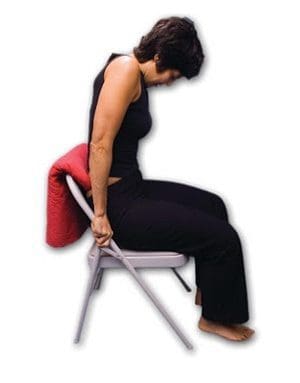
Work with flannel, a towel, or a Stretchsit pillow so it contacts you at mid-back, below the shoulder blades.
Scoot your bottom all the way back in the seat.
Lean forwards from the hips, like a mini crunch is being done by you, and tip your ribcage forward.
Push downwards on the armrests/side bars/seat pan of your chair to get a soft stretch in your lower back.
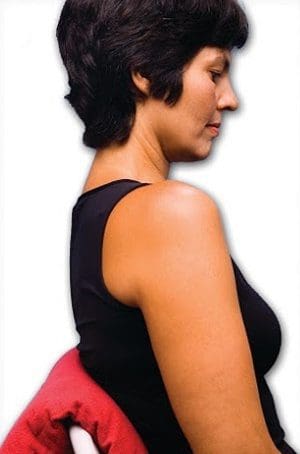
Keeping the stretch, lean back out of your hips and adhere your mid back on to the Stretchsit pillow/towel.
Relax completely, letting the Stretchsit pillow and come from the mini crunch /towel keep you in traction that is light.
Roll each shoulder back and rest your hands close into your own body.
Angle your chin down slightly, letting the back of your neck be long.
(a) Lean forward from the hips, and tilt your ribcage forward, like you are doing a mini-�crunch. (b) Push downwards on the armrests/side bars/seat pan of your chair to get a gentle stretch in your lower back. (c) Keeping the stretch, lean back from your hips and stick your mid-�back on to the Stretch-sit cushion/towel.
(a) Come out of the mini�crunch and relax completely, letting the Stretchsit cushion/towel keep you in mild traction. (b) Roll each shoulder back and rest your hands close into your body.
Angle your chin down slightly, letting the back of your neck be long.
#2. Vary�Your Baseline Posture
No matter how good your bearing, your body still needs a variety of places. Sitting and standing are the most practical positions for most occupations (example computer occupations)�I recommend switching between them every 20- 30 minutes. If other positions and motions are practical for doing your job (eg, walking when speaking on the phone), that�s an excellent bonus�the more baseline stances and movements, the better. (one sitting against backrest, one stack sitting, standing in a desk, and walking with telephone)
Sitting against the backrest.
Stack sitting
Standing at a desk.
Walking while talking on a cell phone.
#3. Supplement With Rest, Exercise, Movement During & Outside The Workday
Use your breaks in the workday along with your time away from work to supplement your special service line spots. Do you need rest? Exertion? Stretching? Strengthening your abdominal muscles?… There are countless tissues and muscles within your body that have needs just like you are served by a diet that is diverse well, a movement regimen that is varied will also.
#4. Use Well – Designed Tools & Furniture
Experiment and learn with what constitutes furniture that is healthy this is an investment in the way you’ll be spending about half your waking life.
IFM's Find A Practitioner tool is the largest referral network in Functional Medicine, created to help patients locate Functional Medicine practitioners anywhere in the world. IFM Certified Practitioners are listed first in the search results, given their extensive education in Functional Medicine