Watch this video and follow along as celebrity instructor and Health contributing editor Kristin McGee guides a 10-minute Pilates workout that�s perfect for beginners and pros alike.
During this sequence, McGee focuses on targeting your abs, especially the transverse abdominals, the deepest layer of muscle in your core. According to McGee, we should lead all of our daily activities from those muscles. They support us, give us good posture, and help us with twisting and movement. Plus, that deep transverse core muscle is what helps make your spine nice and long.
As you do this workout, there are a few crucial things to keep in mind. For starters, tune into your body, and really try to feel the connection both to your pelvic floor muscles and to your transverse abdominals. McGee suggests imagining you�re wearing a wetsuit, and it�s pulling everything in your torso inward.
While your core and pelvic floor should feel tight and engaged, be sure to keep your shoulders soft. It also helps to maintain a slight �C curve� in your spine, which allows your lower abs to be pulled even farther in, helping to activate and tone them.
Finally, use your breath to connect to your pelvic floor muscles and scoop in your abs as you go through each move.
Some of the moves may seem really subtle and simple�but don�t be fooled! This sequence is sure to have your abs aching the next day, in the best kind of way.
Water is a better bet than sports drinks for young athletes, sports medicine specialists say.
Most youngsters don’t exert themselves at an intensity or duration that requires the extra sugar and salt contained in sports drinks, said Dr. Matthew Silvis. He is director of primary care sports medicine at Penn State Health Medical Center.
“Sports drinks can replenish some of what you lost during exercise, but you really need to be exercising for more than 45 minutes to an hour before you would consider that,” Silvis said. “Many of our kids are not doing enough to warrant it,” he added in a university news release.
Also, giving children sports drinks with extra sugar puts them at risk for weight gain and tooth decay, Silvis and his colleagues noted.
Water Over Sports Drinks
Dr. Katie Gloyer is a primary care sports medicine physician at Penn State Medical Group, in State College. She agreed that “kids and adolescents really should not be using these drinks. Water is the best method of hydration.” Energy drinks that contain caffeine or other stimulants are also ill-advised for children, the physicians said. These beverages can boost blood pressure, cause heart palpitations and heart rhythm disorders, headaches and upset stomach.
Some kids may also feel jittery or nervous after downing an energy drink, the experts added. Coaches and parents should provide water to make sure children are properly hydrated during exercise, the doctors said.
“If they are playing 30- or 45-minute halves, they should have a water break, and maybe add fresh orange slices or a granola bar to add a bit of sugar and/or protein at an appropriate level,” Silvis said.
After exercise, whole or low-fat chocolate milk works just as well — if not better — than recovery drinks. “Chocolate milk has the perfect combination of fat, proteins and carbohydrates that you want to get back into your system,” Silvis added.
The scope of our information is limited to chiropractic and spinal injuries and conditions. To discuss options on the subject matter, please feel free to ask Dr. Jimenez or contact us at 915-850-0900 .
Additional Topics: Whole Body Wellness
Maintaining overall health and wellness through a balanced nutrition, regular physical activity and proper sleep is essential for your whole body�s well-being. While these are some of the most important contributing factors for staying healthy, seeking care and preventing injuries or the development of conditions through natural alternatives can also guarantee overall health and wellness. Chiropractic care is a safe and effective treatment option utilized by many individuals to ensure whole body wellness.
Any fitness enthusiast will tell you that what you eat and drink before, during and after a workout plays a key role in how your body performs, recovers and prepares for the next bout of exercise. And whether you�re hitting it hard in the gym, making an effort to add miles to your weekly run, or taking your bike on a long-distance tour, paying attention to when you feed and hydrate your body can be just as important as the workout itself.
The Importance of Post-Workout Nutrition
Post-workout nutrition has three specific purposes: replenish glycogen, decrease protein breakdown and increase protein synthesis. If done correctly, a good post-workout nutrition protocol can help improve recovery, lead to less muscle soreness, increase the body�s ability to build muscle and improve immune function.
If you�ve been around the fitness industry for any length to time, you�re bound to have heard people talking about the �window of opportunity.� What they are referring to is a �window� of time, when your muscles are primed and ready to accept nutrients that stimulate muscle repair, muscle growth, and muscle strength. Sounds serious, right? Well, it really does matter, especially if you want to recover and be ready for your next bout of exercise.
According to Cynthia Sass, RD, CSSD, sports nutritionist and author of Slim Down Now: Shed Pounds and Inches With Pulses-The New Superfood, �Exercise puts stress on your muscles, joints, and bones, and your body uses up nutrients during workouts; so post-workout foods help to put back what you�ve lost, and provide the raw materials needed for repair and healing,� she says. �In fact, it�s the recovery from exercise that really allows you to see results in terms of building strength, endurance, and lean muscle tissue,� adds Sass.
Not recovering properly can leave you weaker as you go into your next workout and up your risk of injury. The minute you end your workout, this window opens. And while the research is varied, some experts say it�s the first 30 minutes that are the most critical, while others claim this window can last up to two hours post-workout. It is during this time that feeding your body the proper nutrients, will help it recover and grow.
What is Post-Workout Nutrition?
Experts recommend that as soon as possible post workout, get carbs and protein into your body. �Ideally, you want to have a recovery meal, snack, or beverage within one hour of the end of the workout,� says Sass. �That�s when your body is primed to use the raw materials from food for repair and healing,� she adds.
Focus on quality carbohydrates to refuel your glycogen stores in preparation for your next workout while taking in protein to help repair and rebuild your muscles. As far as what to eat based on the activity performed, Sass says that different nutrients are not needed for different workouts, rather, different amounts (depending on the length and intensity of the workout) is what matters. �Longer, more intense workouts put more wear and tear on the body, so it makes sense that larger portions are needed to support recovery compared to shorter, less intense training,� she explains.
Sass also says how much you eat after a workout depends on a lot of factors such as: gender, age, height, the length, and intensity of the workout. �But in general, it�s important for more intense workouts to include vegetables, lean protein, good fat, healthy carbs, and natural seasonings, like fresh or dried herbs and spices,� she explains.
And while the options for post-workout meals is endless, Sass has a few favorites she recommends to clients. For people who need a �meal on the go,� a smoothie made with kale, pea protein powder, avocado, fruit, and fresh ginger root, is a great option. And if you�re in the mood for something warm, Sass loves making a stir-fry made with a variety of veggies, organic chicken, sliced almonds, citrus fruit, black rice, ginger, garlic, and chili pepper. But if cold and crisp is what you�re craving, you might want to try a garden salad topped with salmon, avocado, extra virgin olive-oil based vinaigrette made with balsamic and herbs, and white beans, lentils, or chickpeas.
The scope of our information is limited to chiropractic and spinal injuries and conditions. To discuss options on the subject matter, please feel free to ask Dr. Jimenez or contact us at 915-850-0900 .
Additional Topics: Chiropractic and Athletic Performance
Chiropractic care is a popular, alternative treatment option which focuses on the diagnosis, treatment and prevention of injuries and/or conditions associated to the musculoskeletal and nervous system, primarily the spine. Many athletes, and civilians alike, seek chiropractic care to restore their natural health and wellness, however, chiropractic has been demonstrated to benefit athletes by increasing their athletic performance.
American toddlers are more likely to eat french fries than green vegetables on any given day, according to a new national survey on children’s eating habits.
Many young kids also go without any vegetables at all, the survey found.
One in four 6- to 11-month-olds and one in five 1-year-olds had no reported vegetable consumption at all on days they were surveyed, the researchers reported.
“The American Academy of Pediatrics (AAP) recommends vegetable consumption with every meal and snack,” said lead researcher Gandarvaka Miles, a doctoral candidate with the University of North Carolina-Chapel Hill Gillings School of Global Public Health. “On two random days, parents didn’t report any vegetable consumption for these children.”
The survey also found that nearly three out of every five infants aren’t getting any breast milk at all.
These numbers are concerning because kids’ eating patterns develop at a young age, Miles said. Poor eating habits when young can put infants and toddlers on a road to continued poor nutrition into adulthood, she added.
“As we learn more about how dietary habits are established, we are seeing that even as early as infancy, breast milk consumption and consumption of fruits and vegetables can help lay the foundation for healthy eating habits,” Miles said.
She and her colleagues used data from 2005 to 2012 taken from the National Health and Nutrition Examination Survey, conducted by the U.S. Centers for Disease Control and Prevention to track health and diet trends among Americans.
In the survey, mothers were asked to provide a detailed description of what their children ate on two randomly chosen days, Miles said.
About 26 percent of 1-year-olds ate french fries the day before the survey, compared with 7.5 percent who ate dark green vegetables and about 17 percent who ate deep yellow vegetables, according to the results.
The survey also revealed a decline in consumption of healthy fruits and vegetables among 1-year-olds.
The percentage of 1-year-olds eating canned or frozen fruit decreased by more than 10 percent between 2005 and 2012, and consumption of dark green vegetables decreased by more than 50 percent.
Most other vegetable categories also saw a decline in consumption among 1-year-olds — even french fries, which fell from about 32 percent to 26 percent.
The researchers found that nearly 60 percent of infants younger than 6 months did not consume any breast milk. However, they did find that more families are exclusively breast-feeding during the first six months of life, in alignment with AAP recommendations.
It can be difficult to find fresh fruits and vegetables in many parts of the country, said Dr. Annemarie Stroustrup, an associate professor with the Icahn School of Medicine at Mount Sinai in New York City. She was not involved with the study.
“In the wealthier parts of town, you can walk a block and you find a grocery that has a wide variety of fruits and vegetables,” Stroustrup said. “When you go to some of the lower-income neighborhoods, it’s often quite a distance to travel to get somewhere that has a greater variety of fresh foods.”
Toddlers also don’t make it easy on parents, she added.
“Toddlers are not necessarily going to be developmentally ready to try new foods. Toddlers are newness-averse,” Stroustrup said. “You often have to offer a new food to a toddler up to 10 times before that toddler will accept it as something they will eat.”
But it’s important to be diligent and keep trying, both Stroustrup and Miles said.
“Food preferences that we develop begin to be established as early as transition to solid foods, and that usually happens around 6 months for U.S. children,” Miles said.
Stroustrup agreed. “Although your toddler may say they don’t like fruits or vegetables, if you keep offering it, as they enter childhood, they will end up with better eating habits and eventually they will likely accept it,” she said.
Local governments can also take steps to help people improve their children’s eating habits, Stroustrup said.
For example, in New York City the mayor’s office has promoted the institution of farmer’s markets across the city, and supported the acceptance of food stamps at those markets, Stroustrup said. That gives lower-income people a chance to buy healthier foods for their families.
The new study was published online May 1 and appears in the June issue of Pediatrics.
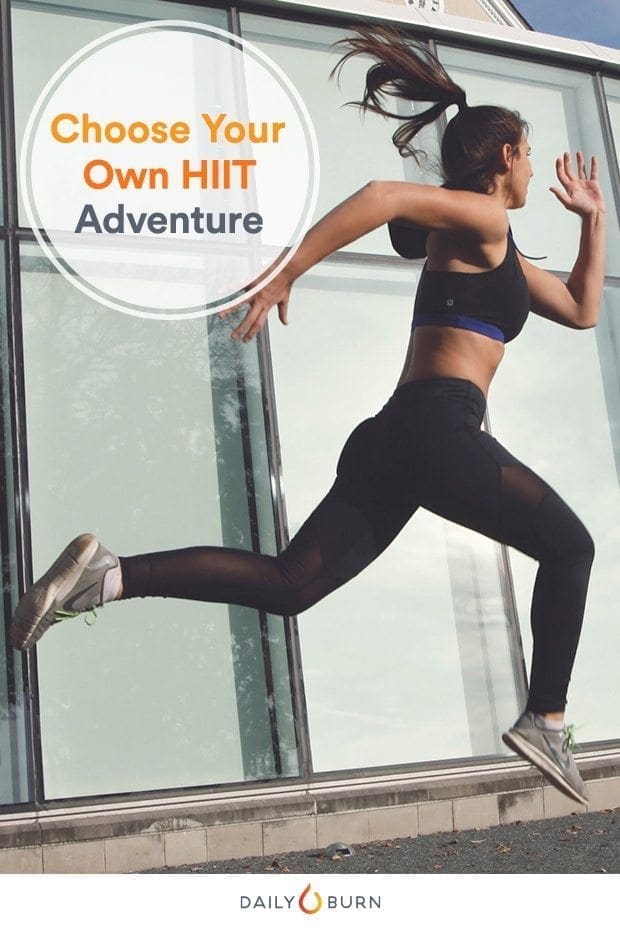
Science and experts alike say high-intensity interval workouts reign as fitness royalty. Touted as a top-notch method for weight loss, improving your VO2 max and even helping you run faster, it�s no wonder this approach to exercise holds such high wellness honors.
Of course, just like any workout you do over and over, the routine can get stale. That is, until you learn the foundation of HIIT workouts and then switch it up every time you go to break a sweat. Allow trainer Adam Rosante, creator of Two Week Transformation and author of Super Smoothie Revolution, to break down the basics so you can turn up the benefits.
�The foundation [of HIIT] is a series of intervals of intense activity, coupled with intervals of less-intense activity or complete rest,� says Rosante. �Beyond buzz, it�s popularity can largely be attributed to its efficiency. HIIT�s a great way to get fit in a short amount of time. But the key is to ensure that the high-intensity intervals are truly performed at your highest intensity.�
How do you know if you�re HIIT-ing it hard enough? Rosante says to go at 80 to 95 percent of your maximum heart rate during the work intervals, and 60 to 65 percent during your rest periods. (To find your max heart rate, just subtract your age from 220. Then take the percentages from there.) If you don�t have a heart rate monitor, push hard enough through the work intervals that you�re sucking wind. You shouldn�t be able to hold a convo, Rosante says.
You can do a HIIT workout with almost any exercise, from plank hip dips to jumping jacks to everyone�s favorite: burpees. That�s because it�s more about intensity than the specific movements, Rosante explains. But to help you narrow down what to do, Rosante says he prefers a mix of moves that force the glutes, quads and hamstrings (the body�s biggest muscles) to work explosively. Some of his go-to�s include jump squats, plyo lunges and sprints.
But don�t stop there. Rosante often alternates between a lower body and upper body move, or a lower body and total body exercise. �The alternation forces your heart to pump blood out to the muscles in a much higher volume, which, naturally, means your heart rate is significantly elevated,� Rosante explains. �When you boost your heart rate like this, you disrupt your metabolic pathways in such a way that they�re scrambling to return to normal long after the workout has ended.� This concept of burning calories even after you stop busting a move � known as excess post-exercise oxygen consumption or EPOC � will blast fat and calories, fast.
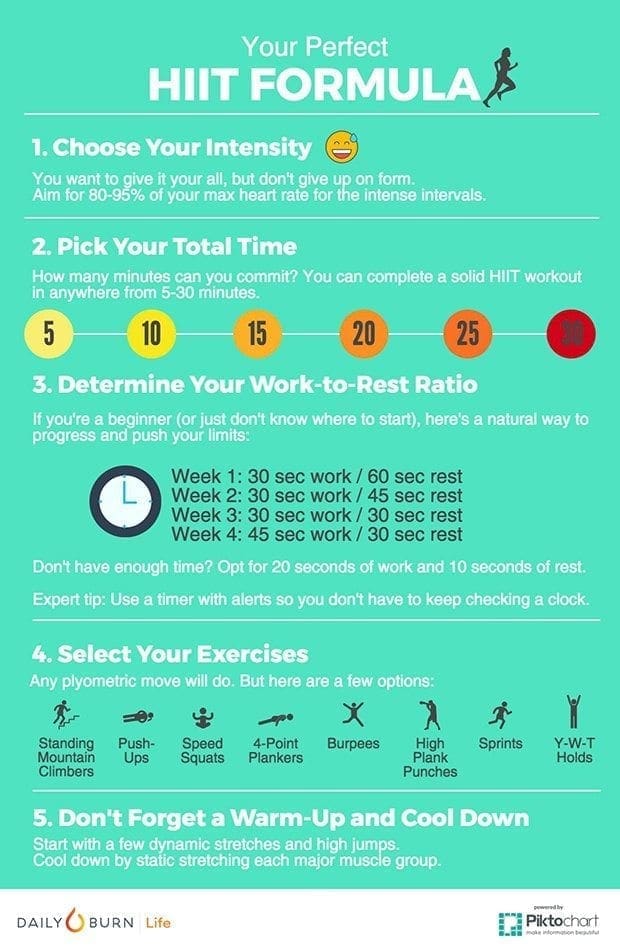
Spike your heart rate, tone your body and break through plateaus with this HIIT formula from Rosante. Start with a goal intensity, then pick an option from each layer. No two workouts have to be the same � but you�ll get sweaty and fit with each round. We�ll call this one smash HIIT.
Infographic: Mallory Creveling / Life by Daily Burn
To warm up before you dive in, do a series of dynamic stretches and a few high jumps. After you HIIT it, cool down with a solid stretch of all major muscle groups. Rosante suggests holding each one for at least 3 to 5 deep breathes.
Standing Mountain Climbers
Start standing, arms bent at your chest, palms facing away from your body. Drive your right knee up toward your chest as you straighten your left arm toward the ceiling. Quickly switch to bring your left knee toward your chest and right hand toward the ceiling. Continue alternating.
Start in a high plank position. Without piking or dropping your hips, bend your elbows and lower your chest to the ground. Then push back up to a plank.
Speed Squats
Start with feet a little wider than hip-distance apart, toes pointed slightly outward. Drive your hips back and butt toward the ground to perform a low squat. Jump back up and bring your feet together. Then jump back into a wide squat position.
4-Point Plankers
Start in a high plank position with feet together. Jump your feet to the left side of your left hand, then hop them back to the plank position. Next, jump your feet to the right side of your right hand, then back to the plank position. Hop your feet between your hands, then back to the plank position. Finally, jump your feet wide, placing one on either side of your hands. Then return to the plank position. Continue jumping to each point, keeping your hands on the ground the whole time.
Start standing. Place your hands on the ground, wrists underneath shoulders and jump your feet back to high plank position. Drop your chest to the ground. Then, without arching your back, push yourself back up and jump your feet back up to your hands. Explode off the ground to perform a hop at the top.
High Plank Punches
Start in a high plank position. Keeping your hips still, punch your right arm out straight in front of you. Then your left. Continue alternating.
Run in place (or on a treadmill or track) as fast as you can, pumping your arms for more power.
Y-W-T Holds
Lie on your stomach, arms straight out in front of you. Lift your legs and arms off the ground, with your arms to a Y position. Hold for a few seconds, then lower back down. Lift your legs and arms off the ground again. This time pull your elbows back and shoulder blades together so your arms form a W. Hold for a few seconds then extend your arms again and lower back down. Lift your legs and arms off the ground another time, this time moving your arms into a T position with elbows straight and arms out to the sides. Lower back down and repeat from the Y.
Please fill out the form below to request more information or schedule your first session with one of our trainers.
If you’d like to reach us directly, please call one of our two locations, Central El Paso (915.203.8122) or West El Paso (915.740.2439), or email us at [email protected]
COLORADO SPRINGS, Colo. ��UTEP rifle team members Abby Monique (smallbore and air rifle) Mara Rouse, Maranda Nelson and Bailey Powell (air rifle only) recently had an amazing opportunity for growth by being invited to compete at the 2017 USA Shooting National Junior Olympic Shooting Championships at the Olympic Training Center in Colorado Springs, Colorado.
The Miners interacted with and shared the range with some of the best shooters in the sport, including 2016 Rio Olympics Women�s Air Rifle gold medalist Ginny Thrasher.
It marked the first such trip to the event for Rouse while Monique and Powell made their third and Nelson her fourth. The Miners performed admirably, placing three individuals among the top 75 (in a field of nearly 200) in the 10m air rifle.
In order to attend the Junior Olympics, athletes who are under the age of 20 (junior-aged athletes), must compete in a state junior Olympic Shooting championship match and receive an invitation to compete by meeting either an automatic score or win the athlete�s respective state title.
�It was very exciting to have all four of our junior aged athletes qualify and compete at the Junior Olympic Shooting Championships representing UTEP,� UTEP head coach Hannah Muegge said. �I�d like to thank our UTEP parents who came out and supported all of our athletes, in addition to those back home who followed along online. In the collegiate category, we definitely had one of the largest showings at this match. I could not ask for a better support system.�
Powell was exceptional, finishing in 14th place (out of a field of 180) in the 10m air rifle. She was particularly strong on the first day of action with her score (413) placing her eighth heading to the second day.
Monique represented the Orange and Blue in the smallbore. She recorded a score of 1120 to land in the upper-echelon of the field with a 31st-place finish. She also joined Powell in the 10m air rifle, tallying a total score of 804.8 to take 68th place.
Rouse, competing in the 10m air rifle, shot 401.3 in the first day before improving to 402.1 on day two. The total of 803.4 was good enough for 74th.
Nelson was saddled with a rifle malfunction on the first day and had to borrow an air rifle for the second day. Despite the challenges she held her head up high.
IFM's Find A Practitioner tool is the largest referral network in Functional Medicine, created to help patients locate Functional Medicine practitioners anywhere in the world. IFM Certified Practitioners are listed first in the search results, given their extensive education in Functional Medicine