Contents
Why the Base of Your Skull May Hurt After a Car Accident
After a rear-end collision on I-10 or Loop 375, many people focus on the stiff, aching feeling in the neck and shoulders. They notice they can’t fully turn their head. Their muscles feel tight, and certain positions make everything worse. However, what often goes unrecognized is that the same forces can produce persistent discomfort right at the base of the skull. This is the sub-occipital region where the upper neck meets the occiput. Patients often treat this as “just neck stiffness.” As a result, they may not connect it to the need for a broader evaluation of headache patterns that may develop days or weeks later.
Pain near the base of the skull after trauma does not automatically mean occipital neuralgia or cervicogenic headache. Those are specific clinical diagnoses that require more than pain location. The same area can be involved in myofascial tension or post-traumatic headache patterns. Additionally, migraine can become more frequent after injury. Multiple factors can be at play, too. Distinguishing among them matters because the treatment path and the documentation needed for recovery both depend on an accurate picture of what is driving the symptoms.
How Collision Forces Affect the Upper Neck and Occiput
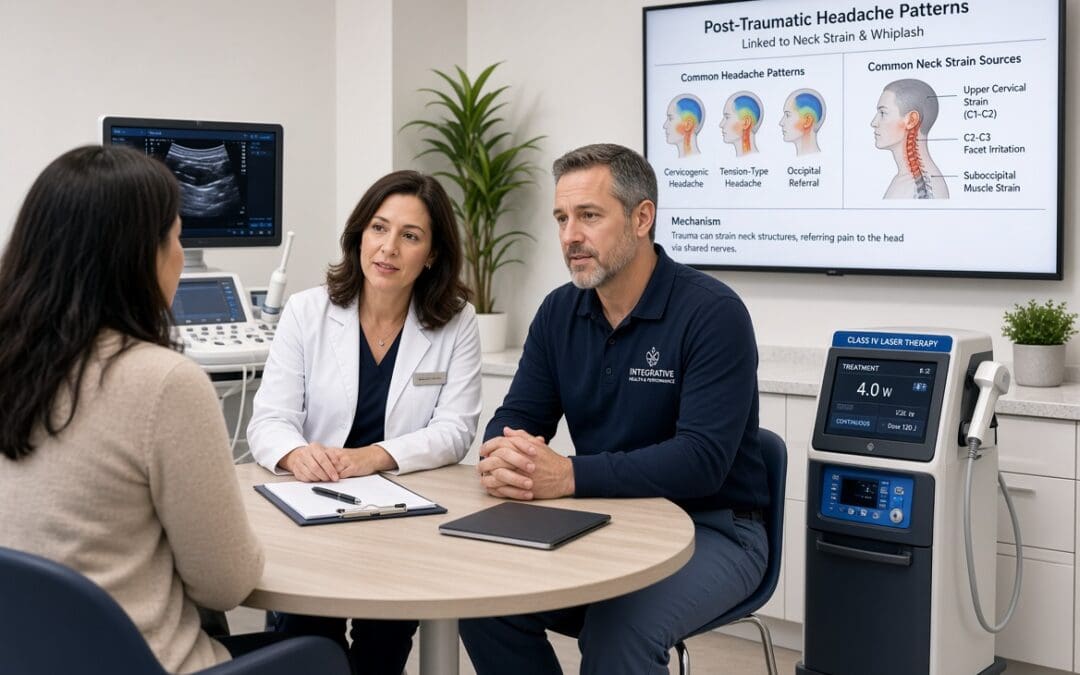
In a typical rear-end impact, the head accelerates rapidly and then decelerates. The upper cervical segments (C1–C3) and the small sub-occipital muscles experience shear and stretch forces. These muscles—rectus capitis posterior major and minor, obliquus capitis superior and inferior—help control fine head movement and are richly supplied with sensory receptors. When they become irritated, or when protective guarding sets in, patients feel a deep, aching, or pressure-like discomfort at the base of the skull. This discomfort can radiate upward. Alternatively, it can feel worse with sustained postures, such as driving or looking at a screen.
Ligaments and facet joints in the upper cervical spine can also be stressed. Because sensory information from these structures converges with fibers from the trigeminal system in the brainstem (the trigeminocervical complex), the brain can perceive irritation in the upper neck as head pain. This is true even when the primary problem is mechanical. As a result, this referral pattern is common after whiplash-type forces. However it is only one possible contributor.
Why Location Alone Does Not Confirm a Specific Diagnosis
Occipital neuralgia involves irritation or entrapment of the greater, lesser, or third occipital nerves. It typically produces sharper, shooting, or electric-like pain that starts at the skull base and radiates toward the vertex or behind the eye, often with scalp tenderness. The pain is usually unilateral and can be provoked by pressure along the nerve pathway or by certain neck movements. Diagnosis rests on the characteristic quality and distribution of pain, along with clinical findings. Temporary relief after a diagnostic nerve block can also support the impression. However, discomfort location alone is not sufficient.
Cervicogenic headache is a secondary headache attributed to a disorder of the cervical spine or its soft tissues. Formal criteria (ICHD-3) require evidence of a cervical source capable of producing headache, along with a clear link—such as onset or worsening that matches the cervical problem, reproduction of the familiar head pain by neck movement or sustained posture, restricted cervical motion, and improvement when the cervical disorder improves. Pain that simply starts near the base of the skull does not meet these requirements. Many post-collision patients have restricted upper-cervical motion and sub-occipital tenderness without meeting full criteria for cervicogenic headache.
Other possibilities include:
- Myofascial pain from trigger points in the sub-occipital group, upper trapezius, or semispinalis capitis that refer pain into the head.
- Post-traumatic headache that may take a migraine-like or tension-type form and can coexist with neck findings.
- Mixed presentations in which neck mechanics lower the threshold for an underlying migraine pattern that becomes more frequent after trauma.
A thorough evaluation looks at headache quality, frequency, associated features (nausea, light or sound sensitivity, visual changes), and the relationship to neck movement. It also includes neurological screening and objective measures of cervical motion and soft-tissue findings. Imaging may be indicated in selected cases. Still, many relevant findings are clinical.
What a Broader Evaluation Looks Like in Practice
Patients who come in focused only on neck stiffness often benefit when the clinician also asks about headache days. It is important to discuss whether the head pain starts at the base of the skull and moves forward. The clinician should also ask whether certain neck positions reliably trigger it. Evaluation should also cover how it affects sleep, concentration, and daily activities. Digital range-of-motion measurements, segmental palpation, and provocative testing help document the mechanical component. Also, when headache frequency is rising, a simple headache diary helps track whether the pattern is stabilizing or worsening.
Conservative care can address the mechanical contributors without assuming a single diagnosis. Gentle upper-cervical mobilization or adjustment, myofascial release of the sub-occipital muscles, postural retraining, and graded exercises for deep neck flexors often reduce both neck restriction and the referred component of head discomfort. When indicated, neurofunctional acupuncture or electroacupuncture may help modulate local muscle tension and pain pathways. These approaches are chosen because they target stressed structures while minimizing the need for prolonged medication. They also reduce the likelihood of needing more invasive procedures.
Dr. Alex Jimenez, DC, APRN, FNP-BC, CFMP, IFMCP, brings dual-licensure training that allows simultaneous attention to soft-tissue mechanics and the broader medical context of post-traumatic symptoms. Working with Medical Director Dr. Maria Guadalupe Cardenas, MD (board-certified in internal medicine), the team can coordinate laboratory evaluation when metabolic or inflammatory factors may be amplifying recovery. Additionally, they provide oversight when headache patterns require medical attention. Injury Medical Clinic PA is one of the only integrated clinics in El Paso that combines this dual-scope expertise under one roof. This arrangement allows soft-tissue findings, functional measures, and medical direction to be documented together. As a result, this coordination supports both clinical decision-making and the clear records often needed when attorneys evaluate causation after collisions on local freeways.
Supporting Recovery While Protecting Patient Choice
Beneficence is served when care targets the actual drivers of symptoms—whether mechanical restriction, muscle guarding, or a developing headache pattern—rather than treating every base-of-skull complaint the same way. Patients typically gain improved neck motion, reduced frequency or intensity of associated head discomfort, better sleep, and a clearer sense of which activities remain limited. Non-maleficence is supported by prioritizing non-invasive options first. Moreover, many people improve with targeted chiropractic and soft-tissue work without progressing to chronic reliance on analgesics or prematurely considering injections or surgery. Explaining the differential clearly reinforces autonomy. This helps the patient understand why a broader headache evaluation is useful even when the most obvious complaint is neck stiffness. Shared records and coordinated communication with the patient’s existing medical team keep the individual in control of decisions.
Objective documentation—timed motion measurements, consistent examination findings, and correlation with the mechanism of injury—helps distinguish traumatic aggravation of upper-cervical structures from pre-existing conditions under the Texas Eggshell Plaintiff rule. When the records show that the collision produced measurable changes in the region that can refer pain into the head, both clinical care and the legal file are strengthened. In addition, the clinic’s resources on integrated headache management, occipital neuralgia approaches, post-accident headache relief, and the role of chiropractic findings in establishing causation also discuss how cervical findings intersect with headache patterns.
If neck stiffness after a collision is accompanied by discomfort at the base of the skull, or if headaches seem to be increasing, a focused evaluation that looks beyond the neck alone can clarify the picture and guide the next steps in recovery.
References
International Headache Society. (2018). The International Classification of Headache Disorders (3rd ed.). Cephalalgia, 38(1), 1–211. doi.org/10.1177/0333102417738202
Bogduk, N., & Govind, J. (2009). Cervicogenic headache: An assessment of the evidence on clinical diagnosis, invasive tests, and treatment. The Lancet Neurology, 8(10), 959–968. doi.org/10.1016/S1474-4422(09)70209-1
Barmherzig, R., & Kingston, W. (2019). Occipital neuralgia and cervicogenic headache: Diagnosis and management. Current Neurology and Neuroscience Reports, 19(7), Article 20. doi.org/10.1007/s11910-019-0933-z
Headache Classification Committee of the International Headache Society. (2018). Headache attributed to trauma or injury to the head and/or neck. In The International Classification of Headache Disorders (3rd ed.). Cephalalgia, 38(1), 1–211.
Bogduk, N. (2001). Cervicogenic headache: Anatomic basis and pathophysiologic mechanisms. Current Pain and Headache Reports, 5(4), 382–386. doi.org/10.1007/s11916-001-0029-7
General Disclaimer, Licenses, and Board Certifications *
Professional Scope of Practice *
The information herein on "Base of Skull Pain After Rear-End Collisions" is not intended to replace a one-on-one relationship with a qualified health care professional or licensed physician and is not medical advice. We encourage you to make healthcare decisions based on your research and partnership with a qualified healthcare professional.
Blog Information & Scope Discussions
Welcome to El Paso's Premier Wellness and Injury Care Clinic & Wellness Blog, where Dr. Alex Jimenez, DC, FNP-C, a Multi-State board-certified Family Practice Nurse Practitioner (FNP-BC) and Chiropractor (DC), presents insights on how our multidisciplinary team is dedicated to holistic healing and personalized care. Our practice aligns with evidence-based treatment protocols inspired by integrative medicine principles, similar to those on this site and on our family practice-based chiromed.com site, focusing on naturally restoring health for patients of all ages.
Our areas of multidisciplinary practice include Wellness & Nutrition, Chronic Pain, Personal Injury, Auto Accident Care, Work Injuries, Back Injury, Low Back Pain, Neck Pain, Migraine Headaches, Sports Injuries, Severe Sciatica, Scoliosis, Complex Herniated Discs, Fibromyalgia, Chronic Pain, Complex Injuries, Stress Management, Functional Medicine Treatments, and in-scope care protocols.
Our information scope is multidisciplinary, focusing on musculoskeletal and physical medicine; wellness; contributing etiological viscerosomatic disturbances within clinical presentations; associated somato-visceral reflex clinical dynamics; subluxation complexes; sensitive health issues; and functional medicine articles, topics, and discussions.
We provide and present clinical collaboration with specialists from various disciplines. Each specialist is governed by their professional scope of practice and licensure jurisdiction. We use functional health & wellness protocols to treat and support care for musculoskeletal injuries or disorders.
Our videos, posts, topics, and insights address clinical matters and issues that directly or indirectly relate to our clinical scope of practice.
Our office has made a reasonable effort to provide supportive citations and has identified relevant research studies that support our posts. We provide copies of supporting research studies upon request to regulatory boards and the public.
To discuss how these matters can assist in a specific care plan or treatment protocol, please contact Dr. Alex Jimenez, DC, APRN, FNP-BC, or reach out to us at 915-850-0900.
We are here to help you and your family.
Blessings
Dr. Alex Jimenez DC, MSACP, APRN, FNP-BC*, CCST, IFMCP, CFMP, ATN
Email: [email protected]
Multidisciplinary Licensing & Board Certifications:
Licensed as a Doctor of Chiropractic (DC) in Texas & New Mexico*
Chiropractic Licenses:
Texas DC License #: TX5807, Verified: TX5807
New Mexico DC License #: NM-DC2182, Verified: NM-DC2182
Nurse Practitioner Licenses:
Texas APRN License #: 1191402, Verified: 1191402 *
New Mexico CNP License #: 90560, Verified 90560
Florida APRN License #: 11043890, Verified: APRN11043890 *
Colorado License #: C-APN.0105610-C-NP, Verified: C-APN.0105610-C-NP
New York License #: N25929, Verified N25929
Georgia APRN License #: GAA-NP005701
Multi-State Advanced Practice Registered Nurse (APRN*) Texas & Multi-States
Multi-state Compact APRN License by Endorsement (43 States)
Compact Status: Multi-State License: Authorized to Practice in 43 States*
Nursing Licensure Compact: Updated Here
DEA Registration: (Drug Enforcement Agency Registered)
All medical (MDs) and family practice providers (FNP-APRN) are registered and licensed to offer various levels of medication.
Verify Providers Here
License Verification Link: Nursys License Verifier
* Prescriptive Authority Authorized (DEA Registered Providers). Call if Required
Board Certification:
ANCC FNP-BC: Board Certified Nurse Practitioner*
Education:
Graduate with Honors: ICHS: MSN-FNP (Family Nurse Practitioner Program)
Degree Granted. Master's in Family Practice, MSN Diploma (Cum Laude)
Dr. Alex Jimenez, DC, APRN, FNP-BC*, CFMP, IFMCP, ATN, CCST
(Board Certified: Family Practice Nurse Practitioner—Multistate)*
(Licensed Nurse Practitioner & Chiropractor - Multistate)*
Clinical Director
DC & FNP License (Review Above)
Digital Business Card
NPI: 1205907805
Dr. Maria Cardenas, MD
(Board Certified: Internal Medicine)
(Licensed Medical Doctor)
Medical Director, Clinical Director & Collaborative Physician
NPI # 1164426748
MD License #: J2933
Licenses and Board Certifications:
MD: Medical Doctor
DC: Doctor of Chiropractic
APRNP: Advanced Practice Registered Nurse
FNP-BC: Family Practice Specialization (Multi-State Board Certified)
FNP-BC: Family Practice Across Life Span (Neonatal to Geriatrics)
RN: Registered Nurse (Multi-State Compact License)
CFMP: Certified Functional Medicine Provider
MSN-FNP: Master of Science in Family Practice Medicine
MSACP: Master of Science in Advanced Clinical Practice
IFMCP: Institute of Functional Medicine
CCST: Certified Chiropractic Spinal Trauma
ATN: Advanced Translational Neutrogenomics
Family with Primary Care Focus (Family Nurse Practitioner or FNP)
- The Family Nurse Practitioner (FNP) promotes, maintains, and restores health for individuals and families across the lifespan. FNPs also identify health risks, promote wellness, and diagnose and manage acute and chronic illness.
- The FNP focuses on comprehensive primary care, promoting healthy lifestyles for patients across the lifespan in settings such as private practice, physician offices, and community health centers.
Memberships & Associations:
TCA: Texas Chiropractic Association: Member ID: 104311
TNA: Texas Nurse Association: Member ID: 06458222
TNP: Texas Nurse Practitioner Association ID: 2025091511
AANP: American Association of Nurse Practitioners: Member ID: 2198960
ANA: American Nurses Association: Member ID: 06458222 (District TX01)
| Primary Taxonomy | Selected Taxonomy | State | License Number |
|---|---|---|---|
| No | 111N00000X - Chiropractor | NM | DC2182 |
| Yes | 111N00000X - Chiropractor | TX | DC5807 |
| Yes | 363LF0000X - Nurse Practitioner - Family | TX | 1191402 |
| Yes | 363LF0000X - Nurse Practitioner - Family | FL | 11043890 |
| Yes | 363LF0000X - Nurse Practitioner - Family | CO | C-APN.0105610-C-NP |
| Yes | 363LF0000X - Nurse Practitioner - Family | NY | N25929 |
| Yes | 363LF0000X - Nurse Practitioner - Family | NM |
90560 |
| Yes | 363LF0000X - Nurse Practitioner - Family | GA | GAA-NP005701 |
Dr. Alex Jimenez, DC, APRN, FNP-BC*, CFMP, IFMCP, ATN, CCST
(Board Certified: Family Practice Nurse Practitioner—Multistate)*
(Primary Care Across Lifespan—Neonatal / Pediatric / Adult / Geriatrics)
(Licensed Nurse Practitioner & Chiropractor - Multistate)*
Clinical Director
Digital Business Card
NPI: 1205907805
Dr. Maria Cardenas, MD
(Board Certified: Internal Medicine)*
(Licensed Medical Doctor)*
Medical Director, Clinical Director & Collaborative Physician
NPI # 1164426748
MD License #: J2933
📆 Schedule Appointment: Schedule 24/7 (Click Here)