When you�re in pain, you might try just about anything to feel better. Claims of miracle cures that instantly relieve back and neck pain are tempting, but they often fall short of their promises.
Save your money and steer clear of the products featured promising to eliminate your spine-related pain.
Copper Bracelets
Copper bracelets and wristbands have attracted a following of arthritis sufferers because of their perceived ability to reduce joint pain.
The key word here is perceived.
A 2013 study in the UK examining the effects of copper bracelets in patients with rheumatoid arthritis found no difference in pain outcomes between those wearing copper bracelets and those using a placebo.
While the bracelets won�t do you any harm, they�re more for looks than clinical benefit. There�s no solid medical evidence available proving they reduce pain or inflammation.
Magnets
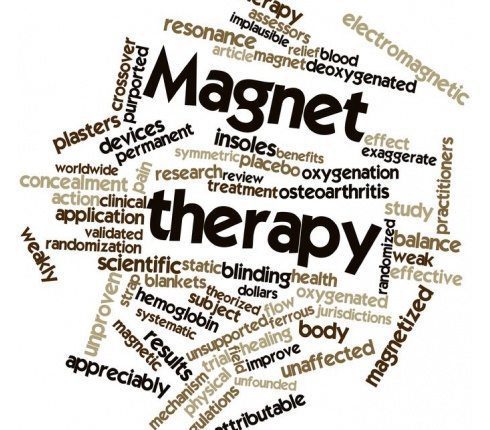
From magnetic shoe inserts to bandages, magnets have been heavily marketed as a miracle cure to zap away a variety of back pain conditions, including fibromyalgia and arthritis. However, no proof exists to back up magnets� health claims.
While studies have examined magnets� impact on pain, the results are mixed�and the quality of some of the research is questionable. Additionally, magnets are not safe for some people, including those who use pacemakers or insulin pumps.
Colloidal Silver
Silver jewelry? Classic. Silver home furnishings? Sure thing. Colloidal silver for your spine pain? Never a good idea.
Colloidal silver for back pain is typically found as a topical cream containing small particles of silver. In 1999, the U.S. Food and Drug Administration (FDA) recommended that people not use colloidal silver to treat any medical condition because it�s neither safe nor effective.
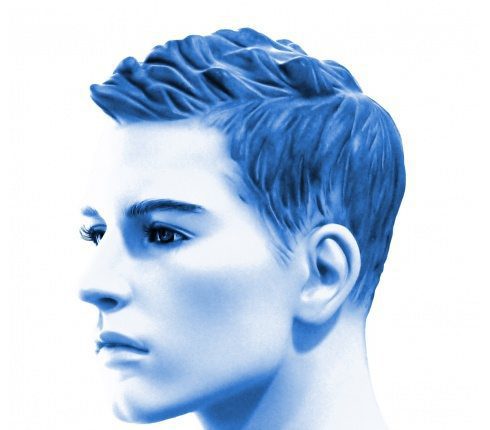
Even worse than the false claims of back and neck pain relief are colloidal silver�s strange and serious side effects. This product can interfere with the absorption of some prescription drugs and even permanently tint your skin a blue-gray color.
DMSO and MSM Dietary Supplements
If you have spondylosis (osteoarthritis), you may have heard of the dietary supplements dimethyl sulfoxide (DMSO) and methylsulfonylmethane (MSM). Some believe this pair of supplements can block pain and inflammation, but no real medical evidence shows these substances actually relieve painful arthritis symptoms.
Instead of eliminating your arthritis pain, MSM and DMSO might cause some unwanted side effects. Both have been linked to causing upset stomach and skin rashes, while DMSO may also leave you with garlic breath and body odor.
A Word on Drug-Supplement Interactions
Speaking of supplements, it�s important to understand that dietary supplements may not mix with over-the-counter or prescription drugs. Some interactions result in mild side effects, but others can be much more serious�even life-threatening.
If you�re using a dietary supplement�even if it�s a seemingly benign herbal or vitamin�always let your doctor and pharmacist know before taking it with an over-the-counter or prescription medication. They will share any dangerous interactions, and ensure you�re safely addressing your back and neck pain.
The Real Deals: Alternative Treatments that Work
Many who fall prey to the products listed in this slideshow have an interest in alternative or complementary therapies for back and neck pain. While some non-traditional treatments should be avoided, many have been proven to reduce spine pain.
Scientists from the National Center for Complementary and Integrative Health at the National Institutes of Health reviewed 105 U.S.-based trials from the past 50 years that included more than 16,000 participants. They found the therapies below effective at controlling pain:
� Acupuncture � Massage � Relaxation techniques � Tai chi
If you prefer alternative methods to manage for your spinal condition, explore the therapies above. They are effective, safe, and will help you live a healthier life.
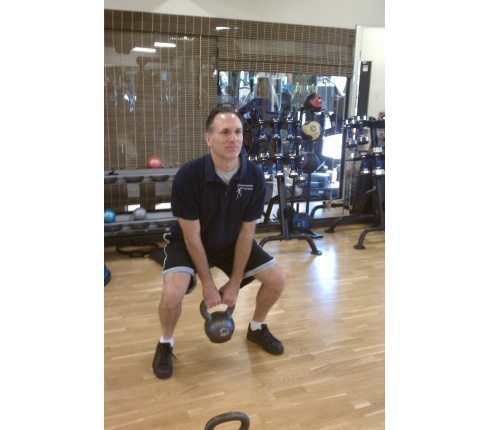
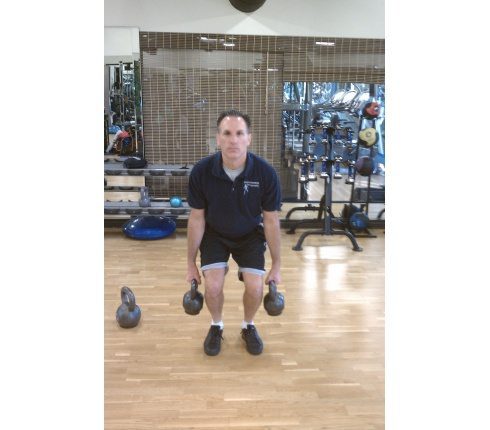
Strengthening the spinal muscles is essential for health and fitness. Functional kettlebell training is resistance training that strengthens the spine. Kettlebell training is an extremely effective type of exercise to increase functional strength, ballistic power, endurance, and flexibility in the entire body, especially the spinal and core muscles.
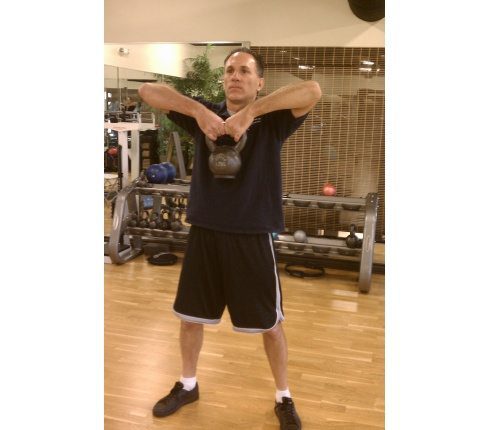
(Exercise shown is Anchor Squats.)
What Exactly Are Kettlebells?
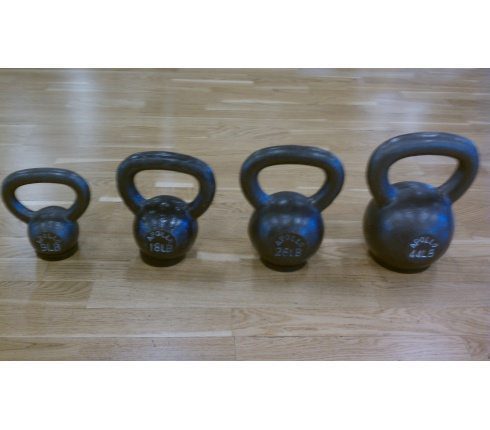
Kettlebells are round cast iron weights with a single handle. Picture a cannonball with a u-shaped handle. Kettlebells are manufactured in a wide range of weights, for all strength levels.
Muscles Used in Kettlebell Training
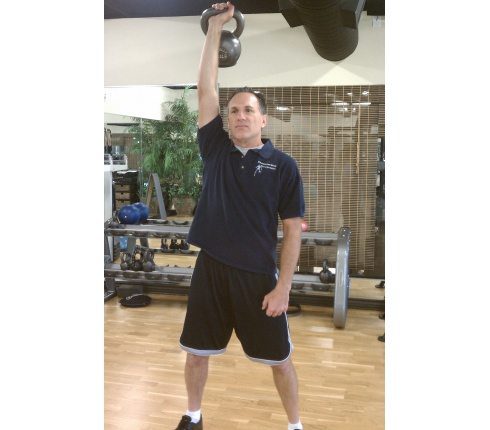
Kettlebell training incorporates large functional movements. Multiple muscle groups work in synergy to complete the exercises. The spinal muscles function as either the primary mover or assist the primary mover in every kettlebell exercise. The spinal muscles also stabilize the body during functional kettlebell training, thus developing the smaller supporting structures.
(Exercise shown is Push Press.)
High Reps Of High Importance In Kettlebell Training
Kettlebell training employs high repetitions, momentum, and centrifugal force. Momentum works the spinal muscles as the weight is raised and lowered. High repetitions combined with momentum and full body movement build strength and endurance in the entire musculoskeletal and cardio-vascular systems. Kettlebell training delivers aerobic and anaerobic benefits.
(Exercise shown is High Pulls.)
Always Learn From A Qualified Kettlebell Instructor
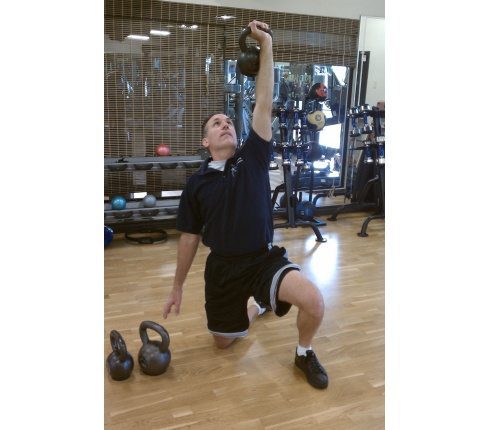
Perfect technique is mandatory during exercise. Correct exercise technique maximizes benefit and lowers injury risk. Poor exercise form increases the possibility of injury and diminishes results. Kettlebell exercises are learned motions, so you should learn proper training technique from a qualified kettlebell trainer. The trainer should demonstrate, instruct, and supervise your training and develop your routine.
(Exercise shown is Turkish Get-up.)
So Many Possibilities
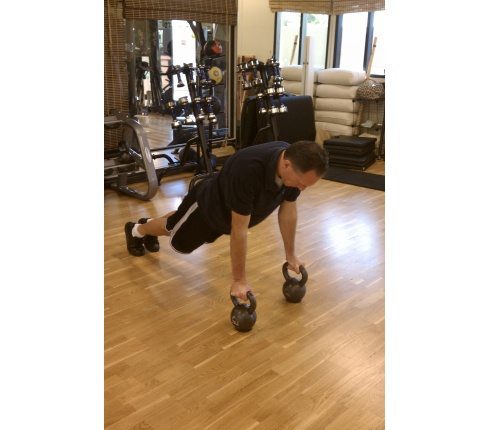
The kettlebell�s shape allows for a wide variety of exercises. This resourceful exercise tool is used for basic exercises like squats (shown in slide 1), cleans, swings, high pulls (shown in slide 4), snatches and push presses (shown in slide 3). The versatility of the kettlebell is demonstrated with exercises such as renegade rows (a combination of push-ups and rows�shown in slide 6), suitcase swings, woodchoppers (a combination of lunges and oblique twists), windmills, and Turkish get-ups (shown in slide 5)
(Exercise shown is Renegade Rows.)
Kettlebell’s Benefits For The Spine
Functional kettlebell training is a rare type of exercises that increases aerobic and anaerobic health simultaneously. The benefits to the spine include increased strength, power, endurance, flexibility, function and mobility.
The UTEP softball team will travel to Ruston to take on Conference USA West Division foe LA Tech April 14-15. Friday�s doubleheader will start at 2 p.m. CT/ 1 MT, while Saturday�s series finale will start at noon CT/ 11 a.m. MT.
The Miners (11-28, 5-10 C-USA) are currently tied with Southern Miss (5-10), while standing one game behind UTSA (6-9) in the West Division. The Lady Techsters (26-14, 9-3 C-USA West) are in first place and currently the no. 2 seed behind Marshall (14-1 East). FIU (8-4 East), Florida Atlantic (7-5 East), North Texas (8-7 West), Charlotte (5-7 East), WKU (6-9 East) and UTSA round out the standings. Middle Tennessee sits in last place (3-9 East).
The top eight schools, out of 12, will advance to the C-USA Tournament in Hattiesburg, Miss, May 10-13. The top three teams from each division, while the next two schools with the best records will advance to the four-day championship. Seeds three and four will receive a bye, while the top two seeds earn a double-bye to advance to the second day.
UTEP won game one against WKU, 10-2 (6), while recording 30 hits during the weekend series. The Miners and Hilltoppers game two scoring fest ranks most runs (26) between both teams in C-USA. The Miners are ranked second in C-USA in team batting average (.307), while their 329 hits rank second. Lindsey Sokoloski is ranked no. 1 in the nation in toughest to strikeout after a K-less weekend and Taylor Sargent is ranked 17th in the C-USA with a .349 batting average. Sargent was hitting .250 after March 26.
In the 2015, LA Tech took care of UTEP in three games, while the Miners returned the favor by sweeping the Lady Techsters in El Paso last season. In 2014, during Tobin Echo-Hawk�s first season, her squad swept LA Tech in Ruston as it was the first ever sweep of a conference opponent in program history.
The Miners will have their bye week following the LA Tech series and will continue play at UAB April 29-30, while the regular season will conclude in El Paso against Florida Atlantic May 6-7 (Senior Weekend).
Join Drs. Jason Deitch and Tom Klapp as they lay out the rationale for remaining one of the few�drug-free options for improving health and wellbeing.
Dr. Klapp says there are three drivers for chiropractors who are trying to bring drugs into the profession�all based on false premises:
Schools teaching a medical/allopathic approach instead of the chiropractic approach
Unsuccessful chiropractors who believe drugs would make them more money
�Pied pipers� who claim prescribing drugs would make chiropractic more �advanced�
Bottom line: Americans� declining health is NOT�because we�are suffering from a deficiency of drugs.
Video Transcription
Jason Deitch:��Hello, everyone. Dr. Jason Deitch here, and today I�m excited to be having a great conversation with my great friend Dr. Tom Klapp. Dr. Tom, thanks so much for making some time in your busy schedule to talk about, what I believe, might just be one of, if not the most important conversation in the chiropractic profession, which is asking the question, �Why is the chiropractic profession better off a drug-free profession?� Now before we get into that, a lot of people know you, you�re on the board of Life University, you�ve been very involved in the politics in the state of Michigan, but for those that may not be aware of who you are, recent graduates and so on, before we get into the message, let�s talk about the messenger. Share with us some of your background and why you have really become one of, I�ll say the world�s, most vocal proponents about keeping chiropractic as a drug-free profession.
Tom Klapp: �Well first of all, I�ve been in practice for, it�ll be 37 years next month, and I have a lot of experience in politics, as you mentioned. I�m the past president of the Michigan Chiropractic Association. I�m the past chairman of the Michigan Association of Chiropractors, which was the newly merged association in Michigan that came together 10 years ago now, believe it or not. I am, as you mentioned, on the board of Life University, and I have a long list of low paying jobs in this profession, so for whatever that�s worth, I know my way around the profession. Let�s put it that way.
Jason Deitch:��Right. You�re being facetious about low-paying jobs, but what you�ve done is you�ve volunteered and participated on a lot of levels around the world in this conversation or really about how to elevate our profession, I�ll say, to the stature that it really deserves to be. You were instrumental, I know, in the mergers of the two state associations. You�re being humble and so on, and that�s all well and good. Let�s get into it. For those chiropractors watching, you may have some chiropractors that have been around for decades, others who are in school, let�s have the conversation. There are those within our profession that actively believe that we will be a better profession with drugs. Why is that not true?
Tom Klapp: �Well, the first reason it�s not true is because there are plenty of professions already out there that are willing, ready and able, and in fact eager, to write as many prescriptions as humanly possible. Currently in the United States, the average American, get this, it�s 13 prescriptions written for him or her annually, and 75% of Americans are taking at least one prescription drug.
The first question I would ask a chiropractor thinking this way is what benefit do you bring to a patient above and beyond what all these other providers and physicians that are writing prescriptions for drugs like crazy, what benefit do you bring that they�re not already getting?
That�s the first question. Then on the other side of the coin, what destruction are you doing, are you wreaking, on the world�s only drug-free [healthcare] profession?If you look around the landscape, there�s all kinds of providers, and I would even argue people like homeopaths and naturopaths, in their own way, have a form of prescribing what could be considered drugs. Yet here we are, we are a holdout.
Several years ago, the Foundation for Chiropractic Progress did significant market surveys, focus groups, and a variety of other methods of determining what does the public believe about chiropractic? What do they like about us? What do they not like about us?
The number one thing that the public likes and appreciates about the chiropractic profession is that we are drug free. The public loves knowing that there is a doctor out there that they can go to that isn�t standing ready as they walk in the door to write a prescription. We have other ways, magnificent, effective, sometimes even unbelievably effective, ways of healing without the necessity, without the bastardization of bringing drugs into our beautiful profession.
Jason Deitch:��What are some of the claims? Those that do believe this. Maybe just share for those that are new to the conversation, why do they think that it�s a better profession with drugs?
Tom Klapp:��I have looked this over, and I�ve kind of come down to three reasons why the profession wants to go down this path. Let�s call them drivers, if you will.
The first driver is that there�s a lot of colleges out there, chiropractic colleges, that are training their doctors in, what I would call, allopathic practice. They teach them how to diagnose; they teach them how to refer to medical doctors; they teach them how to practice, think, and act like a medical doctor. Then what happens to these graduates is when they graduate and they get their chiropractic license, they realize chiropractic is not allopathic, that all the things that they may have been taught in these allopathic-leaning schools, they can�t do. What that leads to is a lot of frustration, anger, maybe they feel � like they were baited and switched, but in any case, they feel like they�ve been, maybe even defrauded. In my mind, maybe they were defrauded.
So we have a lot of dissatisfied graduates when they get out of school thinking, �Well, when I get out of school, I�m going to be a doctor.� They�re a doctor, but not an allopathic doctor. So it leads to �Maybe we should change the profession to reflect what I was taught.� Okay. I�m deeply opposed to anyone who graduates from a college thinking I�m going to change the profession instead of adapting my practice to the laws that govern chiropractic. Because that�s what this amounts to. We have laws that govern what we do, and the schools should be teaching what those laws allow and not all this other stuff. Okay? That�s one major driver.
I think another driver is, simply, lack of success, that a lot of doctors aren�t as successful as they feel like they want to be or they feel like they should be. They look at the medical profession, they see that they get paid when they send a bill to the insurance company, and they think, �Well, if I could only do what they do, maybe I could get paid like they get paid.� Well, that�s very wrong thinking because you�re still a doctor of chiropractic, and there�s no indication that if you were to, all of a sudden, be able to write a prescription, that somehow you�d get paid more. In fact, I�m going to throw a factoid out there that a lot of people may not have even thought of and it�s this: there�s no CPT code for writing a prescription. It�s part of the E and M code, the evaluation and management code. You can already do that. So where�s the advantage? I�d like to see them pay us now for the E and M that we can already do, instead of trying to add prescriptive rights to something and then try to send that in for payment. There�s no indication we�re going to get paid more.
Jason Deitch:��Right.
Tom Klapp:��It�s a pipe dream. The other drivers are there�s the pied pipers in the profession. There�s a group out of Florida that makes a lot of noise about how much more advanced we could be if we could just write prescriptions. Well, I would argue the opposite. We would be devolving as a profession if all of a sudden we [started] acting like every other profession. What makes us powerful, what makes us different, and especially in the mind of the public, is that we are drug free.
Jason Deitch:��Right.
Tom Klapp:��I�d like to see the pied pipers tone down their rhetoric because in addition to all the other bad ideas out there, to make this happen, politically, would be a nightmare for our profession.
Jason Deitch:��There are some that argue that they want the rights in order to be able to take people off of drugs. Do you believe that as a rational argument? It sounds logical. What do you say to those that say, �That�s why I want these rights�?Tom Klapp:��If you believe that argument, there�s a bridge in Brooklyn that I�d love to sell you because it�s just about as ridiculous. I don�t believe a word that these people are saying when they say, �Well, I want to take my patients off drugs.� Here�s what I do, I ask every patient that I see who is on a lot of medications, and believe me, we all see it, I sit down with the patient and I suggest to them that they go see their medical doctor and ask him or her which of the drugs that they�re taking can they live without. Let the medical doctor do his job. His job is to take people off drugs and put them on drugs and all that. My job is to educate my patients that there�s a better way than just dousing your body in harmful chemicals and toxins in the form of prescription medication.
Jason�Deitch:��Okay, so is that-
Tom Klapp:��That�s a false argument.
Jason Deitch:��So it�s an argument that on the surface seems logical but that may have some underlying ulterior motives behind it.
Tom Klapp:��Right.
Jason Deitch:��What about those in the profession that say, �Hey listen. I don�t want to prescribe drugs. Tom, I agree with you. I think you�re right. It�s our tradition, it�s our history, it�s our unique selling factor. But what�s the harm if some people in our profession would like to do it? I don�t want to do it.� What impact does sort of opening this door or going off that cliff, what impact will it have for those that think that we can sort of live and let live? Let those that want to do it, do it. I don�t choose to do it. I�m just making a living helping people in my community.
Tom Klapp:��I have two historical pieces of evidence that will defeat that argument specifically. The first one is the osteopathic profession, who began very much as the chiropractic profession, as a vitalistic manipulation-oriented profession. That�s what they did. They were vitalistic and they manipulated the joints of the body to increase blood flow, blah blah blah blah. In 1958, they had a movement similar to what we have today in chiropractic that said, �Hey, let�s start prescribing drugs. You folks over here, you just keep doing what you�re doing. We�re going to do this.� And that�s exactly what happened. Today, the people that were left to do manipulation are virtually gone, and I would love for you to find me an osteopath today who even remotely looks like one of those osteopaths from 1958. My point is this, that the minute that one chiropractor gets the right to prescribe, it won�t be long before the rest of us will probably be required to prescribe.
Then my second example from history is simply this, that in the various states where the arguments have been made, the liberal chiropractor would say to the conservative, �Let me do what I want to do, and I�m going to let you keep doing what you�re going to keep doing.� Okay? This has gone on � We have 50 states like this, and in all 50 states, when the final bell was rung and the whistle blew and the gun went off, the conservative chiropractor ended up having to be qualified in the exact same manner, take the exact same courses, get the exact same license as the broader-scope chiropractor. So that argument fails because we know what happens.
Jason Deitch:��What I�m hearing you say is that it�s not a live-and-let-live approach. That may seem like that at the moment, however the implications are that in order to prescribe drugs, there�s more education. If there�s more education, there�s more testing. If there�s more testing, higher requirements for licensing, increased malpractice insurance costs because that has to be spread out over everybody basically,-
Tom Klapp:��A big [crosstalk 00:13:58]
Jason Deitch:��-that it sounds good but may not necessarily be the reality when it�s all said and done, [crosstalk 00:14:07]
Tom Klapp:��It sounds good, but it never, ever turns out that way.
Jason Deitch:��Okay. I�m not even sure it sounds good, but it sounds good to some.
Tom Klapp:��Right.
Jason Deitch:��The arguments are that this is a positive step or an advancement of our profession. Others say, �This is who we�ve always been. This is who we should continue to be. It�s what the market is asking for. People are appreciating drug free.� How does this proceed from here? What do people watching, what should they get from it and what should they do? How do they get involved? Do they just watch the potential train wreck happen or is there something they can do to participate, get involved, share their voice, perhaps even inspire others to see it a little bit more clearly, and so on?
Tom Klapp:��Well, that�s a great question because there are a lot of chiropractors sitting on the sidelines of this debate. They�re kind of wondering what�s really wrong with it? Why wouldn�t we do drugs? Then there�s some who know intuitively that they�re against it, and yet they really don�t want to take a stand because taking a stand sometimes can be a problem, can be difficult.
The first recommendation I would make is if you believe that this is a bad idea, going into the path of drugs, if you believe as I do, take a stand. You need to decide within yourself no, this is not what I want to do. When you went to college, Jason, and every other doctor watching this, you didn�t get in it to prescribe drugs. It was never even a discussion. Nobody thought of it. Nobody wanted it. Now all of a sudden it�s a thing. You got into a drug-free profession. From the very get-go, that�s how it was when you got in, and that�s how we should keep it for so many reasons that � We don�t really have all day to enumerate them all but-
Jason Deitch:��That was the deal. We signed up for that deal.
Tom Klapp:��We signed up for it�s drug free.
Jason Deitch:��Right.
Tom Klapp:��Now go with it. The public is getting wise to the drugs. Okay, so what can you do? Stand up, be counted, take a stand against this whole movement, and support the people who are doing the same thing. For example, you and I are involved in a new organization, or a coalition, we call One Chiropractic. We want to unify the profession around one sentence: subluxation-centered, drug-free chiropractic. There you go. How many of us just think it�s that right there? We can create a big, big movement with just that, and there are other organizations out there. My own state of Michigan, the Michigan Association of Chiropractors, to my knowledge, is one of the very few state associations who have passed a resolution that we are drug free, we intend to remain drug free, and it�s not an issue for us.
But if your state association hasn�t done that, get involved. Ask them to take that same position. There are national associations. There are definitely colleges. We know Life University (Life Vision, Today�s Chiropractic Leadership), Life West, there are other colleges that have taken this same position. Those are the folks who need your support. On the other hand, there are colleges, there are individuals, there are associations out there who think that chiropractors should give up their history, give up their philosophy, give up who they are and become allopaths. Well, if you�re supporting them, take your support away. That�s how you can vote with your feet, as they say.
Jason Deitch:��That�s exactly. That�s exactly. It�s a big topic. It�s a big issue. We�ve been close, I think, in New Mexico years ago. It was only by certain individuals, Drs. Guy Riekeman, Gerry Clum, and several others, that we sort of saved it from going over the edge. Is that true? Do you want to give any predictions as to how you think this might play out so that people can sort of be aware of what�s really happening, you know, in today, tomorrow�s time so they can get a sense of the urgency? Is this some theoretical potential problem or how serious is it?
Tom Klapp:��Well, what�s happening even as we�re having this conversation, there are chiropractors, chiropractic associations, who are planning on introducing legislation that would allow chiropractors to prescribe drugs. Now, there are so many problems in passing this kind of legislation. The biggest problem is that other chiropractors don�t agree with it. Okay? We have one state, Wisconsin, where one association decided they were going to go into drugs, and they spawned a completely new association whose intent was it to make sure drugs never came to Wisconsin. What that means in Wisconsin is now you have a divided state. They�re never going to pass a law for drugs there because the legislators look at a divided profession, they�ll never pass it. Yet, the doctors in Wisconsin are being cheated out of a single, powerful, unified association that could be getting good things done.
How about instead of going for drugs, how about we start going for access to chiropractic care? That�s the holy grail. If we could just get what we do paid for on a par that the system pays for allopathy, my god, what an amazing win that would be for our profession. There�s always going to be � As long as this movement stays alive, somebody�s going to be out there trying to pass the law, but I�m telling you right here and right now, we are watching. I�m not even going to tell you who we are, but if somebody so much as introduces anything anywhere, we are going to know about it, we are going to oppose it, and we are going to kill it.
Now, there�s another kind of movement that�s sprung up that�s helping our cause, and that�s this whole idea of opioid addiction. Well, all of a sudden this has become a big thing, and the reason it�s a big thing is because MDs are prescribing opioid drugs, people are becoming addicted, then the MD takes them off the prescription, and now they have to go seek the same high with heroine. Now, you take a perfectly normal human being that had a job, had a family, had a life, and all of a sudden they become a street drug addict, and then they die. This is a serious problem. Why would we want to be involved in that?
See, now the chiropractic profession at the highest levels of leadership are all starting to get together and understand that this would be a disaster for chiropractors to even think about getting involved in any kind of prescriptive rights, especially if they involve opioid drugs. Let�s be smart. Let�s present ourselves as the solution to that problem and not simply buy in, sell our souls for a buck, so we can hand out drugs like Halloween candy, like the MDs do. It�s insane.
Jason Deitch:��I�m hearing you say, on a lot of levels, just one, we�re not filling a need that�s not already being filled.
Tom Klapp:��Exactly.
Jason Deitch:��That�s a perfectly great argument. Two, drugs are dangerous. They have risks, and why would we want to increase any risk of somebody�s life and so on. What you cite is not the exception, it is become the rule. It is a problem epidemic that everybody agrees with at the highest levels. What do you see as the solution, Tom? There are some that say let�s, sort of, split the profession into two: those that want, those that don�t. Sort of create them into two professions or tier the profession, I think is the term that�s been used. That doesn�t seem to be a solution because that then, I guess, implies all these regulations that most of the profession doesn�t want to, and may have issues having to, address later on in their careers. There may be new testing for doctors that have been around for decades that all of a sudden are going to have to go back to school to perhaps take new tests and so on.
All of those things are possible, but what is the solution? For those ardent chiropractors that do feel duped, that do feel �Hey listen, maybe they did go to a school where that was part of the agenda from the get-go,� and as far as they�re concerned, they�re saying, �Wait a minute. The deal that they signed up for was that we were going to do what we can to serve patients, and in some cases some of the times, this is a good thing.� What do you tell those doctors? What�s their solution?
Tom Klapp:��That�s a great question. There are any number of professions out there for which a chiropractor is eminently qualified: nursing, physicians assisting. Go back to DO school, I bet they�d take a lot off your credits. If you want to prescribe, I�m in favor of you prescribing, but I�m not in favor of you prescribing with your DC license. I�d like to quote the late Nancy Reagan, �Just say no.� That�s what this profession � We just need to finalize the decision and make a decision once and for all, it�s too dangerous, it�s too divisive, its consequences are too long-lasting for us to consider doing this, and that all of us will be so much better off using our efforts and our resources to getting more patients, and getting access to more patients, as opposed to getting access to prescription rights.
Jason Deitch:��Absolutely. There is a pathway for those that really want it, really believe in it, really in their gut, assuming there are some out there that actually think this is a great solution, for those individuals, they absolutely can get the appropriate degrees to have the ability to do what it is they want to do. The real issue is don�t change the drug-less profession for your individual preference. Get the degrees from those professions that have those rights as it is. That�s what I�m hearing you say, and that�s totally rational.
Tom Klapp:��That�s right. There are drug-dealing professions all over the place.Jason Deitch:��All right.Tom Klapp:��Leave mine alone.
Jason Deitch:��Let�s wrap things up. Let�s conclude in just a few moments. My closing comments, from what I�m hearing you say, Tom, is you�ve got to take a stand, and what that means is just sitting back and hoping a few leaders are going to handle this without supporting them, whether it�s financially, whether it�s showing up at events, participating in movements, organizations, new coalitions, and so on, shouldn�t be an option. That there is a very real and imminent threat, that this could go through because they�re vocal, they�re active, they raise money, who knows what other sources of money they�re getting, but they�re active and the drug-free movement tends not to be so active for a variety of reasons.
So what I�m hearing you say is it�s time to, basically, take a stand; make your opinion heard; support those groups, organizations, and schools; send students to those schools that are very clearly saying we stand for drug-free chiropractic; support those associations, state associations, coalitions that will protect your rights to stay drug-free, and to � I love what you said in terms of what you do in your practice to, in fact, enhance those that think that having this as an option, or that they�re lesser qualified doctors because they can�t, really need to shift that perspective to realize that � As you�ve told me, time and time again, one of the things your patients appreciate most is that you�re actually a doctor who�s looking out for their long-term interests, and almost as an advocate can say, �Go back to the guy who prescribed you the drugs and just ask for only the ones that are life-saving and really required.� That sounds like a phenomenal service that doesn�t happen within the medical profession, for the most part, as a system.
Let�s close this up with some final thoughts. Please get involved. I�ll just say join us at LIFE Vision Seminars. This is a movement of people just like us who are looking to focus on our unique advantages and bring them to the world as a new force, a new movement, a new group. Send your students to Life University, where it�s very clear that this is a school that stands for, promotes, not just for its own state or for its own protection, but for the entire profession, stands up for the rights to stay drug free. OneChiropractic.org is something to look into. It�s going to spread wildly, I think, once people are aware of what exactly it is and the potential it has. Our future�s only as good as your engagement, as our profession�s engagement. Tom, what am I missing? What other closing comments do you have?
Tom Klapp:��Well, if we sit back and do nothing, if all of us who just assume that chiropractic is and always has been and always will be drug free, and if we sit back and just allow these people to do what they do � And here�s what they do, they very quietly, behind the scenes, do a lot of work. They lay a lot of political groundwork, they acquire political capital, and then they start to quietly move behind the scenes. I would even characterize it as they do it secretly because when people really understand what�s going on behind the scenes, by the time they find out, it�s too late. It�s a done deal. So don�t assume that it�s always going to be the way it�s been. Okay? Don�t get me wrong. We can improve our profession, but putting drugs and prescription rights in our profession is the exact wrong way to do that. In fact, ultimately, that would kill our profession.So be on the lookout. Be vigilant. Keep your eyes open for signs that this movement is gaining traction. Again, support those who support drug-free subluxation-centered chiropractic.
Jason Deitch:��And withdraw your support for those that you think might threaten that.
Tom Klapp:��Absolutely.
Jason Deitch:��Tom, I appreciate your time. We�ll get back to work on all the things that we love, but thanks for joining me here today and really sharing your passion and your expertise with everyone today.
IRVING, Texas- For his efforts toward a share of eighth place at the prestigious 71st Annual Western Intercollegiate, UTEP men�s golfer Charles Corner was named the Conference USA Golfer of the Week for the first time on Wednesday.
�He�s [Corner] been playing great all spring, I�m very happy for him,� head coach Scott Lieberwirth said. �To get a top-10 [finish] in an event that strong, that�s a huge confidence boost to continue on through the rest of the season. His game is right there and I�m convinced he�s got all the capability to breakthrough and even win the conference individually. The state of his game is in a great spot, as good as it�s been in the three years he�s been here.�
Climbing three spots after the final round, Corner spearheaded the Miners� charge at the Intercollegiate, firing a two-over-par 212 (72-69-71) to top his team�s scorecard and help the Miners to a seventh-place finish. The team bested No. 17 Texas, No. 25 Arizona State and No. 32 San Diego State after shooting 1,084 (361-356-367) in the 15-team field, which included eight nationally-ranked teams.
�A third of the way through the final round I heard I was in fourth place at one point and I just stuck to my game plan and kept doing my thing,� Corner said. �It came down to a pretty good score on the final day. It�s good to get those results, especially this time of the year when we need to finish off strong before conference, so its defiantly really positive and good for the team.�
Of the 96 players in the tournament, only three shot under par. Corner�s score was better than 19 players ranked in the Golfstat Top 100, including six of the top-10 players.
A junior from Cayuga, Ontario, Canada has recorded a 72.5 scoring average, third-best on the UTEP squad. He has tallied three top-10 finishes this year in 10 tournaments, with his work at the Western Intercollegiate marking the first time he was the top finisher for UTEP this year.
Corner is the third Miner to earn the C-USA Golfer of the Week honor this season. Andreas Sorensen earned his first recognition the week of September 14 and Frederik Dreier got the nod on October 19.
�It gives me and the team a lot of momentum,� Corner said. �We finished pretty well [at the Western Intercollegiate], we beat a lot of good schools that are ranked better than us so that�s always nice.�
Corner and the rest of the UTEP squad will head to the Conference USA Championships April 23-26 in Texarkana, Ark.
�I think everyone is pretty pumped up that we beat Texas and some high ranked teams, that�s only going to carry over and do good things for us. Those are some big wins, so its good for us to know we can compete against those [ranked] schools going into conference play.�
Several lumbar spine (lower back) disorders may cause sciatica. Sciatica is usually referred to as light to severe pain in the left or right leg. Occasionally doctors call a radiculopathy that is sciatica. Radiculopathy is a medical term used to spell out pain, numbness, tingling, and weakness in legs or the arms caused by a nerve root issue. It’s known as a cervical radiculopathy, in the event the nerve difficulty is in the neck. But since sciatica influences the low back, it is called a lumbar.
Pathways To Sciatic Nerve Pain
Five sets of matched nerve roots in the lumbar spine combine to generate the sciatic nerve. Beginning at the rear of the pelvis (sacrum), the sciatic nerve runs in the trunk, under the buttock, and down through the hip region into each leg. Nerve roots aren’t “solitary” structures but are part of the entire body’s entire nervous system capable of transmitting pain and sensation to different parts of the body. Radiculopathy happens when compression of a nerve root from a disc rupture (herniated disc) or bone spur (osteophyte) happens in the lumbar spine prior to it joining the sciatic nerve.
What Causes Sciatic Nerve Compression?
Several spinal ailments can cause spinal nerve compression and sciatica or lumbar radiculopathy.
spondylolisthesis
Injury
piriformis syndrome
spinal tumors
Common Sciatica Cause #1: Lumbar Bulging Disc or Herniated Disc
A bulging disk is also called a contained disc illness. What this means is the gel-like center (nucleus pulposus) remains “included” within the tire-like outer wall (annulus fibrosus) of the disk.
A herniated disc happens when the nucleus breaks through the annulus fibrosus. It is called a “non-controlled” disk disorder. Whether a disc bulges or herniates, disk stuff compress delicate nerve tissue and cause sciatica and can press against an adjacent nerve root.
The effects of a herniated disc are worse. In both instances, nerve compression and irritation cause inflammation and pain, muscle weakness, tingling, and often ultimately causing extremity numbness.
Common Sciatica Cause #2: Lumbar Spinal Stenosis
Spinal stenosis is a nerve compression illness most frequently affecting older adults. Leg pain similar to sciatica may happen as an effect of lumbar spinal stenosis. The pain is generally positional, frequently brought on by actions like standing or walking and relieved by sitting down.
Spinal nerve roots branch outward through passageways in the spinal cord called neural foramina comprised of bone and ligaments. Between each group of vertebral bodies, located on the left and right sides, is a foramen. Nerve roots pass through these openings and extend outward to innervate other portions of the body. The term foraminal stenosis can be used when these passageways become clogged causing nerve compression or narrow.
Common Sciatica Cause #3: Spondylolisthesis
Spondylolisthesis is a disorder that almost all commonly influences the lumbar spine. It’s distinguished by one vertebra slipping forwards over an adjacent vertebra. When a vertebra slips and is displaced, spinal nerve root compression happens and frequently causes sciatic leg pain. Spondylolisthesis is categorized as developmental (located at birth, grows during childhood) or got from spinal degeneration, trauma or physical stress (eg, lifting weights).
Common Sciatica Cause #4: Trauma
Examples include motor vehicle accidents, falling down, football and other sports. The impact may injure the nerves or, sometimes, the nerves may compress.
Piriformis syndrome is named after the piriformis muscle and the pain caused when the sciatic nerve is irritated by the muscle. The piriformis muscle and the thighbone is found in the lower part of the spine, connect, and aids in hip rotation. The sciatic nerve runs beneath the piriformis muscle. Piriformis syndrome grows when muscle spasms develop in the piriformis muscle thereby compressing the sciatic nerve. It may be challenging to diagnose and treat because of the shortage of x ray or magnetic resonance imaging (MRI) findings.
Common Sciatica Cause #5: Piriformis Syndrome
Piriformis syndrome is named after the piriformis muscle when the muscle irritates the sciatic nerve and the pain caused. The piriformis muscle and the thighbone is located in the low part of the backbone, connect, and aids in hip rotation. When muscle spasms develop in the piriformis muscle thus compressing the sciatic nerve, piriformis syndrome develops. It can be hard to diagnose and treat due to the lack of x-ray or magnetic resonance imaging (MRI) findings.
Common Sciatica Cause #6: Spinal Tumours
Spinal tumors are abnormal growths which are either benign or cancerous (malignant). Fortunately, spinal tumors are uncommon. But when a spinal tumor develops in the lumbar region, there’s a risk for sciatica to grow as a result of nerve compression.
Call your doctor should you imagine you have sciatica. The very first step toward relieving pain is a proper diagnosis.
(HealthDay News) — Healthy aging of the brain relies on the health of your heart and blood vessels when you’re younger, a new study reports.
People with risk factors for heart disease and stroke in middle age are more likely to have elevated levels of amyloid, a sticky protein known to clump together and form plaques in the brains of people with Alzheimer’s disease, the researchers said.
Amyloid In The Brain
MRI scans revealed larger deposits of amyloid in the brains of seniors who smoked, had high blood pressure, were obese, diabetic or had elevated cholesterol levels when they were middle-aged, said lead researcher Dr. Rebecca Gottesman. She’s an assistant professor of neurology at the Johns Hopkins University School of Medicine in Baltimore.
All of these risk factors can affect the health of a person’s blood vessels, otherwise known as vascular health, leading to hardening of the arteries and other disorders.
“Amyloid is what we think, by leading hypotheses, accumulates to cause Alzheimer’s disease. So this suggests that vascular risk in middle age may play a direct role in the development of Alzheimer’s disease,” Gottesman said.
Two or more risk factors nearly tripled a person’s risk of large amyloid deposits. One risk factor alone increased the likelihood of amyloid deposits by 88 percent, the study found.
Obesity
Obesity in particular stood out as a strong risk factor, on its own doubling a person’s risk of elevated amyloid later in life, said Steven Austad, chair of biology of aging and the evolution of life histories at the University of Alabama, Birmingham.
“In terms of one risk factor by itself, that turned out to be the most important one, which is interesting,” Austad said. “Twenty years ago obesity was not the problem that it is now, suggesting that 20 years from now things might be considerably worse.”
Gottesman and her colleagues examined data from nearly 350 people whose heart health has been tracked since 1987 as part of an ongoing study. The average age of the study participants was 52 at the start of the study. Sixty percent were women, and 43 percent were black. The average follow-up time was almost 24 years.
When the participants entered the study, none of them had dementia. About two decades later, they were asked to come back and undergo brain scans to check for signs of amyloid.
The researchers discovered a link between heart risk factors and brain amyloid. The relationship did not vary based either on race or known genetic risk factors for Alzheimer’s.
Poor Blood Vessel Upkeep
Heart risk factors that cropped up late in life were not associated with brain amyloid deposits. What a person does in their middle age is what apparently contributes to their later risk of elevated amyloid, not what happens later, Gottesman said.
The study did not prove a cause-and-effect relationship, but there are several theories why the health of a person’s blood vessels might be linked to Alzheimer’s.
Blood and spinal fluid contain amyloid, and some think that unhealthy blood vessels might allow amyloid to leak out of the bloodstream and into brain tissue, said Austad, a spokesman for the American Federation for Aging Research.
“The idea that the first injury to the brain is really an injury to the blood vessels of the brain has been around for a while, and this would support that, generally,” Austad said. “The amyloid plaques, you’re not seeing them inside the vessels. You’re seeing them outside the vessels, in the brain.”
Blood vessels also play a role in flushing out broken-down amyloid particles that naturally occur in a person’s brain, said Keith Fargo, director of scientific programs and outreach for the Alzheimer’s Association.
“You can imagine if there’s something wrong with your brain’s circulation, it could affect the clearance of this amyloid in some way,” Fargo said.
Hardened arteries also can lead to strokes or mini-strokes that affect the ability to think and remember in some people as they age, which contributes to dementia and Alzheimer’s, Gottesman said.
Based on these findings, people who want to protect their brain health should protect their heart health, and the sooner the better, Fargo said.
“You don’t want to wait until your 60s to start taking care of yourself. It has to be a lifetime commitment,” Fargo said.
The findings were published April 11 in the Journal of the American Medical Association.
SOURCES: Rebecca Gottesman, M.D., Ph.D., assistant professor of neurology, Johns Hopkins University School of Medicine, Baltimore; Steven Austad, Ph.D., chair of biology of aging and the evolution of life histories, University of Alabama, Birmingham, and scientific director, American Federation for Aging Research; Keith Fargo, Ph.D., director of scientific programs and outreach, Alzheimer’s Association; April 11, 2017, Journal of the American Medical Association
News stories are written and provided by HealthDay and do not reflect federal policy, the views of MedlinePlus, the National Library of Medicine, the National Institutes of Health, or the U.S. Department of Health and Human Services.
IFM's Find A Practitioner tool is the largest referral network in Functional Medicine, created to help patients locate Functional Medicine practitioners anywhere in the world. IFM Certified Practitioners are listed first in the search results, given their extensive education in Functional Medicine