When sciatica or other radiating nerve pain presents, can learning to distinguish between nerve pain and different types of pain help individuals recognize when spinal nerve roots are irritated or compressed or more serious problems that require medical attention?
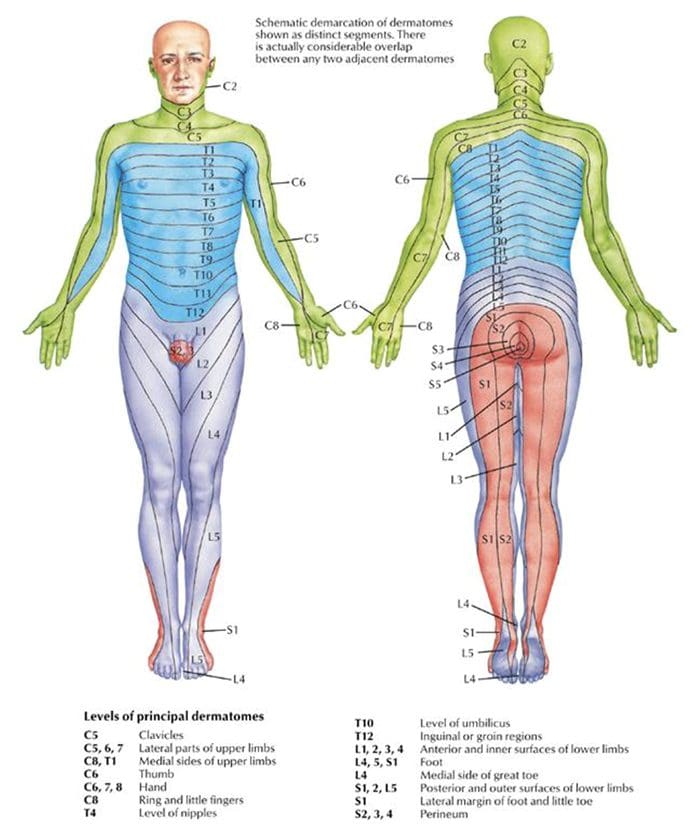
Spinal Nerve Roots and Dermatomes
Spinal conditions such as herniated discs and stenosis can lead to radiating pain that travels down one arm or leg. Other symptoms include weakness, numbness, and/or shooting or burning electrical sensations. The medical term for pinched nerve symptoms is radiculopathy (National Institutes of Health: National Institute of Neurological Disorders and Stroke. 2020). Dermatomes could contribute to irritation in the spinal cord, where the nerve roots cause symptoms in the back and limbs.
Anatomy
The spinal cord has 31 segments.
Each segment has nerve roots on the right and left that supply motor and sensory functions to the limbs.
The anterior and posterior communicating branches combine to form the spinal nerves that exit the vertebral canal.
The 31 spine segments result in 31 spinal nerves.
Each one transmits sensory nerve input from a specific skin region on that side and area of the body.
These regions are called dermatomes.
Except for the first cervical spinal nerve, dermatomes exist for each spinal nerve.
The spinal nerves and their associated dermatomes form a network all over the body.
Dermatomes Purpose
Dermatomes are the body/skin areas with sensory input assigned to individual spinal nerves. Each nerve root has an associated dermatome, and various branches supply each dermatome off that single nerve root. Dermatomes are pathways through which sensational information in the skin transmits signals to and from the central nervous system. Sensations that are physically felt, like pressure and temperature, get transmitted to the central nervous system. When a spinal nerve root becomes compressed or irritated, usually because it comes into contact with another structure, it results in radiculopathy. (National Institutes of Health: National Institute of Neurological Disorders and Stroke. 2020).
Radiculopathy
Radiculopathy describes symptoms caused by a pinched nerve along the spine. Symptoms and sensations depend on where the nerve is pinched and the extent of the compression.
Cervical
This is a syndrome of pain and/or sensorimotor deficiencies when nerve roots in the neck are compressed.
It often presents with pain that goes down one arm.
Individuals may also experience electrical sensations like pins and needles, shocks, and burning sensations, as well as motor symptoms like weakness and numbness.
Lumbar
This radiculopathy results from compression, inflammation, or injury to a spinal nerve in the lower back.
Sensations of pain, numbness, tingling, electrical or burning sensations, and motor symptoms like weakness traveling down one leg are common.
Diagnosis
Part of a radiculopathy physical examination is testing the dermatomes for sensation. The practitioner will use specific manual tests to determine the spinal level from which the symptoms originate. Manual exams are often accompanied by diagnostic imaging tests like MRI, which can show abnormalities in the spinal nerve root. A complete physical examination will determine if the spinal nerve root is the source of the symptoms.
Treating Underlying Causes
Many back disorders can be treated with conservative therapies to provide effective pain relief. For a herniated disk, for example, individuals may be recommended to rest and take a nonsteroidal anti-inflammatory medication. Acupuncture, physical therapy, chiropractic, non-surgical traction, or decompression therapies may also be prescribed. For severe pain, individuals may be offered an epidural steroid injection that can provide pain relief by reducing inflammation. (American Academy of Orthopaedic Surgeons: OrthoInfo. 2022) For spinal stenosis, a provider may first focus on physical therapy to improve overall fitness, strengthen the abdominals and back muscles, and preserve motion in the spine. Pain-relieving medications, including NSAIDs and corticosteroid injections, can reduce inflammation and relieve pain. (American College of Rheumatology. 2023) Physical therapists provide various therapies to decrease symptoms, including manual and mechanical decompression and traction. Surgery may be recommended for cases of radiculopathy that don’t respond to conservative treatments.
Injury Medical Chiropractic and Functional Medicine Clinic care plans and clinical services are specialized and focused on injuries and the complete recovery process. Our areas of practice include Wellness & Nutrition, Chronic Pain, Personal Injury, Auto Accident Care, Work Injuries, Back Injury, Low Back Pain, Neck Pain, Migraine Headaches, Sports Injuries, Severe Sciatica, Scoliosis, Complex Herniated Discs, Fibromyalgia, Chronic Pain, Complex Injuries, Stress Management, Functional Medicine Treatments, and in-scope care protocols. We focus on restoring normal body functions after trauma and soft tissue injuries using Specialized Chiropractic Protocols, Wellness Programs, Functional and integrative Nutrition, Agility, and mobility Fitness Training, and Rehabilitation Systems for all ages. If the individual requires other treatment, they will be referred to a clinic or physician best suited for their condition. Dr. Jimenez has teamed with the top surgeons, clinical specialists, medical researchers, therapists, trainers, and premiere rehabilitation providers to bring El Paso, the top clinical treatments, to our community.
Reclaim Your Mobility: Chiropractic Care For Sciatica Recovery
References
National Institutes of Health: National Institute of Neurological Disorders and Stroke. (2020). Low back pain fact sheet. Retrieved from https://www.ninds.nih.gov/sites/default/files/migrate-documents/low_back_pain_20-ns-5161_march_2020_508c.pdf
American Academy of Orthopaedic Surgeons: OrthoInfo. (2022). Herniated disk in the lower back. https://orthoinfo.aaos.org/en/diseases–conditions/herniated-disk-in-the-lower-back/
American College of Rheumatology. (2023). Spinal stenosis. https://rheumatology.org/patients/spinal-stenosis
Chiropractic Reset: Traveling is not an easy adjustment as it disrupts the body’s internal clock. When flying even just 3 hours, the body can start to experience symptoms like:
Fatigue
Confusion
Insomnia
Joint and muscle pain
Stiffness
Stomach problems
Nausea
Hunger
Bad mood
Not only is the flight a physical challenge, but so are the long lines, backed-up traffic, lost luggage, etc. All take a toll on the mind and body; a chiropractic reset can help restore the body’s balance and energy levels.
Jet Lag
Jet lag happens when the brain region known as the hypothalamus or center that controls sleep cycles, appetite, and temperature conflicts with travel changes. A survey from international flight attendants found that despite being used to long air travel:
90% had fatigue over the first five days.
94% had a lack of energy/motivation.
93% had broken sleep.
70% had ear, nose, or throat issues.
Scientists have estimated that it takes a full day to recover for every hour of time difference. The direction traveled can affect how intense the symptoms are since it’s easier for the body to delay its internal clock than speed it up. Traveling east is more difficult on the body compared to traveling west.
Ways To Limit The Effects
Workout
Get a thorough physical workout the day before you fly.
It doesn’t matter; it can be an hour on an elliptical machine, a mile jog, or a vigorous swim.
The objective is to get the lymph system moving to help prevent edema in the legs, hands and flush toxins from the body.
Take a Walk Every Hour
Try and get up at least once an hour for long trips and every half hour for shorter ones.
If possible, try to get a flight that gets to your destination in the evening.
Then, stay up until 10 pm local time.
If you have to take a nap, set the alarm not to surpass two hours.
Avoid caffeine and alcohol
You don’t have to go without alcohol or caffeine, but they should be cut out a few hours before sleeping.
Both can affect the ability to fall asleep, stay asleep, and the quality of sleep.
Change sleep patterns beforehand
In the week leading up to the trip, start adjusting sleep time and wake time to get closer to the new time zone.
This way, upon arrival, the body is basically adjusted.
Skip the big meal
To help the digestive system, try not to eat a massive meal upon arrival.
Allow body functions like sleep and digestion to adjust to the changes.
Bask in the sun
Daylight has a significant effect on the body’s clock.
Get outside to wake up the brain to help the body and mind adjust to the daytime hours.
Melatonin
This is a hormone in the body that helps control the circadian rhythm.
Melatonin is dependent on the amount of light the body is exposed to.
When there’s light, melatonin release is stopped.
When dark, melatonin release is stimulated.
It is recommended not to take melatonin before leaving, or it will make the jet lag worse.
Wait until landing in the new time zone to supplement one hour before regular sleep time at the new location.
Continue for three nights or until the body has adjusted.
Pycnogenol
Pycnogenol has been studied for its effect of reducing jet lag symptoms.
It reduces cerebral and joint swelling, which leads to fewer short-term memory problems, fatigue, and cardiac issues.
It has been shown to decrease deep vein thrombosis and superficial vein thrombosis, typical side effects of long flights.
Recommendations are to take three times a day for up to five days maximum of seven days after landing.
Chiropractic Reset
Chiropractic reset adjustments the day before and especially after the flight can restore balance to the nervous system and the body. This will help reset sleeping and waking patterns after the stress of flying.
Body Composition
Metabolic Syndrome
Metabolic syndrome is a name for a set of symptoms and conditions that revolve around cardiovascular health.
Obesity and a high amount of visceral fat are significant risk factors for being diagnosed with metabolic syndrome.
Body composition analysis can be thought of as a tool for understanding the approach to preventing the onset of metabolic syndrome. Knowing how to identify the risks can support individuals in making informed decisions on their healthcare journey.
References
Belcaro, G et al. “Jet-lag: prevention with Pycnogenol. Preliminary report: evaluation in healthy individuals and hypertensive patients.” Minerva cardioangiologica vol. 56,5 Suppl (2008): 3-9.
Janse van Rensburg, Dina C Christa et al. “How to manage travel fatigue and jet lag in athletes? A systematic review of interventions.” British journal of sports medicine vol. 54,16 (2020): 960-968. doi:10.1136/bjsports-2019-101635
Straub, WF et al. “The effect of chiropractic care on jet lag of Finnish junior elite athletes.” Journal of manipulative and physiological therapeutics vol. 24,3 (2001): 191-8.
Zerón-Rugerio, María Fernanda et al. “Eating Jet Lag: A Marker of the Variability in Meal Timing and Its Association with Body Mass Index.” Nutrients vol. 11,12 2980. 6 Dec. 2019, doi:10.3390/nu11122980
Skipping Across Time Zones More Than Just Tiring For Pro Baseball Players:
The resulting jet lag may actually harm their performance on the field, a new study suggests.
Researchers analyzed data from more than 40,000 Major League Baseball games played over 20 years. The conclusion: jet lag may have a significant impact on players.
The Northwestern University researchers said they found that jet lag slowed the base running of home teams but not away teams. And both home and away pitchers gave up more home runs when jet-lagged.
“Jet lag does impair the performance of Major League Baseball players. The negative effects of jet lag we found are subtle, but they are detectable and significant. And they happen on both offense and defense and for both home and away teams, often in surprising ways,” study leader Ravi Allada, a circadian rhythms expert, said in a university news release.
The researchers also found that the negative effects of jet lag were generally stronger when teams traveled eastward rather than westward.
“This is a strong argument that the effect is due to the circadian clock, not the travel itself,” Allada said.
What that means is that players’ internal 24-hour body clock falls out of sync with the cycle of sunlight, the study authors explained.
The findings suggest — but don’t prove — that team managers should pay close attention to their players’ body clocks. And even consider sending pitchers ahead of the rest of the team for upcoming games, the researchers added.
“If I were a baseball manager and my team was traveling across time zones — either to home or away — I would send my first starting pitcher a day or two ahead, so he could adjust his clock to the local environment,” Allada said.
The study was published Jan. 23 in the Proceedings of the National Academy of Sciences.
News stories are written and provided by HealthDay and do not reflect federal policy, the views of MedlinePlus, the National Library of Medicine, the National Institutes of Health, or the U.S. Department of Health and Human Services.
IFM's Find A Practitioner tool is the largest referral network in Functional Medicine, created to help patients locate Functional Medicine practitioners anywhere in the world. IFM Certified Practitioners are listed first in the search results, given their extensive education in Functional Medicine