
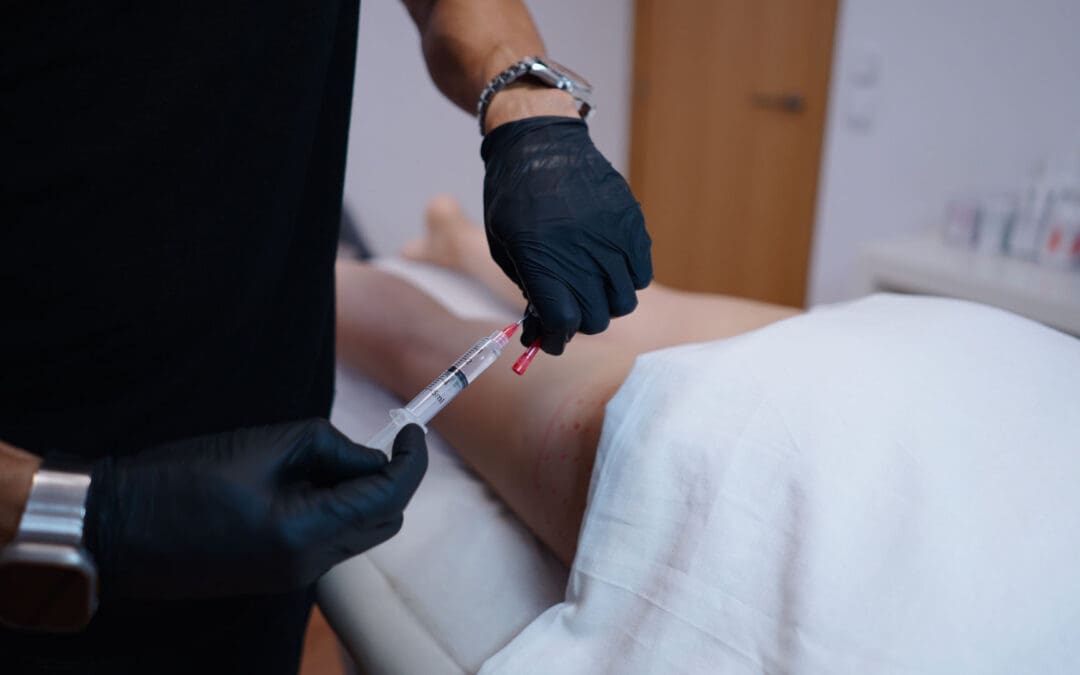
Sports Injury Recovery Using PRF and Chiropractic Care
Sports Injury Recovery Using PRF and Chiropractic Care
Abstract: Sports injuries to ligaments, tendons, and muscles often heal slowly because these tissues receive limited blood flow. Platelet-rich plasma (PRP) and platelet-rich fibrin (PRF) use a concentrated portion of a person’s own blood to deliver growth factors that support natural repair. PRF forms a gel-like biological scaffold that releases those factors over a longer time. When this treatment is combined with integrative chiropractic care, the plan addresses both cellular tissue repair and the mechanical problems that caused or followed the injury. Multidisciplinary clinics that use both methods create a clear, non-surgical path back to activity. This article explains the treatments, how they work together, and how a coordinated medical and chiropractic team supports recovery.

Clarifying the Terminology: PRP and PRF
To clarify a quick terminology point, the medical therapy used for sports injuries is known as Platelet-Rich Plasma (PRP) or Platelet-Rich Fibrin (PRF). While it is occasionally mislabeled as “Platelet Fibrin Plasma” or abbreviated as “PFP,” the core treatment remains the same: isolating a highly concentrated portion of your blood to accelerate the healing of damaged ligaments, tendons, and muscles.
PRP is the liquid form. A small blood sample is drawn and spun at higher speeds, often with an anticoagulant so the material stays fluid for injection. The concentrated platelets release growth factors relatively quickly at the injury site.
For sports injuries, the next-gen biological scaffold known as platelet-rich fibrin (PRF) is spun at a slower pace without anticoagulants to form a thick gel-like matrix that gradually releases growth factors. Unlike conventional PRP, which dissolves rapidly, PRF naturally clots because it forms a solid, three-dimensional structure. At the precise location of a sports injury, this clotted mesh mechanically captures platelets, white blood cells, and stem cells.
Both options use the patient’s own blood, so the risk of rejection or disease transmission stays very low. Ultrasound guidance is often used for accurate placement.
How the PRF Scaffold Supports Healing
A sports injury can leave tissue weak or incompletely repaired. PRF supplies a temporary framework that guides the body’s natural process:
- The fibrin gel clots on its own and stays at the injury site.
- Platelets and supportive cells remain trapped inside the mesh.
- Growth factors leave the matrix slowly, signaling nearby cells to build collagen and new blood vessels.
- The structure encourages organized tissue rather than messy scar tissue.
Studies on ligaments and tendons show that this sustained release can improve tensile strength and the orderly arrangement of collagen fibers in certain models when compared with liquid PRP. The scaffold effect is especially beneficial for tissues that heal slowly, such as the Achilles tendon, rotator cuff, patellar tendon, or medial collateral ligament.
Sports Injuries Commonly Treated with These Therapies
PRP and PRF are used for many overuse and traumatic problems:
- Tendon conditions such as tennis elbow, golfer’s elbow, jumper’s knee, and Achilles tendinopathy
- Ligament sprains or partial tears in the ankle, knee, or elbow
- Muscle strains that take a long time to resolve
- Selected joint irritations and early cartilage issues
Active people often choose these options when rest, physical therapy, or anti-inflammatory measures have not produced full recovery and when surgery is not the first choice. Results depend on the severity of the injury, overall health, and consistent follow-through with rehabilitation. Some research shows faster return to activity or improved function when biologics are added to a solid rehab plan; other studies demonstrate more modest gains.
How Integrative Chiropractic Care Fits into the Plan
Integrative chiropractic care looks at the whole movement system, not only the painful spot. After an injury, joints may lose normal motion, muscles may tighten or weaken unevenly, and posture or gait may change. These mechanical imbalances place extra stress on the healing tissue and can slow recovery or raise the chance of re-injury.
Chiropractic care uses precise adjustments, soft-tissue work, and movement retraining to restore proper joint motion and muscle balance. This reduces abnormal loading on the injured ligament or tendon. When the structure is better aligned, the biological repair from PRF or PRP has a clearer path. Progressive exercises then load the new tissue in a controlled way so it becomes strong and organized.
The Dual Approach: Cellular Repair Plus Mechanical Correction
When utilized in conjunction with integrative chiropractic therapy, Platelet-Rich Fibrin (PRF) repairs biological tissue at the cellular level, and the two modalities work together to alleviate sports injuries by addressing the underlying structural and mechanical abnormalities.
- PRF works at the cellular level by supplying growth factors and a scaffold that help the body rebuild damaged tissue.
- Chiropractic care works at the structural level by correcting the joint and muscle imbalances that contributed to the injury or developed because of it.
A thorough, non-surgical rehabilitation plan is developed by multidisciplinary clinics because injuries are often co-managed utilizing both modalities. The regenerative injection starts the healing process. Chiropractic visits and rehabilitation keep the body moving correctly while the tissue matures. Patients typically progress from protected movement to sport-specific drills under guidance. This coordinated method aims for both repaired tissue and restored function.
Clinical Observations and the Team Approach in El Paso
At Injury Medical Clinic PA in El Paso, Texas, care follows an evidence-based model. Dr. Alexander Jimenez, DC, APRN, FNP-BC, CCST, CFMP, IFMCP, ATN, provides chiropractic care, functional medicine insight, personal-injury evaluation, and rehabilitation planning. Clinical observations from practice show that biologics work best when biomechanics are optimized and when metabolic factors—such as vitamin D status, inflammation control, and nutrition—are addressed. Patients who follow progressive loading and correct movement patterns tend to show steadier, longer-lasting gains.
Dr. Maria Guadalupe Cardenas, MD (Board Certified in Internal Medicine) (NPI #1164426749, Texas MD License #J2933), with over 40 years of experience as an internist, works with Dr. Alex Jimenez, DC, and serves as the Medical Director and Collaborative Physician at his practice, Injury Medical Clinic PA, in El Paso, Texas. This is a multidisciplinary setup common in integrative or injury care clinics, where an MD provides medical direction alongside a chiropractor.
The team integrates chiropractic care (Dr. Jimenez) with medical oversight by Dr. Cardenas (internal medicine), as well as functional medicine, personal injury care, rehabilitation, and related services. This collaboration allows careful patient selection, imaging when needed, and monitoring of overall health factors that influence healing.
What the Recovery Journey Looks Like
A typical course begins with a full evaluation of the injury, movement patterns, and health history. If PRF or PRP is appropriate, the injection is performed under guidance. Short rest follows, then gradual reintroduction of movement. Chiropractic adjustments and soft-tissue work address surrounding restrictions. Rehabilitation exercises progress from simple range-of-motion and activation drills to strength and sport-specific tasks.
Most people notice early changes in pain and swelling over weeks. Tissue quality and function continue to improve over months as the scaffold does its work and controlled loading strengthens the repair. Return-to-activity decisions are based on strength, control, and absence of pain rather than a fixed calendar. Consistent follow-through with the full plan—biologic treatment plus mechanical correction plus progressive exercise—supports the best chance of durable recovery.
Bringing the Pieces Together
PRP and especially PRF concentrate the body’s own healing signals and deliver them exactly where they are needed. PRF’s gel scaffold keeps those signals working longer and provides physical support for new tissue. When this biological tool is combined with integrative chiropractic care that restores proper joint motion and movement patterns, the result is a dual strategy: cellular repair plus mechanical balance. Multidisciplinary teams that include medical oversight and chiropractic expertise help patients move through the process safely and systematically. For many people dealing with stubborn sports injuries, this combination provides a practical, non-surgical route toward stronger tissue and better function.
References
Yale Medicine. (n.d.). Platelet-rich plasma (PRP) injections.
Johns Hopkins Medicine. (n.d.). Platelet-rich plasma (PRP) treatment.
Amira Health. (n.d.). PRF vs PRP: Advancing the future of natural healing.
Jimenez, A. (n.d.). PRP and chiropractic for faster injury recovery explained.
El Paso Chiropractor Blog. (2026). Regenerative medicine and chiropractic care in El Paso.
Health Coach Clinic. (n.d.). Chiropractic and regenerative medicine enhances healing.
Dr. Alex Jimenez. (n.d.). Clinical observations and practice focus.









