Discover the Different Types of Sleep Sounds for a Restful Night
Can listening to sleep sounds help achieve and maintain healthy sleep patterns for individuals having trouble sleeping?
Sleep Sounds
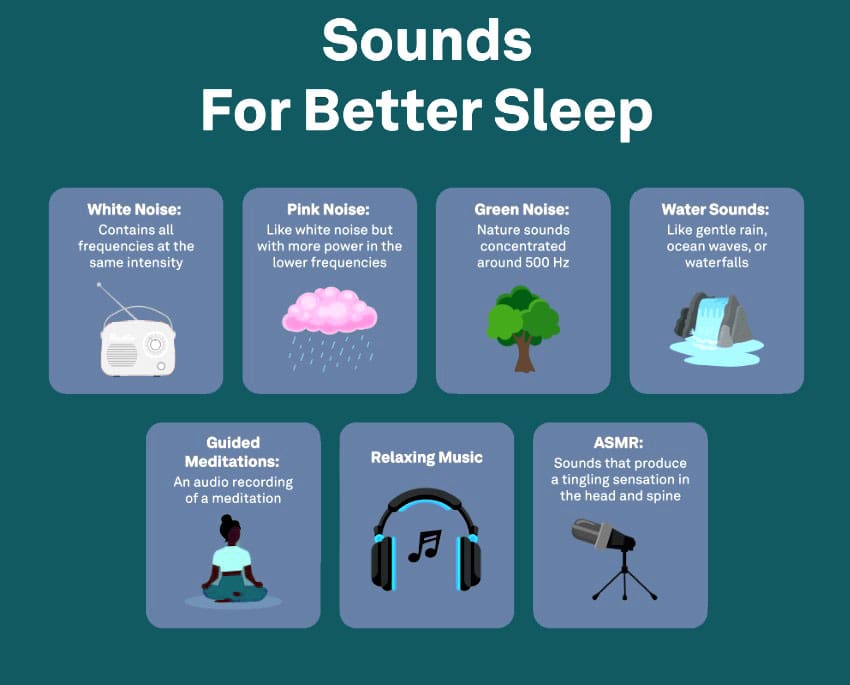
Sleep sounds include white, pink, green, or brown noise, binaural beats, ASMR, nature, and ambient sounds. Each has different benefits and can potentially improve sleep. (Ebben M. R., Yan P., & Krieger A. C. 2021) Sound has no color, but it follows a spectrum. The color of a sound refers to the power spectrum of a particular noise signal. Each color has different qualities.
- White noise, such as an untuned radio or television, is the most well-known background noise and is often used as a sleep aid.
- Green noise features more powerful mid-range frequencies.
- Brown noise is a more low-frequency rumble deeper than green and white noise.
- Pink noise combines white noise softened by brown and could be the most effective option for improving sleep.
White noise is a sound that includes all the audible frequencies at equal volume, like a continuous hiss. One study found that adults fell asleep faster while listening to white noise. (Messineo L. et al., 2017)
Green noise, which features more powerful mid-range frequencies, is similar to natural sounds like ocean waves, rainfall, and rustling leaves. It’s more soothing than white noise and can help individuals with anxiety sleep better.
Brown noise, also known as red noise, has a deeper tone than white noise and is similar to the hum of an airplane. It can help mask lower-pitched sounds and may be especially helpful for individuals with ADHD, as it aids in productivity and concentration. Brown noise mimics sounds found in nature but with a low-frequency rumble. Examples include heavy rainfall, thunder, or loud waves.
Pink Noise
While further scientific research on sleep noise is needed, evidence has begun to suggest that pink noise may be the most effective option for improving sleep. (Ong J. L. et al., 2016) Pink noise is softer and more soothing than the other colored sleep sounds. It combines white noise softened by brown noise and is considered more relaxing because of its lower pitch. It has a pleasant-sounding, balanced volume across frequencies, making it calming to the human ear. Pink noise includes digital recreations of natural sounds such as a gently flowing stream, soft rain falling, wind rustling through trees, or calm waves lapping at the shore.
In a study, adults over 60 were given intermittent bursts of pink noise while sleeping, similar to rushing water. (Papalambros N. A. et al., 2017) The following morning, participants were given memory tests, which indicated that retention levels were approximately three times greater than those of the control group not exposed to the pink noise. Another study found that steady pink noise significantly reduced brain wave complexity during sleep while improving stable sleep time with less fragmentation and fewer wake periods. (Zhou, J. et al., 2012)
Injury Medical Chiropractic and Functional Medicine Clinic
Choosing the right sound for you ultimately comes down to personal preference. Individuals can try each color and see which one they like best. Individuals who struggle with sleep or other sleep disorders that impact their ability to get restful sleep should consult with their healthcare provider about getting an assessment and treatment to restore health. Individuals can recover and regain the benefits of quality rest through healthy sleep practices and lifestyle accommodations. Injury Medical Chiropractic and Functional Medicine Clinic works with primary healthcare providers and specialists to build optimal health and wellness solutions. We focus on what works for you to relieve pain, restore function, prevent injury, and help mitigate issues through adjustments that help the body realign itself. They can also work with other medical professionals to integrate a treatment plan to resolve musculoskeletal problems.
Beyond Medicine: The Power of Chiropractic Care
References
Ebben, M. R., Yan, P., & Krieger, A. C. (2021). The effects of white noise on sleep and duration in individuals living in a high noise environment in New York City. Sleep medicine, 83, 256–259. https://doi.org/10.1016/j.sleep.2021.03.031
Messineo, L., Taranto-Montemurro, L., Sands, S. A., Oliveira Marques, M. D., Azabarzin, A., & Wellman, D. A. (2017). Broadband Sound Administration Improves Sleep Onset Latency in Healthy Subjects in a Model of Transient Insomnia. Frontiers in neurology, 8, 718. https://doi.org/10.3389/fneur.2017.00718
Ong, J. L., Lo, J. C., Chee, N. I., Santostasi, G., Paller, K. A., Zee, P. C., & Chee, M. W. (2016). Effects of phase-locked acoustic stimulation during a nap on EEG spectra and declarative memory consolidation. Sleep medicine, 20, 88–97. https://doi.org/10.1016/j.sleep.2015.10.016
Papalambros, N. A., Santostasi, G., Malkani, R. G., Braun, R., Weintraub, S., Paller, K. A., & Zee, P. C. (2017). Acoustic Enhancement of Sleep Slow Oscillations and Concomitant Memory Improvement in Older Adults. Frontiers in human neuroscience, 11, 109. https://doi.org/10.3389/fnhum.2017.00109
Zhou, J., Liu, D., Li, X., Ma, J., Zhang, J., & Fang, J. (2012). Pink noise: effect on complexity synchronization of brain activity and sleep consolidation. Journal of theoretical biology, 306, 68–72. https://doi.org/10.1016/j.jtbi.2012.04.006