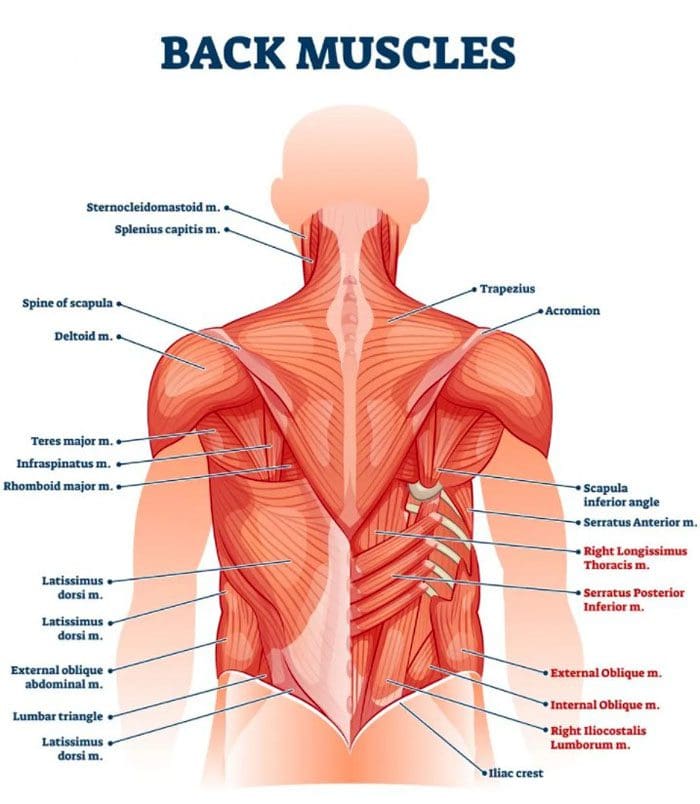
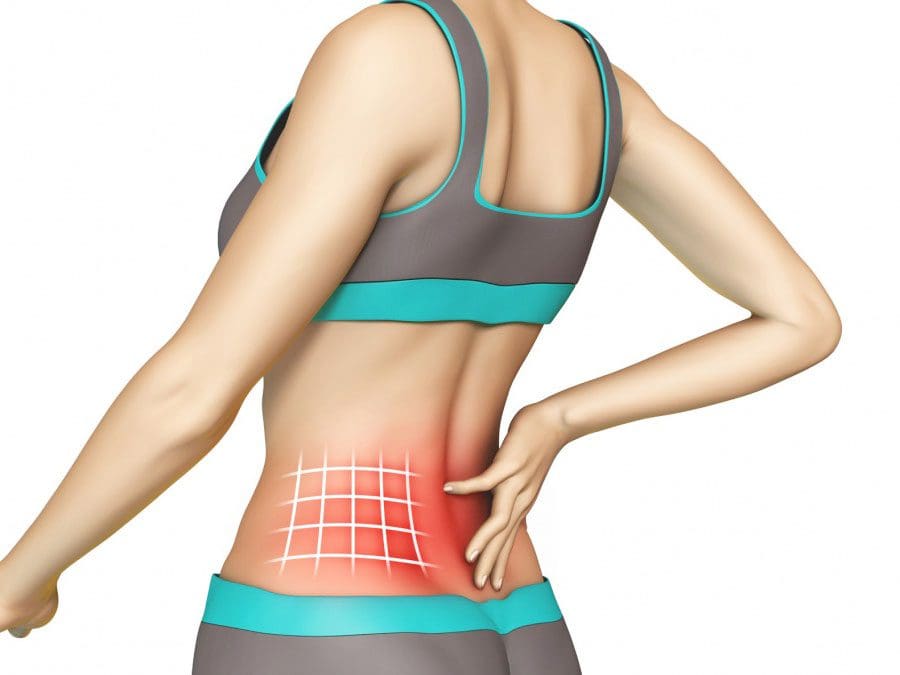
The latissimus dorsi or lats are the large flat muscles on each side covering the width of the middle and lower back. They connect the bone of the upper arm to the spine and the hip. When pain presents in these muscles, it is typically caused by:
Repetitive overuse in a job or doing a task/chore that requires constant
Bending
Pulling
Pushing
Reaching
Twisting
Kneeling
A result of poor technique in sports or similar physical activities.
Chiropractic treatment, along with exercises, can help prevent and relieve this pain.
Symptoms of lat pain
The objective is to diagnose whether the pain is located in the latissimus dorsi or other muscles in the shoulders or back. If the latissimus dorsi is injured, an individual might feel pain in several areas, these include:
Lower, middle, and upper back
Back of the shoulders
The base of the shoulder blade
Lower arms
Inside of the arms, extending down to the fingers
In certain cases, the pain will present without warning and can be felt in the surrounding muscles. This type of pain often gets worse when the individual:
Extends their hands forward and out in front
Raises their hands above their head
Tosses or throws an object
Damage or injury to the latissimus dorsi
Tissue damage or injury can cause other symptoms to present. These include:
If the source of the back pain cannot be identified, or if it is accompanied by:
Fever
Breathing problems
Abdominal pain
Consult a doctor as these could be symptoms of a more serious condition.
Uses and Causes
The lat muscles are used in everyday activities. These include:
Picking up objects like grocery bags
Opening heavy doors
Chest expansion for breathing
Pushing against the armrests of a chair to stand up
Using handrails to climb stairs
For sports or working out, the lats are used in:
Weightlifting exercises using the upper body
Bench-presses
Rowing
Swimming
Throwing
Common causes of pain include:
Overusing the muscles
Using poor techniques
Exercising without warming up
Risk of injury
Individuals that are at risk of developing this injury include those that:
Are continually reaching overhead
Regularly chop wood
Perform regular shoveling
Move furniture or other heavy objects
Regularly practice poor posture
Tearing the latissimus dorsi is possible, especially for athletes. Some athletes with increased risk include:
Golfers
Baseball pitchers
Gymnasts
Swimmers
Tennis players
Exercises that can help bring relief
Certain exercises can alleviate the aches, pain, and strengthen the lat muscles to prevent and/or worsen the injury. It is recommended to consult a doctor, sports chiropractor, or personal trainer before beginning a therapeutic exercise regimen. This is to ensure that the exercises are right for the individual and their condition and that they use the correct form. Here are two exercises that can help reduce the pain. The doctor, chiropractor, or trainer will recommend the frequency the individual should perform the exercises.
Back bow
This pose is known as the superman pose. To perform:
Lay facedown on the floor
Extend the legs so they are straight
Stretch arms away from the body, so they are in front of the head
Bend the knees like for a sit-up with the heels close to the buttocks
Keeping the hands and feet in place
Lift the pelvis upward
Slowly lower back to the floor
Prevention
Individuals can prevent lat pain with lifestyle adjustments. These include:
Using proper technique and posture during work, sports, and exercise
Staying aware to not overuse the muscles
Staying hydrated
Warming up and cooling down thoroughly before and after a workout, sports, physical activities
Regular stretching
Applying ice and heat before and after work, sports, and physical activities
Chiropractic care
Physical therapy massage
Body Composition
Nutrition and Recovery Advantage
Two important steps to achieve optimal health include:
Nutrition
Having a proper protein intake is important for muscle adaptability or the way muscles adapt to stress during exercise and/or strength training. This is also important to stimulate muscle protein synthesisafter exercising and/or strength training. To ensure the body is getting the strength and hypertrophy improvement from exercise and strength training, it is recommended to eat around 25g of high-quality protein after workout sessions.
Recovery
For those doing aerobic and strength training, maximize recovery time between workout sessions. This is because strength and aerobic fitness health gains are low when the two only have a separation of 6 hours or less. Twenty-four hours between sessions is recommended especially if the priority is endurance performance.
References
Anderson, S. E., Hertel, R., Johnston, J. O., Stauffer, E., Leinweber, E., & Steinbach, L. S. (2005, November). Latissimus dorsi tendinosis and tear: imaging features of a pseudotumor of the upper limb in five patients. American Journal of Roentgenology, 185(5), 1145–1151
https://www.ajronline.org/doi/abs/10.2214/AJR.04.1247
Donohue, Benjamin F et al. “Sports Injuries to the Latissimus Dorsi and Teres Major.” The American journal of sports medicine vol. 45,10 (2017): 2428-2435. doi:10.1177/0363546516676062http://journals.sagepub.com/doi/abs/10.1177/0363546516676062?journalCode=ajsb
Henseler, J. F., Nagels, J., Nelissen, R. G. H. H., & de Groot, J. H. (2014, April). Does the latissimus dorsi tendon transfer for massive rotator cuff tears remain active postoperatively and restore active external rotation? Journal of Shoulder and Elbow Surgery, 23(4), 553–560
http://www.jshoulderelbow.org/article/S1058-2746(13)00399-6/fulltext%20
George, Michael S, and Michael Khazzam. “Latissimus Dorsi Tendon Rupture.” The Journal of the American Academy of Orthopaedic Surgeons vol. 27,4 (2019): 113-118. doi:10.5435/JAAOS-D-17-00581
Lehman, Gregory J et al. “Variations in muscle activation levels during traditional latissimus dorsi weight training exercises: An experimental study.” Dynamic medicine: DM vol. 3,1 4. 30 Jun. 2004, doi:10.1186/1476-5918-3-4
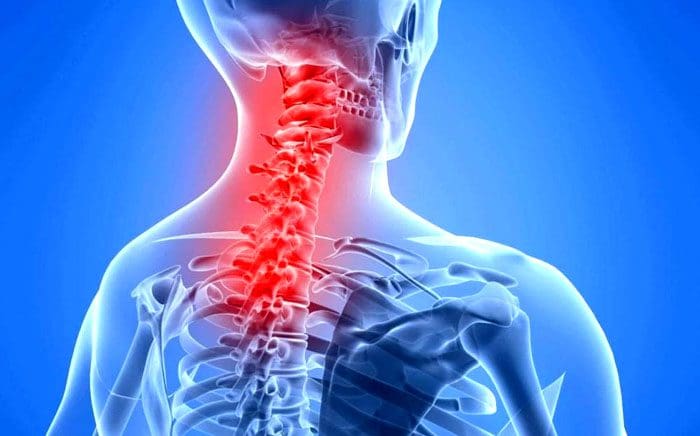
Many individuals will be looking up at the fireworks this 4th of July weekend. A word of caution when keeping the neck in one position for too long can cause neck discomfort and/or pain. Neck discomfort and pain can cause significant disruption with everyday activities. The neck is an area that is constantly in motion. Keeping it in one position for an extended period can cause damage/injury and spinal misalignment. Although neck pain often resolves on its own in a few days. However, it can lead to headaches or an inability to concentrate, affecting an individual’s quality of life. Here are some potential causes and remedies for decreasing neck discomfort and pain.
Keeping The Neck In One Position For Too Long Can Cause
Mechanical issues and imbalances in the upper spine, known as the cervical spine
Muscle tension
Muscle strain
Spinal misalignment
Poor posture
Sleeping problems
Injury or trauma to the neck from the force and weight
Chronic neck misalignment
If symptoms come on suddenly, are severe, or result in neurological issues like severe shooting pain, tingling, numbness, or sudden loss of arm strength, seek medical attention immediately.
Treatment
When the neck is strained or out of alignment, it disrupts nerve circulation integrity. Spinal misalignment is subtle in nature and can be difficult to detect without a professional examination. A chiropractor is trained to recognize any underlying issues to reset/realign the entire spine to optimal form. They will assess, guide, and treat the issue/s specific to the individual’s needs. Once the nerves are working uninhibited, a chiropractor can recommend neck exercises, stretches, and more to strengthen and prevent neck problems. When spinal alignment is restored, the body will begin to operate at full potential.
Healthy Body Composition
Meal Prep to Success
For individuals that want to eat less and change eating habits, change up the approach.
Meal prepping is a healthy habit that many have had success with because it helps achieve sustainable outcomes in weight loss. Every meal plan will vary for everyone.
First, individuals have different health goals.
Second, everyone has a different approach to their diet choices. For example, an individual might want to go low-carb and goes with the ketogenic diet. In comparison, some individuals are comfortable planning a week in advance and freezing labeled plastic containers.
Regardless of goals, dietary, or fitness preferences, a workable meal plan is recommended. The ultimate goal is to prevent feeling overwhelmed about planning the next healthy meal and resort to a junk food meal. To steer clear of unhealthy food choices and achieve a healthy body composition, here is a real-world tip to create and stick to a healthy meal plan.
Have a well-stocked fridge and pantry
Keeping to a meal plan is easier with a well-stocked fridge and pantry. Ensure to keep a list of essential groceries whenever going to the store to ensure plenty. This list of staples includes:
Having these ingredients ready to go means a healthy meal can be quickly put together when short on time.
Be realistic and make room for crazy days
You don’t have to come up with a seven-day weekly meal plan. It is important to change up the routine, so boredom doesn’t set in. Before planning and prepping several meals, double-check the calendar. Allow yourself some slack. This could be one or two lunches or dinners in a week just in case something comes up. If batch cooking, even schedule days for leftovers for that extra flexibility.
References
BMJ. 2017 Advances in the diagnosis and management of neck pain. Available at: https://pubmed.ncbi.nlm.nih.gov/28807894/
Mayo Clin Proc. 2015. Epidemiology, diagnosis, and treatment of neck pain. Available at: https://pubmed.ncbi.nlm.nih.gov/25659245/
Open Orthop J. 2016. A Qualitative Description of Chronic Neck Pain has Implications for Outcome Assessment and Classification. Available at: https://www.ncbi.nlm.nih.gov/pmc/articles/PMC5301418/
Phys Ther. 2018. A Mechanism-Based Approach to Physical Therapist Management of Pain. Available at: https://www.ncbi.nlm.nih.gov/pmc/articles/PMC6256939/
Pilates or yoga can work wonders and always stretch before physical exercise.
Get fit – no regular physical activity can lead to serious conditions and possibly chronic pain.
Exercise benefits all, even some light walking around the neighborhood is enough. Just get moving!
Playing a sport could be a way to keep active. Remember, in order for any exercise to work is that it is done regularly.
Strength training is important, just as its name implies strength training builds muscle and reduces muscle imbalances.
It�s never too late to increase strength and flexibility.
Look at activities that you and your friends/family can enjoy and make doing them a regular thing.
A�chiropractor�is the ideal�medical professional to consult with for any unexplained pain in the musculoskeletal system. They are highly qualified professionals that their specialty is treating conditions like lower back pain and they are very affordable. If you or a loved one have pain in the lower back, give us a call. We�re here to help!
Understand *FOOT PRONATION* & How to Correct it with Orthotics | El Paso, TX (2019)
Foot pronation is the natural movement that occurs during foot landing while walking or running. Foot pronation also occurs while standing, and in this instance, it is the amount in which the foot rolls inward toward the arch. Foot pronation is normal, however, excessive foot pronation can cause a variety of health issues, including bad posture. The following video describes the 5 red flags of excessive foot pronation, which can ultimately affect a person’s overall health and wellness. Dr. Alex Jimenez can help diagnose and treat excessive foot pronation. Patients recommend Dr. Alex Jimenez and his staff as the non-surgical choice for excessive foot pronation health issues.
IFM's Find A Practitioner tool is the largest referral network in Functional Medicine, created to help patients locate Functional Medicine practitioners anywhere in the world. IFM Certified Practitioners are listed first in the search results, given their extensive education in Functional Medicine