Joint Dislocation Chiropractor: Back Clinic
Dislocations impact the joint and are injuries that force/knock the bones out of position. Dislocations can be caused by a motor vehicle collision, falls, sports trauma, or weakened muscles and tendons. However, less impact/force is needed to dislocate smaller joints. Dislocations commonly occur at the shoulders, ankles, knees, hips, elbows, fingers and toes, and the jaw. The experience causes swelling, inability to move, and pain. A joint dislocation chiropractor can manipulate, reset, rehabilitate and strengthen the affected area and rebalance the body.
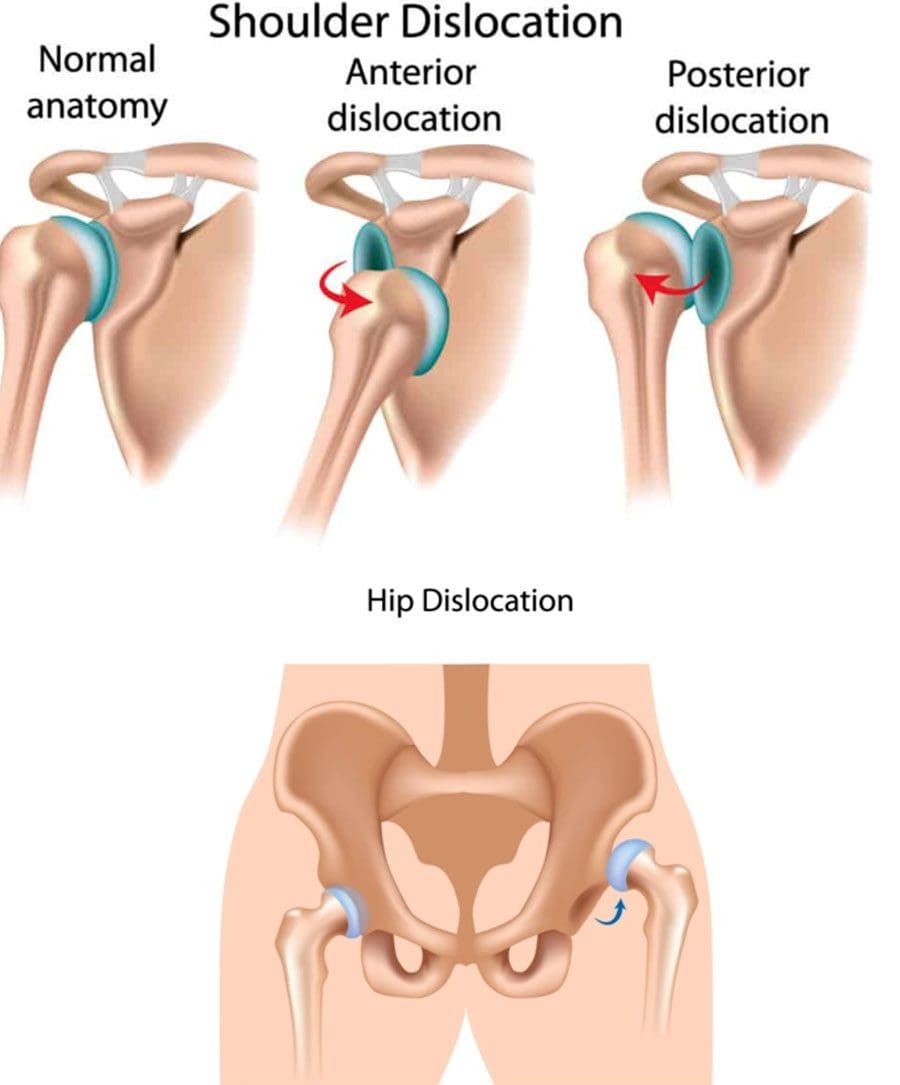
Joint Dislocation
The region where two or more bones come together is a joint. Each has a primary function, but their functions overlap. The joints allow the bones to move/articulate the skeletal system. Maintaining the body’s balance requires mobility and stability.
- Mobility is the ability to move the body without restriction.
- Stability is maintaining equilibrium, healthy posture, and support during movement.
- The stable joints do not dislocate easily because their structures are not as flexible.
- Mobile joints are at an increased risk, as they can move in almost any direction.
The stability joints include the following:
- Cervical spine
- Elbow
- Lumbar spine
- Knee
- Foot
The mobility joints include:
- Shoulder
- Wrist
- Thoracic spine
- Hip
- Ankle
The kinetic chain is a sequence of joints forming an alternating pattern of stability and mobility that create a solid platform for dynamic movement. However, any joint can become dislocated, causing the affected area to become unsteady or immobile, strain or tear the surrounding muscles, nerves, and tendons which are the tissues that connect the bones to a joint.
- A joint can be partially dislocated/subluxation or fully dislocated.
- Joints dislocated previously have an increased risk of re-dislocating because the surrounding tissues that hold the joint have been torn or overly stretched.
Symptoms
Symptoms vary depending on the severity and location of the injury. Common symptoms include:
- Instability
- Loss of ability to move
- Swelling
- Bruising
- Pain
- Visible deformation
Increased Risk
Various factors can lead to joint dislocation, including:
- Weakness of the supporting ligaments and muscles from natural wear and tear/age or lack of physical conditioning.
- Older individuals with poor balance are more vulnerable to falls that can knock joints out of place.
- Young children developing have more elastic supporting ligaments and are prone to falls, collisions, and other injuries.
- Previous dislocations with overstretched or torn supporting tissues.
- Repeated dislocations are likely to follow the shoulder, knee, and hip.
- Inherited conditions can cause the elastic tissues to overstretch. Examples include Ehlers-Danlos syndrome and Marfan syndrome.
- Physical activities like extreme sports, contact sports, or sports that involve quick body shifts, twists, and turns on the feet.
- Physically demanding job.
- Operating heavy machinery/equipment.
- Joint hypermobility is common in children and around 5% of adults. It can be caused by weak or loose ligaments, weak or loose muscles, and/or shallow joint sockets.
Joint Dislocation Chiropractic
Treatment will vary based on the severity of the injury and the dislocated joint. Depending on the location and severity, a chiropractor will perform different movements/manipulations to realign the joint and strengthen the area.
- Significant force could be necessary to pull the bones apart to realign them back into their proper position.
- The joint may need to be pulled out and rotated slightly before being put back.
- The focus is on increasing ligament strength.
- Once the joint is back in place, it may need to remain immobile, possibly using a sling or splint to help fully heal the injury.
- Physical therapy exercises will be recommended to strengthen the muscles and ligaments around the joint to support it optimally.
Shoulder Pain Chiropractic
References
Dizdarevic, Ismar, et al. “Epidemiology of Elbow Dislocations in High School Athletes.” The American journal of sports medicine vol. 44,1 (2016): 202-8. doi:10.1177/0363546515610527
Hodge, Duncan K, and Marc R Safran. “Sideline management of common dislocations.” Current sports medicine reports vol. 1,3 (2002): 149-55. doi:10.1249/00149619-200206000-00005
Prechel, Ulla et al. “The Treatment of Temporomandibular Joint Dislocation.” Deutsches Arzteblatt international vol. 115,5 (2018): 59-64. doi:10.3238/arztebl.2018.0059
Skelley, Nathan W et al. “In-game Management of Common Joint Dislocations.” Sports health vol. 6,3 (2014): 246-55. doi:10.1177/1941738113499721