Kyphosis is a condition that is most typically identified by a humped mid to upper back. It can be frustrating to find yourself diagnosed with kyphosis, both due to the unusual appearance it causes and the physical discomfort that can come with the condition. Fortunately, chiropractic offers a variety of treatment options for kyphosis that are non-invasive, drug-free and quite effective. With the right approach, it should be possible to get significant relief for your symptoms through chiropractic care.
Causes
Many times kyphosis is caused by poor posture. Years of hunching your back can cause the body to change the way the vertebrae sit atop one another�leading to stretching of soft tissues and a resting position that is hunched instead of upright.
Not all cases of kyphosis are the result of poor posture, however. There are some people who are born with kyphosis. There are also those that develop kyphosis following trauma or due to disease. One of the most common diseases that result in kyphosis is Scheuermann’s disease.
Chiropractic can often help resolve kyphosis that is caused by poor posture. If your kyphosis is due to trauma or other issues, chiropractic can still provide a much-needed relief from many of your symptoms�including pain and stiffness.
How Chiropractic Helps With Kyphosis
HEALTHCARE AND MEDICAL CONCEPT: KYPHOSIS
Diagnosing the Cause
Your first visit to the chiropractor will begin with a comprehensive examination to determine the cause of your condition. An accurate diagnosis is key to developing an effective treatment plan. The examination will most likely include imaging tests like an x-ray or MRI. It may also include a physical examination to figure out how your body currently moves, where you are tender and/or in pain, etc.
Treatment Plan
Your chiropractor will never move forward with treatment until he or she has explained your options and gotten your permission to begin. The treatment plan you are offered may include:
The joint in the human body, particularly the spinal joints, have an ideal alignment where everything fits together best. The more you can achieve and maintain this alignment, the less pain, stiffness and other disruptions you can expect to experience. Chiropractic adjustments aim to bring your body back into alignment.
Regular adjustments should help to improve your spinal alignment and straighten your back. In the case of poor posture, adjustments can aid you in learning how to improve your posture and keep those improvements over the long term.
Mobility Increased
The curving of the back typical of kyphosis can lead to a lot of stiffness in the spine and surrounding soft tissues. Lack of mobility makes everything you do more difficult, so it makes sense to try and increase your mobility when possible.
Chiropractic adjustments and complementary therapies are ideal for relaxing the soft tissues that may have become stiff as the kyphosis developed. One of the great things about improving the mobility of the spine is that it allows you to improve your posture. Over time, it should become easier to keep your back in a more healthy alignment.
Pain Lessened
Pain is common with kyphosis. The spine is not meant to hump as it does with kyphosis, which explains why pain is so typical with the condition. Chiropractic is very useful for decreasing pain related to spinal issues. Many patients get relief immediately following their first adjustment.
Schedule an Appointment With Us Today
If you are suffering from kyphosis, please contact us to schedule an appointment. Our chiropractic team is standing by to answer your questions and help you get treatment for your condition.
What is a Pronated Foot & What Can Custom Orthotics Do?
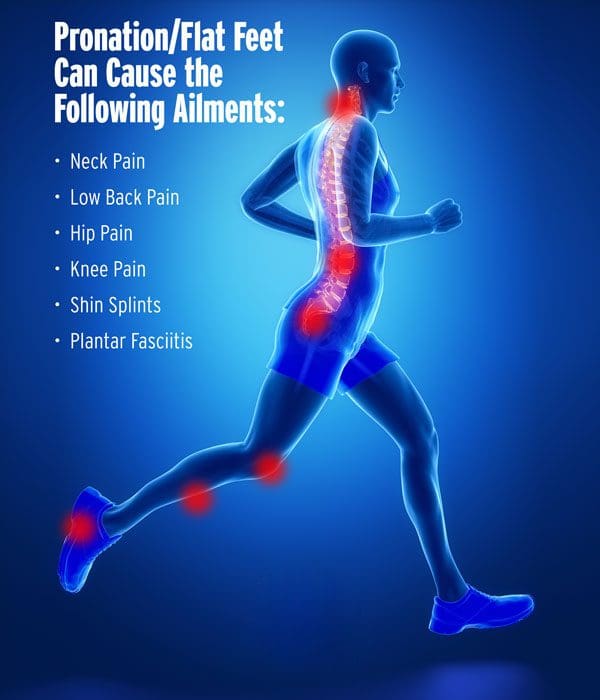
When a foot is pronated, it means its arches have fallen and the foot is flat. Flat feet do not absorb shock as well and make for a less stable base for�the bones, muscles, ligaments, and tendons. They can also:
Shift the body’s alignment out of order
Cause aches and pains in the feet, knees, hips, neck and/or spine
Lead to injury and problems like shin splints, Achilles tendinitis, and plantar fasciitis
Up to a third of people suffer from flat feet
Causes
The connective tissue, called the plantar fascia, on the underside of the foot is what maintains the foot�s healthy arch shape. Injury and health conditions can cause the fascia to stretch out and flatten. But so can everyday walking and standing. Once the fascia stretches out, it is unable to spring back. When the foot structure becomes flattened, the body�s foundation is prone to injury and health conditions.
Treatment
Chiropractic adjusting to ensure proper positioning of bones and joints
Custom orthotics in every pair of shoes for pronation control, support, and comfort
Get Rid of *Foot Pronation* with *FOOT ORTHOTICS* | El Paso, Tx (2019)
Pronation
Pronation describes the way that the foot rolls inward during its normal motion. The foot turns inward, flattening out, as the heel�s outer edge strikes the ground. For the foot to function correctly, there must be a significant degree of pronation. However, excessive pronation, or overpronation, can cause injury and damage to the foot and ankle. It creates the arch in the foot to flatten, and the ligaments, tendons, and muscles under the foot overstretch. For instance, overpronation of the foot causes a series of internal changes that extend up through the leg. The femur may rotate causing hip pain and inflammation of the sacroiliac joint which leads to back pain. Other misalignments in the body that are caused by foot problems can also lead to chronic lower back pain as well.
NCBI Resources
Sometimes there are abnormalities of the spine and it causes a misalignment of the natural curvatures or some curvatures may be exaggerated. These unnatural curvatures of the spine are characterized by three health conditions called�lordosis, kyphosis, and scoliosis. They gently curve, sloping slightly inward at the small of the back, and again slightly at the neck. The pull of gravity, combined with body movement, can put a great deal of stress on the spine and these slight curves help absorb some of the impact. Spinal manipulations for spinal curvature disorders�have been shown to be very effective. Chiropractic helps restore the spine�s natural balance even if the patient has one of these types of conditions.
The sciatic nerve is the largest and longest nerve in the human body. It connects the lower extremities to the central nervous system. Any type of compression or impingement can cause sciatic nerve pain. A herniated disc, misalignment of the spine, and other spinal health issues can cause symptoms of sciatica.
Sciatic nerve pain, or sciatica, is a collection of symptoms characterized by low back pain, tingling sensations, and numbness which radiate down the length of the legs and into the feet. Dr. Alex Jimenez helps many patients from all walks of life find pain relief. Chiropractic medicine specializes in treating sciatica. EP Back Clinic patients give their testimonies, as to how Dr. Jimenez is the best chiropractor for sciatica pain.
EP Back Clinic
We are blessed to present to you�El Paso�s Premier Wellness & Injury Care Clinic.
As El Paso�s Chiropractic Rehabilitation Clinic & Integrated Medicine Center,�we passionately are focused on treating patients after frustrating injuries and chronic pain syndromes. We focus on improving your ability through flexibility, mobility and agility programs tailored for all age groups and disabilities.
We want you to live a life filled with more energy, positive attitude, better sleep, less pain, proper body weight and educated on how to maintain this way of life.
I assure you, I will only accept the best for you�
If you have enjoyed this video and we have helped you in any way, please feel free to subscribe and recommend�us.
It is required to perform minimum 2-views orthogonal to each other:
1 AP (Anterior to Posterior) or PA (Posterior to Anterior)
2 Lateral
Supplemental views: Oblique views etc.
Skeletal radiographs typically use AP & lateral views
Chest radiographs and Scoliosis imaging in children will usually use the PA technique
Exceptions for PA chest views: patients unable to cooperate (severely ill or unconscious patients)
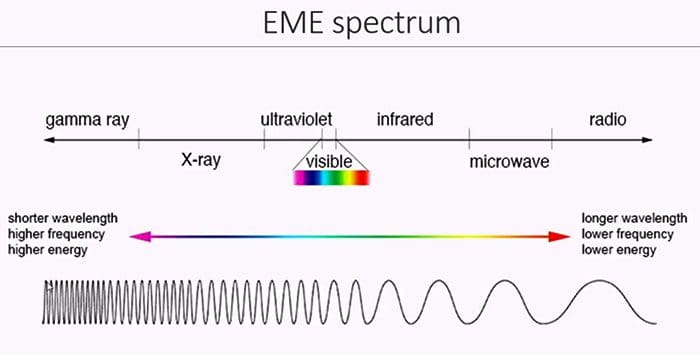
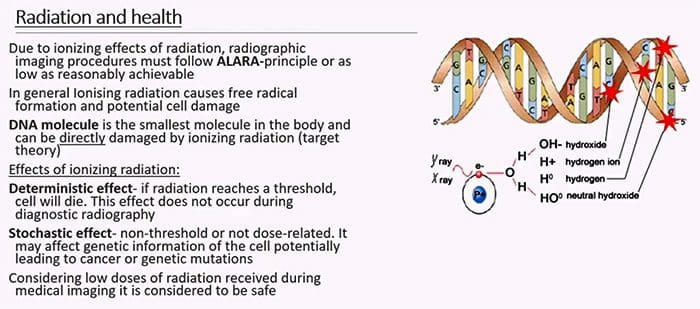
X-rays are a form of electromagnetic energy (EME) similar to light photons or other sources
X-rays are a form of man-made radiation
Ionizing effect of x-rays process of removal of atomic electrons from their orbits
Two basic types of ionizing radiation:
Particle (particulate) radiation produced by alpha & beta particles that are the result of radioactive decay of different materials
Electromagnetic Radiation (EMR) produced by x-rays or gamma rays called photons
The energy of EMR depends on its wavelength
Shorter wavelength corresponds to higher energy
The energy of EME is inversely related to its wavelength
X-ray Properties
No charge
Invisibility
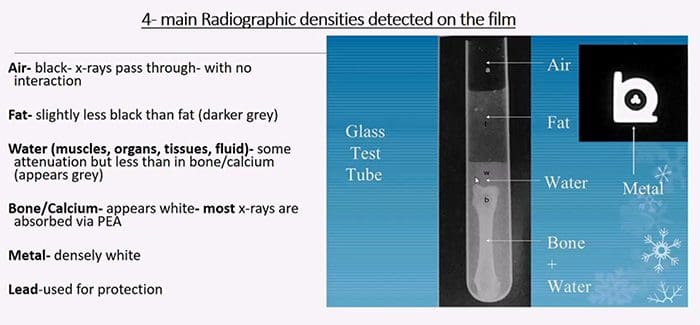
Penetrability of most matters (esp. human tissues) depends on “Z” (atomic number)
Making compounds fluoresce and emit light
Travel at the speed of light
Ionization and biologic effect on living cells
The Imaging System
X-rays are produced by an imaging system ( x-ray tube, operator’s console, and high voltage generator)
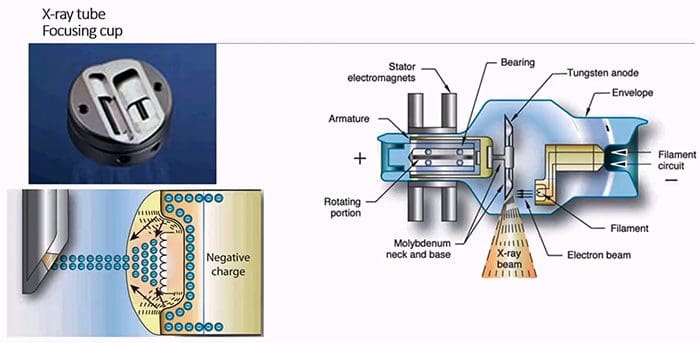
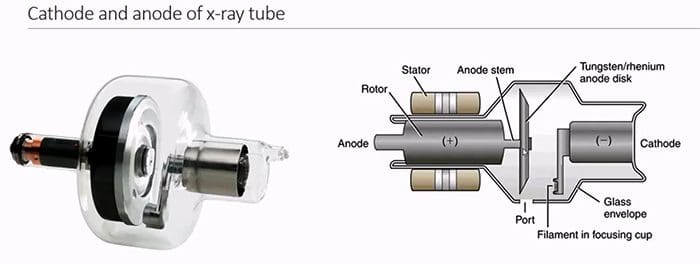
X-ray tube composed of (-) charged cathode and (+) charged anode enclosed in the evacuated class envelope and housed in the protective coat of metal
A Cathode made up of filament wire embedded within the focusing cup to give electrostatic focus to electrons’ cloud
Filament wire of heat resistant thorium tungsten metal of high melting point (3400 C) that “boils off” electrons during thermionic emission
Focusing cup polished nickel (-) charged that�accommodated� the filament to electrostatically repulse the electrons and confines them to the focal spot of the anode disc where x-rays are produced
Anode (+) charged target for electrons to interact at the focal spot
Conducts electricity
Rotates to dissipating heat
Made of tungsten to resist heat
Anode has a high atomic number to produce x-rays of very high efficiency at the focal spot
There are 2-focal spots large and small, each corresponding to cathode’s filament size (small vs. large) that depends on the magnitude of current in the cathode dictated by a radiographic study of larger or smaller body parts
It is known as the dual focus principle
When Electrons are emitted from the cathode as the cloud, they slam into the Anode’s focal spot resulting in 3 man events
Production of heat (99% outcome)
Production of Bremsstrahlung (i.e., breaking radiation) x-rays that represent the majority of x-rays within the x-ray emission spectrum
Production of Characteristic x-rays very few in the emission spectrum
Newly formed x-rays at the anode are of different energies
Only need high energy or “hard” x-rays to perform the radiographic study
Before x-rays exiting the tube we need to remove weak or low energy photons, i.e., “harden the beam.”
Added tube filtration in the form of aluminum filters is used that removes at least 50% of the “unfiltered” beam thus minimizing the patient’s radiation dose and maximizing image quality
High Voltage Generator
X-ray production requires an uninterrupted flow of electrons to the anode
Regular electricity supplies AC power with sinusoidal currents of “peaks and drops.”
In the past, single-phase high voltage generators would convert AC power into a half, or full wave rectified supply with a measure in the thousands of volts delivered with a “voltage ripple” or peaks of high voltage. Therefore, a term kilo voltage peaks (kVp) was used
Modern generators provide “uninterrupted” flow of electrical potential to the x-ray tube eliminating “voltage ripples” thus referred to as kilovoltage kV without “peaks.”
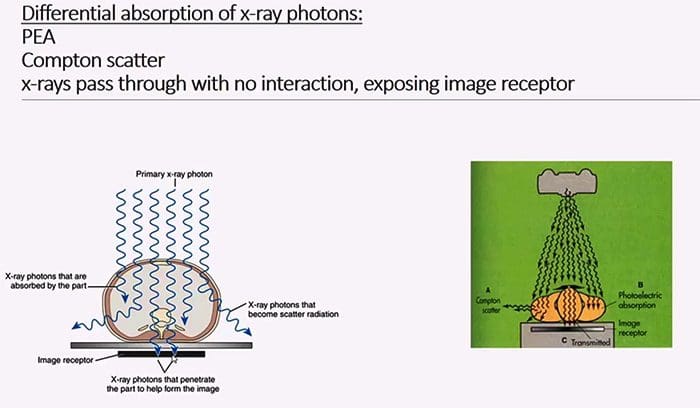
When x-rays interact with the patient’s tissued 3 events will occur
X-rays will pass through without interaction and “expose” the image receptor
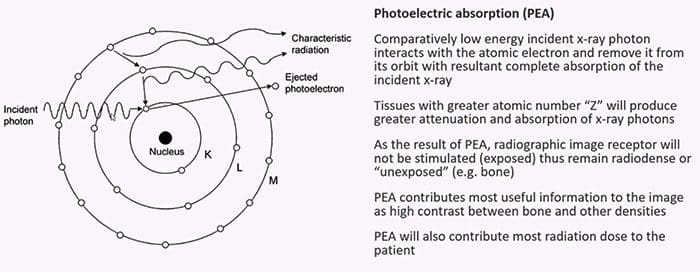
Photoelectric interaction/effect (PE) comparatively lower energy x-rays will be absorbed/attenuated by the tissues
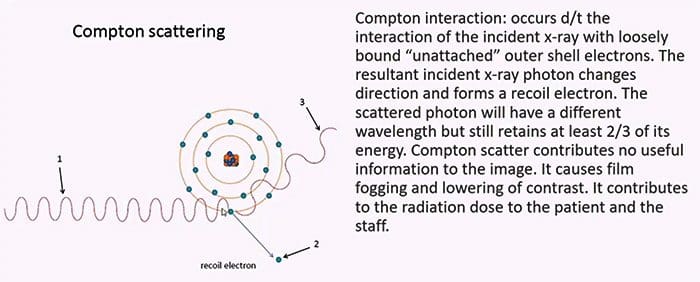
Compton scatter x-rays are “bounced off” to form scatter, contributing no useful information to the film and lower image contrast while potentially giving unnecessary radiation dose to staff
The final image is the product of all three types of interactions known as
Differential absorption of x-ray photons – the result of photons’ absorption via PE, Compton scatter and x-rays passing through the patient
Compton scatter probability decreases with an increase in x-ray energy compared to PE effect
Compton effect probability does not depend on the atomic number (Z)
An increase of total mass density (thick vs. thin) will increase Compton and PE interaction
What cells in the body are considered most vulnerable and most resistant to radiation?
Cells that are rapidly dividing and not terminally differentiated, epithelial cells, etc. are more radiosensitive
Bone marrow cells (stem cells) & lymphocytes are very radiosensitive
Muscle & and nerve cells are terminally differentiated and are less sensitive to radiation
Aged (senescent cells) vs. immature fetal cells are more vulnerable to radiation
However, following low dose radiation in most healthy individual cells will be able to repair likely without any long-lasting changes
Pregnancy & radiation initial 6-7 weeks are the most vulnerable
Do not use routine (non-emergent) radiographic examinations in pregnancy
Apply 10-day rule establish that radiographs can only be obtained during the initial ten days from the onset of the last menstrual cycle
Radiographic imaging of children:
If clinically possible use non-ionizing forms of medical imaging (e.g., ultrasound)
Non-axial imaging studies that use x-ray photons:
Conventional radiography
Fluoroscopy
Mammography
Radiographic angiography (currently less often used)
Dental imaging
Cross-sectional imaging using x-ray photons: Computed Tomography
Indication and Contraindication for conventional radiographic imaging
Advantages of Radiography: widely available, inexpensive, low radiation burden, the first step in imaging investigation of most MSK complaints
Disadvantages: 2D imaging, relatively lower diagnostic yield during an examination of soft tissues, numerous artifacts, and dependence on correct radiographic factors selection, etc.
Indications:
Chest: initial assessment of lung/intrathoracic pathology. Potentially determines or obviates the need for chest CT scanning. Pre-surgical evaluation. Imaging of pediatric patients due to extremely low radiation dose.
Skeletal: to examine the bone structure and diagnose fractures, dislocation, infection, neoplasms, congenital bone dysplasia, and many forms of arthritis
Abdomen:�can assess acute abdomen, abdominal obstruction, free air or free fluid within the abdominal cavity, nephrolithiasis, evaluate placement of radiopaque tubes/lines, foreign bodies, monitor resolution of postsurgical ileus and others
Cost Effectiveness: There are tons of reasons why a person would answer “yes.” From overall general health to specific aches and pains, to an injury, millions of folks turn to chiropractors for pain relief, increased movement and strength, and overall healing.
For some individuals, the price tag seems to hinder their decision to seek chiropractic treatment. Lack of insurance coverage, or a recommended ongoing treatment regimen (because it usually takes more than one treatment) are two of the most common reasons patients deem it too expensive.
When looking at the big picture, however, patients see and understand the cost of NOT pursuing the care of a chiropractor, and these costs end up being more than simply dollars.
Let’s look at three reasons an individual would visit a chiropractor, and the cost effective savings each scenario provides.
The Cost Effectiveness Of Chiropractic Treatment
An Ounce Of Prevention Is Worth A Pound Of Cure.
Choosing to see a chiropractor to promote and sustain good health is a forward thinking idea that is increasingly attractive to those striving to stay younger, longer. Chiropractic care promotes healing through the body as a whole.
Spinal adjustments and joint manipulations help increase mobility and maximize the entire body’s performance. In addition, they offer a wide variety of health benefits, from decreasing blood pressure to lowering the chance of headaches. Avoiding these health issues potentially save tens of thousands of dollars in future doctor bills!
Regular visits to a professional chiropractor enable a person to stay healthy and enjoy a more active life with a healthy back, bones, and joints.
Oops! I Strained It Again!
Millions of unfortunate souls injure their bodies in a variety of mishaps. From sports injuries to car accidents, to erroneously thinking you really can walk in those four inch heels, our backs, ankles, and hips take a beating.
Choosing chiropractic care for an injury is a smart decision. In many cases, a chiropractor is able to promote healing, decrease a patient’s dependence on drugs for pain management, and minimize the chance of a recurrence.
Chiropractic care treats the body as a whole, so a patient’s visits help strengthen other parts of the surrounding area of the body, not just the injured area. The cost effectiveness of chiropractic care for treating injuries, decreases the money spent on costly medicine and reduces time off work. It also helps people stay married, because most individuals are hateful when they are in pain. (Ok, we made that last point up).
Chronic Medical Conditions.
Many types of medical conditions are ongoing, with no definitive cure. These can be devastating to a person’s quality of life. Daily pain, and loss of strength and mobility are difficult to manage, and sometimes medicine is the chosen option. Numerous times, chiropractic care can work wonders in these situations.
A chiropractor who is experienced in treating the specific type of medical condition can build a treatment plan to help manage the symptoms of the condition, including drug-free pain management. With adjustments to the afflicted area, along with an at-home routine of recommended exercise, the patient frequently experiences a reduction in pain and symptoms, and an increase in mobility. In the best situation, his or her quality of life is positively affected, and relapses are avoided.
Chiropractic care is a productive treatment for a variety of injuries and medical conditions, as well as a preventive therapy to maintain and prolong wellness. The up front cost is paltry when measured against the rewards of increased mobility, decreased pain, and a greater quality of life.
Ohio Attorney General Mike DeWine is suing five makers of opioid painkillers for their role in the state’s opioid epidemic.
The five companies named in the suit are Purdue Pharma, Johnson & Johnson, Teva Pharmaceuticals, Endo Health Solutions and Allergan.
This is the second suit of its kind brought by a state, after Mississippi.
Ohio attorney general sues 5 pharma companies over their role in the opioid epidemic��
Ohio Attorney General Mike DeWine is suing five makers of opioid painkillers for their role in the state’s opioid epidemic.
The suit, which DeWine said is the second by a U.S. state, after Mississippi, claims the drugmakers violated multiple state laws, including the Ohio Corrupt Practices Act, and committed Medicaid fraud.
Purdue Pharma, Johnson & Johnson and its Janssen Pharmaceuticals unit, Teva Pharmaceuticals and its Cephalon unit, Endo Health Solutions and Allergan are all named in the suit.
“In 2014 alone, pharmaceutical companies spent $168 million through sales reps peddling prescription opioids to win over doctors with smooth pitches and glossy brochures that downplayed the risks” of the medicines,” DeWine said at a press conference Wednesday. Last year, he said, 2.3 million people in Ohio, or about a fifth of the state’s population, were prescribed opioids.
In a statement, a spokesman for Purdue Pharma, which manufactures OxyContin, said the company shares the attorney general’s concerns about the opioid crisis and that it is “committed to working collaboratively to find solutions.”
“OxyContin accounts for less than 2% of the opioid analgesic prescription market nationally, but we are an industry leader in the development of abuse-deterrent technology, advocating for the use of prescription drug monitoring programs and supporting access to Naloxone � all important components for combating the opioid crisis,” he said.
Allergan declined to comment, as did a Teva spokeswoman, who said, “We have not completed review of the complaint.”
J&J’s Janssen unit said the company believed the allegations in the lawsuit were “both legally and factually unfounded.”
“Janssen has acted appropriately, responsibly and in the best interests of patients regarding our opioid pain medications, which are FDA-approved and carry FDA-mandated warnings about the known risks of the medications on every product label,” said Jessica Castles Smith, a Janssen spokeswoman.
Endo officials weren’t immediately available to comment.
The Ohio action follows suits from counties and cities seeking to hold accountable the industry that produces, markets and distributes opioid painkillers. DeWine said the Ohio suit, filed Wednesday morning in Ross County, “would compel these companies to clean up this mess through several remedies,” including an injunction to stop “continued deception and misrepresentation in marketing,” damages paid to the state for money spent on the crisis, and repayment to consumers.
Sales of prescribed opioids � including oxycodone, hydrocodone and methadone � almost quadrupled in the U.S. between 1999 and 2015, according to the Centers for Disease Control and Prevention, contributing to a more than quadrupling of deaths from prescription opioids in that same period. Almost 2 million Americans either abused or were dependent on prescription opioid painkillers in 2014, according to the CDC.
“We understand what we’re taking on: five huge drug companies,” DeWine told reporters Wednesday. “I don’t want to look back 10 years from now and say we should have had the guts to file. � It’s something we have to do.”
IFM's Find A Practitioner tool is the largest referral network in Functional Medicine, created to help patients locate Functional Medicine practitioners anywhere in the world. IFM Certified Practitioners are listed first in the search results, given their extensive education in Functional Medicine