For individuals affected by headaches that occur 15 or more days a month for more than three months, can knowing the signs and symptoms help healthcare providers help treat and prevent chronic tension headaches?
Chronic Tension Headaches
Most individuals have experienced a tension-type headache. The pain is usually described as a dull tightening or pressure on both sides of the head, like having a tightening band around the head. Some individuals experience these headaches frequently, a condition known as chronic tension headaches. Chronic tension headaches are uncommon but can be debilitating, as they can interfere with a healthy quality of life and daily living.
Tension headaches are typically caused by stress, anxiety, dehydration, fasting, or lack of sleep and usually resolve with over-the-counter medications. (Cleveland Clinic. 2023)
This is a primary headache disorder that affects around 3% of the population.
Chronic tension headaches can occur daily and negatively impact the quality of life and daily functioning. (Cleveland Clinic. 2023)
Symptoms
Tension headaches can be referred to as stress headaches or muscle contraction headaches.
They can present with dull, aching pain and include tightness or pressure across the forehead, sides, or back of the head. (Cleveland Clinic. 2023)
Additionally, some individuals experience tenderness on the scalp, neck, and shoulders.
Chronic tension headaches materialize 15 or more days a month on average for more than three months.
The headache can last for several hours or be continuous for several days.
Causes
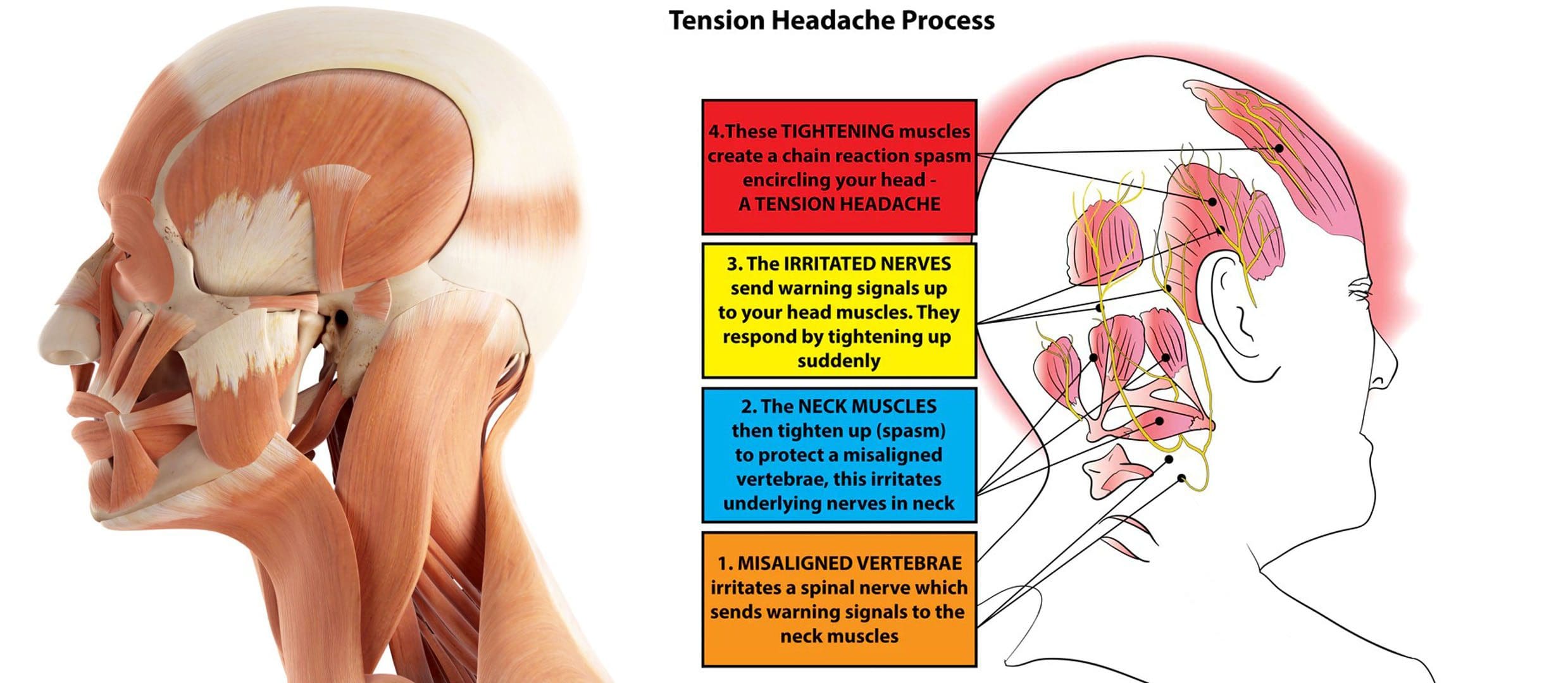
Tension headaches are typically caused by tight muscles in the shoulders, neck, jaw, and scalp.
Teeth grinding/bruxism and jaw clenching can also contribute to the condition.
Headaches can be brought on by stress, depression, or anxiety and are more common in individuals who:
Individuals experiencing headaches that interfere with daily life or need to take medication more than twice a week are recommended to consult a healthcare provider. Before the appointment, it can be helpful to keep a headache diary:
Record the days
Times
Description of the pain, intensity, and other symptoms.
Some questions the healthcare provider may ask include:
Is the pain pulsating, sharp, or stabbing, or is it constant and dull?
Where is the pain most intense?
Is it all over the head, on one side, on the forehead, or behind the eyes?
Do the headaches interfere with sleep?
Is working or doing tasks difficult or impossible?
A healthcare provider will likely be able to diagnose the condition based on symptoms alone. However, if the headache pattern is unique or different, the provider may order imaging tests, like MRI or CT scans, to rule out other diagnoses. Chronic tension headaches can be confused with other chronic daily headache disorders like chronic migraine, hemicrania continua, temporomandibular joint dysfunction/TMJ, or cluster headaches. (Fayyaz Ahmed. 2012)
Treatment
Pharmacological therapy for chronic tension headaches usually involves preventive medication.
Amitriptyline is one medication that has been found to be beneficial in chronic tension headache prevention.
According to a meta-analysis of 22 published studies in the Journal of General Internal Medicine, these medications are superior to placebo in reducing headache frequency, with an average of 4.8 fewer headache days per month.
Additional preventive medications may include other antidepressants like:
Remeron – mirtazapine.
Anti-seizure medications – like Neurontin – gabapentin, or Topamax – topiramate.
A healthcare provider may also prescribe medication to treat headache episodes, which include:
Prescription non-steroidal anti-inflammatory drugs or NSAIDs, including acetaminophen, naproxen, indomethacin, or ketorolac.
Opiates
Muscle relaxants
Benzodiazepines – Valium
Non-Medication Treatment
Behavioral therapies are sometimes used on their own or in combination with medication to prevent and manage chronic tension headaches. Examples include:
Acupuncture
An alternative therapy that involves using needles to stimulate specific points on the body believed to connect with certain pathways/meridians that carry vital energy/chi throughout the body.
Biofeedback
In Electromyography – EMG biofeedback, electrodes are placed on the scalp, neck, and upper body to detect muscle contraction.
The process can be costly and time-consuming, and there is little evidence to support its effectiveness.
Physical Therapy
A physical therapist can work out stiff and tight muscles.
Train individuals on stretches and targeted exercises for loosening tight head and neck muscles.
Cognitive Behavioral Therapy/CBT
Involves learning how to identify headache triggers and cope in a less stressful and more adaptive way.
Headache specialists often recommend CBT in addition to medication when developing a treatment plan. (Katrin Probyn et al., 2017)
Teeth-grinding and jaw-clenching training/treatment can help when they are contributors.
Regular exercise, as well as practicing healthy sleep hygiene, can be beneficial in prevention.
Supplements
Some individuals with chronic tension headaches may find relief using supplements. The American Academy of Neurology and the American Headache Society report the following supplements can be effective: (National Center for Complementary and Integrative Health. 2021)
Butterbur
Feverfew
Magnesium
Riboflavin
If the headaches come on suddenly, cause waking up from sleep, or last for days, it’s important to consult a healthcare provider to rule out any underlying causes and develop a personalized treatment plan.
Ahmed F. (2012). Headache disorders: differentiating and managing the common subtypes. British journal of pain, 6(3), 124–132. https://doi.org/10.1177/2049463712459691
Jackson, J. L., Mancuso, J. M., Nickoloff, S., Bernstein, R., & Kay, C. (2017). Tricyclic and Tetracyclic Antidepressants for the Prevention of Frequent Episodic or Chronic Tension-Type Headache in Adults: A Systematic Review and Meta-Analysis. Journal of general internal medicine, 32(12), 1351–1358. https://doi.org/10.1007/s11606-017-4121-z
Probyn, K., Bowers, H., Mistry, D., Caldwell, F., Underwood, M., Patel, S., Sandhu, H. K., Matharu, M., Pincus, T., & CHESS team. (2017). Non-pharmacological self-management for people living with migraine or tension-type headache: a systematic review including analysis of intervention components. BMJ open, 7(8), e016670. https://doi.org/10.1136/bmjopen-2017-016670
For individuals trying to get into a regular fitness regimen, could using the FITT Principle help structure exercise, track progress, and achieve fitness goals?
FITT Principle
The FITT principle is a set of guidelines for adjusting, revising, and improving exercise workouts. FITT is an acronym for:
Frequency
Intensity
Time
Type of exercise
Individuals take these elements to create and adjust workouts that fit their goals and fitness levels.
For example, this could be a workout of 3 to 5 days combined with low, medium, and high-intensity exercises for 30 to 60 minutes each session that incorporates cardio and strength training. Focusing on these details and progressing over time helps create an effective program.
Frequency
Workout frequency and how often the individual is going to exercise is the first thing to look at.
Frequency depends on various factors, including the type of workout being done, how hard the workout is, fitness levels, and exercise goals.
General exercise guidelines developed by the American College of Sports Medicine offer recommendations. (Carol Ewing Garber, et al., 2011)
Cardiovascular Workouts
Cardio workouts are usually scheduled more often.
Depending on goals, guidelines recommend moderate cardio exercise five or more days a week or intense cardio three days a week to improve health.
Individuals can adjust the exercise intensity level easily on a treadmill to provide excellent and convenient cardiovascular workouts.
Individuals who want to lose weight may want to work up to more workouts gradually.
However, more is not always better, and recovery time is essential. (Pete McCall. 2018)
For individuals following a split routine, like upper body one day and lower body the next, workouts can be more frequent than total body workouts.
Intensity
Workout intensity involves how hard the individual is pushing themselves during exercise. How it is increased or decreased depends on the type of workout. (Carol Ewing Garber, et al., 2011)
Cardiovascular Workouts
For cardio, individuals will monitor workout intensity by:
The general recommendation is to work at a moderate intensity for steady workouts.
Interval training is done at a higher intensity for a shorter period.
It’s recommended to mix up low, medium, and high-intensity cardio exercises to stimulate different energy systems and prevent overtraining. (Nathan Cardoos. 2015)
Strength Training
Individual intensity comprises the amount of weight being lifted and the number of reps and sets done.
The intensity can change based on health goals.
Beginners looking to build stability, endurance, and muscle are recommended to use a lighter weight and do fewer sets with high repetitions – for example, two or three sets of 12 to 20 reps.
Individuals wanting to grow muscle are recommended to do more sets with a moderate amount of reps – for example, four sets of 10 to 12 reps each.
Individuals who want to build strength are recommended to use heavy weights and do more sets with fewer reps – for example, five sets of three reps each.
The next element of the plan is how long the exercise will be during each session. Exercise length depends on individual fitness level and the type of workout being done.
Cardiovascular Workouts
The exercise guidelines suggest 30 to 60 minutes of cardio, but workout duration will depend on fitness level and type of exercise. ((Carol Ewing Garber, et al., 2011)
Beginners are recommended to start with a 15- to 20-minute workout.
Individuals with some workout experience and are doing steady-state cardio, like jogging or using a cardio machine, might exercise for 30 to 60 minutes.
For individuals doing interval training and working at very high intensity, the workout will be shorter, around 10 to 15 minutes of high-intensity interval training.
Having a variety of workouts of different intensities and durations will provide a solid, balanced cardiovascular program.
Strength Training
How long an individual strength trains will depend on the type of workout and schedule.
A total body workout can take over an hour.
A split routine can take less time by working fewer muscle groups in one session.
Type
The type of exercise you do is the last part of the FIIT principle.
It is easy to manipulate to avoid overuse injuries or weight loss plateaus.
Cardiovascular Workouts
Cardio is easy to adjust and change because any activity that increases heart rate counts.
Walking, dancing, running, cycling, swimming, and using an elliptical trainer are a few activities that can be incorporated.
Having multiple cardio activities is recommended to reduce burnout and keep workouts fresh.
Strength Training
Strength training workouts can also be varied.
They include any exercise where some type of resistance – bands, dumbbells, machines, etc. are used to work the muscles.
Bodyweight exercises can also be considered a form of strength training.
Strength workouts can be changed from total body training to adding, for example, supersets or pyramid training.
Incorporating new exercises for each body area is another way to vary the type of workouts.
Spending a few weeks working on functional strength movements, then switching to hypertrophy or strength-based training.
Each modality includes various alternative types of strength-based exercises.
Using FITT
The FITT principle outlines how to adjust workout programs to achieve better results. It also helps figure out how to change workouts to avoid burnout, overuse injuries, and plateaus.
For example, walking three times a week for 30 minutes at a moderate pace is recommended for a beginner to start out with. After a few weeks, the body adapts to the workout. This results in burning fewer calories, burnout, or weight management efforts, and goals are put on hold. This is where the FITT principles come in. For example, a change-up could include:
Changing frequency by adding another day of walking or jogging.
Changing intensity by walking faster, adding more challenging terrain like a hill, or jogging at certain intervals.
Walking for a longer time each workout day.
Changing the type of workout by swapping one or more of the walk sessions for cycling or aerobics.
Even just changing one element can make a big difference in the workout and how the body responds to exercise.
It’s important to change things up regularly to keep the body healthy and mind engaged.
Injury Prevention
One of the best things about using FITT is that it allows individuals to monitor the length and intensity of their workouts. When individuals work out too frequently or don’t get enough rest, they run the risk of overuse injuries, burnout, and muscle strains. The FITT principle encourages adding variety to workouts. When following this practice, it allows the body to rest and recover properly. Because individuals are not working the same muscle groups over and over again, better results are achieved.
Fighting Inflammation Naturally
References
Garber, C. E., Blissmer, B., Deschenes, M. R., Franklin, B. A., Lamonte, M. J., Lee, I. M., Nieman, D. C., Swain, D. P., & American College of Sports Medicine (2011). American College of Sports Medicine position stand. Quantity and quality of exercise for developing and maintaining cardiorespiratory, musculoskeletal, and neuromotor fitness in apparently healthy adults: guidance for prescribing exercise. Medicine and science in sports and exercise, 43(7), 1334–1359. https://doi.org/10.1249/MSS.0b013e318213fefb
McCall Pete. 8 reasons to take a rest day. (2018) American Council on Exercise.
National Strength and Conditioning Association. (2017) Determination of resistance training frequency.
Schoenfeld, B. J., Ogborn, D., & Krieger, J. W. (2016). Effects of Resistance Training Frequency on Measures of Muscle Hypertrophy: A Systematic Review and Meta-Analysis. Sports medicine (Auckland, N.Z.), 46(11), 1689–1697. https://doi.org/10.1007/s40279-016-0543-8
Cardoos, Nathan MD. Overtraining Syndrome. (May/June 2015). Current Sports Medicine Reports 14(3):p 157-158. DOI: 10.1249/JSR.0000000000000145
Digestive disorders affect millions of individuals and cover a variety of diseases ranging from mild to severe. These conditions involve the digestive tract, also known as the gastrointestinal or GI tract. The digestive disorders of heartburn, acid reflux, and gastroesophageal reflux disease/GERD are related and have similar symptoms but are different. Accurately diagnosing digestive disorders involves a thorough medical history, imaging and lab tests, and physical examination to develop the proper treatment plan.
Digestive Disorders
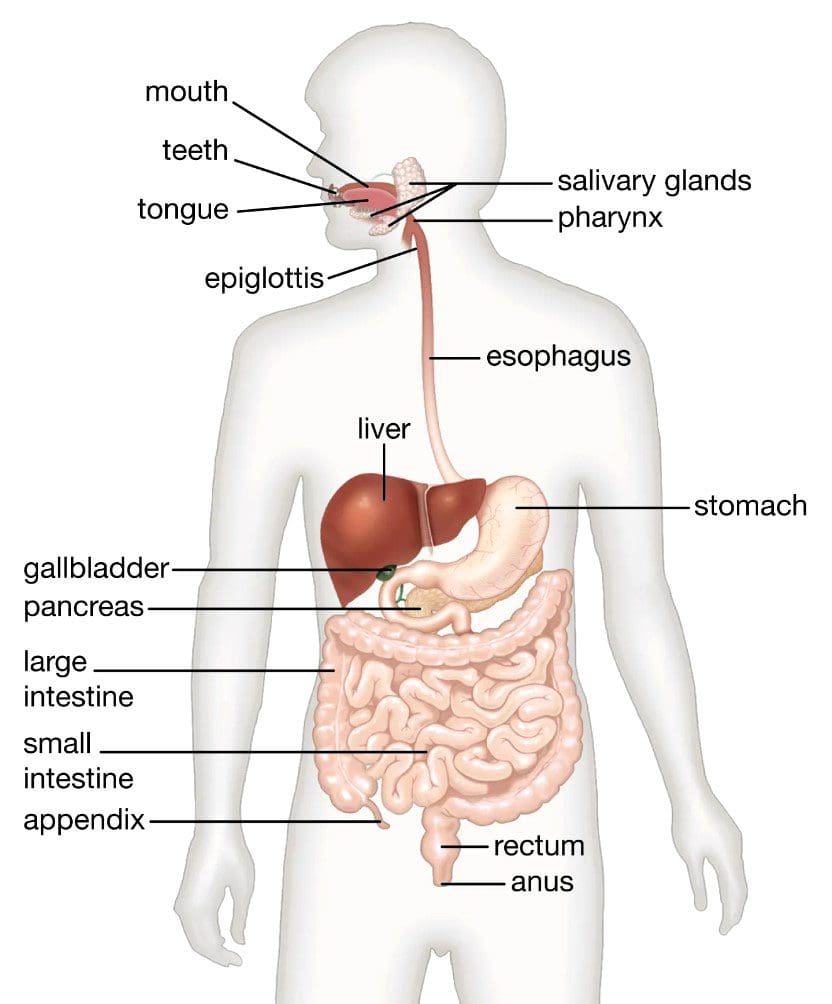
The gastrointestinal tract includes the esophagus, liver, gallbladder, stomach, pancreas, and large and small intestines.
Heartburn
Heartburn has nothing to do with the heart but describes a burning sensation in the chest. Individuals experience heartburn when stomach acid flows back into the esophagus. Occasional heartburn after eating spicy foods or foods an individual is not used to is common and is no cause for alarm. Most can manage the discomfort symptoms with lifestyle adjustments and over-the-counter medications. Chronic heartburn that interferes with daily/nightly routines could indicate a more serious condition requiring medical care. Symptoms include:
The burning discomfort sensations in the stomach and chest regions are usually worse after eating a meal, bending down, at night, and when lying down.
A bitter or acidic taste.
Acid Reflux
The esophagus comprises mainly smooth muscle that extends from the throat down through the chest cavity and past the abdomen, where it connects with the stomach. When swallowing, the esophagus opens and squeezes food down to the bottom, where a valve (lower esophageal sphincter LES) separates it from the stomach. The valve is normally closed. When swallowing, it opens so that food can pass through and then closes up. Acid reflux is a disorder that causes the valve to open when it’s not supposed to. This allows stomach contents like acid, digestive juices, enzymes, and food to flow backward from the stomach into the esophagus, causing heartburn symptoms. This usually happens when the lower esophageal sphincter is under added pressure, weakened, or malfunctioning. Symptoms can be caused by:
Overeating.
Eating spicy or acidic foods that can trigger symptoms.
Eating right before going to bed.
Medications.
Over alcohol consumption.
Exercising after eating.
Pregnancy.
Smoking.
Acid reflux and heartburn affect everyone, but most can handle the discomfort by taking antacids and avoiding the foods that brought it on. Occasional acid reflux can be treated with over-the-counter medication, including:
Acid reflux can potentially progress to gastroesophageal reflux disease, a more serious form of acid reflux that lasts longer. GERD is frequent heartburn that happens two or more times a week. Other signs and symptoms can include:
Some individuals with digestive disorders may need more extensive diagnostic evaluations, including GI endoscopy, laboratory tests, and imaging.
Chiropractic Treatment
Body misalignments, unhealthy posture, and restrictive positions can contribute to digestive disorders that put pressure on the stomach and chest, triggering symptoms. A chiropractor can realign the body and take the stress off the joints and spine, relieving the pressure on the nerves. They can also strengthen the muscles through adjustments that help alleviate pressure on the stomach. A chiropractor designs a treatment plan that suits the individual’s needs, including stretches and exercises, nutrition, and health coaching to achieve and manage a healthy weight.
Chiropractic Precision
References
Carvalho de Miranda Chaves, Renata, et al. “Respiratory physiotherapy can increase lower esophageal sphincter pressure in GERD patients.” Respiratory medicine vol. 106,12 (2012): 1794-9. doi:10.1016/j.rmed.2012.08.023
Harding, Susan M. “Acid reflux and asthma.” Current opinion in pulmonary medicine vol. 9,1 (2003): 42-5. doi:10.1097/00063198-200301000-00007
Kahrilas, Peter J. “Regurgitation in patients with gastroesophageal reflux disease.” Gastroenterology & hepatology vol. 9,1 (2013): 37-9.
Pope, C E 2nd. “Acid-reflux disorders.” The New England journal of medicine vol. 331,10 (1994): 656-60. doi:10.1056/NEJM199409083311007
IFM's Find A Practitioner tool is the largest referral network in Functional Medicine, created to help patients locate Functional Medicine practitioners anywhere in the world. IFM Certified Practitioners are listed first in the search results, given their extensive education in Functional Medicine