Back Clinic Health Team. The level of functional and metabolic efficiency of a living organism. In humans, it is the ability of individuals or communities to adapt and self-manage when facing physical, mental, psychological, and social changes in an environment. Dr.Alex Jimenez D.C., C.C.S.T, a clinical pain doctor who uses cutting-edge therapies and rehabilitation procedures focused on total health, strength training, and complete conditioning. We take a global functional fitness treatment approach to regain complete functional health.
Dr. Jimenez presents articles both from his own experience and from a variety of sources that pertain to a healthy lifestyle or general health issues. I have spent over 30+ years researching and testing methods with thousands of patients and understand what truly works. We strive to create fitness and better the body through researched methods and total health programs.
These programs and methods are natural and use the body’s own ability to achieve improvement goals, rather than introducing harmful chemicals, controversial hormone replacement, surgery, or addictive drugs. As a result, individuals live a fulfilled life with more energy, a positive attitude, better sleep, less pain, proper body weight, and education on maintaining this way of life.
Ever find yourself going about your day, not even thinking about food, when all of a sudden your appetite kicks in, and you’re at the drive-thru or rummaging through your pantry, looking for whatever it is you crave?
That’s because feeling hungry often has little to do with whether your system really needs food and a lot more to do with some sneaky cues and behaviors you encounter without realizing it. These 6 are among the biggest offenders tricking you into thinking you’re hungry when you really aren’t.
Cooking Shows
There may be a downside to turning to TV for recipe inspiration. A new study found that people who cook from scratch based on recipes they got off a cooking show weighed 11 pounds more than those who watched these shows but didn�t cook very often. The authors of the study, from Cornell University�s Food and Brand Lab, think the extra pounds might have to do with how indulgent TV recipes are. When people make them at home and consume them, they think it’s okay to take in all the extra calories.
Orange and Red-Colored Foods
From a biological perspective, humans �tend to seek out vibrant colored foods, as these contain the most vitamins and minerals,� says Susan Albers, PsyD, clinical psychologist at the Cleveland Clinic and author of 50 More Ways to Soothe Yourself Without Food. �The response is subconscious�think about a time when you’ve walked through a grocery store and found yourself picking up a sack of oranges or bag of red peppers.� But that instinct works against you when you’re face to face with a plate of mac and cheese or gooey nachos. These dishes share a similar hue as oranges do, but they have way more fat and calories.
Food Packages on Kitchen Counter
You know the saying, out of sight is out of mind? That definitely applies to food as well, and it sums up the dangers of not putting your groceries away as soon as you come back from the supermarket or leaving out half-eaten boxes of takeout pizza. When you see these items, even in their containers, your appetite gets going, and it�s hard to resist consuming them.
�People tend to reach automatically for foods that are within arm�s reach,� Dr. Albers says. �If it�s there, you�re likely to eat it.� One study shows that people who keep soda and cereal on their counters weigh a startling 26 pounds more than those who opt to tuck them away in a pantry.
Other People Eating
You�re having drinks with friends when someone orders a round of apps. You weren�t hungry at all before the order was placed, so why did you dig in when the food arrived at the table? We automatically match the pace at which people around us eat and �mirror� their behavior, Dr. Albers explains, and that�s true even if they�re at another table and you don�t know them. You could also blame a little social anxiety. �We�re simply trying to fit in and make a situation more comfortable,� she adds.
Large Plates
If you�re served a heaping pile of food on a large plate, you�ll likely try to finish it, even after you�re already full. �We naturally eat more off of large plates and bowls,� says Dr. Albers. It�s a mean trick your eyes play on you. Larger plates cause us to think a serving of food is smaller than it actually appears. One study showed that people scarfed down 16% more cereal than usual when it was served to them in a bigger bowl.
A Happy Mood
You know about stress eating: tough day of work = pint of ice cream. But it’s not just negative emotions that lead us to dive into our kitchens. Positive emotions like joy, excitement, and even love can crank your appetite as well. It has to do with the fact that certain foods, like chocolate, trigger satisfying neurochemical responses in the brain. �We want to hold onto [those happy emotions], and another creamy bar of chocolate or crispy bag of chips promises to keep the good feelings rolling,� says Dr. Albers.
Also, when life is going well and you feel good, you�re more relaxed and less vigilant about your calorie intake. �People actually eat more when they�re in a happy relationship,� Dr. Albers notes.
The scope of our information is limited to chiropractic and spinal injuries and conditions. To discuss options on the subject matter, please feel free to ask Dr. Jimenez or contact us at 915-850-0900 .
Additional Topics: Whole Body Wellness
Maintaining overall health and wellness of the body can be achieved through a balanced nutrition, regular physical activity and/or exercise, as well as by getting plenty of rest. Along with these basic principles, its important to receive whole body maintenance, especially making sure the spine is properly aligned, ensuring the nervous system is functioning to its fullest capabilities. Chiropractic care is an alternative treatment option which focuses on musculoskeletal and nervous system conditions and injuries, helping to maintain spinal health.
The first sign was itchy skin. My thighs itched. My belly itched. Everything itched. I couldn’t see any rashes or dry skin, but after two months, the sensation got so bad that it distracted me at work.
I finally went to a dermatologist in December 2007. We considered potential explanations. Could it be eczema? Probably not; I showed none of the classic markers of the disorder. At the end of the appointment, I mentioned that I had a lump above my collarbone. It might be getting bigger, I told her, but I wasn’t sure.
She examined the bump and told me it was an enlarged lymph node, a gland that helps the body fight off infections. She advised me to see a general practitioner for a full checkup. She even called me a few times the following week to remind me.
So I went to a general physician to have blood work done and take a chest x-ray. Then came additional tests, including a tissue biopsy of the lump. That biopsy confirmed the last thing I expected: I had stage 2A Hodgkin’s lymphoma, a blood cancer that often strikes adults in their 20s and 30s. Itchy skin, it turns out, can be a symptom.
I collapsed into my mom’s arms when I got the diagnosis. “I just don’t want to die,” I told her. I was 23, and I had so much more life to live.
The battle begins
I started chemotherapy two weeks later in my doctor’s office, enduring 12 treatments over six months. I’d get the drugs every other Thursday and take off work the following Monday, when the steroids that were supposed to ease side effects like nausea and pain wore off. Apart from that—and the wig I wore to conceal my bald head—I kept my life normal. I went my job as a fundraising event planner and met friends for dinner.
By summer, I was in remission. Yet I wasn’t feeling like my old self, and I knew I wanted to get strong again. When two friends told me they were running the Nike Women’s Marathon in San Francisco in my honor (fundraising for the Leukemia & Lymphoma Society), I was moved and motivated. With my doctor’s okay, I started to train for the Disney Half Marathon in Orlando in January 2009.
I admit it was a little crazy. I’d been a runner pre-cancer, but I had never attempted a race longer than 10K. Still, I did it—I ran the half in two hours and eight minutes. Victory, right? Not quite. The weekend of my half-marathon, I noticed a familiar feeling near my collarbone. Could the lump be coming back?
Returning to normal life in remission
I should mention that coincidentally, I’d recently started working in the fundraising department at Memorial Sloan Kettering Cancer Center (MSKCC), a top cancer hospital that my doctor was affiliated with. I wore my wig when I interviewed at Memorial in September 2008, but I didn’t mention that I had been diagnosed with cancer less than a year earlier. I wanted to be hired because I had the skills they were looking for, not my health history. Luckily, I got the job. But right after I ran my half in January, my doctor confirmed that my Hodgkin’s lymphoma was back.
Lauren vs. cancer: round two
My doctors told me that treatment would be more aggressive the second time around, and I had to be admitted into the hospital for most of it: two preconditioning chemotherapy treatments were followed by two weeks of radiation followed by four-day rounds of high-dose chemo. “Uncomfortable” doesn’t begin to describe the high fevers I struggled with and such severe throat pain that it hurt to eat.
I also underwent a stem cell transplant: a catheter transfers my own cells, collected by medical staffers weeks earlier, back into my body. The hope was that the newly transferred cells would prompt my system to produce healthy new blood cells. It’s a milestone; people in the medical world call the date of your stem cell transplant your second birthday. I celebrated my 25th birthday in the hospital on April 17. A week later, I had my ‘second birthday’ when I got my transplant.
A life dedicated to fitness
I left the hospital in May and focused my life on recovery and getting strong again. I’ve always loved trying new classes and getting better at old ones. After all I’d been through, working out felt even more rewarding. Nearly every Saturday for the next five years, I’d be at Core Fusion Barre class at Exhale or sweating it out at SoulCycle.
My teachers inspired me to develop a level of strength I didn’t know I had, and the thrill I felt when I realized I was getting better motivated me. With time, I made the decision to devote my life to inspiring others through fitness. In fall 2014, I signed up for barre teacher training with Exhale. Two hundred hours later, I was certified.
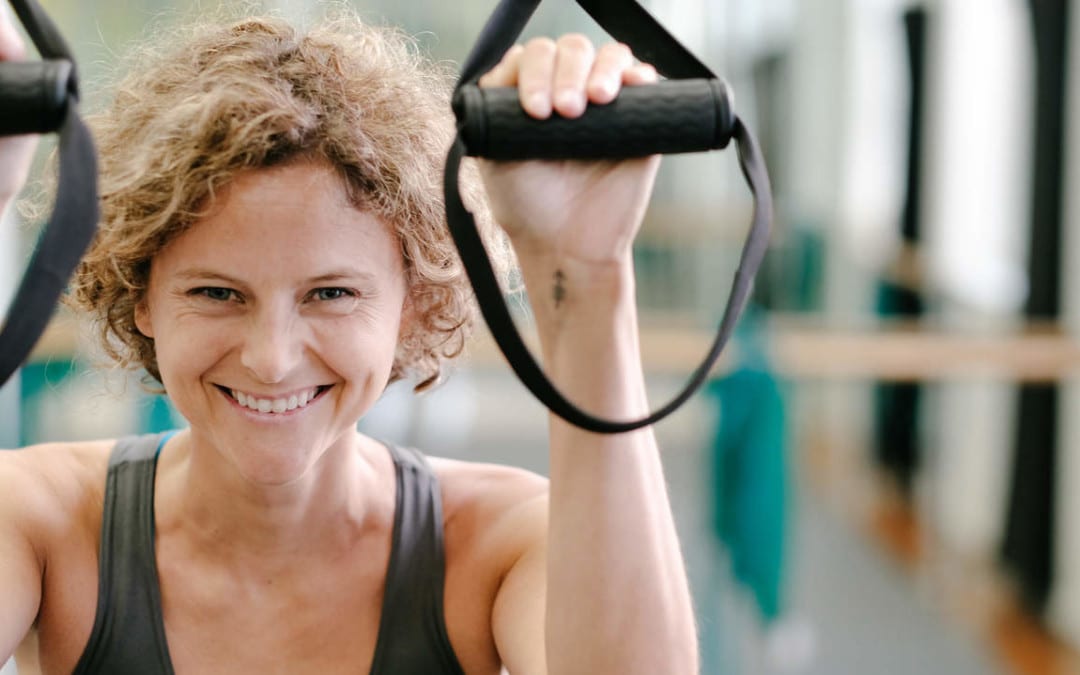
In January 2015, I left the security of a full-time job and founded Chi Chi Life. This is my way of pursuing fitness while keeping up my love for fundraising, event planning, and cancer advocacy. I teach barre at Exhale and Pilates and TRX classes at Flex Studios in New York City while also working with clients to plan philanthropic events.
For me, fitness is all about community and connection. I’ve run several half marathons since my cancer’s been in remission, raising more than $75,000 for causes I’m passionate about. I even ran the New York City Marathon, which took me past the Memorial Sloan Kettering Cancer Center building. I wish there were words to capture what it felt like to run past the place that saved my life—and helped me discover my life’s mission.
Meditation continues to become more and more popular, and for good reason. Research shows it can help with everything from getting a good night’s sleep to reducing stress to even easing pain.
However, many people are under the impression that in order to meditate properly, you need to be sitting still for an extended period of time in a perfectly zen setting. But that doesn’t have to be the case. In fact, you can meditate anywhere, says wellness expert and founder of BexLife, Rebekah Borucki. That could mean while you’re commuting, during your lunch break, right before bed, or in any other setting that works with your schedule and lifestyle.
However, if you can, it does help to find a place you where you feel comfortable, she says. This way, you can enter a state of mediation without feeling distracted by the position of your body.
There are also plenty of options for what to focus on during your meditation—positive affirmations, a peaceful visualization, or simply quieting all the commotion in your mind. In this video, Borucki guides us through a meditation for self-acceptance, which is meant to quiet your inner critic and ease self-doubt. To try out this meditation for yourself, play the video and get ready to focus on yourself for ten minutes. From here, all that’s left to do is to close your eyes, connect with yourself, check in with your body, tune in to your breathing, and do your best to keep all distractions at bay. Then, just pay attention to her calming words—you’ll be working towards a more kind, loving relationship with yourself in no time.
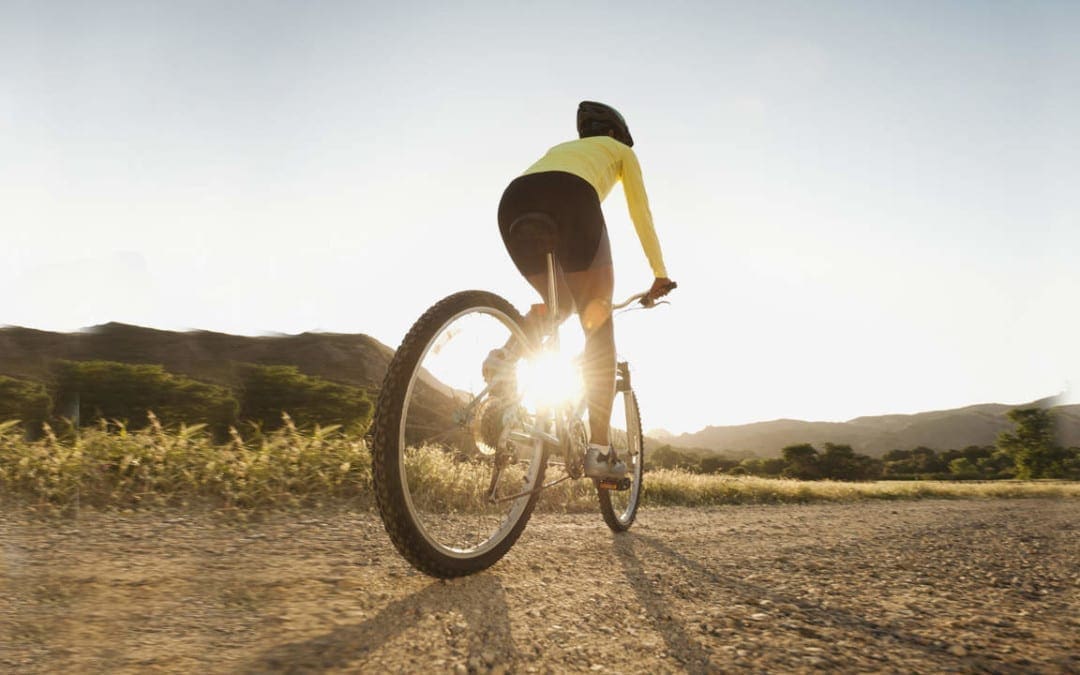
Sure, spin class feels killer, but outdoor cycling may require you to work even harder, according to a study in Journal of Strength and Conditioning Research. Plus, “there’s something really nice about covering distance and being in the fresh air and sunshine,” says Jim Rutberg, a cycling expert for Carmichael Training Systems and Strava in Colorado Springs, Colorado. He created the 30-minute interval workout below. If you’re a beginner, try doing the workout in a loop first so you can log the distance without getting too far from home. Once you feel comfortable, turn it into an out-and-back ride and explore some new terrain.
• Six 30-second speed intervals separated by 30 seconds of easy recovery. Rev your cadence and power as you accelerate for 30 seconds, then pedal very lightly as you slow down for 30 seconds before starting the next effort. These aren’t really sprints so much as hard, seated accelerations.
• 3 1⁄2 minutes easy recovery
• 8-minute tempo interval. Effort should be a 6 on a rate of perceived exertion scale of 1 to 10, with 10 being as hard as you can go. Your breathing should be deep and controlled, nowhere near panting.
• Cool down with an easy pace for 5 minutes.
This workout burns approximately 285 calories (for a 30-minute ride at 12 to 14 mph for a 150-pound person).
Not sure how to tell if you’re biking at “easy” or “fast”? There are a lot of ways to gauge your intensity level, but you won’t always have a heart rate monitor handy. Instead, you can use a “talk test” to track your efforts.
• Talking casually: recovery pace/easy • 1 to 2 sentences at a time: endurance pace/moderate • 2 to 3 words at a time: labored breathing/hard
For timed intervals, look at a watch, or you can time the distance between landmarks, like phone poles, and use those as your markers.
In October of my junior year of high school, I was at the top of my cross-country game. I was running five to six days a week, knocking more and more time off my mile split, and gearing up for a big race that would finally prove I had what it took to hit varsity status. So when opportunities arose to run a few extra miles and push myself harder, I took them without a second thought.
Then came the day of the race. I’d been noticing some pain and throbbing in my shins for a few days, but assumed I just had shin splints—something I’d dealt with many times in the past. So before my event, I popped a couple of Ibuprofen and visualized myself totally dominating the race. Spoiler: That’s not what happened.
When the race started, I took off and headed to the front of the pack. I kept up my pace as I wove through the trail, adrenaline surging through my body. That is, until about mile 1, when my runner’s high was interrupted by an excruciating pain in my left shin.
I tried to ignore it, unwilling to give up just yet. But the pain only got worse, and soon I was limping. Girls passed me left and right, but I kept hobbling my way across the grassy path until I reached the finish line and collapsed.
Fast forward through two doctor’s visits, an X-ray, and a bone scan. The verdict was that I had seven small stress fractures in my left shin.
My case is certainly nothing out of the ordinary. In fact, ABPM-certified podiatrist Melissa Lockwood, DPM, says nearly one in five runners she sees is for a stress fracture. But why do young, healthy people end up with this injury? Here, she explains what causes stress fractures, and shares tips for preventing and treating them.
Stress fractures are characterized as “overuse injuries.” They occur when a bone experiences repeated, unusual force, says Dr. Lockwood, who’s based in Bloomington, Illinois: “For example, when runners increase their distance and speed—basically anything that changes the amount of pressure they’re putting on the body.”
Dr. Lockwood typically sees these injuries happen in the metatarsals, which are the small bones right behind your toes, and the lower leg (as in my case). According to the American Academy of Orthopedic Surgeons, more than 50% occur in the lower leg.
While stress fractures are associated with running, “they can also be caused by regular force, if the bones are weakened by other problems, such as osteoporosis or another systematic problem like an eating disorder,” adds Dr. Lockwood. Research suggests women are more susceptible, possibly because they’re more prone to the above-mentioned conditions.
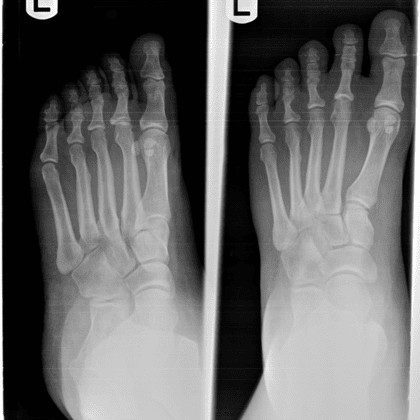
But really, stress fractures can affect anyone. Dr. Lockwood got one in her foot after walking around Disney World all day. (See her X-rays below.)
“The biggest thing is to watch for increased pain with increased activity,” says Dr. Lockwood. “Meaning it doesn’t hurt so badly first thing in the morning, but then the more you’re on it throughout the day, or after you go for a run, the pain gets worse, even excruciating.”
Unlike a strain or pull, the ache associated with stress fractures doesn’t tend to resolve itself after a couple of days, or go away with rest. So if you still feel a throbbing pain after sitting down, that’s also pretty good indicator.
But diagnosing a stress fracture can get a bit tricky: “Typically you can’t see a stress fracture on an X-ray until two weeks after the initial injury.” For that reason doctors often order other tests, like an MRI or bone scan, to identify the injury.
If a patient describes stress fracture symptoms, Dr. Lockwood always treats it as one, she says, unless she figures out an alternative explanation.
Once you’ve had one stress fracture, it puts you at greater risk for another, says Dr. Lockwood. [Insert un-amused emoji here] But luckily, there are a number of smart strategies you can use to keep your bones healthy.
For starters, invest in solid sneakers. If you’re a runner, head to a running store and find a pair that works optimally for your stride and foot type.
It’s also crucial to retire your shoes after a certain amount of use, Dr. Lockwood warns. Either toss them based on time (no more than 6 months) or miles (no more than 300).
And whether you’re an athlete or not, if you’ve suffered a stress fracture in the past, you may want to consider getting custom orthotics to make sure you’re moving with the right biomechanics, says Dr. Lockwood.
At the time of my own injury, I was stupidly wearing a pair of sneakers that were past their expiration date. So please, don’t make the same mistake, and actually pay attention to your shoes!
Don’t get discouraged
After my injury, I felt really down. I worried that my body wasn’t cut out for running, and that this was a sign I needed to throw in the towel.
But as Dr. Lockwood puts it, “having stress fractures does not mean your running career is over.” It may mean you need to change how you’re training, whether that’s adjusting the distance or frequency of your runs, or running on softer surfaces (think grass vs. concrete).
For me, getting back into running entailed everything Dr. Lockwood mentioned: scaling back my runs, paying better attention to my form, and regularly swapping out my shoes. Today running is still a huge part of my lifestyle. I even run-commute to work sometimes. But I’m much better about listening to my body now, and taking notice when it needs a break.
If you sense that something is off with your body, “don’t sit and wait to get it checked,” says Dr. Lockwood. “Or rather, don’t run and wait.”
Scroll through Hannah Bronfman’s Instagram feed and you’ll get a nice picture of what healthy living looks like: The 29-year-old DJ and fitness influencer regularly shares snapshots of her killer workouts and stellar skincare regimen with her 364,000 followers. (FYI: She’s obsessed with microcurrent facials.)
But these days, Bronfman’s current motivation to keep up her clean lifestyle is her wedding. She’s tying the knot with fellow DJ and social media star Brendan Fallis this weekend in Morocco.
Bronfman’s idea of wedding prep has nothing to do with detoxing, however. “There’s all this stupid pressure about losing weight for your wedding,” the HBFIT founder told The New York Times earlier this month. “I’m really not into it.”
The soon-to-be bride’s goal is to feel her best on the big day. Here are five ways she has made wellness a top priority during her wedding week.
Bronfman says she always tries to avoid dairy, but in the last few days, she’s been following a macrobiotic diet while staying at the Sha Wellness Clinic in Spain. She wrote on Instagram that this new way of eating has made her “rethink her diet completely.”
In an Instagram story, Bronfman shared this snap of her and the almost-groom getting cozy on the tennis court. Talk about a perfect match.
After slipping into some killer Adidas gear (Bronfman’s a global ambassador for the brand), she got her “om” on. Not a bad idea to get centered before the wedding craziness begins: “will try to channel the zen to calm my inner hype beast!!” she wrote.
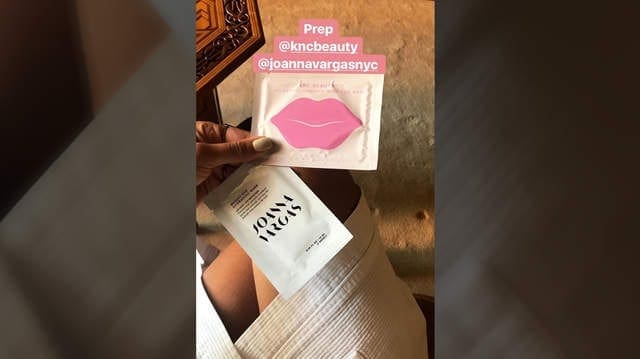
Because no skincare enthusiast would be wedding-ready without her go-to products, Bronfman tagged two of her beauty must-haves in this snapshot she posted to her Instagram story yesterday: The Bright Eye Firming mask from Joanna Vargas ($60 for 5 masks; joannavargas.com) and KNC Beauty’s All-Natural, Collagen-Infused lip mask ($25 for 5 masks; birchbox.com).
Ever had a less-than-poised moment on a weight machine, or in a boot camp class? Hey, you’re certainly not the only one. In a recent Reddit thread titled “Stupidest thing you’ve ever done in the gym?” in the XXFitness subreddit, users revealed their most cringeworthy (and often painful) workout moments—from tripping on the treadmill to gym flirting gone wrong. Here are some of the comments that had us giggling. (We recommend you stop reading now if you’re currently on a cardio machine!)
Uneven bar
User Sambeano made the mistake of unloading a heavy barbell on one side, but not the other: “It was resting on the safety bars at the time, at about knee height, with about 30 kgs loaded on the other side. The bar flipped in the air and crashed into a glass door frame … The crash was so loud everyone turned around to look.” Whoops.
Bike dominos
“I thought this bench near some cardio equipment was fixed to the ground for some reason and grabbed onto it to stretch my shoulders out. I flew backwards into a row of eight stationary bikes, knocking them all over like dominoes,” wrote Mpaellen.
Bottom out
Themortalvalkyrie got off a rowing machine with a bruised bum: “My butt fell off the rower. I was [trying to] do sprints and got a little too excited, and at one point I think my butt must have come up a little and the seat flew back and i came down on the bar. But it was funny.” (Another Redditer jumped in, “I wish that thing had a seatbelt!”)
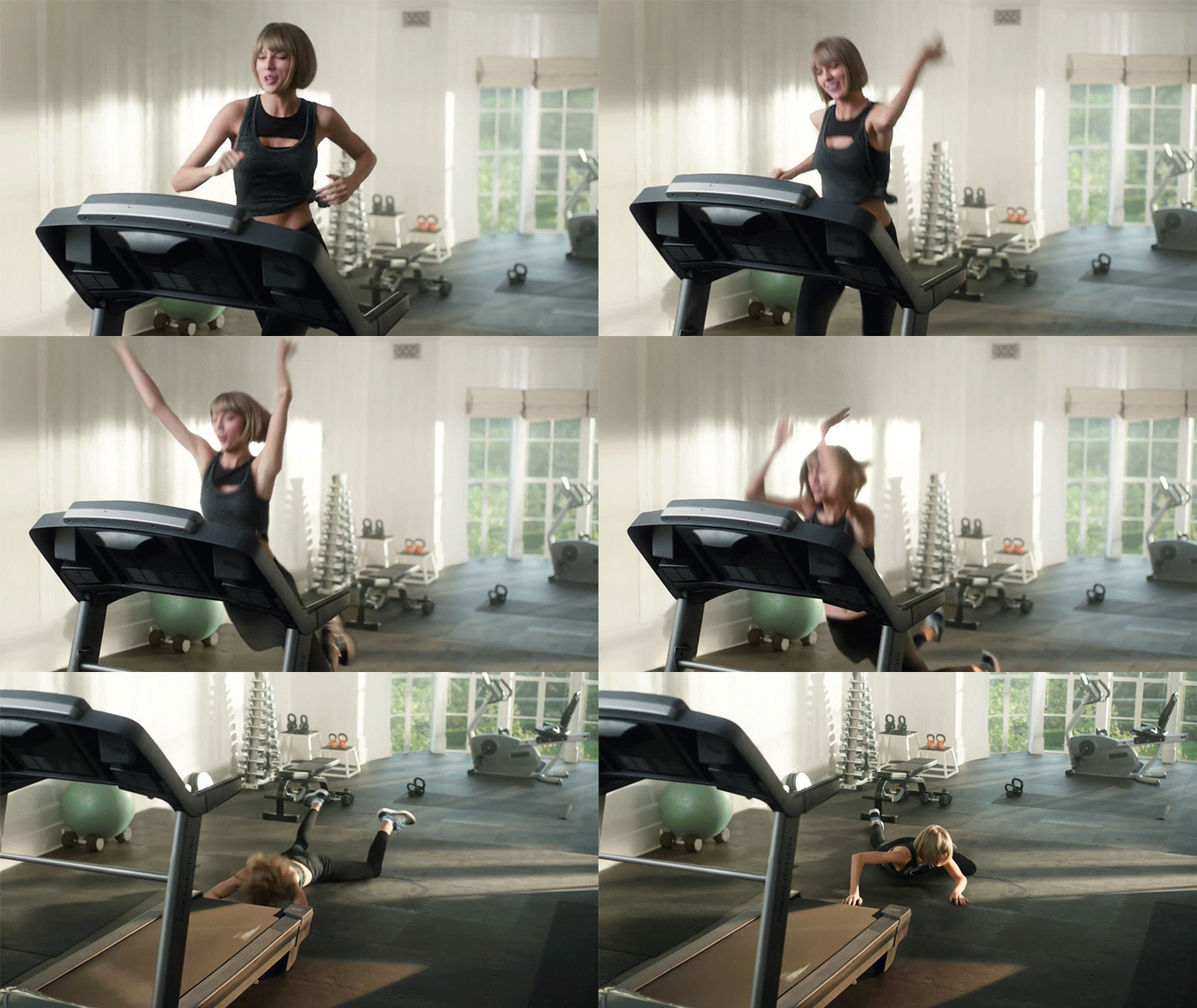
From jazzehcakes: “Once I was running on the treadmill and closed my eyes to sneeze, which caused me to trip, land face first, and fly off the treadmill.”
When exercise balls attack
“I threw an exercise ball on the mini trampoline and it flung back hit my fingers, which then hit my face,” shared another Redditer. “I managed to grab the ball before it caused further chaos. Everyone around me either didn’t notice or pretended not to. I probably looked like an idiot laughing to myself.”
Is this thing on?
Reddutchess15 was new to the exercise scene when she tried out her university’s fancy gym. Feeling a bit intimidated, she decided to “start off easy on the elliptical,” she wrote. “Well, I get to the elliptical, try to push the start button, and nothing. I keep pushing the start button and nothing happens. So, I thought it was broken. Worse, I worried that I would be blamed. So I just left without doing any workout at all. It wasn’t until my friend starting making fun of this other girl for the same reason days later that I realized i was supposed to get on it first.” (Trust us, we’ve been there!)
“Tried to kill a spider while running on the treadmill,” user little—dolly posted. “I lost my balance, fell down, got my shirt caught up and ended up with two scraped knees and treadmill road rash down one side of my face. Oh, and I didn’t get the spider.”
Pee problem
“I peed myself while squatting in a busy gym,” wrote Souponastick. “That wasn’t the worst part. For whatever reason my brain decided I needed to announce it, so as I was coming up from the bottom of the squat I screamed, ‘I’M F****** PISSING MYSELF!’ Everyone looked and watched me clean up my puddle.”
“Saw a cute guy in the gym,” posted Tokyo1964. “I went to take a swig of water just as our eyes met, but accidentally squeezed the bottle slightly and sprayed it into my eye instead.”
Ripped pants
From Blaserea: “Ripped the crotch out of my shorts squatting, even heard it through the headphones.”
Fast and furious
Ever cranked up your speed on a cardio machine to clock a specific number of miles before your time runs out? Phoenixinda attempted this strategy, without success: “Last year I decided to go extra fast on the cross trainer for the last two minutes so that I could get a full 3-mile distance at the end of the 30 minutes. Foot slipped, fell between the pedals, and my foot fractured in three places. I was out for three months … I have been back at the gym, but I just can’t bring myself to even touch the cross trainer.”
Vkm5028 learned the hard way to make sure you actually know the person you’re waving at before you say hi. “Thought I saw a friend of a friend out of the corner of my eye. I was in a goofy mood, and decided to make a goofy face and wave at him. Turns out, it wasn’t the guy who I thought it was, he was on the phone whenever I made the face at him, and I found out he’s a player for the local minor league baseball team and probably thought I was fan-girling at the sight of him.”
Sweat stain
“Worn pale blue leggings,” one user commented. “It looked like I’d [peed] myself half way through my gym session.”
Stuck on you
Wearing athleisure fresh out of the laundry? Make sure there’s no other laundry stuck to it before you leave the house. “I once had a thong static-cling itself to my leggings,” MyShoulderHatesMe posted. “I was at least 20 minutes into my workout before I noticed.”
IFM's Find A Practitioner tool is the largest referral network in Functional Medicine, created to help patients locate Functional Medicine practitioners anywhere in the world. IFM Certified Practitioners are listed first in the search results, given their extensive education in Functional Medicine