Choosing to receive treatment from a chiropractor won�t stop your slice or improve your putting, but it just might end up improving your overall game and lowering your score. It�s no secret that golf can be hard on your lower back. The quick, repetitive twisting motion required to swing a club puts your back at risk every time you play, and if you already have a back injury you�re putting other muscle groups at risk. Keep reading to learn how to improve your golf game in El Paso with chiropractic care.
How Chiropractic Boosts Your Game
Since a chiropractor is specifically trained to treat the entire neuromusculoskeletal system they are able to help golfers reduce the amount of stress and strain placed on their bodies. The lower back does undergo a lot of stress with the torque of a standard golf swing, but there are other body parts that can affect your golf game, too. Pain or range of motion issues in your shoulders, elbows, knees or wrists will definitely affect your swing and lead to inflated scores.
Chiropractic treatment can put your body back into alignment, remove nerve compression, and improve blood flow to vital muscles. When you are free from pain and your mobility isn�t hindered in any way, you can swing freely and focus on your game.
It All Begins With You
Although you can improve your golf game in El Paso with chiropractic, taking steps to help yourself will improve it even further. Arrive early at the course and do some warm up stretching and light swings before your game. Whether you hit some balls at the practice range or not, stretching and loosening up is key. You�ll also want to perform some light stretches after your round to keep your muscles loose and lengthened.
It�s easy to get dehydrated out on the golf course, but not drinking enough can set the stage for a strained muscle or similar injury. Make sure you drink plenty of water before, during, and after playing golf, especially if it is hot outside. If you walk the course when you play, avoid carrying your bag and pull it instead. Carrying a heavy golf bag over 18 holes can cause disc problems and irritate nerves.
If you have the option, avoid wearing metal spikes when you play. They have the potential to get stuck in the ground during your swing, causing a serious knee or back injury. And if you find that your swing is causing pain in any area of your body, consider taking lessons to learn a more efficient way to swing your clubs. If you follow these tips you�ll enjoy a pain-free round every time out.
Have you ever wondered how many years your treating chiropractic doctor went to school for or how their education compares to that of other health care professionals? Knowing your doctor’s educational background and additional certifications is often essential to helping you choose the health care provider that is right for you. While the word�”doctor” automatically implies an extensive academic curriculum, each health care specialist has a unique and individualized educational program to complete prior to practicing in the field. Our doctors�have designed this article to help you understand your chiropractor�s educational background and how it may affect your care.
Chiropractors Educational Requirements?
As with many professionals, the specific requirements outlined often vary from state to state. Typically, chiropractors are required to have completed undergraduate pre-medical studies and obtained a bachelor�s degree prior to admission to a post graduate chiropractic college. Each chiropractic college has undergone a meticulous evaluation process to become certified by the Department of Education as an accredited educational institution.
The amount of time that your chiropractic doctor spends at a specific chiropractic academic institution is impressive. In fact, your chiropractor has spent a minimum of 4,200 hours at a chiropractic college prior to receiving his diploma. This time is spent in the classroom, laboratory, and clinic learning about the various aspects of the chiropractic profession and health care in general.
In the classroom, your doctor focuses his studies on the subjects of anatomy, physiology, diagnosis, pathology, biochemistry, neuromuscular and orthopedic evaluation, pediatric and geriatric care, microbiology, nutrition, immunology, radiology, philosophy, and clinical research. While this may seem like a lot, all of this information is assimilated and tested prior to advancement to clinical work. Once the student has completed his academic work, he will typically spend a minimum of 1,000 hours at a campus clinic under the guidance of a clinic doctor. During this time he will learn hands on how to diagnosis and treat patients in real clinical situations.
During your chiropractors education they will be tested through a number of different evaluations. Not only is your doctor subject to evaluation by their chiropractic college, they must also pass a series of national board examinations. Chiropractors practicing in the United States are required to have passed a series of four national board exams which evaluate them on their understanding of the basic sciences, clinical sciences, physiological therapeutics, diagnostic imaging, case management, and clinical competency. In addition to these requirements, following graduation and completion of national board examinations, each chiropractor must become certified by their state licensing agency.
The completion of these standards is not the end of the educational journey for chiropractic doctors. Depending on the state, each chiropractor is required to complete additional approved course work at designated times following their licensure. For example, Wisconsin requires a minimum of 40 hours of continuing education every two years following graduation.
Chiropractors Education In Comparison To Other Health Care Professionals?
After reading the above information, I feel it is safe to say that your chiropractic doctor knows far more about your health than just treating your back. To help understand this it is useful to compare a chiropractor�s education to other members of the health care community. Since many people are familiar with a medical doctor, we will compare their educational background with that of a chiropractic doctor. For starters, the typical chiropractic student will have completed a total of approximately 2,419 hours of academic work prior to the initiation of clinical studies. In comparison, the majority of medical students will have completed somewhere around 2,047 hours of study. Further, while each health care discipline has its strengths, chiropractic students undergo more hours of study in the fields of anatomy, embryology, physiology, biochemistry, diagnosis, x-ray, and orthopedics. In contrast, medical practitioners have had more classroom hours studying the subjects of pathology, psychology, and obstetrics.
When analyzing these numbers it is important to understand that while differences exist, each of your doctors has undertaken and completed a similar core education. In addition, it is important to remember that each of your doctors (even in the same health care discipline) possess various strengths to compensate for other health care professionals’ weaknesses and utilize a different approach to healing the body. In the end, finding the doctor that understands your needs and has the tools to provide you with the most appropriate care is what is important.
Degenerative disk disease (DDD) develops as an outcome of the effects of aging in your back and particularly in your intervertebral discs.
Additionally, it may be associated with an injury to the back, but in that scenario, your disks have generally become weak because, with age, disks lose water content, may become thinner; both of which can change shape and the strength of one or more discs. Before you feel the result of DDD� other symptoms as well as pain � your discs along with other backbone constructions are changing. That is simply the natural consequence of the stress and tension each of us places our backs through every day.
Causes and Effects of DDD
Effects and the causes of degenerative disc disease are relatively clear-cut: You age, your disks change, your bones could be affected, and also you can develop pain. It even helps to think as a cause and effect process or cascade of DDD: One anatomical change happens, which leads to changes and more degeneration in the structures of your back. These changes combine to cause degenerative disk disease and its particular symptoms.
DDD begins with changes in your intervertebral discs, but eventually it’s going to change another movement parts of the spine, like the facet joints.
Over time, the collagen (protein) structure of the annulus fibrosus (that is the outer portion of the intervertebral disc) changes.
Moreover, water-pulling molecules�and consequently water�in the disc declines.
These changes decrease the ability to manage back move of the disc.
How Disc Degeneration Occurs
The disc can be less spongy and substantially thinner. A disc that is thinner means the space between the vertebra above and below the disc gets smaller, which causes a brand new problem, this time with all the facet joints. They help stabilize the back, and changes move, in the event the disc loses height. Subsequently the cartilage that protects the facets starts to wear away, and they start to proceed too much: They “override” and become excessively mobile.
Function of the Spine with Hypermobility
Freedom causes another change in your spine. It attempts to cease the motion with the growth of little bony parts called bone spurs (osteophytes). Sadly, the bone spurs sometimes pinch nerve structures and cause pain. The bone spurs can narrow the space for nerves and the spinal cord �that disorder is called spinal stenosis. Degenerative disc disease won’t cause spinal stenosis but it’s something you should be aware of if you’ve degenerative disc disease.
Genetics and DDD
Your genes can also raise your danger of developing degenerative disk disease. You might be predisposed to excessive joint and disc wear and tear, so if someone in your family has or had degenerative disk disorder, you may even develop back pain or neck pain related to DDD.
Controlling Your Lifestyle
Eventually, the method you are living could result in degenerative disk disease. Smoking, by way of example, will cause them to degenerate faster and adversely affects your disks. Smoking really decreases the level of water in your discs, and water is part of what helps your discs absorb move. With less water content, your intervertebral discs can wear out sooner.
The scope of our information is limited to chiropractic and spinal injuries and conditions. To discuss options on the subject matter, please feel free to ask Dr. Jimenez or contact us at 915-850-0900 .
By Dr. Alex Jimenez
Additional Topics: What is Chiropractic?
Chiropractic care is an well-known, alternative treatment option utilized to prevent, diagnose and treat a variety of injuries and conditions associated with the spine, primarily subluxations or spinal misalignments. Chiropractic focuses on restoring and maintaining the overall health and wellness of the musculoskeletal and nervous systems. Through the use of spinal adjustments and manual manipulations, a chiropractor, or doctor of chiropractic, can carefully re-align the spine, improving a patient�s strength, mobility and flexibility.
El Paso, TX. Chiropractor Dr. Alex Jimenez focuses on the rise in opioid use among older adults.
SpineUniverse reported on a study that indicated a 10% increase in opioid addiction or dependency in patients prescribed such drugs to take care of postoperative pain. Although spine surgery was not among the forms of operations included in the research, it�s intriguing to see that 3% of the patients ages 55-years plus, disclosed addiction and opioid use.
Older adults as well as the elderly are part of about 100 million adults in the USA (US) affected by severe or chronic pain. Low back pain is neck pain, and among the most frequent causes of pain, followed by headache/ migraine pain. Spinal stenosis, spinal osteoarthritis, and degenerative disc disease are frequent investigations in elderly residents and our mature adult.
In a presentation by Sullivan in 2003 about chronic pain and prescription opioid abuse and dependence in mature adults, it had been reported that �the prevalence of pain increases with each decade of life Additionally, 80% were grown by pain criticisms in adults age 65 and older. Moreover, as the number of opioid prescriptions increased, so did use by older adults�but some medical studies regularly blown off addiction as temporary or rather rare.
Regulators React
Acknowledge and its particular bureaus and the government started to recognize opioid use and the potential risks in elderly Americans. In 2012, a study revealed that more than 700,000 adults (ages 45 to 84) were hospitalized particularly for opioid abuse. Mature adults as well as the elderly accounted for a five-time increase in hospitalizations for opioid abuse compared to younger Americans.
Adults of any age taking an opioid may experience drug unwanted effects that are possibly dangerous. But for mature adults or senior -aged individuals, the hazards are weightier. Why? Old people frequently take several medications simultaneously to treat different medical problems (eg, diabetes, hypertension). It may be a challenge for the patient to keep an eye on when to take a drug that is prescribed or remember if the medicine was taken, which may result in unintentional doses. An opioid drops, and introduces another tier of potential risks, including respiratory depression, lack of balance, confusion, dizziness, drowsiness, nausea.
In 2015, Congress introduced a Medicare-specific bill called �Ceasing Drug Exploitation and Shielding Seniors Act.� Now, we see changes dispensed, and monitored to prevent physician- shopping and other ways drugs could possibly be obtained and abused.
Managing Opioid Medications
Elderly patients or some adult live alone, in a household setting, receive home-health support, or reside in a assisted-living facility or alternative scenario. In some cases, the direction of the medication, including pain-relieving drug is managed by healthcare or nursing staff.
Many older adults and aged patients are quite capable of handling physician�s visits, their drugs, and everyday life. Then there are other people who want support. They might not realize they need help or may not ask. This is where friend, a family member or caregiver might help by being observant and step in to help. By way of example, does the patient take their medication as prescribed, but nevertheless look to be in pain? Does he /she stumble easily or fall, complain about feeling dizzy, confused, constipated, or have a few other criticisms?
Remember that people so do their needs for drugs and change with age. In unwanted effects and handling pain, the alternative can be an alternate kind of drug or a dose change. Considering many senior adults and aged men take multiple medications, it’s an excellent idea to bring OTC medication all prescription and nutritional supplements to each physician�s visit for review. This creates a superb chance for you and the individual to talk together with the doctor about new challenges and health changes.
El Paso, TX. Chiropractor Dr. Alex Jimenez looks at back pain medications and their effect on sleep.
Can you relieve spine pain and get a good night�s rest? Sure some drugs get in the way.
Prescription medications are among the most recommended nonsurgical treatments for back and neck pain. While these drugs might help alleviate what ails your back, your sleep may suffer because of this. That�s a big deal, as sleep deprivation hurts your general wellbeing.
Unfortunately, back and neck pain medications can have side effects�and interfering with your sleep and ability to operate normally throughout the day are ones that are typical. Your medication may stop you from getting enough sleep or falling asleep. Or, your slumber quality suffers, although you might doze off readily. Plus, sleep-related side effects do n�t just affect you during the nighttime hours, as you may experience drowsiness or jitters during the day.
Sleep Science 101: Reconsidering Sedatives
Before delving into common back and neck pain drugs that may affect your slumber, it�s important to comprehend one of the biggest misconceptions about sleep medicines: the effect of sedation.
Many view sedatives as sleep aids due to the fact that they enable you to fall asleep fast. Nevertheless, this doesn�t tell the entire image, based on Steven A. King, MD, MS, who practices pain medicine in New York and is a clinical professor of Psychiatry at the New York University School of Medicine.
�When contemplating what�s good for sleep, it really is vital to not forget that sleep is just not a uniform activity through the entire span of the night, but rather, a succession of cycles involving different levels of wakefulness,� wrote Dr. King in a site for Psychiatric Times. �Merely because a medication may put one to sleep doesn�t mean restful slumber will be provided by it if it disrupts the normal sleep cycles.�
During a good night�s sleep, your brain will repeatedly cycle through five phases: stages 1, 2, 3, 4, and rapid eye movement (REM) sleep. You should spend about 25% of your total slumber and this is the cycle. As researchers believe it contributes to regulating your mood, learning, and saving memories having uninterrupted REM sleep is significant.
Monitor your sleep quality, if you�ve been prescribed a medicine with sedative effects, for example an opioid. It�s not about how fast you fall asleep but also how refreshed you feel the very next day. If you dazed and �re waking up groggy, talk to your doctor about possible alterations to your medication regimen.
Back &�Neck Pain Medications That May Disrupt Sleep
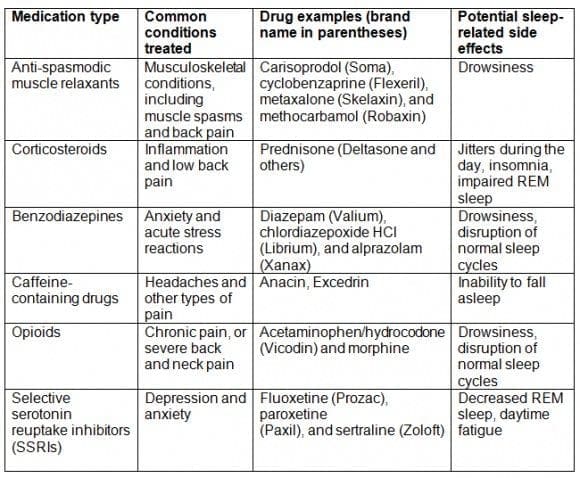
Below are drugs that treat spinal conditions and may likewise have sleep-associated side effects.
Note: The table below features common back and neck pain medications that could interfere with your sleep and daytime functioning; it is not an all inclusive list. Always discuss the potential side effects of your medications that are certain with your physician.
Talk To Your Doctor About Drug Alternatives For Better Sleep
The quality of your slumber shouldn�t suffer�as a result, although keeping your spine healthy is vital. If you�ve detected a decrease in quality or quantity of sleep since beginning your back or neck pain medicine, tell your physician. She or he might prescribe an alternative drug or treatment while addressing your spinal issue to restore healthful sleep.
Degenerative disc disease (DDD) is commonly associated with aging. As you get older, your discs, like other joints within the body, can degenerate (break down) and become problematic: That’s a natural part of growing older, the body begins to deal with years of strain, overuse, and perhaps even misuse.
Nonetheless, DDD can appear in people as young as 20, so regrettably, youth doesn’t always protect you from this disc-related spinal condition. In fact, some patients may inherit a prematurely aging spine.
Degenerative disc disease involves the intervertebral discs, or the pillow-like shock absorbers between your vertebrae in your back. These help your back carry weight and permit complex movements of the back while maintaining stability. As you get older, the discs can lose flexibility, elasticity, and shock absorbing features. Additionally they become thinner as they dehydrate. The discs change from a supple state that enables smooth movements into a stiff and rigid state that restricts your movement and causes pain.
You could have degenerative disk disease if you experience chronic back or neck pain. It normally happens in your lower back (lumbar spine) or neck (cervical spine). Developing degenerative disc disease can be a slow process.
How Does Spinal Degeneration Occur?
Degenerative disc disease (DDD) can change many parts of your spine. To understand how, you first need a basic knowledge of what makes up your back. First of all, you’ve vertebrae, labeled in the picture below as the “vertebral body.” In your back, or vertebral column, you have 33 vertebrae.
Your spine is split into separate areas:
Neck (cervical spine)
Mid-back (thoracic spine)
Low back (lumbar spine)
At the low end of your back, you additionally possess the sacrum and also the coccyx, which is often called your tailbone.
Degenerative disc disease is most likely to occur in your lumbar spine or your cervical spine.
Intervertebral Discs
In between your vertebrae, you have intervertebral discs. These act like shock absorbers or pads on your back as it moves. Each disc is composed of a tire-like outer band known as the annulus fibrosus and a gel-like inner substance called the nucleus pulposus. Degenerative disc disease alters the discs and makes them less able to cushion the movements of the spine. With DDD, your intervertebral discs also become more vulnerable to injuries or conditions; they may bulge or herniate.
Together, the vertebrae and the discs provide a protective tunnel (the spinal canal) to where the spinal cord and spinal nerves are placed. These nerves run down the center of the spine and the vertebrae to various portions of the body, where they help you move and feel.
Facet Joints
Your spine also consists of facet joints, which are joints located to the posterior side (back) of your vertebrae. These joints (like all joints in your body) help facilitate movements and are extremely important to your flexibility.
Cartilage
Your spinal joints are covered by cartilage, which shields your bones as you move. Without cartilage, your bones would rub together and could be very painful. Unfortunately, your cartilage might be affected by general damage on your own back, plus it may wear away. That’s when bone spurs (osteophytes) can form as your body attempts to repair itself.
Muscles, Blood Vessels, and Ligaments, Tendons
Your back additionally has ligaments muscles, tendons, and arteries. Muscles are fibrils of tissues that power your motion. Ligaments are the powerful, flexible bands of fibrous tissue that link the bones together, and tendons connect muscles to bones. Blood vessels provide nourishment. These parts all work together that will help you move.
Further Concerns Regarding Degenerative Disc Disease
What is DDD?
Degenerative disc disease (DDD) isn’t really a disorder�it is the regular wear and tear process of aging on your spine. Unfortunately, as we age, our intervertebral discs (pillow-like pads involving the bones in your spine) lose their flexibility, elasticity, and shock-absorbing features. When this happens, the disks shift from a supple, flexible state which allows flowing motion, into a rigid and stiff state that limits your movement.
What Causes Degenerative Disc Disease?
Degenerative disc disease is generally the result of aging, and that means you are more inclined to have it if you’re older than 50. However, younger people can have symptoms of DDD as well. Injuries also can start the process that is degenerative .
The degenerative process causes your discs to lose their capability to cushion your moves. Slowly, the collagen (protein) structure of the outer portion of your disk�the annulus fibrosus�weakens. The degenerative process also affects the water content in your discs, as well as the water content is a must to preserving movement. With the water, DDD -attracting molecules in your disks decrease, making your disks become inflexible and more stiff.
Are There Non-Surgical Options to Treat DDD?
You can attempt, to help deal with pain from degenerative disc disease:
bed rest (only several days)
restricting your actions that boost the pain
light exercise (walking, swimming, etc) as recommended by your doctor
Over the counter medications
prescription medications
When Should Surgery Be Considered for DDD?
Although degenerative disc disease patients respond well to non-operative treatments, some patients do need surgery. Surgery should really be considered only after you have tried several months of non-operative treatment. You surgeon will recommend the best kind of operation for you. Here are a few common sorts of surgery used for patients with DDD:
Anterior cervical discectomy and fusion (ACDF)
Foraminotomy
Microdiscectomy
The scope of our information is limited to chiropractic and spinal injuries and conditions. To discuss options on the subject matter, please feel free to ask Dr. Jimenez or contact us at 915-850-0900 .
By Dr. Alex Jimenez
Additional Topics: What is Chiropractic?
Chiropractic care is an well-known, alternative treatment option utilized to prevent, diagnose and treat a variety of injuries and conditions associated with the spine, primarily subluxations or spinal misalignments. Chiropractic focuses on restoring and maintaining the overall health and wellness of the musculoskeletal and nervous systems. Through the use of spinal adjustments and manual manipulations, a chiropractor, or doctor of chiropractic, can carefully re-align the spine, improving a patient�s strength, mobility and flexibility.
El Paso, TX. Chiropractor Dr. Alex Jimenez takes a look at sit/stand desks to see if they help with back pain and burn calories.
Regular utilization of sit-stand desks at work can help burn off calories and stop weight gain when coupled with other low-intensity tasks, according to findings from a current study in Occupational Medicine. The sit- stand desks did not increase pain or reduce productivity.
�In fact, other longer-term studies are demonstrating that using a sit-stand desk may actually reduce pain,� clarified lead writer Bethany Barone Gibbs, PhD, FAHA, Assistant Professor of Health and Physical Activity, Clinical, and Translational Science in the Physical Activity and Weight Management Research Center at the University of Pittsburgh.
For patients who have back pain or have lately experienced spinal surgery, the recommendation to stand on and off during the day is very important, commented A. Nick Shamie, MD, Chief of Orthopaedic Spine Surgery and Professor of Orthopaedic Surgery and Neurosurgery at UCLA School of Medicine.
�Sitting down puts significant pressure on disks and the backbone,� Dr. Shamie said. �In addition, the pressure on discs is extremely high when one is seated and bends forward to pick something off of the flooring,� he noted.
The Way The Study Was Performed
For the study, 18 people (9 men, 9 women) performed standardized deskwork at different positions for three independent one-hour sessions: 60 minutes sitting, 60 minutes standing, and 60 minutes spent alternating between sitting and standing for 30 minutes each. Standardized deskwork contained posts that were typing from a magazine, copying definitions from a dictionary, and math exercises. Areas completed experimental sessions in a haphazard order, at least and within four weeks.
All participants were between the ages of 22 and 57 years old, had earned at least a high school degree, and worked sedentary office occupations having an average daily sitting time of 8.8 hours.
Sit-Stand Desks May Burn Off 50-60 Calories Each Day
The research found that if your person stood for thirty minutes during each hour, they might burn 5.5 more calories than they’d have by sitting for the entire hour. Standing for the full hour burned an extra 8.2 calories. Changing evenly between sitting and standing on the course of an 8-hour day�4 hours sitting and 4 hours standing �could burn off as much as 56.9 calories for guys and 48.3 calories for girls.
While the number of calories is comparatively small, it may be sufficient to stop weight gain from working a sedentary job. In reality, the researchers pointed to other studies showing that modest increases in daily activity, the equivalent of burning 100 calories per day, prevents weight gain in most individuals. Routine usage of sit-stand desks could be one of many small tasks that would help weight is maintained by office workers, the researchers noted.
The Advantages Of Sit-Stand Desks
�Sit-stand desks are an easy way to get an increase in energy cost that matches into America�s present office culture. By combining the action of standing for part of the day with other occasional actions�say, electing to walk to the printer farthest away from your work space or selecting to make use of the restroom that�s found a few flights of stairs away�you can attain a significant amount of extra energy cost while at work which could help in weight control,� Dr. Barone Gibbs said.
�It’s essential that we understand standing at work isn�t going to burn off as many calories as choosing a brisk walk or a long term,� Dr. Barone Gibbs said. �However, our findings add to an increasing area of research that demonstrates the advantages of sit-stand desks, including increases in energy and productivity, blood sugar, and lower pain, and potentially blood pressure.�
Folks can certainly go online and also read reviews of the greatest sit-stand desks and how to incorporate them into work setting, Dr. Shamie said. He included that sit-stand desks are simply one part of back care. Eating a healthy diet, sleep, regular exercise, are all factors that play a job in an overall healthy lifestyle and back care, he explained.
IFM's Find A Practitioner tool is the largest referral network in Functional Medicine, created to help patients locate Functional Medicine practitioners anywhere in the world. IFM Certified Practitioners are listed first in the search results, given their extensive education in Functional Medicine