Upper back pain is a common spinal disorder, which causes pain and discomfort. Joint dysfunction and muscle irritation can be the common cause of this problem. Sometimes injuries can cause upper back pain.
A fracture of vertebrae, poor posture, and pressure on spinal nerves can be the causes of upper back pain. Many people suffer from the back ache especially upper back pain or thoracic spine. It can be chronic and very uncomfortable as it is associated with multiple ligaments, tendons and nerves in upper back.
When any of these associated ligaments or tendons becomes inflamed or irritated, it may result upper back pain. This can disrupts the life of many people but relief can be found through exercise and natural remedies. Some common symptoms of upper back pain include anxiety, depression, fatigue, headache, morning stiffness, neck pain, shoulder pain, redness, warmth or swelling of the back, stress, insomnia and much more. There are many ways to relieve upper back pain and promote spinal health:
Steps to Relieve Back Pain & Other Symptoms
Take rest: You should take a break if your back hurt a lot. You can return to your activities after taking break for few minutes. You should also avoid the things like carrying heavy weight and many more that make your pain worse.
Use ice pack or a heating pad: Heat can be helpful in reducing muscle stiffness and back ache. Ice is also equally effective in reducing swelling and pain. You can switch back or forth between cold or heat unit you find what makes you feel better.
Exercise: There are so many exercises that help strengthen your muscles in stomach, shoulder and back. These muscles mainly help support your spine and improve your spinal health. Strong muscles of back help reduce pain, improve body posture, keep your body in balance and decrease chances of injuries.
Practice good posture: Sometimes stress on your back muscles may be the main cause of upper back ache and poor posture may be the reason of stress on back.
Eat nutritious food: Healthy eating habits, plenty of calcium and vitamin D in your diet may help prevent backache. Calcium is an essential nutrient that strengthens your bones and muscles.
Stay hydrated: Staying hydrated is very significant in maintaining elasticity of soft tissues and fluidity in joints.
Take Orthoxil Plus capsules and oil: Orthoxil Plus capsule is highly beneficial and effective remedy for upper back pain. It possesses herbal and natural ingredients which helps repair damages. These pills work effectively promote healthy spine. The pure and natural ingredients check osteoporosis, progression of arthritis, and disc degeneration and many more issues. These capsules improve overall health and reverse ill effects of bone disorders, nutritional deficiencies, medical conditions that deplete muscles, ligaments, discs and bones. You can also use Orthoxil Plus oil to massage the affected area. You can take few drops of this oil to massage the painful area. It helps get rid of pain and improve your spinal health.
The scope of our information is limited to chiropractic and spinal injuries and conditions. To discuss options on the subject matter, please feel free to ask Dr. Jimenez or contact us at 915-850-0900 .
Additional Topics: Preventing Spinal Degeneration
As we age, it’s natural for the spine, as well as the other complex structures of the spine, to begin degenerating. Without the proper care, however, the overall health and wellness of the spine can develop complications, such as degenerative disc disease, among others, which could potentially lead to back pain and other painful symptoms. Chiropractic care is a common alternative treatment option utilized to maintain and improve spine health.
Doctor of Chiropractic, Dr. Alexander Jimenez reveals what the popping sound is during a spinal adjustment.
Chiropractic Care &�Back Pain
Has this happened to you? You are at the chiropractor getting treatment for your own back pain, and during a spinal adjustment, a sizable popping sound is heard by you. It seems somewhat alarming, does not it? Rest assured, though: That pop within a chiropractic spinal adjustment is totally ordinary.
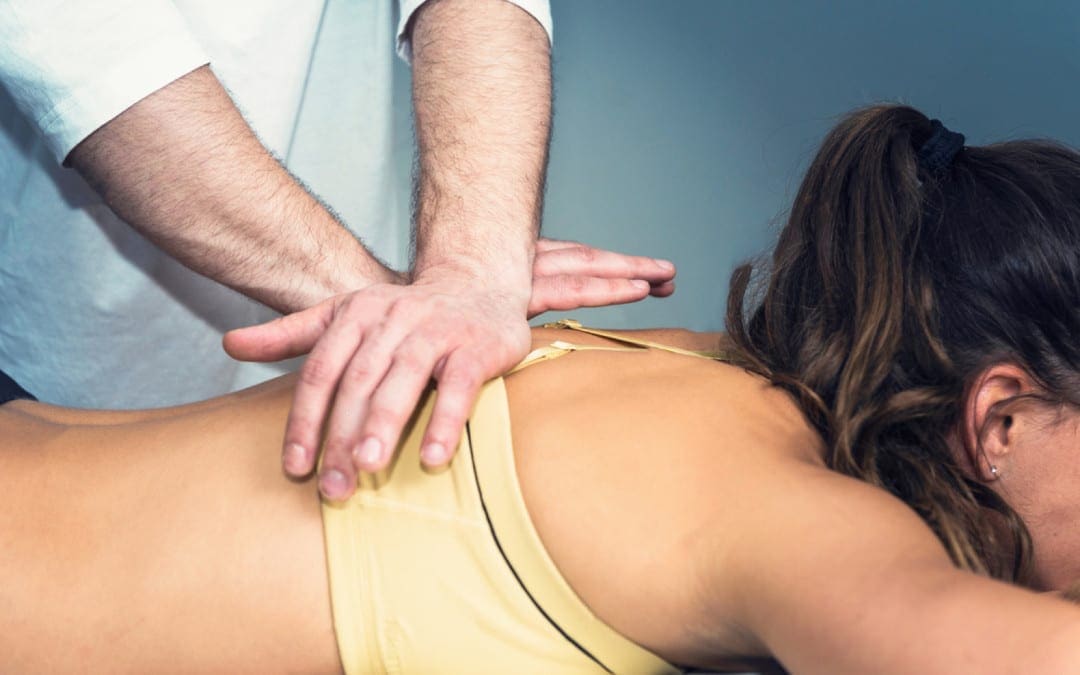
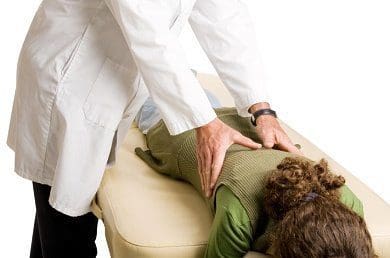
During a back adjustment, your back experiences rapid, mild stretching of the spinal joint, which means you may hear a snapping or popping sound. This really is brought on by little pockets of air or bubbles, which are in the fluid that surrounds your joints. When joint tissues are extended throughout a chiropractic adjustment, the pockets of atmosphere “pop,” which creates that cracking sound you hear.
Following this treatment, you could feel in your back for more movement. But, the muscles may still be raw and tight.
Your chiropractor might also incorporate other chiropractic care treatments like muscle therapy. You must notice more back pain relief with each session.
Your chiropractor could also advocate preventive care, including specific exercises, and he/she might give you ergonomic tips on the best way to accurately bend and lift, in addition to how to take good care of your back while at your desk (if you work in a office). Doing specific exercises and maintaining good posture might help keep movement that is healthy in your back.
Is Chiropractic Care Right For You?
It is crucial that you consider that chiropractic care is not a cure all for all conditions that are back. Some backbone conditions that cause back pain may require a combination of treatments, or other treatments, for example surgery and drugs.
But in the event you have a condition that causes pain back and you need to test a non-operative treatment, chiropractic care can be an excellent treatment choice for you personally. But remember, you need to not be alarmed by a popping noise during a spinal adjustment�it’s ordinary in chiropractic care.
Chiropractic care is an alternative treatment option you may want to consider for degenerative disc disease, or DDD.
The first steps a chiropractor will take to treat degenerative disc disease involves carefully diagnosing a disc-related complication. Back pain is a main symptom of DDD and 3 main causes are looked at by the chiropractor.
Degeneration in the spinal joints might be disturbing the mechanisms of the spine.
Thinning and degenerative discs might be bulging and putting pressure on spinal nerves.
Spinal stenosis can cause back pain and leg pain.
Diagnosing Degenerative Disc Disease
At your first exam, you�ll go throughout your past medical history with the chiropractor and he/she will discover areas of restricted joint motion, disc injury, muscle spasms and ligament injury by performing a few easy tests.
Your chiropractor will even look at how you walk as well as your entire posture and movement capabilities. Those details will help them understand your body mechanics and how your spine moves.
You may also need an imaging test, like an x-ray or MRI.
After the assessment, the chiropractor will diagnose your condition and create a treatment strategy to reduce back pain and other symptoms of DDD.
Chiropractic Treatments for DDD
The goal of chiropractic care for DDD would be to enhance joint mechanics by reducing inflammation and improving spinal motion. The chiropractor could also focus on enhancing the function of the intervertebral discs�but that if you do not have disc degeneration that is innovative.
To help treat your degenerative disc disease symptoms, your chiropractor may use spinal manipulation, also called spinal adjustment. There are multiple kinds of spinal manipulation. Some common ones are:
Particular spinal manipulation: Your chiropractor will identify the joints which might be restricted or those that reveal unusual motion. He/she will work to restore movement to the joints using a gentle thrusting technique.
flexion-distraction technique: This kind of spinal manipulation uses a gentle, non-thrusting technique; it�s normally used to treat spinal stenosis and herniated discs.
Device-assisted manipulation: This technique works on the handheld device. Without thrusting directly to the spine, the chiropractor applies mild force.
Manual therapy can also be utilized to greatly help treat degenerative disc disease symptoms. Examples of manual therapy techniques are:
trigger point treatment: Tight painful points are identified by the chiropractor and gets direct pressure on those points to alleviate stress.
manual joint stretching and resistance techniques: Your chiropractor may use any of these methods to relieve pain and also other DDD symptoms.
instrument-assisted soft tissue therapy: An example of this type of manual therapy is the Graston technique, which uses an instrument to reduce pain and other symptoms.
In addition to spinal manipulation and manual therapy techniques, your chiropractor may use other kinds of therapy to help reduce inflammation caused by degenerative disc disease. Examples are:
interferential electrical stimulation: A low frequency electrical current can be used to stimulate your muscles to lessen inflammation.
ultrasound: Ultrasound will help reduce pain, stiffness, and muscle spasms by sending sound waves deep into your muscle tissues. This creates a mild heat that improves circulation.
Your chiropractor could also urge therapeutic exercises, which may help augment your other treatments. With chiropractic care, prevention is essential, and remedial exercises can prevent your DDD symptoms.
Benefits of Chiropractic for Degenerative Disc Disease
Your chiropractor will work hard to treat your degenerative disc disease and address your DDD symptoms all. But chiropractors treat the �whole individual��not only your symptoms that are particular. Your chiropractor may prepare you on stress management, nutrition, and lifestyle goals in addition to treating your degenerative disc disorder symptoms.
The scope of our information is limited to chiropractic and spinal injuries and conditions. To discuss options on the subject matter, please feel free to ask Dr. Jimenez or contact us at 915-850-0900 .
By Dr. Alex Jimenez
Additional Topics: What is Chiropractic?
Chiropractic care is an well-known, alternative treatment option utilized to prevent, diagnose and treat a variety of injuries and conditions associated with the spine, primarily subluxations or spinal misalignments. Chiropractic focuses on restoring and maintaining the overall health and wellness of the musculoskeletal and nervous systems. Through the use of spinal adjustments and manual manipulations, a chiropractor, or doctor of chiropractic, can carefully re-align the spine, improving a patient�s strength, mobility and flexibility.
Doctor of Chiropractic, Dr. Alexander Jimenez breaks down how pinched nerves cause back and neck pain.
You hear people say it a lot:
�I have a pinched nerve, and wow, it hurts.�
But what exactly is a pinched nerve? How does it cause back pain or neck pain? What are the symptoms of a pinched nerve�beyond pain? And most importantly, what can you do about a pinched nerve? Learn the basics of pinched nerves here.
Pinched Nerves: A Common Cause of Back & Neck Pain
What Is A Nerve?
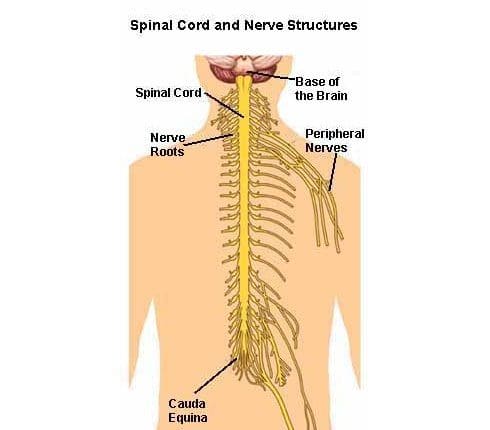
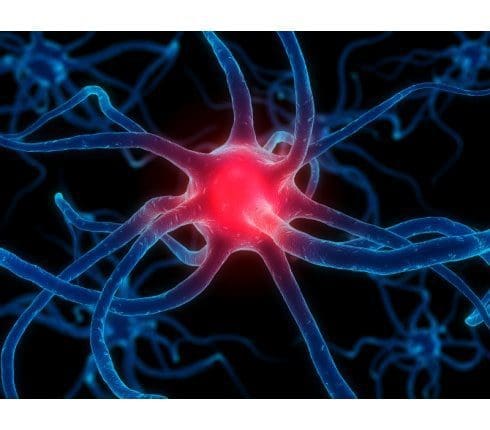
Nerves are your body�s messengers. They transport signals to and from your brain�messages like �Move this toe� or �Ouch, that cactus needle really is sharp.� You have a central nervous system, which is made up of your brain and spinal cord. You also have a peripheral nervous system, which is the system of nerves that branches off the brain and spinal cord.
What Do Nerves Look Like?
If it helps, think of nerves like a garden hose (except they aren�t green). They have an outside membrane that transports those electrical messages. Inside nerves, there�s a fluid that nourishes and replenishes the outer membrane.
You�re Getting on My Nerves
When a nerve gets pinched, the messages and the nourishing fluid don�t flow quite as well as they should (still helpful to think of a garden hose here). A pinched nerve can start sending the �Ow, pain� message to the brain, and it can also have trouble communicating clear messages, possibly leading to weakness, numbness, or tingling.
What Can Pinch a Nerve?
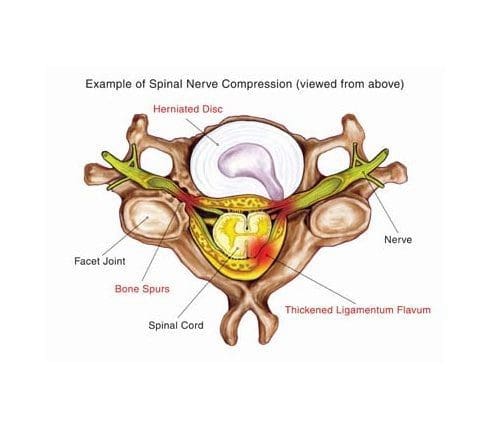
As a nerve exits the spinal canal, it can be pinched by a herniated disc or a bone spur. Bone spurs, also known as osteophytes, are bony bumps that can develop on a spinal joint over time. They can push into the spinal nerve, as you can see in this illustration (red = pain generator, of course).
What Does a Pinched Nerve Feel Like?
A pinched nerve mostly feels like pain. If you have a pinched nerve in your low back, it can cause pain to travel (or radiate, in doctor-speak) down your leg. You may also know that as sciatica. A pinched nerve in the neck can create pain that shoots down your arm. Other symptoms of pinched nerves include muscle spasms, burning, tingling, and a hot/cold sensation.
Now the Good Stuff: Pinched Nerve Treatments
Pinched nerve treatments fall into two categories: what you can do at home (self-care) and what your doctor may prescribe for you.
Pinched Nerve Self-care #1: Heat and Ice
Heat and ice can work wonders on a pinched nerve. Switch between 20 minutes of heat and 20 minutes of ice�and remember that you shouldn�t put the heat and ice packs directly on your skin.
Pinched Nerve Self-care #2: Get a Massage
The muscles around a pinched nerve can become tight, so having a professional massage therapist work the painful area can bring pain relief. You may also consider a handheld massager.
Pinched Nerve Self-care #3: Take a Walk
Let�s say it�s your low back�a pinched nerve in your low back�that�s hurting you. A nice, easy stroll is a good way to stay active and address your pain. Gone are the days of extended bed rest for back pain: doctors now are more likely to recommend you exercise and stretch to help relieve your pain.
When Should You Call a Doctor?
If you try the self-care thing and yet your pinched nerve pain persists, you should consider calling the doctor. If you�ve been in pain for more than a couple of days, schedule an appointment. You should also call the doctor if you experience a very sudden onset of weakness, or if you experience profound numbness. Losing bowel and/or bladder control is also a good reason to call the doctor.
How a Doctor Treats a Pinched Nerve
The doctor will try to diagnose the cause of your pinched nerve, and then the doctor will be able to develop a treatment plan. That plan may include prescription pain medications, physical therapy, or cortisone injections. But keep this in mind: the treatment plan will be specifically tailored for you, and it�s in your best interest to follow it closely.
There is significant excitement among surgeons as well as among patients following the recent FDA, or Food and Drug Administration, release of the Charit� Artificial Disc (DePuy Spine, Inc.). The delight among patients with degenerative disc disease comes from the perception that there’s now a safe way to eliminate pain from degenerative discs while also maintaining normal movement. Several patients have developed advanced stages of disc degeneration requiring an additional fusion process or have heard about others with similar difficulties getting fusion processes before, who still continue with constant pain or had more than one effort at fusion. They’ve also discovered the successful results following disc arthroplasty in Europe which has been highly publicized by the media in America.
Lumbar Fusions and Other Discoveries
That is certainly an exciting new addition to the variety of therapies and methods for treating degenerative disc disease. An almost amazing quantity of progress has been made when looking at the way in which the evaluation and treatment for degenerative disc disease has developed over recent years. Many healthcare professionals are now able to recognize disc disorder with MRI and pain generators with discography and facet blocks. Now they could be performed through incisions that are barely observable either anteriorly through the abdomen or through the back where only a decade past, lumbar fusions were being performed through substantial posterior incisions. With the usage of instrumentation that is presently available, achievement rates for one amount fusions approach 90 to 95 percent. Regrettably, not every patient who has degenerative disc disease and contains a successful fusion has a successful clinical result. There’s still a number of patients for whom fusion will not effectively relieve pain.
Risks of Disc Replacement
Disc replacement arthroplasty has the prospect of the treatment of most of the spinal motion segment illnesses which are currently being treated both successfully and not by one of the numerous fusion techniques. At this comparatively early phase of disc replacement development, many healthcare specialists don’t know all of the issues which will be encountered following these procedures. Because the surgical strategy is via the abdomen either retroperitoneal or transperitoneal, in other words, around or through the gut, there are several foreseeable complications including vascular injury, thrombophlebitis, or vein inflammation accompanied by blood clot formation, nerve root injuries, injury to the ureter, and retrograde ejaculation in men.
It’s also known that several disc replacements have failed and have been converted to some fusion with varying clinical consequences. Removing artificial discs, especially at the L4-5 level, poses a substantial risk of vascular injury due to scarring round the prosthesis. Surely, it’s known that artificial joints produce wear debris where that is obviously not an issue with fusion and an inflammatory reaction which could escalate over time.
Early Results of Procedure
Spine specialists and other healthcare professionals in general are very positive and excited about total disc arthroplasty, and suitably so. Appropriate training via cadaveric labs and courses will help minimize the learning curve of the procedure, to avoid other possible complications. There will without a doubt be many improvements and modifications in the prosthetic layouts.
Early results are surely encouraging in the hands of the investigational surgeons but are fraught with the numerous problems common to the creation of a procedure that is new. Total disc arthroplasty is likely to be an option that is better than fusion for several degenerative disorders of the lumbar spine as layout advancements continue being made and as further encounter defines the indicators because of its use.
The scope of our information is limited to chiropractic and spinal injuries and conditions. To discuss options on the subject matter, please feel free to ask Dr. Jimenez or contact us at 915-850-0900 .
Brain injuries are common complications in our modern world. Approximately 2 million individuals experience a head injury in the United States alone each year. Although most brain or head injuries are not considered life threatening, they could sum up to billions of dollars in annual revenue. Brain injuries are often categorized according to patient response. Only 1 out of 4 reported brain injuries are considered moderate or severe.
Doctor of Chiropractic, Dr. Alexander Jimenez examines people that see�a chiropractor and their reduced�usage of opioids and other types of drugs.
The draft Guidance for Prescribing Opioids for Chronic Pain, issued in December 2015 by the U.S. Centers for Disease Control and Prevention, included �many complementary and alternative therapies (e.g., manipulation, massage, and acupuncture)� among its recommended non-pharmacologic approaches. However, when the final Guidance was released three months later, manipulative therapy and its 75,000 licensed chiropractic practitioners was not directly referenced. A recent study from James �Jim� Whedon, DC, MS, pictured, suggests that the CDC harmed its mission with its excision of explicit reference to manipulation. Patients using chiropractors were less likely to use prescription opioids.
Whedon is currently a researcher at the Southern California University of Health Sciences, and is co-chair of the Research Working Group of the Academic Collaborative for Integrative Health. He is a relatively rare resource in the integrative health community, as a specialist in diving into huge data sets of insurers and seeking to extract useful information. Whedon is a veteran of arguably the most important research center in this type of work, The Dartmouth Institute at the Geisel Medical School at Dartmouth College.
Whedon�s research began with awareness that �little is known about the comparative effectiveness of non-pharmacological care for low back pain as a strategy for reducing the use of opioid analgesics.� What is well known, as Whedon shared in his poster and presentation at the 2016 conference of the Academy of Integrative Health and Medicine, is that patients with such pain are swimming in opioid prescriptions. Whedon�s presentation included a Baskin-Robbins-like list of 39 opioid varieties. He postulated that opioid use would be less likely among those receiving chiropractic care.
Association Between Utilization Of Chiropractic For Back Pain & Use Of Prescription Opioids
Preliminary results of a health claims study,� Whedon reports what he found through examining the New Hampshire All Payer Claims Database.� Of roughly 33,000 adults registered as having low back pain, slightly over a third saw a chiropractor. Of these, 38 percent had at least one opioid prescription. Of those who did not see a chiropractor, 61 percent had at least one opioid prescription.
The core question that interested Whedon was how many prescription fills the two sets of insured patients received. Those whose opioid prescription was integrated with chiropractic care had an average of 3.9 fills. Those who did not receive chiropractic manipulative therapy averaged 8.3 fills per patient. He estimated that the average per person opioid charges were $88 for those using chiropractors. The figure was $140, or 60 percent higher for those not using chiropractic care.
Whedon�s conclusions were, first, that the likelihood of filling a prescription for a high-risk drug of any type was 27 percent lower. Secondly, the likelihood of filling a prescription for an opioid analgesic was 57 percent lower in the chiropractic-using population.
�These are preliminary results,� Whedon cautioned. �We intend to analyze the data further, applying robust methods to reduce the risk of bias that can result from other differences between people who use chiropractic care and those who do not.�
Comment: While Whedon takes care to note that �no causal inferences can be made,� the associations should be of real interest to the CDC and other policy makers. A follow-up study might attempt to compare the whole costs of the chiropractic-using population and those who didn�t.� These costs could include, on the one hand, the cost of chiropractic treatment, and on the other, the costs of other medications or treatment that may be prescribed for those on longer-term opioid treatment who may end up cycling into the addiction.
Doctor of Chiropractic, Dr. Alexander Jimenez looks at high heels at what they do to the back.
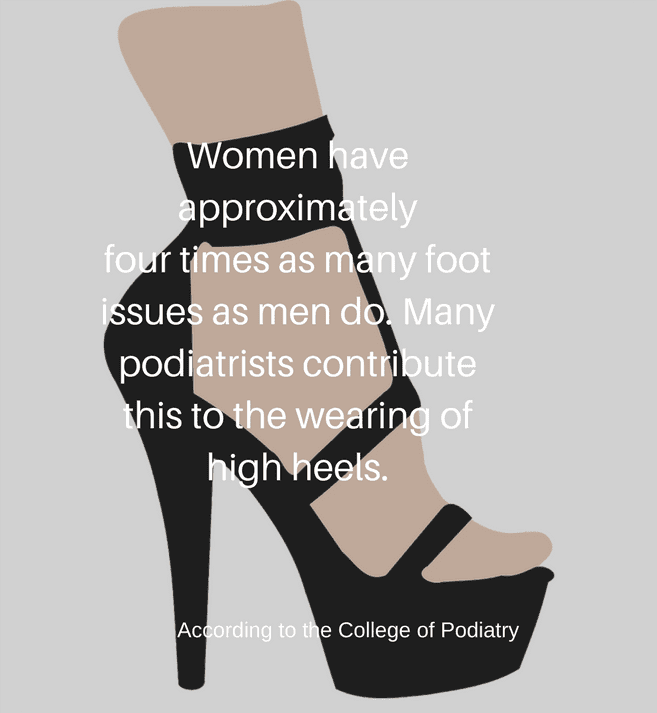
Ladies, ever wonder why you suffer from regular bouts of lower back pain?� Achy hips?� How about crazy tight leg muscles?� Don�t blame it on your cycling class, or too many squats or, the trainer you only see once or twice a week.� Look down.� Are you wearing high heels?� Bingo!� You�ve heard high heels are bad for you.� But it�s not just because they cause all kinds of pain and trauma to your feet.� High heels are also messing up your physical fitness. �They throw you out of proper postural alignment causing your joints and spine to take on more�wear and tear, which means aches and pains.
Is it possible to still look rockin� and save your joints? �My suggestion is more Athleisure-wear. �I know some fashion hard-liners say, no way will I walk around in yoga pants on a weekday!� But we�ve come a long way since those flare-leg, fold-over yoga pants.
Let�s chat for a moment about the evils of high heels.
First there�s the obvious.� They make your feet hurt.� Blisters, calluses and swelling are par for the course.� And pointy toes, fuhgeddaboutit!� I�m sure they were invented by someone on the Marquis de Sade�s payroll.� Second, they can lead to foot injuries like plantar fasciitis (usually from a bone spur that makes your heels hurt), hammertoes, bunions, and neuromas.� �Then there�s the domino effect.
Not only do high heels make your feet hurt, but problems with the feet can travel up the leg and cause injuries in the back, knees and hips. �Your knees take on extra pressure from the weight being pushed forward onto the balls of the feet. �Walking in this position makes your hip flexors and calf muscles short and tight. �And it doesn�t stop there.� Back problems are incredibly common in women who don�t give up their high heels.
Back Problems are incredibly common in women who don�t give up their high heels
Here�s why:
ext”>
Postural changes:�The S-curve of your spine has cushiony discs in between the vertebrae that act as a shock absorbers to protect them from stress. Like when you�re bending or jumping. �Wearing heels causes the lower back to arch more than normal because the body weight is pushed forward.� To compensate, the upper body has to lean back to maintain balance.� This puts extra stress on the discs. ��Spending hours with your body in funky alignment can lead to muscle spasms and back pain. �Tight hamstring muscles, which�attach to back of the pelvis and lower back, can also make your back ache.
Anatomical changes: Wearing high heels on a daily, or very regular basis, over years, can actually cause anatomical changes to your body.� In addition to the extra strain on your back and knees, the calf muscles can also shorten and the tendons can get tighter and thicker.
And It Can Get Even Nastier If You Get One Of These Spine Injuries:
Spondylolisthesis: it�s a mouthful, but is a common injury that can happen in the lower back from too much hyperextension (arching the back).� It�s when one vertebra slips forward over another.
Foraminal stenosis: I have this one congenitally and it sucks. This is a spine and nerve issue that occurs when anatomical abnormalities reduce the spaces the nerves travel through as they exit the spinal column.� The spaces are called foramina, and when they get blocked, the nerves get squeezed.� The pain can radiate through the buttocks and down the legs.� Symptoms are shooting pains, numbness, tingling, muscle weakness, spasms and, or cramping.
Sciatica:�The sciatic nerve is the longest one in the body. �It runs from the bottom of the lumbar spine all the ways down the legs. �When the sciatic nerve gets compressed it causes radiating pain, tingling, numbness and muscle weakness down the leg and can The pain can travel all the way to the bottom of the foot.
What Can You Do? �My Case for Athleisure-Wear To Combat Back Pain
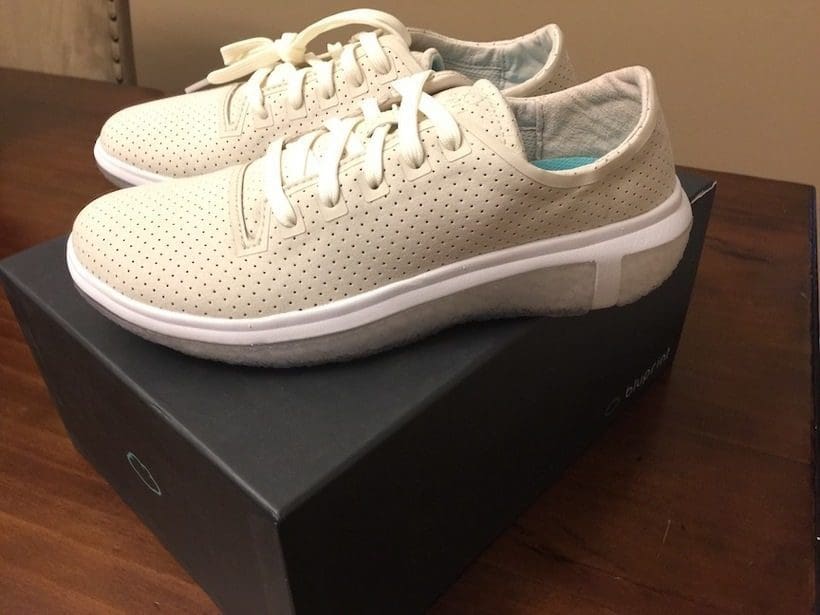
It�s time for stuffy office attire to retire. �Comfy clothes and flat shoes can be very chic. �Have you seen the boards on Pinterest?� Thanks to this hopefully permanent fashion style, my jeans and heels spend more time in my closet than on my body.� Leggings and cute kicks are my go to�s.� Night out?� No prob.� I reach for my sleek workout leggings, a ruched top or off the shoulder top with some high heel sneaks (they�re wedges so not nearly as bad for you). �I also discovered these by Bluprint which I put to the test at 2 huge conventions where I walking and standing for hours on end.� The soles made of memory foam � like those beds!
My podiatrist friend, Steven Rosenberg, DPM has been preaching the need for comfy shoes to his female clients for years. �(Fortunately for his practice, not everyone listens!) �Dr. Steve says, wearing shoes designed more for comfort can help you live more pain-free. ��Because comfort shoes are made of�soft cushiony materials�with soft foam innersoles, those are what you should turn to for shopping, walking or standing for long periods of time to avoid�blisters, muscle spasms or arch cramps.� � He also says to check for arch support in your shoes. �If there�s none, you can buy ones to put inside.
Even after reading this, you may still not be willing to give up high heels for good. �Me either.� I still get glammed up once in a while.
Here Are Some Tips For When You Must:
Wear them for as little time as possible.
Try to opt for heels around 2� high
Steer clear of pointy toes.
Buy shoes with leather insoles to so your foot doesn�t slide.
Buy arch inserts or use orthotics to support your arches.
Vary your footwear so you�re not wearing high heels every day.
Gradual or lower slopes are a little better, go for platforms or wedges instead of stilettos
Thicker heels are better than spiky heels
Stretch and strengthen the overworked muscles.
Here�s How:
Stretch your leg muscles and hip flexors before and after wearing heels.� For the calves, stand on a step and let one heel hang down until you feel a stretch.
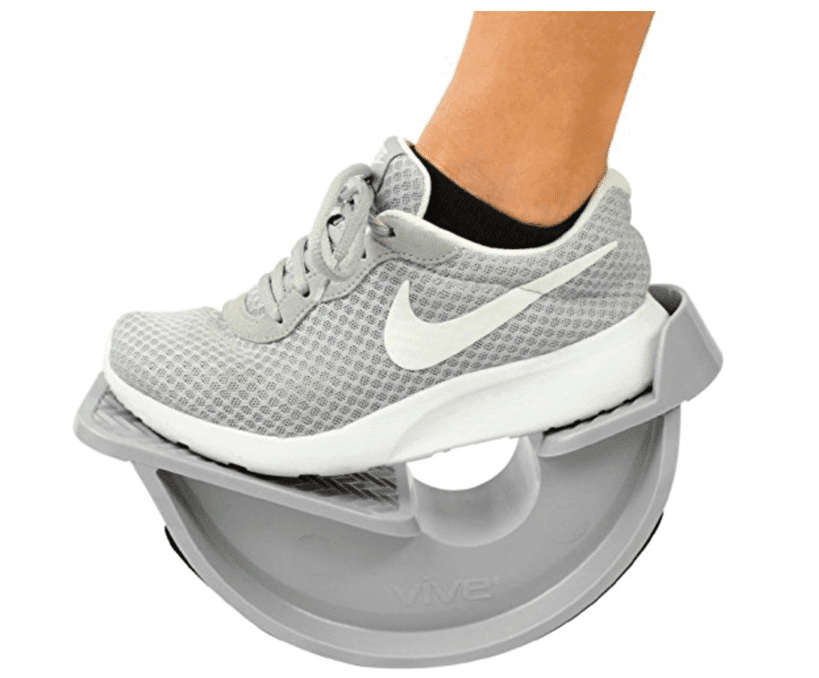
Try this convenient device, the foot rocker by Vive.� It stretches the calf and the sole of the foot relieving pain from plantar fasciitis.
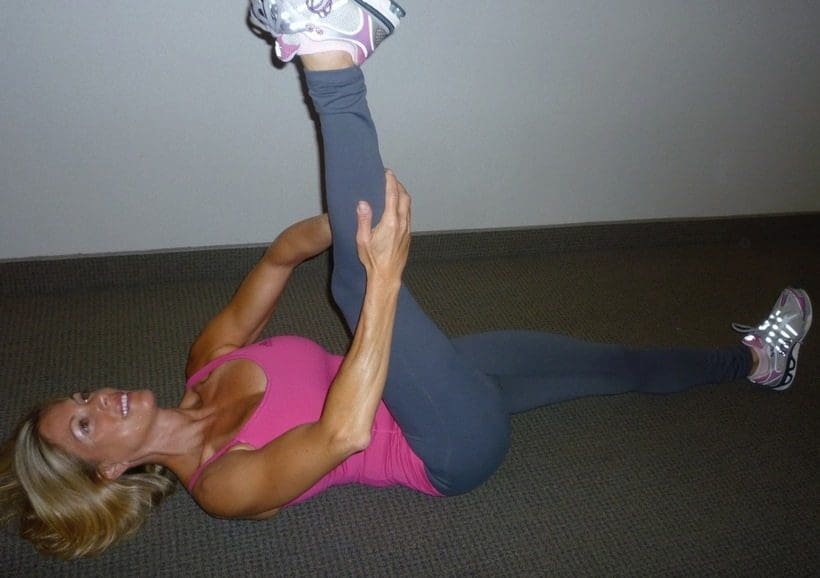
Front of the hip and thigh stretch for before and after wearing high heels
Hamstring stretch for before and after wearing high heels
Massage and stretch the muscles in the soles of your feet.� Roll your foot on a golf ball before and after wearing heels and, get regular foot massages.
Strengthen and increase the range of motion in your ankles and feet.� Put a rag on the floor.� Using your foot, write the letters of the alphabet.� Also put a bunch of marbles on the floor.� Pick one or a few of them up using just your foot.� Put them down about 6 inches away without lifting your foot off the floor.� Try that 10 times.� If you don�t have marbles, you can do it with a hand towel.
So next time you�re shopping for shoes, think about your foot fitness first. �Look for fashion that keeps you closer to the ground and that will hopefully keep you farther away from the doctor.
IFM's Find A Practitioner tool is the largest referral network in Functional Medicine, created to help patients locate Functional Medicine practitioners anywhere in the world. IFM Certified Practitioners are listed first in the search results, given their extensive education in Functional Medicine