In October of my junior year of high school, I was at the top of my cross-country game. I was running five to six days a week, knocking more and more time off my mile split, and gearing up for a big race that would finally prove I had what it took to hit varsity status. So when opportunities arose to run a few extra miles and push myself harder, I took them without a second thought.
Then came the day of the race. I�d been noticing some pain and throbbing in my shins for a few days, but assumed I just had�shin splints�something I�d dealt with many times in the past. So before my event, I popped a couple of Ibuprofen�and visualized myself totally dominating the race. Spoiler: That�s not what happened.
When the race started, I took off�and headed to the front of the pack. I kept up my pace as I wove through the trail, adrenaline surging through my body. That is, until about mile 1, when my runner�s high was interrupted by an excruciating pain in my left shin.
I tried to ignore it, unwilling to give up just yet. But the pain only got worse, and soon I was limping. Girls passed me left and right, but I kept hobbling my way across the grassy path until I reached the finish line and collapsed.
Fast forward through two doctor’s visits, an X-ray, and a bone scan. The verdict was that I had seven small stress fractures in my left shin.
My case is certainly nothing out of the ordinary. In fact, ABPM-certified podiatrist Melissa Lockwood, DPM, says nearly one in five runners she sees is for a stress fracture. But why do young, healthy people end up with this injury? Here, she explains what causes stress fractures, and shares tips for preventing and treating them.
Stress fractures are characterized as “overuse injuries.” They occur when a bone experiences repeated, unusual force, says Dr. Lockwood, who’s based in Bloomington, Illinois:��For example, when runners increase their distance and speed�basically anything that changes the amount of pressure they�re putting on the body.�
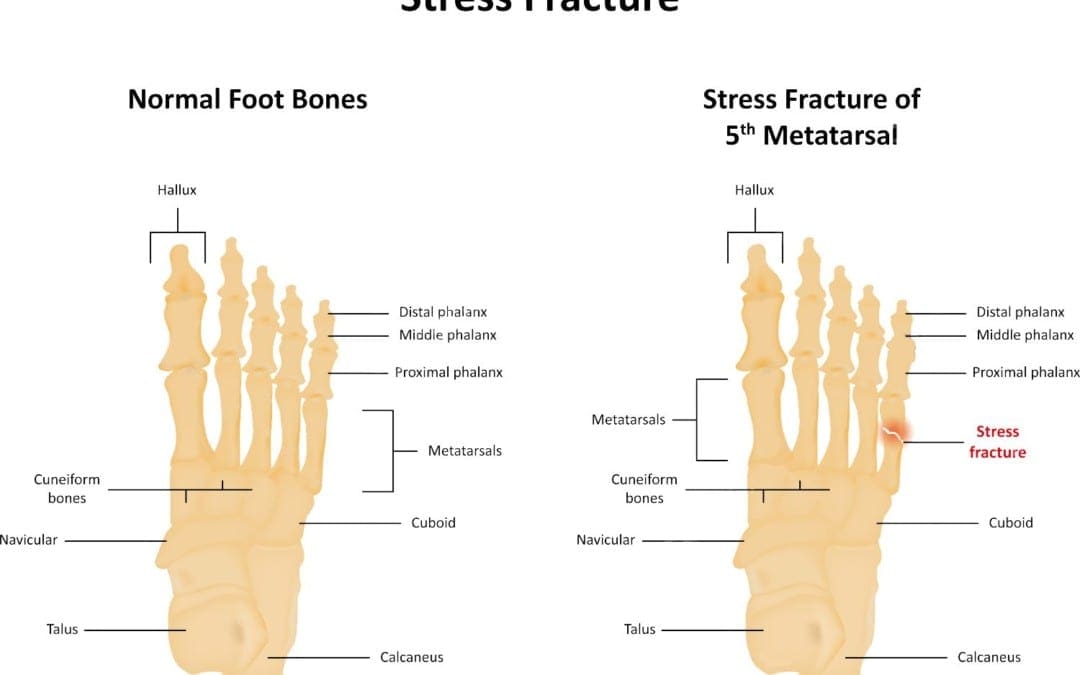
Dr. Lockwood typically sees these injuries happen in the metatarsals, which are the small bones right behind your toes, and the�lower leg (as in my case). According to the American Academy of Orthopedic Surgeons, more than 50% occur in the lower leg.
While stress fractures are associated with running, �they can also be caused by regular force, if the bones are weakened by other problems, such as osteoporosis or another systematic problem like an eating disorder,� adds Dr. Lockwood. Research suggests�women are more susceptible, possibly�because they’re more prone to the above-mentioned conditions.
But really, stress fractures can�affect anyone. Dr. Lockwood got one in her foot after walking around Disney World all day. (See her X-rays below.)
�The biggest thing is to watch for increased pain with increased activity,� says Dr. Lockwood. �Meaning it doesn’t�hurt so badly first thing in the morning, but then the more you�re on it throughout the day, or after you go for a run, the pain gets worse, even excruciating.�
Unlike a strain or pull, the ache associated with stress fractures doesn’t�tend to resolve itself after a couple of days, or go away with rest. So if you still feel a throbbing pain after sitting down, that�s also pretty good indicator.
But diagnosing a stress fracture can get a bit tricky: �Typically you can�t see a stress fracture on an X-ray until two weeks after the initial injury.� For that reason doctors often order other tests, like an MRI or bone scan, to identify the injury.
If a patient describes stress fracture symptoms, Dr. Lockwood always treats it as one, she says, unless she figures out an alternative explanation.
Once you�ve had one stress fracture, it puts you at greater risk for another, says Dr. Lockwood. [Insert un-amused emoji here]�But luckily, there are a number of smart strategies you can use to keep your bones healthy.
For starters, invest in solid sneakers. If you�re a runner, head to a running store and find a pair that works optimally for your stride and foot type.
It�s also crucial to retire your shoes after a certain amount of use, Dr. Lockwood warns. Either toss them based on time (no more than 6 months) or miles (no more than 300).
And whether you�re an athlete or not, if you�ve suffered a stress fracture in the past, you may want to consider getting custom orthotics to make sure you�re moving with the right biomechanics, says Dr. Lockwood.
At the time of my own injury, I was stupidly wearing a pair of sneakers that were past their expiration date. So please, don�t make the same mistake, and actually pay attention to your shoes!
Don�t get discouraged
After my injury, I felt really down. I worried that my body wasn�t cut out�for running, and that this was a sign I needed to throw in the towel.
But�as Dr. Lockwood puts it,��having stress fractures does not mean your running career is over.� It may mean you need to change�how you�re training, whether that�s adjusting the distance or frequency of your runs, or running on softer surfaces (think grass vs. concrete).
For me, getting back into running�entailed everything Dr. Lockwood mentioned:�scaling back my runs, paying better attention to my form, and regularly swapping out my shoes. Today running is still a huge part of my lifestyle. I even run-commute to work sometimes. But I’m much better about�listening to my�body now,�and taking notice when it needs a break.
If you sense that something is off with your body, �don�t sit and wait to get it checked,� says Dr. Lockwood. �Or rather, don�t run and wait.�
Kids of all ages are invited to sign up for the 2017 edition of the UTEP Miners Summer Camps. Officials say this year�s camps are offered for cheerleading, men�s basketball, football, soccer, track & field and volleyball.
The cheer camp is slated for July 5-8 at the Don Haskins Center.� Men�s basketball has two sessions � June 19-21 (Miner Basketball Camp) and June 26-29 (Boys and Girls Camp), both at the Don Haskins Center.
Football will hold its annual Youth Camp on June 10 in the Sun Bowl.� Soccer has two Advanced Camps and two Soccer & Splash Camps, both June 19-22 and July 17-20.
Track & Field will conduct a Speed and Agility Camp June 15-16 at Kidd Field.� Volleyball has two Li�l Miners Indoor Camps (June 7-9 and July 13-15), two Miners Indoor Camps (June 7-9 and July 13-14), two Miner Position Camps (July 11 and July 12), and four Miners Beach Volleyball Camps (June 7�10 am and pm and July 12-15 am and pm).
Visit the UTEP Athletics Website�for full details on all the camps or to sign up.� Inquiries will also be accepted by phone (747-6065) or via e-mail ([email protected]).
Doctor of Chiropractic, Dr. Alexander Jimenez examines why sciatica can be so painful.
Sciatica may be perceived as the worst form of nerve malady, but that�s more reputation than reality.
Nerve pain is one of the most extreme forms of pain. It elicits imagery of searing heat, electric shock, and lightning bolt -like shooting sensations. And, the most dreaded kind of spinal nerve damage is arguably the tell tale low back and leg pain of sciatica.
A question patients frequently ask is, � Why is sciatica so distressing?� That�s not the case, although they often consider there�s something exceptional about sciatica versus other kinds of spinal nerve malady.
�
Myth-busting Sciatica Pain
Many assume sciatic nerve compression delivers more pain than other pinched nerves through the body because sciatica requires the sciatic nerve, which can be the longest and largest nerve within the body. But in 99 percent of sciatica cases, it�s not the sciatic nerve that�s compressed�it�s the nerve roots in the lumbar spine (low back) that join as they leave the spinal column and form the sciatic nerve.
When most folks refer to sciatica, they describe pain that shoots down the leg after the path of the sciatic nerve, but it�s actually one or two nerve roots compromised (commonly, the L4 or L5 nerve root). Doctors ascertain the exact nerve roots which are compressed by the positioning of the pain, like if the pain goes down to the side of the foot or the big toe.
Other Sources Of The Sciatica Stigma
It Affects Your Legs
One of the reasons sciatica gets so much attention is since the sciatic nerve�s roots feed to the legs, and we use our legs a lot. Sciatica may be perceived by patients as being more painful when compared to a compressed root in a less active portion of the human body, for example in the torso. In case you compressed or irritated another nerve of prominence or identical use to your own leg, it will be equally as distressing as sciatic pain.
Muscle Spasms Are�The Actual Culprit
Another rationale sciatica is associated with intense pain isn’t related to nerve compression muscle spasms. A patient with sciatic symptoms is hunched over and can�t stand up straight when, that�s a signal the patient has had a back spasm due to the nerve irritation. As sciatica changes your lumbar spine, the muscles that could spasm following nerve damage will be the large, postural back muscles. You�ll feel them when they spasm, because these muscles are so large. On the other hand, if a neck nerve root is compressed by you, you won�t find a muscle spasm that is potential quite as much because the muscles near the cervical spinal column are much smaller. (But spasms of neck muscles can nevertheless be really painful!)
Sciatica Is A Standard Enemy
The lumbar spine is prone to wear and tear on the intervertebral discs. When this happens, materials that irritate the encompassing nerves are leaked by the discs. Discs can also herniate, and that may irritate the nerve. Sometimes, the commonality of sciatica helps it be a catch all diagnosis when a patient doesn�t even have nerve root problem. For example, tweaking your back from lifting is generally a muscular problem, not a nerve issue.
Nerve Pain Is Created Equal
There are various causes of back malady, and sciatica is merely one. As they are all equally hazardous, sciatica isn�t especially unique when you compare it to other types of nerve malady. It can be really intense and debilitating, when nerve pain happens everywhere in the body. Lives are turned upside down from nerve pain, so don�t hesitate to see a spine specialist to simply help alleviate nerve pain in your neck or back.
Sure, spin class feels killer, but outdoor cycling may require you to work even harder, according to a study in Journal of Strength and Conditioning Research. Plus, “there�s something really nice about covering distance and being in the fresh air and sunshine,” says Jim Rutberg, a cycling expert for Carmichael Training Systems and Strava in Colorado Springs, Colorado. He created the 30-minute interval workout below. If you�re a beginner, try doing the workout in a loop first so you can log the distance without getting too far from home. Once you feel comfortable, turn it into an out-and-back ride and explore some new terrain.
� Six 30-second speed intervals separated by 30 seconds of easy recovery. Rev your cadence and power as you accelerate for 30 seconds, then pedal very lightly as you slow down for 30 seconds before starting the next effort. These aren�t really sprints so much as hard, seated accelerations.
� 3 1?2 minutes easy recovery
� 8-minute tempo interval. Effort should be a 6 on a rate of perceived exertion scale of 1 to 10, with 10 being as hard as you can go. Your breathing should be deep and controlled, nowhere near panting.
� Cool down with an easy pace for 5 minutes.
This workout burns approximately 285 calories (for a 30-minute ride at 12 to 14 mph for a 150-pound person).
Not sure how to tell if you’re biking at “easy” or “fast”? There are a lot of ways to gauge your intensity level, but you won�t always have a heart rate monitor handy. Instead, you can use a �talk test� to track your efforts.
� Talking casually: recovery pace/easy ��1 to 2 sentences at a time: endurance pace/moderate � 2 to 3 words at a time: labored breathing/hard
For timed intervals,�look at a watch, or you can time the distance between landmarks, like phone poles, and use those as your markers.
Many Americans are overweight or obese and find low back pain is a debilitating problem. Studies have shown that losing weight might have an important effect on controlling low back pain. Weight loss programs can be very helpful for patients that are overweight or obese and who need to relieve their back pain that is low.
However, there are numerous weight loss programs to select from, plus they have their differences. Some are commercialized, others managed with a doctor. Nutritional supplements are endorsed by some plans; drug is prescribed by others. Some are insured by insurance companies; many aren’t.
With each one of these aspects to consider, it�s significant to do a little research to discover the proper weight loss program before signing up and spending any cash. Some weight loss programs might not follow the very best practices recommended by doctors, and it might be hard to tell just by looking at their respective websites.
Health and Wellness Details
A recent study looked at 191 different weight-loss programs in the Maryland�Washington, DC�Virginia region. The overwhelming bulk of programs did not offer enough important info on their websites.
The kind of diet, the amount of exercise, types of behavioral treatments, use of drugs�these are all vital details that were missing online. Many sites aren’t designed to provide details of a program, but alternatively to offer contact information for prospective clients.
Finding the Proper Weight Loss Program
A comprehensive lifestyle program should feature:
A somewhat- caloric meal plan that is reduced
A regimen for increased physical action
A behavioral therapy strategy
These are three vital aspects to a highly effective weight loss plan, as recommended by the American Heart Association, American College of Cardiology, as well as the Obesity Society (AHA/ACC/OBS). FDA-approved medications to help treat obesity are accessible, but have to be prescribed by an accredited physician.
Some programs may include weight loss supplements ; again, information that might not be mentioned on an internet site. Patients ought to be mindful with products not accepted by the FDA. Some materials may be ineffective or possibly harmful, which explains the reason why it is essential to consult a physician before taking something to lose weight.
Seek Professional Advice
Many weight loss programs are commercialized products or services that don’t meet professional standards. Based on Dr. J. Michael Gonzalez-Campoy, MD, PhD, FACE, a specialist in obesity medicine, patients should first seek guidance from health care professionals who are trained to treat obesity and overweight.
�With the epidemic of overweight and obesity in this country, two-thirds of Americans will seek help managing their weight. The point is well taken that there is a lot of commercialism�selling products with a promise of unrealistic accomplishments. It’s best for every patient to address weight control with their personal health care professional first. � Speaking into a licensed pro is a course that is more efficient and far safer. Patients can locate obesity medicine doctors through the web site of The American Board of Obesity Medicine (ABOM).
Physical Activity With Low Back Pain
Many patients might think it is challenging to be active with low back pain. Nonetheless, inactivity can lead to weak and back muscles that are stiff, and core strength is required to assist support the spine. Walking or working out in a pool (aquatic treatment) is low-impact motion which may be a great choice to help reduce weight and strengthen muscles.
Patients with obesity are more inclined to have weak muscles in their lower back, making it tough to walk on a treadmill or measure mill. A good approach to remaining active with low back pain would be to talk with a specialist�such as physical therapist, physician assistant, or a primary care doctor. It could be wise to procure a precise analysis if pain worsens, and/ although obesity or overweight can cause/contribute to pain in the low back or is accompanied by numbness weakness or tingling sensations.
Regular Exercise is Beneficial
Regular exercise can enable you to prevent exacerbating low back pain during physical action that is prolonged or intense. Over time, routine exercise can increase flexibility, strength and endurance.
The scope of our information is limited to chiropractic and spinal injuries and conditions. To discuss options on the subject matter, please feel free to ask Dr. Jimenez or contact us at 915-850-0900 .
Additional Topics: Weight Loss Eases Back Pain
Back pain and symptoms of sciatica can affect a majority of the population throughout their lifetime. Research studies have demonstrated that people who are overweight or obese experience more back complications than people with a healthy weight. A proper nutrition along with regular physical fitness can help with weight loss as well as help maintain a healthy weight to eliminate symptoms of back pain and sciatica. Chiropractic care is also another natural form of treatment which treats back pain and sciatica utilizing manual spinal adjustments and manipulations.
SAMMAMISH, Wa.� The incredible run that was the UTEP men�s golf team�s season came to an end at the 2017 NCAA Washington Regional in Sammamish, Washington on Wednesday.
The Miners shot 32-over 884 (297-294-293) at the Aldarra Golf Club to finish in ninth place, four spots out of the desired fifth place and the opportunity to punch their ticket to the national championships. Top-seeded Southern California, also the no. 1 team in the nation, remained under par to finish first in the regional with 3-under 849 (280-283-286).
Kent State, Florida State, Alabama and Penn State will join Southern California at the NCAA National Championships in Rich Harvest Farms in Sugar Grove, Ill. on May 26-31.
Four Miners finished in the top-50 of the field. Charles Corner, who spearheaded the Orange and Blue�s run all tournament, finished in a tie for 22nd with 5-over 218 (70-74-74). Corner collected four birdies in the final round on holes no. 9, no. 10, no. 12, and no. 17 and tied for seventh overall in par-4 scoring (4.11, +3). The junior also shot the team�s lone eagle during round two.
Senior Frederik Dreier made his last appearance as a Miner, shooting 7-over 220 (76-68-76) to finish in a tie for 27th. The two-time C-USA Golfer of the Year led his squad in par-5 scoring (4.75, -3), pars (34) and held the lowest round of any UTEP participant in his second round score of 68. One stroke behind Dreier, Aaron Terrazas finished with a share of 29th after firing 8-over 221 (73-77-71).
The sophomore carded four birdies and tied for fifth overall in par-3 scoring (3.07, +1). Terrazas also tied with Corner for a team-leading eight birdies while collecting 30 total pars.
Andreas Sorensen shot his best round of the tournament to total his 14-over 227 (79-75-73) score, breaking into the top-50 with a tie for 47th place finish. Sorensen collected his tournament-high three birdies in the third round while matching Dreier�s 34 pars to contribute to the teams� 162 total pars.
Nicklas Pihl shot his lowest score of the three rounds on Wednesday and completed the Miners� run with a share of 62nd after shooting 18-over 231 (78-78-75). The junior had six total birdies in the tournament.
The Miners, who made their first NCAA Regional appearance as a team since 2004, ended their season with four tournament titles, including the Conference USA Championship. The C-USA title was the first since 1985 and the second conference title ever in program history.
In the latest installment of the Alien franchise, set 10 years after 2012�s Prometheus,�a�new heroine has been charged with kicking some major alien butt:�Katherine Waterston plays�Daniels, a chief teraformist on a colonizing mission to a new planet. And after an advanced screening of Alien: Covenant, which hits theaters Friday, I can assure you that Waterston embodies the�strong female lead that’s�been a staple of�the Alien movies since Sigourney Weaver�s portrayal of Ellen Ripley, the original badass known for beating down extraterrestrials.
As you might�imagine, sparring with (or running from!) blood thirsty�and let’s face it, pretty freaking scary�creatures isn�t an easy task. Translation: Waterston needed to be in great shape.
�I was so nervous that [director] Ridley [Scott] wasn�t going to let me do the stunts,” she said during a pre-screening talkback with cast members. “There was a sort of fit test at the beginning that nearly killed me, but I didn�t want to seem like I couldn�t handle it, because I thought they might take the fun moves away from me.”
But the 37-year-old actress explained that she didn’t arrive on set in the best shape of her life on purpose:�”I didn�t want to seem like some kind of warrior at the beginning of the film, because I feel like that journey happens within it, so I didn�t want to come in too ripped,” she said.
Waterston’s plan worked: She got progressively fitter just by playing her role, she said. “A lot of the training happened on set because we were carrying heavy packs and carrying really heavy guns�for me it was heavy.”
Still, Waterston�knew she needed to build muscle before�filming began�to avoid getting hurt on the job. “I didn�t want to rip my shoulder out my socket or something,” she said.
One of her�strengtheners�of choice: �curls, really heavy bicep curls.” Which totally makes since considering you�ll see her wielding gigantic guns, and swinging and climbing around a space shuttle for two-plus hours.
Channel your inner warrior and try a few: Stand tall with feet hip-width distance apart and arms at sides, a dumbbell in each hand; palms face forward. Without moving upper arms, bend elbows and curl�weight toward shoulders. Slowly lower back to start, and then repeat.
Prefer to do curls with a cable machine? Check out the video below to see the proper form.
Clearly Waterston nailed her training approach for the sci-fi horror flick because actor Michael Fassbender (who plays the androids�David and Walter�in the film)�had this to say about his costar: �She was fearless.�
IFM's Find A Practitioner tool is the largest referral network in Functional Medicine, created to help patients locate Functional Medicine practitioners anywhere in the world. IFM Certified Practitioners are listed first in the search results, given their extensive education in Functional Medicine