ClickCease
+1-915-850-0900 [email protected]
Select Page
A Clinical Approach To Reproductive Health & Sexual Wellness for All Ages

A Clinical Approach To Reproductive Health & Sexual Wellness for All Ages

Explore the clinical approach to reproductive health, focusing on evidence-based practices to enhance well-being.

Reproductive Health

In terms of reproductive health, many women may see physical changes when their menstrual cycles increase or decrease, which might have an impact on their bodies. Menstrual changes may continue anywhere from one to three years, but each woman’s menopausal symptoms will be unique.

The following are a few signs of hormonal alterations related to reproductive health:

  • Sleeplessness
  • Variations in weight
  • Weariness Muscle and joint pain

At the same time, a woman’s body is exhibiting pain-like sensations as a result of hormonal changes related to her reproductive health. The body, hormones, and spinal structure all change with age. Low back pain may result from overlapping risk profiles for the musculoskeletal system and reproductive health caused by a variety of environmental variables that impact the body. Numerous variables, such as different menstrual cycles and greater pain sensitivity, are blamed for the low back discomfort that many people, particularly women, experience. (Chen and others, 2024)


Hormone Replacement Therapy

Hormone replacement Therapy or HRT is a treatment that can be used to treat some of the symptoms of hormonal changes associated with reproductive health by replacing hormones that are at a lower level. For females, low estrogen and progesterone levels can affect neuroprotective receptors in the brain, causing symptoms of inflammation and stress to impact the body. (Hwang et al., 2020) For males, low testosterone levels can cause skeletal muscle mass and strength reduction, decreased bone mineral density, and sexual dysfunction. (Barone et al., 2022) So, for males and females, taking HRT can help replenish the lost hormones in their bodies and reduce the overlapping pain symptoms.


Andropause & Menopause

When a woman between the ages of mid-40s and mid-50s deals with changes in their menstrual cycle, it is known as menopause. When a woman goes through menopause, it is a transition period where the woman’s ovaries stop releasing eggs, and their hormone levels of estrogen and progesterone decrease, thus ceasing a woman’s menstruation cycle. Within that time frame during menopause, most women will experience weight gain and have an increase of peripheral fat stored in the hips, glutes, and around the abdominals. (Ko & Kim, 2020) This extra weight around the abdominals and hips can lead to the development of musculoskeletal issues like back pain.


While males have the capability of reproduction throughout their lives after puberty, when they begin to age, they produce low testosterone levels and fewer sperm. Additionally, a majority of men can experience low levels of testosterone hormones as they start to notice a decreased libido, body hair loss, loss of muscle mass, and breast enlargement. This is known as andropause, where, like menopause in women, the testosterone hormone levels are lowered. Luckily, low testosterone levels can be tested, allowing males to be treated with testosterone replacement therapy. Testosterone replacement therapy can provide beneficial results by replenishing testosterone levels associated with reducing symptoms of decreased libido, improving skeletal muscle function, and restoring bone mineral density. (Barbonetti et al., 2020)


Testosterone Deficiency In Men- Video


Surgical & Non-Surgical Interventions

Many middle-aged adults would discuss with their partners about not wanting to have children or are finished having children. When it comes to interventions such as this, many choose surgical or non-surgical procedures. Females can have a surgical procedure known as tubal ligation. This procedure has the fallopian tubes either cut, tied, or removed to prevent pregnancy while still having their menstrual cycle until menopause, so there is no impact on the hormones. For males, they can go through a surgical procedure known as a vasectomy so that the vas deferens are cut and sealed. Both methods are 99% effective in preventing pregnancy. These outpatient procedures have different state laws and safeguards regarding sterilization surgery.


However, not many people will go on the surgical route to prevent surgery and will go on the non-surgical route. Many people will utilize birth control methods like birth control medication, condoms, and natural cycle planning. For women, many will incorporate hormonal birth control medication as part of their routine in preventing pregnancy. Some of the added benefits for women who are taking contraceptives include: (Allen et al., 2013)

  • Restoring menstrual regularity
  • Improving vasomotor symptoms
  • Preventing bone mineral density decline


Sex Changes In Middle Adulthood

Many people are sexually active via communication and strong connections with their partners, making them an integral part of people’s life at any age. Intimacy allows many healthy couples to express their needs and desires more easily. Adults also experience sexual changes associated with their reproductive health as they age. Many women have pelvic discomfort as a result of decreased lubrication brought on by the vagina’s normal constriction, shortening, and thinning of its walls.

As men age, their erection functionality also changes, particularly if they have health and wellness-related comorbidities. The inability to get an erection, often known as erectile dysfunction or ED, is one of the most prevalent changes in older guys. (Sooriyamoorthy & Leslie, 2025) When risk profiles from environmental variables intersect, ED may develop as a symptom. Fortunately, ED may be treated by altering one’s lifestyle and taking care of interpersonal or psychological problems. (Lowy & Ramanathan, 2022) Men may find it challenging to talk to their physicians about it, but it is crucial for their health and welfare.


Final Thoughts

In general, many people who suffer from pain and musculoskeletal problems might benefit from a personalized treatment plan for their sexual and reproductive health. In the long run, small changes to a routine can pay off, and gradually introducing a new routine—such as eating more vegetables and lean meats, exercising for half an hour, or getting a wellness checkup—can help manage pain-like symptoms brought on by environmental factors and support an individual’s health journey.


Injury Medical & Functional Medicine Clinic

We associate with certified medical providers who understand the importance of assessing individuals dealing with reproductive and sexual health associated with body pain. When asking important questions to our associated medical providers, we advise patients to implement various approaches to their reproductive and sexual health associated with their pain. Dr. Alex Jimenez, D.C., utilizes this information as an academic service. Disclaimer.


References

Allen, R. H., Cwiak, C. A., & Kaunitz, A. M. (2013). Contraception in women over 40 years of age. CMAJ, 185(7), 565-573. https://doi.org/10.1503/cmaj.121280

Barbonetti, A., D’Andrea, S., & Francavilla, S. (2020). Testosterone replacement therapy. Andrology, 8(6), 1551-1566. https://doi.org/10.1111/andr.12774

Barone, B., Napolitano, L., Abate, M., Cirillo, L., Reccia, P., Passaro, F., Turco, C., Morra, S., Mastrangelo, F., Scarpato, A., Amicuzi, U., Morgera, V., Romano, L., Calace, F. P., Pandolfo, S. D., De Luca, L., Aveta, A., Sicignano, E., Trivellato, M.,…Crocetto, F. (2022). The Role of Testosterone in the Elderly: What Do We Know? Int J Mol Sci, 23(7). https://doi.org/10.3390/ijms23073535

Chen, D., Zhou, J., Lin, C., Li, J., Zhu, Z., Rao, X., Wang, J., Li, J., Chen, H., Wang, F., Li, X., Gao, M., Zhou, Z., Xi, Y., & Li, S. (2024). A causal examination of the correlation between hormonal and reproductive factors and low back pain. Front Endocrinol (Lausanne), 15, 1326761. https://doi.org/10.3389/fendo.2024.1326761

Hwang, W. J., Lee, T. Y., Kim, N. S., & Kwon, J. S. (2020). The Role of Estrogen Receptors and Their Signaling across Psychiatric Disorders. Int J Mol Sci, 22(1). https://doi.org/10.3390/ijms22010373

Ko, S. H., & Kim, H. S. (2020). Menopause-Associated Lipid Metabolic Disorders and Foods Beneficial for Postmenopausal Women. Nutrients, 12(1). https://doi.org/10.3390/nu12010202

Leslie, S. W., & Sooriyamoorthy, T. (2025). Erectile Dysfunction. In StatPearls. https://www.ncbi.nlm.nih.gov/pubmed/32965924

Lowy, M., & Ramanathan, V. (2022). Erectile dysfunction: causes, assessment and management options. Aust Prescr, 45(5), 159-161. https://doi.org/10.18773/austprescr.2022.051
Disclaimer

Women With Low Back Pain and Possible Causes

Women With Low Back Pain and Possible Causes

Women experiencing low back pain will find there are a variety of possible causes. Lower back pain can stem from the reproductive system or the spine itself. Finding the possible cause of low back pain can be difficult to diagnose. As well as, pinpointing the pain can be a very challenging task. Women wonder how it’s possible to mistake menstrual cramps for back pain and then it happens to them. There are certain conditions that make the low back and core region a central location of continual pain. And unfortunately, women could be more susceptible.  
11860 Vista Del Sol, Ste. 128 Women With Low Back Pain and Possible Causes
 
Most individuals will experience low back pain at some point during their life. However, there is a slight prevalence and is more common in females than males across all ages. Low back pain in women increases with age. A research comparison studying middle-aged individuals reported an increase of low back pain in females versus males post-menopause. Some possible low back pain causes include.

Menopause and Hormone Issues

Chronic lower back pain is one of the most reported musculoskeletal issues women face during menopause. About sixty-seventy percent of perimenopausal women present symptoms associated with estrogen deficiency. And over half in perimenopause report chronic musculoskeletal pain. Many of these studies show increasing menopausal symptoms and the correlation to chronic low back pain symptoms.

Menstruation and Uterine Dysfunction

Dysmenorrhea is a uterine dysfunction that involves frequent and severe cramping during menstruation, which often leads to low back pain. The condition is classified as primary or secondary. Both types include low back pain as a common symptom. Primary dysmenorrhea starts when a woman begins menstruation and continues throughout their life. Intense contractions can cause continual and severe menstrual cramping. Secondary dysmenorrhea usually starts later and is caused by another condition like endometriosis or pelvic inflammatory disease.

Endometriosis

Endometriosis is a condition that can contribute to back pain in women. Tissue that behaves like endometrial tissue begins to grow outside of the uterus, in the pelvic cavity or other areas. The new tissue responds to the body’s hormonal changes and can cause swelling, pain, spotting, and bleeding. Endometriosis growths bleed monthly as well. Without a place for the blood to go, the excess irritates and inflames the surrounding tissue. The condition can cause heavy periods, chronic pain, and scar tissue build-up. Symptoms can present at any menstrual cycle stage. Pelvic pain that runs down the legs is common. Some women have also reported throbbing, shooting pain that can be mild to severe. Symptoms include:
  • Abdominal pain
  • Low back pain
  • Pain when walking or standing
  • Pain during ovulation
  • Pain when urinating
  • Urinary urgency
  • Pelvic inflammation
  • Constipation
  • Pain during intercourse
  • Bowel movement pain
  • Rectal pain that radiates
  • Pain caused by scar tissue build-up within the bladder, fallopian tubes, bowels, and ovaries
  • Chronic fatigue
Endometriosis can be diagnosed by a doctor during an initial pelvic exam. Further imaging tests to assist in the identification could be requested.  
11860 Vista Del Sol, Ste. 128 Women With Low Back Pain and Possible Causes
 

Spinal Issues

The reproductive organs can sometimes contribute to back pain. However, women can also be susceptible to degenerative conditions that affect the spine’s structure. Low back pain is common with an average patient experiencing one to two episodes a year. Low back pain can start in early adulthood and become a chronic problem that can be triggered by various events or activities. Most back pain issues are resolved within six weeks. This is known as acute low back pain. When the pain doesn’t stop for more than 12 weeks it is considered chronic lower back pain.

Postmenopausal Compression Fractures

Around twenty-five percent of women will go through a vertebral compression fracture of the middle or lower spine. The risks increase with age, with around a 40 percent chance at 80 years of age. Small cracks in the vertebrae can cause severe disability and limit function. Osteoporosis is the most common cause of vertebral compression fracture/s. Postmenopausal women are at an increase of developing osteoporosis. This comes from hormonal changes that decrease bone mineral density, leaving the bones open to fracture.

Spondylolisthesis

This is when one vertebral body, or the thick oval bone segment in front of the vertebra, slips against an adjacent body. The result is pain or mechanical symptoms. The pain can spread throughout the spine to the hip, buttocks, into the legs, and possibly the foot. The condition can be congenital, from an unknown cause, or acquired. There is some research on childbirth and hysterectomies putting women at risk for spondylolisthesis. It is common in the lumbar spine/lower back, but can also present in the cervical spine/neck region. The thoracic/middle spine is extremely rare except in trauma cases. The thoracic spine is the longest region of the spine. It is between the cervical and lumbar regions. One cause of the increased pain is longer times spent sitting in chairs that are not ergonomic. A second is being confined to smaller workspaces. The key is to get up and move around or use a sit-stand desk to alternate sitting and standing. Irregular and localized low back pain is typical for low back spondylolisthesis. The pain usually worsens when the area/region is flexed or directly touched.

Piriformis Syndrome

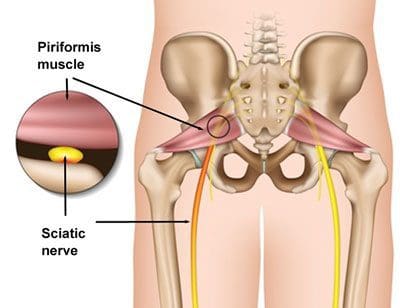
Back pain sometimes isn�t back pain, but piriformis syndrome. The piriformis muscle is a small muscle that extends from the lower spine to the top of the femur. It can involuntarily contract and compress or irritate the sciatic nerve. The muscle helps rotate and turn the leg and foot outward. Symptoms are consistent with sciatica. It typically presents with buttock pain that shoots, aches, or throbs along the leg�s backside, thigh, calf, and foot. Tingling along the nerve along with numbness is common. Causes include:
  • Buttock injury
  • Hip injury
  • Weight training specifically the gluteal/buttock, hips, and hamstrings
  • Sitting for a long time – Examples include truck drivers, desk job workers, etc.
  • Damage to the piriformis muscle
  • Sciatic nerve wraps around the piriformis muscle
piriformis detail
 

Sacroiliac Joint Dysfunction

Sacroiliac joint dysfunction involves inflammation of the joints, located at the connection of the pelvis and lower spine. It can present as low back or buttock pain that radiates down the leg/s. The pain worsens when climbing stairs or standing for an extended amount of time. Sacroiliac joint dysfunction can be tough to diagnose, as it is often mistaken for other low back pain causes.

SI joint dysfunction causes:

  • Pregnancy – the increased weight and altered movement/s can cause additional stress and wear.
  • Joint infection – in rare cases, the joints can be subject to infection.
  • Arthritis – the joints can develop arthritis from normal wear and tear.
  • Traumatic Injury – the joints can be injured from a forceful impact from a fall or auto accident.
Most cases do not end up requiring medication or surgery. It is when the pain lasts more than six weeks that there could be something more taking place like neurologic symptoms or other conditions, spinal or otherwise.

Personalized Chiropractic Spine Treatment


Dr. Alex Jimenez�s Blog Post Disclaimer

The scope of our information is limited to chiropractic, musculoskeletal, physical medicines, wellness, and sensitive health issues and/or functional medicine articles, topics, and discussions. We use functional health & wellness protocols to treat and support care for injuries or disorders of the musculoskeletal system. Our posts, topics, subjects, and insights cover clinical matters, issues, and topics that relate and support directly or indirectly our clinical scope of practice.* Our office has made a reasonable attempt to provide supportive citations and has identified the relevant research study or studies supporting our posts. We also make copies of supporting research studies available to the board and or the public upon request. We understand that we cover matters that require an additional explanation as to how it may assist in a particular care plan or treatment protocol; therefore, to further discuss the subject matter above, please feel free to ask Dr. Alex Jimenez or contact us at 915-850-0900. The provider(s) Licensed in Texas& New Mexico*
Mastodon