Q/Quadriceps Angle Knee Injuries In Women Athletes
The Q or quadriceps angle is a measurement of pelvic width that is believed to contribute to the risk of sports injuries in women athletes. Can non-surgical therapies and exercises help rehabilitate injuries?
Quadriceps Q – Angle Injuries
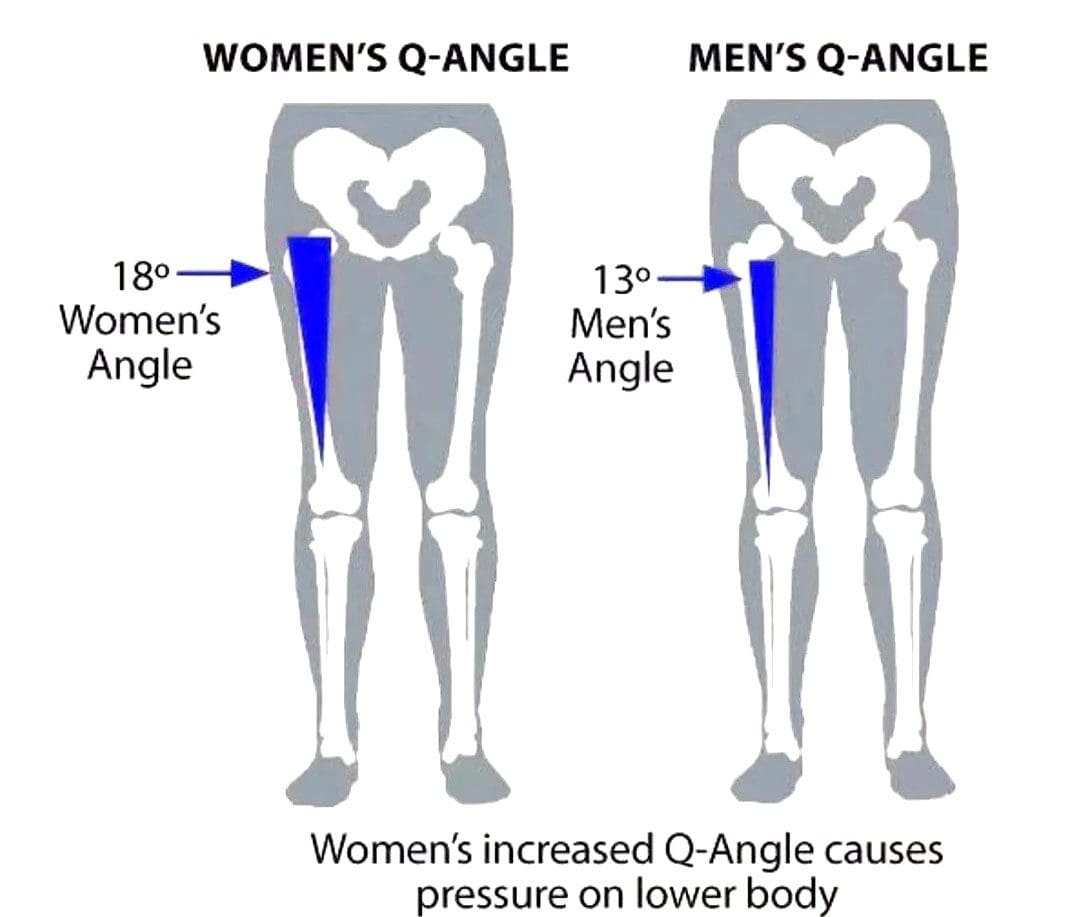
The Q angle is the angle where the femur/upper leg bone meets the tibia/lower leg bone. It is measured by two intersecting lines:
- One from the center of the patella/kneecap to the anterior superior iliac spine of the pelvis.
- The other is from the patella to the tibial tubercle.
- On average the angle is three degrees higher in women than men.
- Average 17 degrees for women and 14 degrees for men. (Ramada R Khasawneh, et al., 2019)
- Sports medicine experts have linked a wider pelvis to a larger Q-angle. (Ramada R Khasawneh, et al., 2019)
Women have biomechanical differences that include a wider pelvis, making it easier to give birth. However, this difference can contribute to knee injuries when playing sports, as an increased Q angle generates more stress on the knee joint, as well as leading to increased foot pronation.
Injuries
Various factors can increase the risk of injury, but a wider Q angle has been linked to the following conditions.
Patellofemoral Pain Syndrome
- An increased Q angle can cause the quadriceps to pull on the kneecap, shifting it out of place and causing dysfunctional patellar tracking.
- With time, this can cause knee pain (under and around the kneecap), and muscle imbalance.
- Foot orthotics and arch supports could be recommended.
- Some researchers have found a link, while others have not found the same association. (Wolf Petersen, et al., 2014)
Chondromalacia of the Knee
- This is the wearing down of the cartilage on the underside of the kneecap.
- This leads to degeneration of the articular surfaces of the knee. (Enrico Vaienti, et al., 2017)
- The common symptom is pain under and around the kneecap.
ACL Injuries
- Women have higher rates of ACL injuries than men. (Yasuhiro Mitani. 2017)
- An increased Q angle can be a factor that increases stress and causes the knee to lose its stability.
- However, this remains controversial, as some studies have found no association between the Q angle and knee injuries.
Chiropractic Treatment
Strengthening Exercises
- ACL injury prevention programs designed for women have resulted in reduced injuries. (Trent Nessler, et al., 2017)
- The vastus medialis obliquus or VMO is a teardrop-shaped muscle that helps move the knee joint and stabilize the kneecap.
- Strengthening the muscle can increase the stability of the knee joint.
- Strengthening may require a specific focus on muscle contraction timing.
- Closed-chain exercises like wall squats are recommended.
- Glute strengthening will improve stability.
Stretching Exercises
- Stretching tight muscles will help relax the injured area, increase circulation, and restore range of motion and function.
- Muscles commonly found to be tight include the quadriceps, hamstrings, iliotibial band, and gastrocnemius.
Foot Orthotics
- Custom-made, flexible orthotics decrease the Q angle and reduce pronation, relieving the added stress on the knee.
- A custom orthotic ensures that the foot and leg dynamics are accounted for and corrected.
- Motion-control shoes can also help correct overpronation.
Knee Rehabilitation
References
Khasawneh, R. R., Allouh, M. Z., & Abu-El-Rub, E. (2019). Measurement of the quadriceps (Q) angle with respect to various body parameters in young Arab population. PloS one, 14(6), e0218387. https://doi.org/10.1371/journal.pone.0218387
Petersen, W., Ellermann, A., Gösele-Koppenburg, A., Best, R., Rembitzki, I. V., Brüggemann, G. P., & Liebau, C. (2014). Patellofemoral pain syndrome. Knee surgery, sports traumatology, arthroscopy: Official journal of the ESSKA, 22(10), 2264–2274. https://doi.org/10.1007/s00167-013-2759-6
Vaienti, E., Scita, G., Ceccarelli, F., & Pogliacomi, F. (2017). Understanding the human knee and its relationship to total knee replacement. Acta bio-medica : Atenei Parmensis, 88(2S), 6–16. https://doi.org/10.23750/abm.v88i2-S.6507
Mitani Y. (2017). Gender-related differences in lower limb alignment, range of joint motion, and the incidence of sports injuries in Japanese university athletes. Journal of Physical Therapy Science, 29(1), 12–15. https://doi.org/10.1589/jpts.29.12
Nessler, T., Denney, L., & Sampley, J. (2017). ACL Injury Prevention: What Does Research Tell Us? Current reviews in musculoskeletal medicine, 10(3), 281–288. https://doi.org/10.1007/s12178-017-9416-5