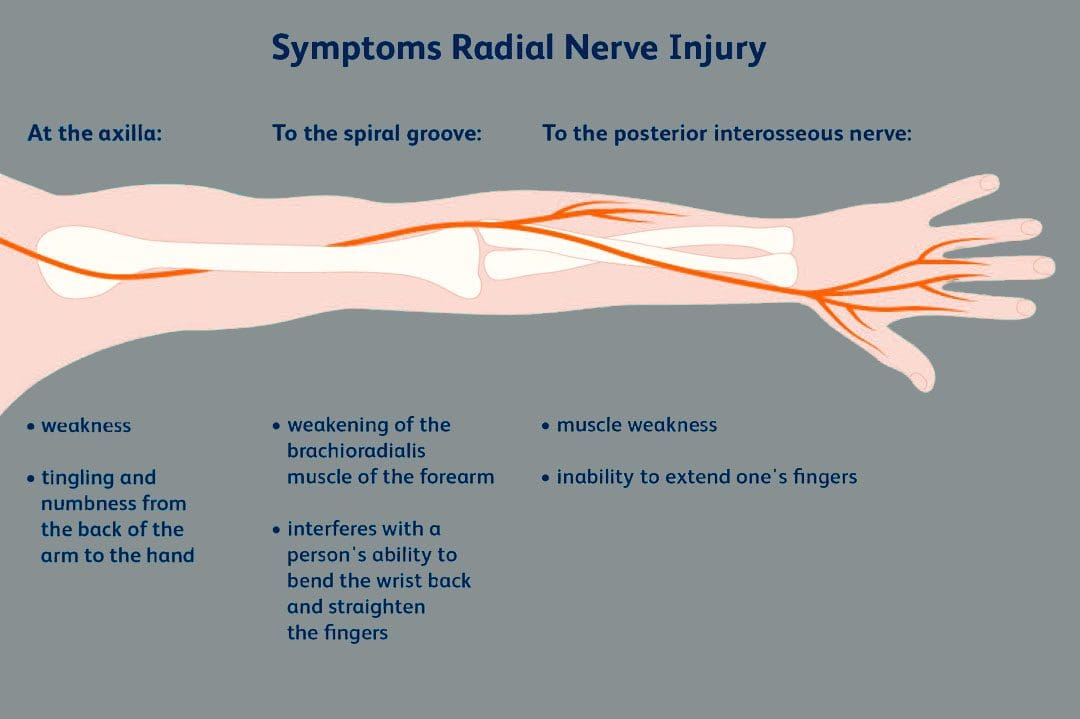
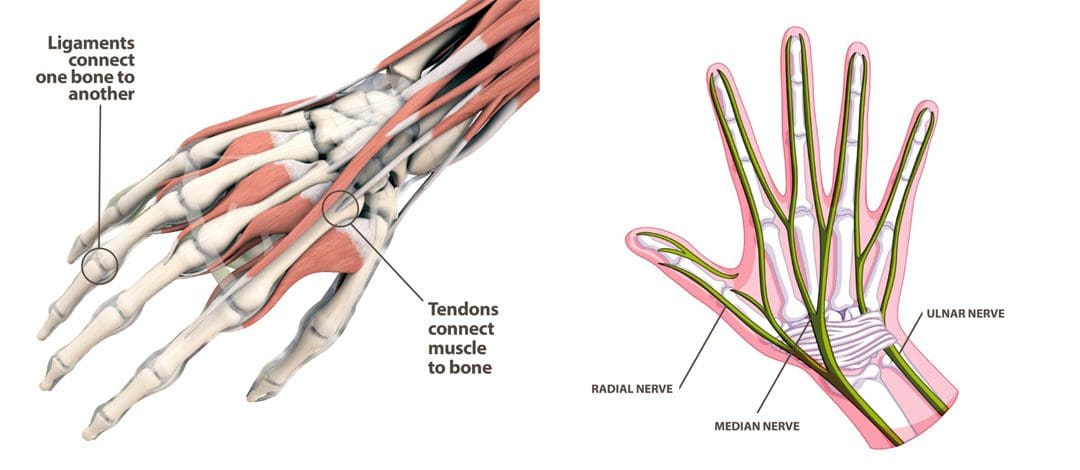
The brachial plexus is a network of nerves that begin in the cervical/neck spinal cord and travel down the cervicoaxillary canal into the armpit. Forming in the area of the shoulder joint at the branch junction of the brachial plexus, the radial nerve extends down the arm, through the elbow joint, into the forearm, across the wrist, and tips of the fingers. The nerves are susceptible to injury that can cause abnormal function leading to unusual sensations and impaired muscle function.
Radial Nerve
One of the major nerves of the upper extremity.
There is one brachial plexus on each side of the body that carries the nerves to each arm.
The radial nerve has two major functions.
One is to provide sensations in the hands, forearms, arms, and fingers.
The other is to deliver messages to muscles about when to contract.
Motor Function
The radial nerve transmits signals to the muscles of the back of the arm and forearm on when to contract.
Individuals who have abnormal radial nerve function can experience weakness of the muscles and symptoms like wrist drop.
A wrist drop occurs when the back forearm muscles cannot support the wrist, causing the individual to hold the wrist in a flexed posture.
Abnormal radial nerve function can cause symptoms of numbness or tingling in the back of the hand.
Conditions
Associated conditions to the radial nerve include lacerations, contusions, fractures, and palsies.
Nerve Contusion
A contusion typically occurs through blunt force trauma that can crush and smash the nerve area.
This causes abnormal or no function.
A nerve contusion can occur from a personal, work, or sports injury or other conditions that generate intense pressure on the nerve/s.
Nerve Lacerations
A laceration occurs when there is a penetrating injury that cuts and/or severs the nerve.
This injury can occur from stab wounds or sliced by broken glass, metal, etc.
Fractures
Broken bones of the upper extremity can lead to extended damage to the nerves near the damaged bone.
The most common type of fracture associated with radial nerve malfunction is fractures to the humerus bone.
The nerve wraps tightly around the humerus and can be injured with a fracture.
Most fracture-related radial nerve injuries heal on their own and do not require surgery.
However, the way the injury heals can be the difference between normal function and chronic pain.
Crutch Palsy
Crutch palsy is pressure on the radial nerve in the armpit resulting from using crutches incorrectly.
To use crutches properly, the individual needs to support their body weight through the hands.
However, many tend to place pressure around the armpit at the top of the crutch, causing irritation to the nerve in that area.
Padding the top of crutches and using the proper form can prevent the condition.
Saturday Night Palsy
Saturday night palsy is the abnormal function of the radial nerve after sleeping in a position that causes direct pressure against the nerve.
This often occurs when an individual falls asleep with their arm draped over an armrest on a chair.
The name comes from when individuals are intoxicated and fall asleep in a location other than the bed and in awkward positions.
Treatment
Nerve injuries often cause symptoms at different locations other than where the nerve damage is, complicating diagnosis. Determining the specific location of nerve damage is the first step in developing an appropriate treatment plan. Once the location has been identified, steps can be taken to prevent worsening damage to the nerve.
The objective is to relieve the pressure from the irritation or compression.
Massage to relax the area and increase blood circulation.
Decompression to physically restore alignment.
Adjustments to restore body balance.
Exercises and stretches to maintain treatment, strengthen the muscles, and prevent injuries.
In cases where there is structural damage, surgery may be necessary to remove pressure or repair damage.
Avoid Surgery
References
Ansari FH, Juergens AL. Saturday Night Palsy. [Updated 2023 Apr 24]. In: StatPearls [Internet]. Treasure Island (FL): StatPearls Publishing; 2023 Jan-. Available from: https://www.ncbi.nlm.nih.gov/books/NBK557520/
Barton, N J. “Radial nerve lesions.” The Hand vol. 5,3 (1973): 200-8. doi:10.1016/0072-968x(73)90029-6
Daly, Michael, and Chris Langhammer. “Radial Nerve Injury in Humeral Shaft Fracture.” The Orthopedic Clinics of North America vol. 53,2 (2022): 145-154. doi:10.1016/j.ocl.2022.01.001
DeCastro A, Keefe P. Wrist Drop. [Updated 2022 Jul 18]. In: StatPearls [Internet]. Treasure Island (FL): StatPearls Publishing; 2023 Jan-. Available from: https://www.ncbi.nlm.nih.gov/books/NBK532993/
Eaton, C J, and G D Lister. “Radial nerve compression.” Hand Clinics vol. 8,2 (1992): 345-57.
Glover NM, Murphy PB. Anatomy, Shoulder and Upper Limb, Radial Nerve. [Updated 2022 Aug 29]. In: StatPearls [Internet]. Treasure Island (FL): StatPearls Publishing; 2023 Jan-. Available from: https://www.ncbi.nlm.nih.gov/books/NBK534840/
Ljungquist, Karin L et al. “Radial nerve injuries.” The Journal of hand surgery vol. 40,1 (2015): 166-72. doi:10.1016/j.jhsa.2014.05.010
In cold weather, it’s normal to experience cold hands and fingers. But if there is a coldness in only one finger while the rest of the hand is normal, changes to skin color, numbness, tingling, or pain symptoms could be a sign of poor circulation or an underlying medical condition. Cold fingers could indicate various problems, including overuse injuries, vitamin deficiencies, Raynaud’s syndrome, hypothyroidism, anemia, arterial disease, or an autoimmune condition. Chiropractic care and massage therapy can increase circulation, release compressed nerves, relax the muscles, and restore mobility and function.
Cold Fingers
Blood circulates throughout, nourishing and maintaining body warmth. When compression, obstructions, or narrowing paths inhibit blood flow, the body cannot achieve proper circulation. Unhealthy circulation can cause several symptoms, including:
Pins and needles sensations along the shoulder, arm, hand, and fingers.
Weakened arm and hand muscles.
Numbness.
Cold finger/s.
Muscles aches, soreness, and tightness.
Swelling.
Pale or bluish skin color.
Overuse Injury
Repeating one movement or motion constantly over time can lead to overuse syndrome/repetitive motion disorder in the hands and arms. Certain jobs and activities can cause overuse syndrome, including:
Cashiers.
Food service work.
Graphic sign work.
Computer work.
Sewing work.
Landscaping.
All of these jobs and activities can put a lot of repeated stress on the hands and arms.
Vitamin B-12 Deficiency
Vitamin B-12 is required for proper red blood cell formation and neurological function. It is found in many foods, including eggs, fish, meat, poultry, and dairy products. A vitamin B-12 deficiency can cause neurological symptoms like numbness, tingling, and coldness in the hands and feet. Other symptoms include:
Anemia
Fatigue
Weakness
Difficulty maintaining balance
Depression
Soreness of the mouth
A doctor requires a blood sample to test for the deficiency. A common treatment is a high dose of an oral supplement or injections for individuals that have difficulties absorbing B-12 through the digestive tract.
Raynaud’s Syndrome
Raynaud’s syndrome is a condition that causes some areas of the body, usually the fingers, to feel cold and numb when exposed to cold temperatures or high-stress levels. This happens because the small arteries that supply blood to the skin are experiencing spasms. During an episode, the arteries narrow, which prevents blood from circulating correctly. The fingers can change color, going from white to blue to red. When the flare-up ends, and the blood flow returns to normal, there may be tingling, throbbing, or swelling. The condition isn’t usually debilitating, and treatment options often include medications that expand the blood vessels to improve circulation. These include calcium channel blockers,alpha-blockers, and vasodilators.
Hypothyroidism
Hypothyroidism is when the thyroid doesn’t produce enough hormones. Hypothyroidism comes on gradually and rarely generates symptoms in the early stages. Hypothyroidism doesn’t cause cold fingers but increases the body’s sensitivity to cold. Other symptoms include:
Fatigue
Muscle weakness, tenderness, and achiness.
Joint swelling, stiffness, and pain.
Puffiness.
Dry skin.
Hoarseness.
Weight gain.
High or elevated cholesterol levels.
Thinning hair and hair loss.
Depression.
Over time, the condition can cause complications such as obesity, joint pain, heart disease, and infertility. A doctor can detect hypothyroidism with a simple blood test. Treatment involves taking a daily dose of synthetic thyroid hormone.
Anemia
Anemia is when the blood has a lower-than-normal amount of red blood cells. It also occurs when the red blood cells lack a crucial iron-rich protein called hemoglobin. Hemoglobin assists red blood cells in delivering oxygen from the lungs to the rest of the body. A low supply of hemoglobin to carry oxygen to the hands can result in cold fingers. There may also be fatigue and weakness. Iron deficiency is what typically causes most cases. A doctor may suggest nutritional adjustments if blood work indicates low iron levels. An iron-rich nutritional plan and taking iron supplements can help relieve symptoms.
Arterial Diseases
Diseases that affect the arteries can reduce blood flow to the hands, causing cold fingers. This can be from plaque buildup or inflammation in the blood vessels. Any blockage in the blood vessels can prevent blood from circulating normally. Another arterial problem is primary pulmonary hypertension, which affects the lungs’ arteries and can lead to Raynaud’s syndrome.
Chiropractic Care
Chiropractic adjustments can remove misalignments, restore proper nerve communication, increase blood flow, and correct an overactive sympathetic nervous system. Massaging the shoulders, arms, and hands relaxes the nerves, and muscles, breaks up compressed tissues, and increase blood flow. The circulation of lymphatic fluid around the body is also promoted, which carries toxins away from the muscles and tissues. To improve circulation, the following may be utilized:
Deep tissue pressure is effective at relieving congestion and tension.
Percussive massage to break up scar tissue.
Non-surgical Decompression to stretch the spine and body out.
Lymphatic drainage is designed to improve the circulation of the fluid.
Bilić, R et al. “Sindromi prenaprezanja u saci, podlaktici i laktu” [Overuse injury syndromes of the hand, forearm and elbow]. Arhiv za higijenu rada i toksikologiju vol. 52,4 (2001): 403-14.
Ernst, E. “Manual therapies for pain control: chiropractic and massage.” The Clinical journal of pain vol. 20,1 (2004): 8-12. doi:10.1097/00002508-200401000-00003
InformedHealth.org [Internet]. Cologne, Germany: Institute for Quality and Efficiency in Health Care (IQWiG); 2006-. How does the blood circulatory system work? 2010 Mar 12 [Updated 2019 Jan 31]. Available from: https://www.ncbi.nlm.nih.gov/books/NBK279250/
Pal, B et al. “Raynaud’s phenomenon in idiopathic carpal tunnel syndrome.” Scandinavian journal of rheumatology vol. 25,3 (1996): 143-5. doi:10.3109/03009749609080004
Waller, D G, and J R Dathan. “Raynaud’s syndrome and carpal tunnel syndrome.” Postgraduate medical journal vol. 61,712 (1985): 161-2. doi:10.1136/pgmj.61.712.161
IFM's Find A Practitioner tool is the largest referral network in Functional Medicine, created to help patients locate Functional Medicine practitioners anywhere in the world. IFM Certified Practitioners are listed first in the search results, given their extensive education in Functional Medicine