Dr. Alex Jimenez has a great therapy for cervical sprains. He is great with his hands; he has been able to relieve a lot of headaches and a lot of cervical sprains with the special techniques that he has.
Sandra Rubio
Vertigo is the sensation of spinning or a rocking whenever you’re still. It tends to last for hours even days. Medically, it is distinct from dizziness since it involves the feeling of motion. Vertigo is a health issue affecting the internal ear, particularly in the semicircular canals. These structures line with cells within the inner ear that are responsible for providing feedback on our position, and they act like a gyroscope for your own body.
Causes for Vertigo
Various causes can cause vertigo. The reason may be central or peripheral. While peripheral problems�are due to a health issue in the inner ear, central problems can�occur in the brain or spinal cord. Small crystals within the ear, known as otoconia, can also become loose and lead to irritation in a health issue called benign paroxysmal positional vertigo or BPPV. A�buildup in the inner ear can also lead to vertigo. Headaches, head injuries, strokes, tumors, and multiple sclerosis may also cause vertigo.
Head injuries can increase the risk factor for developing vertigo. Additionally, drugs and/or medications like aspirin, blood pressure prescriptions, and even antidepressants have been found to cause vertigo. For some people, vertigo�is caused by alcohol consumption.
Diagnosis and Treatment for Vertigo
To diagnose vertigo, a health professional will need a full record of your signs and symptoms, including recent illnesses, previous medical problems, and�use of drugs and/or medications. Afterward, a physical exam is performed. For vertigo, these often feature a neurological examination to examine brain function and determine if it is peripheral or central.
The health issue may pinpoint signs or symptoms of abnormal eye movement. The Dix-Hallpike test or the roll test may be done to determine this diagnosis. The evaluation repositions the head and tracks symptoms. The head is quickly transferred from side to side. An MRI or a CT scan can also help exclude structural issues. Electronystagmography may additionally be carried out to diagnose the health issue. A vertigo diagnosis is essential before following up with the best treatment.
The most effective treatments in the event of peripheral vertigo include partial repositioning movements. It’s called the canalith repositioning procedure or the Epley maneuver. Particular head movements are performed to move the crystals back into place. Cawthorne head exercises may also be performed to achieve this in a series of eye and head movements. These improve vertigo and contribute to the decreased sensitivity of the nerves. However, this needs to be done on a regular basis for optimum results. A qualified and experienced healthcare professional, such as a chiropractor, can perform these types of treatments.
Furthermore,�chiropractic care can help correct any spinal misalignments, or subluxations, which may be contributing to vertigo. Chiropractic care is a safe and effective alternative treatment option which focuses on the treatment of a variety of injuries and conditions associated with the musculoskeletal and nervous system. A chiropractor may also offer lifestyle modifications to help speed up the recovery process. Although some drugs and/or medications, such as�Meclizine, can be used to manage vertigo, keep in mind that these may only provide temporary relief.
Vertigo may occur due to health issues in the inner ear as well as due to disturbances in the pathways of the nervous system. Regardless of the cause, the persistent sensation of dizziness, followed by other symptoms, can ultimately impact an individual’s quality of life. Many healthcare professionals like chiropractors can help treat symptoms of vertigo.
Dr. Alex Jimenez D.C., C.C.S.T.
Prognosis for Vertigo
Most patients with peripheral vertigo can find substantial relief with treatment. It’s been suggested that the Epley maneuver in cases of BPPV cures as many as 90 percent of affected patients. It is unlikely that vertigo will persist past a few days, although there is a 15 percent recurrence of BPPV in the first year after an episode. Tests for any structural�problems of the brain, spinal cord, or ear may be necessary if vertigo continues.
If you are feeling dizzy with an awareness of motion, you might have vertigo. Ensure that your world stops spinning with the help of a certified and experienced chiropractor. Many trained in the Epley maneuver and the Cawthorne head exercises for vertigo. A chiropractor can even offer you instruction on how to do these exercises. Contact a healthcare professional to complete an analysis of your symptoms and follow up with treatment.� The scope of our information is limited to chiropractic as well as to spinal injuries and conditions. To discuss the subject matter, please feel free to ask Dr. Jimenez or contact us at�915-850-0900�.
Curated by Dr. Alex Jimenez
Additional Topics: Acute Back Pain
Back pain�is one of the most prevalent causes of disability and missed days at work worldwide. Back pain attributes to the second most common reason for doctor office visits, outnumbered only by upper-respiratory infections. Approximately 80 percent of the population will experience back pain at least once throughout their life. The spine is a complex structure made up of bones, joints, ligaments, and muscles, among other soft tissues. Because of this, injuries and/or aggravated conditions, such as�herniated discs, can eventually lead to symptoms of back pain. Sports injuries or automobile accident injuries are often the most frequent cause of back pain, however, sometimes the simplest of movements can have painful results. Fortunately, alternative treatment options, such as chiropractic care, can help ease back pain through the use of spinal adjustments and manual manipulations, ultimately improving pain relief.
You have been diagnosed with Benign Paroxysmal Positional Vertigo. This brochure is designed to help increase your understanding of this disorder and its potential treatments.
Benign Paroxysmal Positional Vertigo
What Is BPPV?
Benign paroxysmal positional vertigo (BPPV) is a disorder of the inner ear. People with BPPV typically experi�ence brief episodes of vertigo (dizziness) when they change the position of their head with respect to gravity. Approximately 20 percent of all vertigo is due to BPPV.
What Causes BPPV?
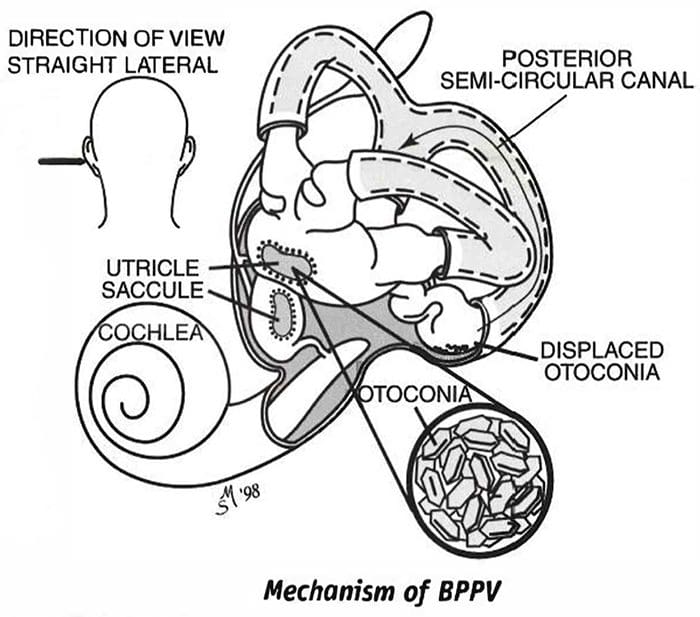
Benign Paroxysmal Positional Vertigo is thought to be due to tiny crystals, called otoconia, that have collected within a sensitive part of the inner ear. Otoconia are crystals of calcium carbonate that are normally located in a structure of the ear called the utricle.
Dizziness occurs when the crystals are displaced from the utricle into the semicircular canals of the inner ear.
Otoconia may become displaced when the utricle is injured, if there is an infection or other disorder of the inner ear, or simply due to advanced age. When you change the position of your head, the otoconia move within the semicircular canals and this causes the dizziness. The dizziness subsides when the otoconia stop moving.
The most common cause of BPPV in people under age 50 is head injury. In older people, the most common cause is degeneration of the vestibular system of the inner ear. BPPV becomes much more common with advancing age. Other causes include minor strokes, Meniere’s disease, and viruses such as those causing vestibular neuritis. In approximately half of all BPPV cases, no cause can be determined.
What Are The Symptoms?
The symptoms of BPPV include dizziness or vertigo, lightheadedness, imbalance, and nausea. Activities that
bring on symptoms vary among individuals, but symptoms are usually associated with a change in the position of the head with respect to gravity. Getting out of bed, rolling over in bed, and tipping the head back to look up are common “problem” motions. The use of shampoo bowls in hair salons may bring on symptoms. An intermittent pattern is common. BPPV may be present for a few weeks, then stop, and then come back again.
How Is Benign Paroxysmal Positional Vertigo (BPPV) Diagnosed?
BPPV is diagnosed with the Dix-Hallpike test. This test involves observing the eyes with the head and body positioned in specific ways. It can be performed either by the clinician, or as part of a laboratory test called an electronystagmography, or ENG. If the Dix-Hallpike test is abnormal and the findings are “dassic” for BPPV, then additional testing is not necessary. If the results are normal or not “classic” then the diagnosis of BPPV is less certain and other tests may be suggested.
What Are The Treatments For BPPV?
There are four approaches to treating BPPV.
1. Do Nothing And Wait For It To Go Away By Itself
BPPV symptoms sometimes go away within six months of onset, therefore you might want to wait and see if your symptoms subside on their own. During this waiting period, medications to prevent motion sickness or nausea are sometimes helpful in controlling the nausea associated with BPPV.
2. Physical Maneuvers Performed In The Clinic
(The Epley and Semont Maneuvers)
The Epley and Semont maneuvers, named for their inventors, are treat�ments that are performed in the clinic. These treatments are specifi�cally intended to move the otoconia from the semicircular canals to a less sensitive location within the inner ear. Your clinician will select the treatment that is most appropriate for you.
Each of these treatments takes about 15 minutes and alleviates symptoms in about 80 percent of patients. In the remaining 20 percent, a second treatment may be necessary, or you may be instructed to perform the Brandt-Daroff exercises (see “Home Treatment”).
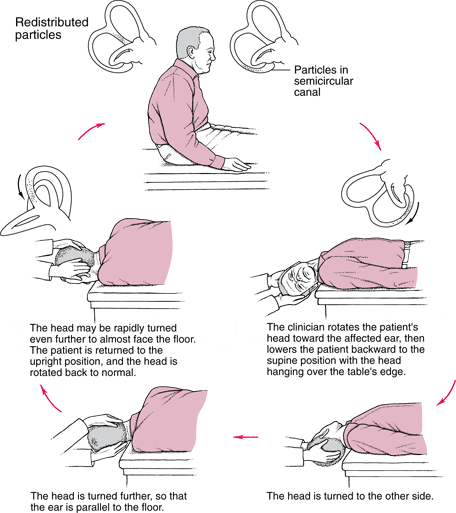
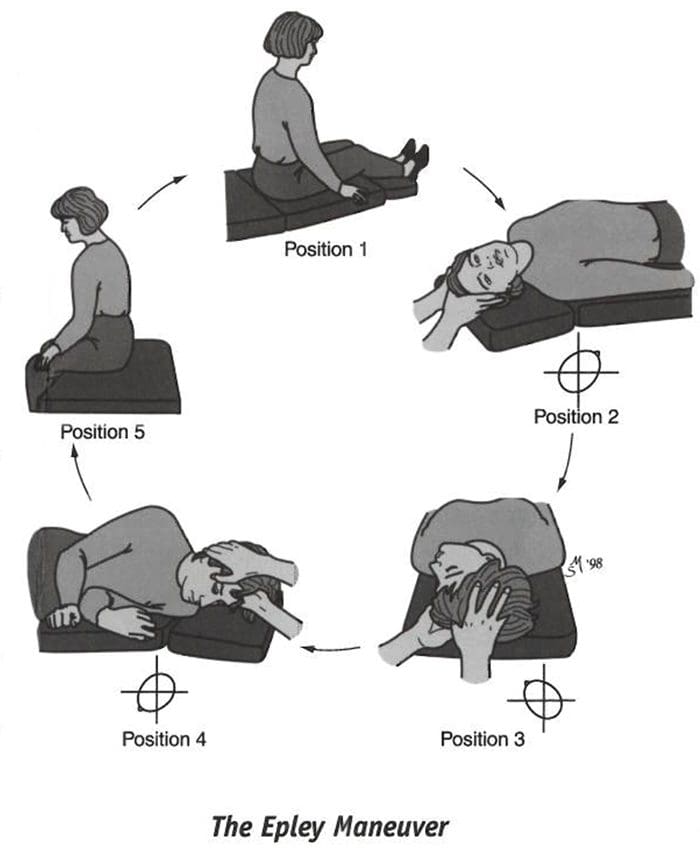
The Epley maneuver, also called the canalith reposi�tioning procedure (CRP) and particle repositioning, is a procedure in which the clinician moves your head into five positions, maintaining each position for ap�proximately 30 seconds. The Semont maneuver (also called the liberatory maneuver) is a procedure in which the clinician rapidly moves you from lying on one side to lying on the other side. These maneuvers may not be appropriate for patients with neck or back problems. Pa�tients who experience nausea or anxiety may wish to take medication prior to the treatment.
INSTRUCTIONS FOR PATIENTS AFTER CLINIC TREATMENTS
Follow these instructions after the Epley or Semont maneuver. B.Y doing so you will minimize the opportunity for otoconia to return to the semicircular canals of the inner ear and reduce the potential that your dizziness will recur.
Wait at least 10 minutes after the maneuver before going home.
This is to avoid “quick spins” or brief bursts of vertigo as the otoconia reposition themselves immedi�ately after the maneuver. If possible, arrange to have someone drive you home.
The following two days:
Sleep semi-recumbent for the next two nights. This means sleeping with your head halfway between flat and upright, at a 45-degree angle. This is most easily done by sleeping in a recliner chair or by sleeping with pillows appropriately arranged on a couch.
During the day, try to keep your head vertical. A soft neck brace may be helpful.
Do not go to the barber, hairdresser or dentist.
When shaving, keep your head vertical by bending forward at your hips with your neck extended.
If you need to administer eye drops, try to keep your head as vertical as possible.
Sham�poo only under the shower.
During the following week, avoid provoking head positions that might bring on BPPV.
Use two pillows when you sleep.
Avoid sleeping on the affected side.
Don’t turn your head far up or far down.
Avoid tilting your head back especially when lying on your back with your head turned toward the affected side.
If possible, postpone elective surgery and going to the beauty parlor or the dentist’s office.
Avoid far head-forward positions and exercises where the head is not kept upright, for example toe touches.
The effectiveness of the clinic treatment cannot be determined for one week.
Wait one week after treatment to test the effectiveness of treatment. Place yourself in the position that usually makes you dizzy. Be sure to position yourself cautiously and under conditions in which you can’t fall or hurt yourself.
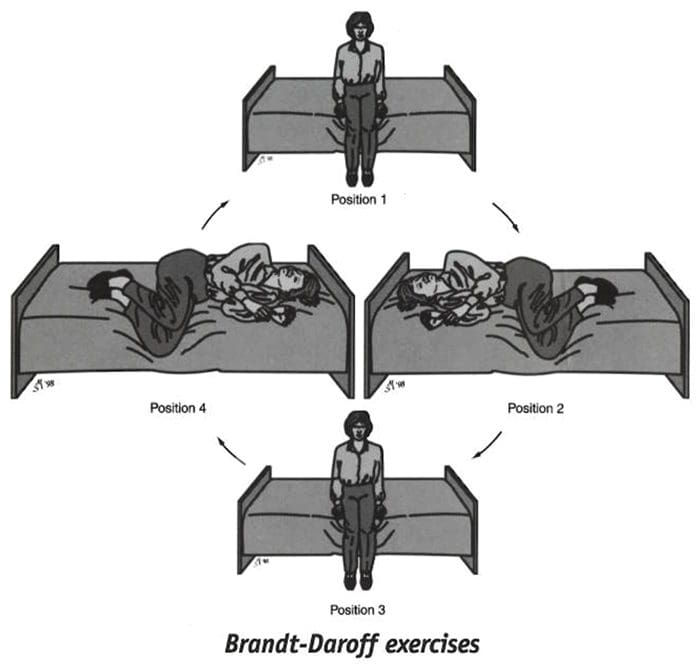
3. Home Treatment Of Benign Paroxysmal Positional Vertigo (Brandt-Daroff Exercises)
When the clinic treatment (Epley or Semont) fails, when the involved side is not determined, or when a case is mild, the Brandt-Daroff exercises may be recommended. These exercises succeed in 95 percent of cases but take longer to work than the clinic treatments. You should perform these exercises only if instructed to do so by your clinician. If your clini�cian performed the Epley or Semont maneuver, you must wait one week after that treatment before you begin the Brandt-Daroff exercises.
These exercises should be performed on a flat surface, without a pillow.
Start sitting upright on the edge of the bed or on the floor.
(Position 1)�Turn your head 45 degrees to the left and lie down on your right side.
(Position 2)�When in the right side-lying position, your head should be at a 45-degree angle turned halfway between the flat surface and the ceiling. Stay in the side-lying position for at least 30 seconds. If you are still dizzy, stay until the dizziness subsides or one minute, whichever is less.
Then sit up (Position 3} and stay in the sitting posi�tion for 30 seconds. Turn your head 45 degrees to the right and lie down on your left side.
(Position 4)�Again keeping your head turned halfway toward the ceiling for 30 seconds or until the dizziness subsides. Return to Position 1 (sit upright) for 30 seconds. This is one repetition.
One set (five repetitions) takes about 10 minutes to complete and should be performed each morning, mid-day and evening.
The Brandt-Daroff exercises should be performed for two weeks, three sets each day, or for three weeks, two sets each day (52 sets total). In most individuals, complete relief from symptoms is obtained after 30 sets, or about 10 days. In approximately 30 percent of patients, BPPV will recur within one year. If BPPV recurs you may wish to add one 10-minute exercise (one set) to your daily routine.
If the maneuvers or exercises do not control symptoms that have persisted for a year or longer and the diagnosis is very clear, surgery may be recommended. The most common surgical procedure, called posterior canal plugging, blocks most of the posterior canal’s function without affecting the functions of the other canals or parts of the ear. There is, however, a small risk of hearing loss. This surgery is effective in about 90 percent of individuals who have not responded to other treatments and when symptoms are severe and long-standing.
�?2000 Northwestern University. Authors: Timothy C. Hain, MD, Janet Odiry Helminski, PhD, PT.
This information is for educational purposes and is not intended as a substitute for examination, diagnosis, or medical care provided by a licensed and qualified health professional. This work was supported by the Center for Sensory and Communicotion Disorders at Northwestern University, a national research and training center funded by the National Institute on Deafness and Other Communication Disorders.
Benign paroxysmal positional vertigo, or BPPV, is a mechanical issue in the inner ear. It occurs when some of the calcium carbonate crystals (otoconia) that are normally embedded in gel at the utricle become dislodged and migrate to at least one of those 3 fluid-filled semicircular canals, where they are not supposed to be. When enough of these particles accumulate in one of the canals they interfere with the normal fluid motion that these canals utilize to sense head motion, causing the inner ear to send false signals to the mind.
Fluid in the semi-circular canals doesn’t normally react to gravity. However, the crystals do proceed with gravity, thereby shifting the fluid when it normally would be still. When the fluid moves, nerve endings in the canal are eager and send a message to the brain the mind is moving, even though it is not. This false information doesn’t match what another ear is sensing, together with what the eyes are seeing, or with what the joints and muscles are doing, and also this mismatched information is perceived by the brain as a turning sensation, or vertigo, which generally lasts less than one minute. Between vertigo spells some people today feel symptom-free, while some feel a mild sense of imbalance or disequilibrium.
A healthcare professional will execute a collection of tests and evaluations in order to properly diagnose the individual’s BPPV. Regular medical imaging (e.g. an MRI) is not helpful in diagnosing BPPV, because it doesn’t show the crystals which have moved to the semi-circular canals. But when someone with BPPV has their own head moved into a position that produces the dislodged crystals move within a tube, the error signals cause the eyes to move in a very specific pattern, called”nystagmus”.
The nystagmus will possess distinct characteristics that let a trained practitioner to identify which ear the crystals that are displaced are in, and then canal(s) they have moved into. Tests such as the Dix-Hallpike or Roll Tests involve moving the head into specific orientations, allowing gravity to move the dislodged crystals and activate the vertigo while the professional watches for the tell-tale eye movements, or nystagmus.�To execute the Dix-Hallpike test, a healthcare professional will ask the patient to sit on the test table with their legs stretched out. They will then turn the head 45 degrees to one side, which contrasts the right posterior semicircular canal with the sagittal plane of the body, then they are going to allow the patient to lie back quickly, while the eyes are open, so that their head hangs slightly over the edge of the desk.
When the health care provider has finished the diagnosis, then they can perform the appropriate treatment maneuver. The maneuvers make use of gravity to guide the crystals back to the room where they are supposed to be via a very specific series of head movements, commonly referred to as Repositioning Maneuvers. Repositioning maneuvers are highly effective in treating BPPV, inexpensive, and easy to apply.
Dr. Alex Jimenez’s Insights
While the use of surgical interventions as well as that of drugs and/or medications are occasionally recommended to relieve the symptoms associated with benign paroxysmal positional vertigo, or BPPV, they do not treat the underlying health issue. Repositioning maneuvers, like the ones demonstrated below, are considered to be safe yet effective treatment options for BPPV. There is good evidence to support the treatment of BPPV with the Epley maneuver. Although less amounts of research studies have been conducted on other repositioning maneuvers, outcome measures of a variety of patients with BPPV have benefitted from the other treatment options for benign paroxysmal positional vertigo.
Considering that the therapeutic efficacy among maneuvers for every canal is comparable, the option of treatment is generally predicated on clinician preference, complexity of their maneuvers themselves, therapy response to certain maneuvers, as well as musculoskeletal considerations, such as arthritic changes and range of motion of the cervical spine. Below, many repositioning maneuvers are demonstrated, for instance, deep mind hanging maneuver, the Lempert (BBQ) maneuver and the Epley maneuver.
The deep head hanging maneuver is a repositioning maneuver which is used for one of the least common places where BPPV occurs, the superior semi-circular canal, amounting to only about 2 percent of most benign paroxysmal positional vertigo instances. However, the advantage of deep head hanging maneuvers is that they may be effectively performed without knowledge of the side involved. It consists of three steps with four position changes at intervals of approximately 30 seconds.
The deep head hanging maneuver is performed with the patient at the long-sitting position, while the head is brought to a minimum of 30� below the horizontal with the head straight up. When the nystagmus induced by this measure is finished, the head is brought up rapidly to touch the chest while the patient remains supine, and after 30 seconds, the individual has been brought back to a seated position with head flexion maintained. Finally, the patient will be brought back to a neutral head position.
The Lempert maneuver, also referred to as the Barbeque maneuver or the Roll maneuver, is a repositioning maneuver commonly utilized to help treat canilithiasis of the horizontal and lateral canal. It might occur as a complication of posterior canal BPPV treatment repositioning maneuvers. The side with the most notable horizontal nystagmus is assumed to be the affected side.
To perform the Lempert maneuver, the patient should lie supine on the exam table, using the affected ear facing down. Afterward, the healthcare professional will quickly turn the head 90� towards the unaffected side, facing up, waiting 15-20 minutes between each head turn. The medical professional will subsequently turn the head 90� so the affected ear is currently facing up. The next step includes having the individual tuck their arms to their torso, in order to allow the doctor to roll the patient to a more moderate position with their head down. The individual must be turned on their side since the physician rolls their head 90� (returning them to their original position, with the affected ear facing down ). At length, the medical professional should place the patient so that they are face up and bring them into a sitting posture.
Treatment with the Lempert maneuver is efficient approximately 75% of the moment, however, the effectiveness can vary from individual to individual. It is important to keep in mind that longer periods of time between head turns may provoke nausea. This sort of repositioning maneuver shouldn’t be done on patients in which it isn’t safe to move their mind, including in the case of cervical spine injuries.
Epley Maneuver for BPPV
The most common repositioning maneuver for the treatment of benign paroxysmal positional vertigo, or BPPV, is known as the Epley maneuver. The Epley maneuver, occasionally referred to as the canalith repositioning maneuver, is a process which involves a series of head movements, normally performed by a healthcare professional who’s experienced and qualified in the treatment of vestibular disorders, so as to relieve the symptoms associated with BPPV, including dizziness.
The Epley maneuver is performed by placing the patient’s mind at an angle in where gravity can help alleviate the symptoms. Tilting the mind can move the crystals out of the semicircular canals of the inner ear. This means that they will quit displacing the fluid, relieving the dizziness and nausea they may have been causing. In this manner, the Epley maneuver alleviates the symptoms of BPPV. But, it may have to be repeated more than once, as occasionally, some head movements can once again displace the small crystals of the internal ear, once they had been repositions after the first treatment.
Research studies have shown that the Epley maneuver is a safe and effective treatment for the specific vertigo disorder, offering both long-term and immediate relief. The Epley maneuver, named after Dr. John Epley, has been named the canalith repositioning maneuver because it helps to reposition the small crystals at a person’s inner ear, which might be causing the sensation of dizziness.
Repositioning these tiny crystals called otoconia helps to ease BPPV symptoms.�There are two types of BPPV: one where the loose crystals can move freely in the fluid of the canal (canalithiasis), and, more rarely, one where the crystals are thought to be �hung up� on the bundle of nerves that sense the fluid movement (cupulolithiasis).�It is important to make this distinction, as each repositioning maneuver may affect each variant differently. The scope of our information is limited to chiropractic as well as to spinal injuries and conditions. To discuss the subject matter, please feel free to ask Dr. Jimenez or contact us at 915-850-0900 .
Curated by Dr. Alex Jimenez
Additional Topics: Sciatica
Sciatica is medically referred to as a collection of symptoms, rather than a single injury and/or condition. Symptoms of sciatic nerve pain, or sciatica, can vary in frequency and intensity, however, it is most commonly described as a sudden, sharp (knife-like) or electrical pain that radiates from the low back down the buttocks, hips, thighs and legs into the foot. Other symptoms of sciatica may include, tingling or burning sensations, numbness and weakness along the length of the sciatic nerve. Sciatica most frequently affects individuals between the ages of 30 and 50 years. It may often develop as a result of the degeneration of the spine due to age, however, the compression and irritation of the sciatic nerve caused by a bulging or herniated disc, among other spinal health issues, may also cause sciatic nerve pain.
Benign paroxysmal positional vertigo is a common type of vertigo, a sensation of spinning or whirling and loss of balance, which has been reported to account for as many as 17 percent of all cases of dizziness. Benign paroxysmal positional vertigo, or BPPV, is believed to be caused by a health issue in the inner ear. While it is typically associated with aging, head injuries have also been found to cause BPPV.
BPPV occurs when several of the small crystals found in the inner ear, known as otoconia, become loose and wind up in one or more of the three fluid-filled semicircular canals of the ear. Whenever these crystals move around the inner ear, they can cause the fluid in the semicircular canals to become displaced. This ultimately results in a spinning or whirling sensation, otherwise referred to as vertigo. The symptoms of BPPV can often come on suddenly when an individual with benign paroxysmal positional vertigo moves their head in a certain position. By way of instance, symptoms may trigger when turning over in bed during night time. Symptoms of BPPV can last anywhere from several seconds to several minutes, and may include:
Dizziness;
A feeling that surroundings are spinning or moving (vertigo);
A loss of equilibrium or balance;
Nausea; and
Vomiting.
BPPV Treatment
Although many healthcare professionals often prescribe drugs and/or medications for BPPV, there is not enough evidence to support their use as treatment for this condition. In other, very rare cases, surgical interventions are considered. However, in the majority of instances, BPPV can safely and effectively be adjusted mechanically.
Once a healthcare professional specializing in vestibular disorders, such as a vestibular rehabilitation therapist, a chiropractor, a specially trained physical therapist, an occupational therapist or audiologist, or an ENT (ear, nose & throat specialist who specializes on vestibular disorders), has properly diagnosed the individual’s type of benign paroxysmal positional vertigo by performing tests like the Dix-Hallpike Test, then they’ll have the ability to understand which of the semicircular canal(s) the crystals are in, and whether it is canalithiasis, where the loose crystals can move freely in the fluid of the tube, or cupulolithiasis, where the crystals are believed to be ‘hung up’ on the bundle of nerves that feel the fluid motion, then they can recommend you the appropriate therapy maneuver.
Other Auditory & Vestibular Function Tests
The Dix-Hallpike Test is commonly used to diagnose BPPV, however, if the diagnosis is negative, healthcare professionals may utilize a variety of other auditory and vestibular function tests in order to properly diagnose the patient’s source of their symptoms.
The most common treatment for benign paroxysmal positional vertigo, or BPPV, is called the Epley maneuver. The Epley maneuver, sometimes referred to as canalith repositioning, is a procedure which involves a succession of head movements, normally performed by a healthcare professional who is qualified and experienced in the treatment of vestibular disorders, in order to relieve the symptoms associated with BPPV.
Research studies have demonstrated that the Epley maneuver is a safe and effective treatment for the condition, offering both immediate and long-term relief. The Epley maneuver, named after Dr. John Epley, has been named the canalith repositioning maneuver because it�helps reposition the small crystals in a individual’s ear, which may be causing the sensation of dizziness. Repositioning these small crystals, also known as otoconia, ultimately helps to relieve BPPV symptoms.
The Epley maneuver is performed by placing the patient’s head at an angle from where gravity can help alleviate the symptoms. Tilting the head can move the crystals from the semicircular canals of the inner ear. This means that they will stop displacing the fluid, relieving the dizziness and nausea they may have been causing. In this way, the Epley maneuver alleviates the symptoms of BPPV. But, it may need to be repeated more than once, as occasionally, some head movements can once again displace the small crystals of the inner ear, once they had already been repositions after the initial treatment.
When a healthcare professional carries out the Epley maneuver, they’ll perform the following measures:
Ask the patient to sit upright in an examination table, completely extending their legs out in front of them.
Rotate the patient’s head in a 45-degree angle to the side they’re experiencing the worst vertigo.
Instantly push the patient back, so they are lying with their shoulders touching the table. The patient’s head is retained facing the side most negatively affected by vertigo but at a 30-degree angle, so that it is lifted slightly off the table. The healthcare professional holds the patient in this position for between 30 seconds and two minutes, until their symptoms stop.
Rotate the patient’s head 90 degrees from the opposite direction, stopping when the other ear is 30 degrees away from the table. Again, the doctor holds the patient in this position for between 30 minutes and two minutes, until their symptoms cease.
Next, the healthcare professional will roll the patient in precisely the same direction that they are facing, onto their side. The moment they encounter the worst vertigo on will be facing upward. The physician holds the patient in this position for between 30 minutes and 2 minutes, until their symptoms stop.
Eventually, the healthcare professional will bring the patient back up into a sitting position.
The whole process is repeated up to three times, until the patients’s symptoms have been completely relieved.
A healthcare professional specializing in vestibular disorders, such as a chiropractor or physical therapist, will utilize the Epley maneuver to help alleviate an individual’s dizziness and nausea, among other symptoms, when they have decided that BPPV is the cause. As mentioned before, the Epley maneuver isn’t suitable to treat vertigo brought on by another health issue aside from BPPV. If the individual is unsure of what is causing their vertigo, they ought to talk to a doctor and ask to be properly diagnosed. Other causes of vertigo may include:
Migraine headaches
Ear infections
Anemia
Cerebellar stroke
After performing the Epley maneuver, a doctor will advise the patient who has BPPV to prevent specific movements that may dislodge the crystals. These movements include:
Bending quickly
Lying down fast
Leaning the head
Moving the head back and forth
Many research studies have been done on the safety and effectiveness of therapy maneuvers for BPPV, such as the Epley maneuver, together with results and outcome measures demonstrating that the rates of recovery are well into the 90 percent range by 1 to 3 treatments. The more infrequent cupulolithiasis, or ‘hung-up’ version of BPPV, can be a little more stubborn to resolve, as this type of BPPV is generally the consequence of trauma or injury.
Dr. Alex Jimenez’s Insight
If you’ve ever experienced a sudden spinning or whirling sensation, dizziness and nausea when you make certain head movements, especially while rolling over in bed at night or when getting out of bed in the morning, you may be suffering from a common condition called benign paroxysmal positional vertigo, or BPPV. This type of vertigo can be frustrating to deal with and it can tremendously affect an individual’s quality of life. A healthcare professional who specializes in vestibular disorders, including chiropractors and physical therapists, frequently diagnose BPPV using the Dix-Hallpike Test before following up treatment for benign paroxysmal positional vertigo using the Epley maneuver.
Benign Paroxysmal Positional Vertigo, or BPPV, is a frequent health issue, and will be encountered more and more as our population ages. The effect can vary from a mild annoyance to a highly debilitating condition, and can affect function and safety as well as increase the risk of falls. Fortunately, symptoms tend to decrease in intensity over time as the brain gradually adjusts to the strange signals it is receiving, or as the condition resolves on its own. However, with a healthcare professional who’s suitably qualified and experienced in the diagnosis and treatment of BPPV, most patients will find overall relief of their problem once it readily corrected and their world stops spinning or whirling. The scope of our information is limited to chiropractic as well as to spinal injuries and conditions. To discuss the subject matter, please feel free to ask Dr. Jimenez or contact us at 915-850-0900 .
Curated by Dr. Alex Jimenez
Additional Topics: Sciatica
Sciatica is medically referred to as a collection of symptoms, rather than a single injury and/or condition. Symptoms of sciatic nerve pain, or sciatica, can vary in frequency and intensity, however, it is most commonly described as a sudden, sharp (knife-like) or electrical pain that radiates from the low back down the buttocks, hips, thighs and legs into the foot. Other symptoms of sciatica may include, tingling or burning sensations, numbness and weakness along the length of the sciatic nerve. Sciatica most frequently affects individuals between the ages of 30 and 50 years. It may often develop as a result of the degeneration of the spine due to age, however, the compression and irritation of the sciatic nerve caused by a bulging or herniated disc, among other spinal health issues, may also cause sciatic nerve pain.
IFM's Find A Practitioner tool is the largest referral network in Functional Medicine, created to help patients locate Functional Medicine practitioners anywhere in the world. IFM Certified Practitioners are listed first in the search results, given their extensive education in Functional Medicine






 (The Epley and Semont Maneuvers)
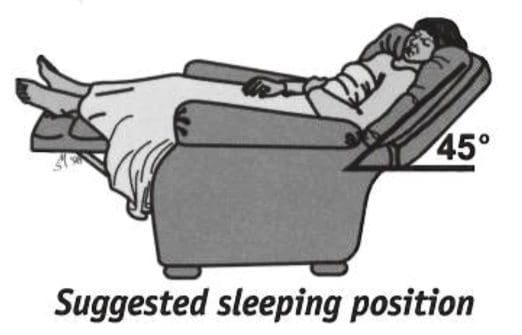 Sleep semi-recumbent for the next two nights. This means sleeping with your head halfway between flat and upright, at a 45-degree angle. This is most easily done by sleeping in a recliner chair or by sleeping with pillows appropriately arranged on a couch.