

Intercostal Muscle Strain: El Paso Back Clinic
Intercostal muscles are the muscles within the rib cage, commonly called the intercostals, which connect the ribs and make up the chest wall. An intercostal muscle strain refers to an injury between two or more ribs. If these muscles become overstretched, restricted, or suffer damage, it can cause inflammation and significant pain in the middle and upper back. Intercostal muscle strain is a common injury in athletes and physically demanding jobs. Chiropractic care and massage therapy can realign the vertebrae with the ribs and loosen and relax the muscles to increase circulation and restore mobility and function.
Intercostal Muscle Strain
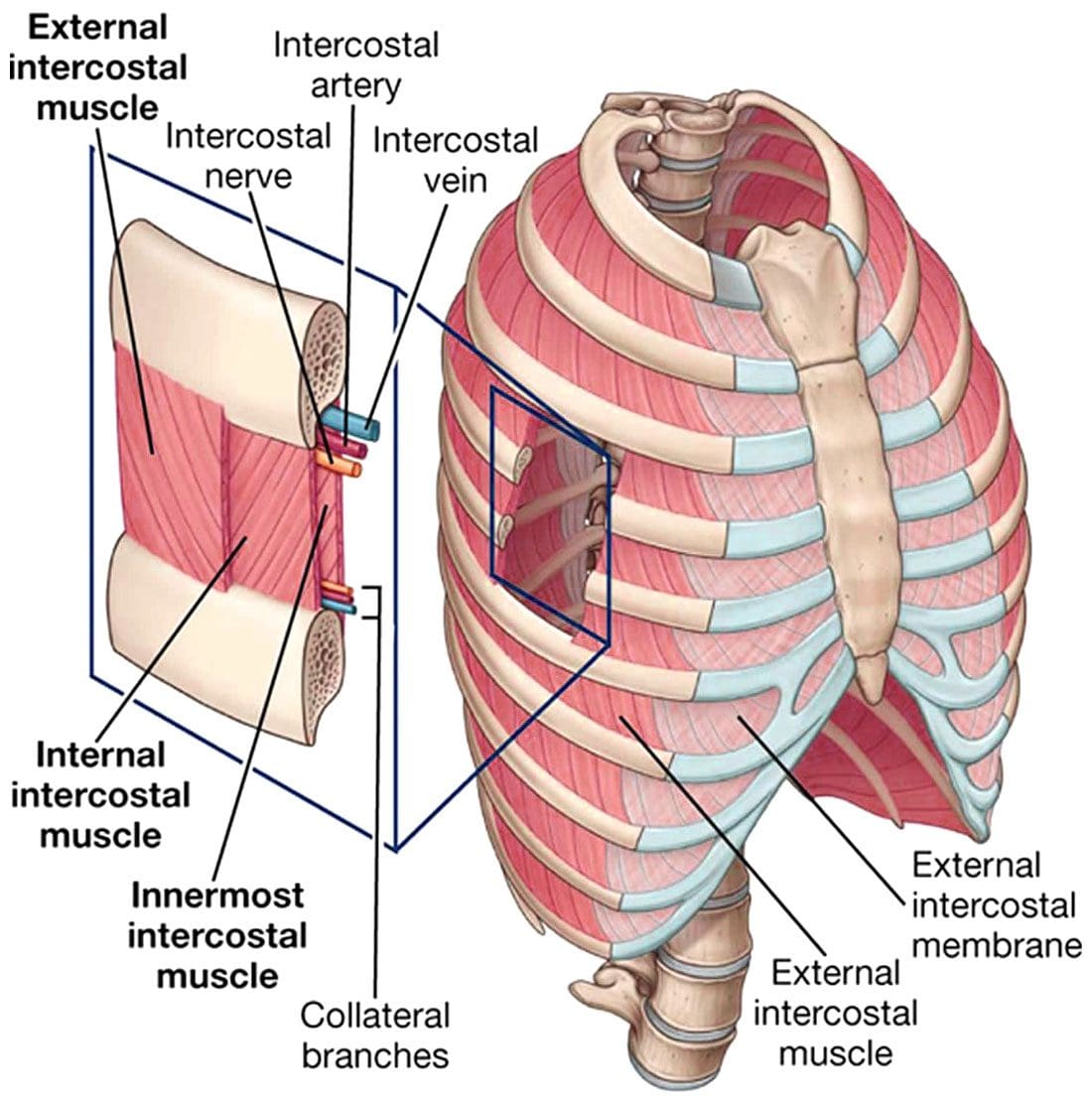
The intercostal muscles have different layers attached to the ribs to help build the chest wall and assist in breathing. There are 11 intercostal muscles on each side of the rib cage. Each set is located between connected ribs in the upper and mid-back and consists of the following:
External
- These are the outermost intercostals, responsible for expanding the chest during breathing to help inhale air and allow full deep breaths.
- The external intercostals originate at the lower edge of a rib and run diagonally to attach to the upper edge of the rib below.
- They are found in the rib cage’s back, sides, and front.
Internal
- These sit directly underneath the externals and help collapse the chest during breathing to exhale.
- The muscle fibers run perpendicular to the external intercostals, moving diagonally from front to back along the ribs, and are in the entire rib cage.
Innermost
- These sit directly underneath, run parallel to the internal intercostals, and run from the back of the rib cage to each side.
- The veins, arteries, and nerves lie between the internal and innermost intercostals.
When an intercostal muscle gets twisted, overused, or stretched too far, it can tear, causing muscle strain. Often radiating pain along the rib cage is experienced that extends to the back.
Causes
An intercostal muscle strain often occurs as the result of an injury or overexertion of the muscles. Common causes include:
- Trauma to the rib cage, such as from a fall or automobile collision.
- Impact trauma from sports or physical activities.
- Over twisting the torso beyond its normal range of motion from lifting weights, sports, yoga postures, or dance positions.
- Repeatedly reaching overhead for work or tasks like cleaning or painting.
- Lifting heavy objects above shoulder height.
- Repetitive torso movements.
- A sudden increase in physical activity that the body is not used to can also lead to intercostal muscle strain.
- This can happen when a lack of conditioning or unhealthy postures weaken muscles.
Symptoms
The signs and symptoms can vary, depending on the severity and cause. Symptoms can include:
- Intercostal muscle spasms.
- Mobility difficulties.
- Inflammation, swelling, and sensitivity in the affected area.
- Stiffness and tension, causing upper back pain.
- Upper back and rib pain.
- Tenderness in the area between the ribs.
- Muscle rigidity when bending or twisting the upper body.
- Gradual worsening pain after repetitive movements.
- Worsening pain when coughing, sneezing, or breathing in deeply.
- Severe and sudden pain, particularly if caused by direct trauma to the chest or back.
Chiropractic
Diagnosis involves the individual’s medical history and a physical exam to check for movement limitations and assess affected and sensitive areas. Once the inflammation is reduced, chiropractic and physical therapy will focus on the following:
- Pain relief treatment.
- Breathing exercises.
- Posture training.
- Stretching under supervision.
- Strengthing exercises.
- Most cases fully heal within 6 to 8 weeks.
Rib Muscle Injury
References
De Troyer, A et al. “Mechanics of intercostal space and actions of external and internal intercostal muscles.” The Journal of clinical investigation vol. 75,3 (1985): 850-7. doi:10.1172/JCI111782
Lord, Michael J, and William G Carson Jr. “Multiple Rib Stress Fractures.” The Physician and sports medicine vol. 21,5 (1993): 80-91. doi:10.1080/00913847.1993.11947575
Morrison W. What is an intercostal muscle strain? Medical News Today. Jan 2020
Page P. Current Concepts in Muscle Stretching for Exercise and Rehabilitation. International Journal of Sports Physical Therapy. 2012;7(1):109-119.
Park, Kyung-hee, et al. “Difference in selective muscle activity of thoracic erector spinae during prone trunk extension exercise in subjects with slouched thoracic posture.” PM & R: the Journal of Injury, Function, and Rehabilitation vol. 7,5 (2015): 479-84. doi:10.1016/j.pmrj.2014.10.004
Tran H. Causes of Intercostal Muscle Strain. Spine-health. October 2017
Yoo, Won-Gyu. “Effect of a combined thoracic and backward lifting exercise on the thoracic kyphosis angle and intercostal muscle pain.” Journal of physical therapy science vol. 29,8 (2017): 1481-1482. doi:10.1589/jpts.29.1481
Yoo, Won-Gyu. “Effect of thoracic stretching, thoracic extension exercise and exercises for cervical and scapular posture on thoracic kyphosis angle and upper thoracic pain.” Journal of physical therapy science vol. 25,11 (2013): 1509-10. doi:10.1589/jpts.25.1509







