Back Clinic Health Team. The level of functional and metabolic efficiency of a living organism. In humans, it is the ability of individuals or communities to adapt and self-manage when facing physical, mental, psychological, and social changes in an environment. Dr.Alex Jimenez D.C., C.C.S.T, a clinical pain doctor who uses cutting-edge therapies and rehabilitation procedures focused on total health, strength training, and complete conditioning. We take a global functional fitness treatment approach to regain complete functional health.
Dr. Jimenez presents articles both from his own experience and from a variety of sources that pertain to a healthy lifestyle or general health issues. I have spent over 30+ years researching and testing methods with thousands of patients and understand what truly works. We strive to create fitness and better the body through researched methods and total health programs.
These programs and methods are natural and use the body’s own ability to achieve improvement goals, rather than introducing harmful chemicals, controversial hormone replacement, surgery, or addictive drugs. As a result, individuals live a fulfilled life with more energy, a positive attitude, better sleep, less pain, proper body weight, and education on maintaining this way of life.
Exercising on sand offers not only amazing views but also a huge calorie blast. A study in The Journal of Experimental Biology found that running on sand requires 1.15 times more energy than running on a hard surface. (So for a 150-pound person, a half-hour, three-mile run on the beach would burn around 403 calories, compared with 350 on a typical surface.) Plus, it’s good for your joints—as long as the surface isn’t too slanted (instability can be tough on your hips and cause muscle imbalances).
Try this 30-minute interval workout, courtesy of Zack Daley, trainer and training manager at Tone House, an athletic-based fitness studio in New York City. It features running as well as bodyweight exercises to improve total-body strength and is perfect for beginners and experienced runners.
First, take 25 to 30 large steps from your starting point and make a mark in the sand. This will be your point of reference for the “down-and-back” portions of the workout.
The warm-up:
• Light jog/run down and back two times • High knees down and back one time • Butt kicks down and back one time • Run down and back at about 60 percent of your top speed two times • 10 burpees • Lateral shuffle down and back two times, facing away from the water • Lateral shuffle down and back two times, facing the water • Skip down and back one time • Run down and back at about 80 percent of your top speed one time
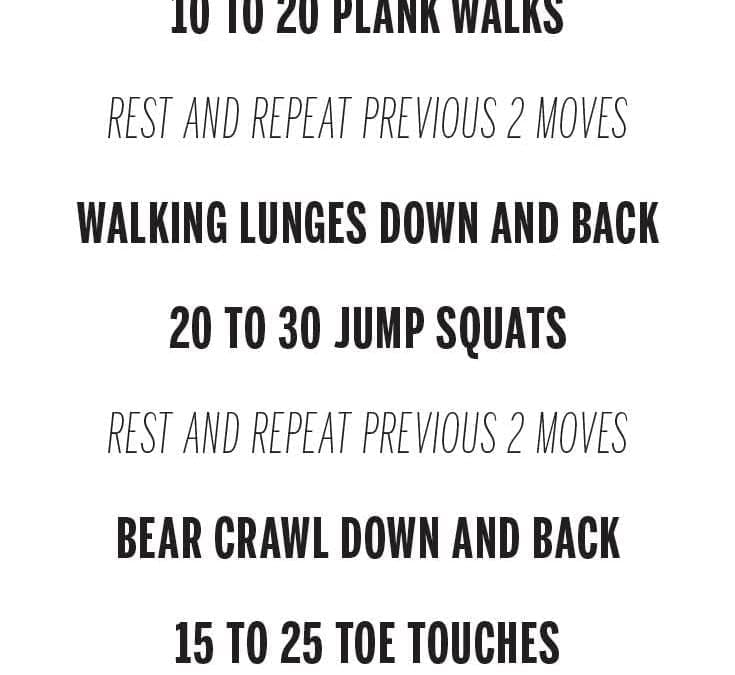
• 15 to 25 push-ups • 10 to 20 plank walks (alternate from high plank to elbow plank and back) • Rest for 30 to 45 seconds and repeat previous two moves • Walking lunges down and back • 20 to 30 jump squats • Rest for 30 to 45 seconds and repeat previous two moves • Bear crawl down and back • Rest for 30 to 45 seconds and repeat previous move • 15 to 25 toe touches • Plank knee to elbow (in high plank, bring your left knee to your left elbow, then right knee to right elbow; do 15 reps per side) • Bicycle-crunch burnout (keep going until you can’t do any more) • Rest for 30 to 45 seconds and repeat previous three moves • Sprint down and back twice, aiming to reach your fastest speed
Pin the full workout:
Your calorie burn: Approximately 285 (30 minutes of calisthenics for a 150-pound person).
In the latest installment of the Alien franchise, set 10 years after 2012’s Prometheus, a new heroine has been charged with kicking some major alien butt: Katherine Waterston plays Daniels, a chief teraformist on a colonizing mission to a new planet. And after an advanced screening of Alien: Covenant, which hits theaters Friday, I can assure you that Waterston embodies the strong female lead that’s been a staple of the Alien movies since Sigourney Weaver’s portrayal of Ellen Ripley, the original badass known for beating down extraterrestrials.
As you might imagine, sparring with (or running from!) blood thirsty—and let’s face it, pretty freaking scary—creatures isn’t an easy task. Translation: Waterston needed to be in great shape.
“I was so nervous that [director] Ridley [Scott] wasn’t going to let me do the stunts,” she said during a pre-screening talkback with cast members. “There was a sort of fit test at the beginning that nearly killed me, but I didn’t want to seem like I couldn’t handle it, because I thought they might take the fun moves away from me.”
But the 37-year-old actress explained that she didn’t arrive on set in the best shape of her life on purpose: “I didn’t want to seem like some kind of warrior at the beginning of the film, because I feel like that journey happens within it, so I didn’t want to come in too ripped,” she said.
Waterston’s plan worked: She got progressively fitter just by playing her role, she said. “A lot of the training happened on set because we were carrying heavy packs and carrying really heavy guns—for me it was heavy.”
Still, Waterston knew she needed to build muscle before filming began to avoid getting hurt on the job. “I didn’t want to rip my shoulder out my socket or something,” she said.
One of her strengtheners of choice: “curls, really heavy bicep curls.” Which totally makes since considering you’ll see her wielding gigantic guns, and swinging and climbing around a space shuttle for two-plus hours.
Channel your inner warrior and try a few: Stand tall with feet hip-width distance apart and arms at sides, a dumbbell in each hand; palms face forward. Without moving upper arms, bend elbows and curl weight toward shoulders. Slowly lower back to start, and then repeat.
Prefer to do curls with a cable machine? Check out the video below to see the proper form.
Clearly Waterston nailed her training approach for the sci-fi horror flick because actor Michael Fassbender (who plays the androids David and Walter in the film) had this to say about his costar: “She was fearless.”
Janette Sherman, 38, a recent transplant to Colorado, recalls how a casual walk with her dog last month turned into a frantic trip to the ER�and the mistakes she made along the way.
On one of the first warm days of April here in Denver, I set off on my lunch break for a hike in nearby Bear Creek Lake Park. I work for a cycling company where most people ride for an hour in the afternoons, but I had my dog with me that day and he needed a good walk.
I moved to Colorado last year from California, and my boss had warned me about rattlesnakes on the trail�especially in the spring, when the ground starts to warm up and the cold-blooded critters�look for places to soak up some sun. Still, I�ve encountered snakes before and wasn�t overly concerned: I was wearing shorts (instead of pants and snake gaiters, like some experts recommend), and certainly wasn�t watching the ground every step of the way.
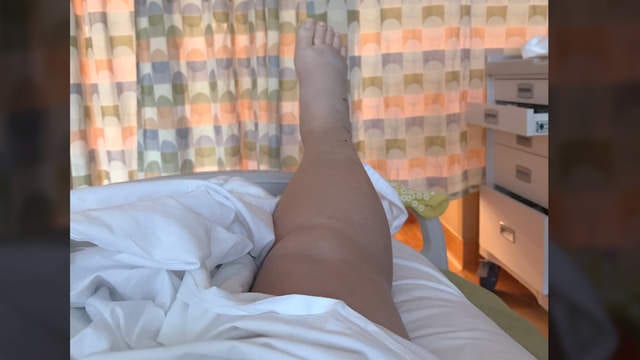
Almost a mile into my hike, I felt a sharp, sudden pain on my ankle, like I�d been stung by a wasp. I looked up, expecting to see a bug flying away. Then I looked down and saw the obvious puncture wounds.
I glanced behind me and saw the snake, coiled up, ready to strike again. It wasn�t particularly large�its coil was maybe 6 inches across�and it hadn�t rattled, the warning sign that often alerts people to back away. I wasn�t sure what kind of a snake it was, but I knew I should call 911 just to be safe.
The dispatcher asked me if my bite looked like a horseshoe; I learned later that horseshoe-shaped wounds come from nonvenomous snakes with tiny teeth all the way around their mouths. When I told her no, there were three distinct holes (which indicates the fangs of a venomous snake), she calmly told me I should get to a hospital.
But at that point I still felt OK, and was embarrassed to make a big deal about things. Even though the dispatcher wanted to send an ambulance, I told her I�d walk back to my car�the long way, since I refused to backtrack past where the snake had been�and drive myself to a fire station down the road.
As I walked, my foot began to swell and hurt badly. A driver on the road saw me limping and gave me a ride to my car, and I managed to get myself to the fire station. I was sweating a lot more than normal, and my lips and face had started to go numb. Now I know that overexertion can speed up a person�s reaction to snake venom and make symptoms worse. Looking back, I should have waited for help to arrive.
At the fire station, the EMTs took my shoe off and used a Sharpie to mark how far the swelling had spread�up my leg and across my foot�in the 30 minutes since my bite. This would help the doctors determine how serious my case was, they explained. (They also told me that commercial �snake bite� kits are worthless, but that hiking with a permanent marker is a good idea for this very reason.)
I asked if I could go to an urgent care center, but the EMTs told me that only major hospitals would have antivenin, the technical name for what’s also known as anti-venom. About two out of five rattlesnake bites are what�s known as a �dry bite��not venomous�but with my swelling and facial numbness, that didn�t seem to be the case.
An ambulance took me to Saint Anthony�s Hospital in Denver, where the paramedics’�suspicions were confirmed. But the antivenin had to be mixed in the pharmacy�it�s not always stored in a ready-to-use formula�which would take a while. I was seriously starting to regret not agreeing to an ambulance right away.
In the meantime, the doctors performed an EKG to check my heart rhythm, and gave me anti-nausea medication to keep me from throwing up (a common symptom of snake bites). Then, about two hours from when I was bitten, I started seeing double and my vision began fading to black. In the nick of time, the antivenin was ready, and the doctors administered six vials.
Over the next few hours, I received six more vials as the hospital staff monitored my vital signs, making sure I didn�t have a bad reaction to the drug. Snake venom can interfere with blood cells� ability to clot, so my doctors also had to take frequent blood draws and pay close attention to that, as well.
The pain from the swelling in my leg was excruciating, and I had to be monitored closely to make sure I didn�t develop compartment syndrome, when pressure builds up and causes tissue and blood vessel damage. But I got really lucky: Because I�d been treated quickly enough, I didn�t have any permanent injury.
I spent about three days in the hospital, and was discharged with crutches and some strong pain meds. I was cleared for exercise, and went back to the office, a week after the bite happened. I�d tried to answer work emails while recovering at home, but I felt really out of it those first few days�like my brain wasn�t working at full speed.
Then came several follow-up appointments, with an orthopedist and my primary care doctor, to make sure there were no lasting complications. My liver enzymes tested a little high, so I was told not to drink alcohol or take acetaminophen for a month.
It�s now been about three weeks since I was bitten, and I still have tenderness and swelling in my leg�especially if I spend a lot of time on my feet. But the bruising has faded and you can barely see the puncture marks. Also thankfully, I have health insurance: I haven�t gotten a bill yet, but I�ve read that antivenin can cost $2,500 a vial, and that it�s not unusual for snake-bite treatment to total $100,000 or more.
The most lasting effect of all this, honestly, is that it�s made me a little freaked out to go back out on the trail. I finally went for a bike ride at Bear Creek Lake this past weekend, and I screamed a few times when things brushed my leg. Luckily, I was able to calm myself down with some deep breaths and logical thinking.
I did learn a lot from my experience� that rattlesnakes don�t always rattle, how to recognize a venomous bite, how important it is to get to a hospital ASAP, and what not to do: Experts agree that you shouldn�t apply ice, cut into the wound, raise the affected limb above your heart, or apply a tourniquet.
I do plan to buy some snake gaiters, especially for when I�m exploring on foot, and I�m sure I will be more cautious from now on when I do get back out there. I know I�ll get my confidence back soon, though, because hiking and biking is what keeps me happy and healthy�rattlesnakes and all.
There is a belief among many that if you want to lose weight, you should do cardio. If you want to put it on, you need to pick up a barbell.
There is some truth to this � cardio will burn fat, resistance training will build muscle. However, weights will also burn fat. And fix your posture. And increase your power. Running? Not so much. So take a trip to the other side of the gym. It�s time to embrace the appeal of steel.
You�ll Burn More Fat In Less Time
The more muscle you use, the more calories you burn. And some of the bigger lifts call on almost every muscle in your body, says Dylan Jones, founder of P4 Body. �Due to the higher neurological demand and multi-joint involvement in some of the more complex lifts, the body works twice as hard compared to when sitting on a stationary bike or fixed path rowing machine.�
Even if tight for a time, weights mean you can still work the entire body. �Combine a dumbbell curl with a lunge, finished with an overhead press,� says Jones. Do 15 reps on each side, for three rounds total. �This uses the large muscles in the legs, shoulder, back and core to stabilise you. All of which requires a demand for oxygen to perform every rep.�
You�ll Burn More Fat Sitting Down
To oversimplify things a little, cardio burns calories while you�re moving. Strength training torches fat even when back at home. �It helps build muscle, and muscle is �active� tissue,� says Rob Aitken, a senior trainer at Matt Roberts gyms. Unlike fat, which is inactive, active tissue constantly uses energy: the more muscle you have, the more calories you burn. Even in bed.
�Try circuits using dumbbells or kettlebells,� says Jones. Pick five exercises then perform 40 seconds of work, 20 seconds of rest. Repeat for three rounds total in your normal cardio slot. �You are likely to burn more body fat at the same time as holding on to muscle.�
You�ll Power Up
Cardio is good for endurance, less so for brawn. �Choosing the weights room over a steady paced run wins hands down in the delivery of building performance and power into your game,� says Jones. This can have knock-on effects on your performance back in the park � the better you can put your strength through the ground, the faster you�ll move.
To hit everywhere that matters, all you need is a barbell and some serious weight. Deadlifts in sets of six reps will hit your glutes and posterior chain as well as fire up your metabolism. �You�ll be surprised by the additional power you create focusing on the non-favoured muscle groups,� says Jones.
You�ll Stop Feeling The Burn
Trying to squat too much weight does nothing good for your back. But lifting right can help ease the fire in your spine. �One of the main causes of bad posture and injury is from muscle imbalance,� says Jones. �This is developed by repetitive actions of everyday life, like sitting at a desk, using the telephone, operating a mouse, or commuting for hours a day. Adding to this with repetitive cardio is not going to help.�
Instead, strengthen what your day job has weakened by getting a qualified trainer to assess where you�re lacking. �A balanced weight training programme, which is designed specifically for you and your imbalances, will allow the body to move the way it was originally designed. This improves your posture and reverses some of the nasties that modern life has imposed.�
The scope of our information is limited to chiropractic and spinal injuries and conditions. To discuss options on the subject matter, please feel free to ask Dr. Jimenez or contact us at 915-850-0900 .
Additional Topics: Weight Loss Eases Back Pain
Back pain and symptoms of sciatica can affect a majority of the population throughout their lifetime. Research studies have demonstrated that people who are overweight or obese experience more back complications than people with a healthy weight. A proper nutrition along with regular physical fitness can help with weight loss as well as help maintain a healthy weight to eliminate symptoms of back pain and sciatica. Chiropractic care is also another natural form of treatment which treats back pain and sciatica utilizing manual spinal adjustments and manipulations.
It’s makeover time for the chocolate bars you’ve loved since you were a kid. On Thursday, some big-brand candy companies made a joint announcement that they�ll be shrinking the package size of their products, which in turn will lower the total calorie count. The label on the front of the bar will also list the exact number of calories inside.
The changes, to be completed by 2022, are all part of an effort to tackle the high rates of obesity in the U.S. The companies made the announcement at a meeting organized by the Partnership for a Healthier America; participating brands include Mars Chocolate, Wrigley, Nestle USA, Ferrero, Lindt, Ghirardelli, Russell Stover, and Ferrara Candy Company.
Healthy Changes for Chocolate Bars
Here�s a rundown of how the candy counter is going to change. First, half of the individually wrapped products made by the above brands will be available in smaller single-serving packages that have no more than 200 calories. Calorie counts will also be easier to read and understand, as they’ll be printed right on the front of the package. The calorie count will cover the entire bar or bag. Also, no more serving-size mumbo-jumbo.
Information about candy will be easier to access as well. A new website known as, AlwaysATreat.com, will become a digital resource to help consumers understand what ingredients go into the candy and chocolate and the will help have any questions answered.
Currently, most of the individually wrapped products these companies sell already have less than 250 calories per package, so the change won�t seem drastic. But with more size options, people can more easily choose how they�d like to indulge.
�Educating the public about food products, even candy, is key to helping consumers make informed choices,” says Libby Mills, RD, spokesperson for the Academy of Nutrition and Dietetics. But despite the changes, “consumers need to remember that smaller portions with nutritional information on the packaging doesn�t mean that the candy item is healthy.�
The scope of our information is limited to chiropractic and spinal injuries and conditions. To discuss options on the subject matter, please feel free to ask Dr. Jimenez or contact us at 915-850-0900 .
Additional Topics: Weight Loss Eases Back Pain
Back pain and symptoms of sciatica can affect a majority of the population throughout their lifetime. Research studies have demonstrated that people who are overweight or obese experience more back complications than people with a healthy weight. A proper nutrition along with regular physical fitness can help with weight loss as well as help maintain a healthy weight to eliminate symptoms of back pain and sciatica. Chiropractic care is also another natural form of treatment which treats back pain and sciatica utilizing manual spinal adjustments and manipulations.
To the age-old question �Is coffee bad for you?�, researchers are in more agreement than ever that the answer is a resounding �no.�
A new study published in the journal Nature Medicine found that older people with low levels of inflammation � which drives many, if not most, major diseases � had something surprising in common: they were all caffeine drinkers.
�The more caffeine people consumed, the more protected they were against a chronic state of inflammation,� says study author David Furman, consulting associate professor at the Institute for Immunity, Transplantation and Infection at Stanford University. �There was no boundary, apparently.�
Coffee and Aging
In the study, Furman and his colleagues analyzed blood samples from 100 young and old people. The older people tended to have more activity in several inflammation-related genes compared with the younger group � no surprise, since as people get older, inflammation throughout the body tends to rise. Chronic diseases of aging, like diabetes, hypertension, heart problems, cancer, joint disorders and Alzheimer�s, are all believed to have inflammation in common. �Most of the diseases of aging are not really diseases of aging, per se, but rather diseases of inflammation,� Furman says. The more active these genes were, the more likely the person was to have high blood pressure and atherosclerosis.
What�s more, even among older people, those with lower levels of these factors were more protected against inflammation � and they had something else in common too. They all drank caffeine regularly. People who drank more than five cups of coffee a day showed extremely low levels of activity in the inflammatory gene pathway. Caffeine inhibits this circuit and turns the inflammatory pathway off, the researchers say.
The goal isn�t to make every trace of inflammation disappear, the scientists stress. In fact, inflammation is an important function of the immune system, which uses it to fight off infections and remove potentially toxic compounds. But with aging, the process isn�t regulated as well as it is in a younger body. �Clearly in aging something is breaking down, and we become less effective at managing this inflammation,� says Mark Davis, director of the Stanford institute. �But now in this paper, we identify a particular pathway that was not associated with inflammation before. We are able to point, with a much higher resolution picture, at aging and the things that should be markers for inflammation.�
The key will be to figure out when the inflammatory response starts to spiral out of control. In an upcoming study, Furman and others will soon investigate the immune systems of 1,000 people; he hopes to use that information to develop a reference range of immune-system components to tell people whether their levels are normal, or if they�re at higher risk for developing chronic conditions driven by inflammation. In the meantime, following the example of caffeine-drinking adults with lower levels of inflammation � by having a cup of joe or two � might be a good idea.
The scope of our information is limited to chiropractic and spinal injuries and conditions. To discuss options on the subject matter, please feel free to ask Dr. Jimenez or contact us at 915-850-0900 .
Additional Topics: What is Chiropractic?
Chiropractic care is an well-known, alternative treatment option utilized to prevent, diagnose and treat a variety of injuries and conditions associated with the spine, primarily subluxations or spinal misalignments. Chiropractic focuses on restoring and maintaining the overall health and wellness of the musculoskeletal and nervous systems. Through the use of spinal adjustments and manual manipulations, a chiropractor, or doctor of chiropractic, can carefully re-align the spine, improving a patient�s strength, mobility and flexibility.
The first rule of diet success is to make changes you can stick with for the long term. And that means scheduling — not skipping — meals and snacks. This keeps you feeling satisfied and helps you say no to tempting high-fat foods.
You might do best on a plan with many small meals throughout the day. Or maybe a schedule of three meals, two small snacks and a low-calorie dessert would work better for you. People often find that mid-morning and mid-afternoon snacks help them stick to a diet.
For a small-meal schedule, you might plan out five 200- to 250-calorie meals for 7 a.m., 10 a.m., 1 p.m., 4 p.m. and 7 p.m. For a three-meal/two-snack schedule, you could schedule breakfast, a mid-morning snack, lunch, a mid-afternoon snack and then dinner with dessert. Schedule snacks for about two hours after breakfast and lunch.
Once you decide on a schedule, plan out your meals and snacks. Using a diet diary can help keep you on track. Pick and choose from lean protein, low- or no-fat dairy, whole grains, fruits, vegetables and some heart-healthy fats.
Starting a Dietary Plan
Snacks can be a great way to get more fruits and vegetables into your day.
Great veggie snacks include:
Bell pepper strips.
Baby carrots.
Pea pods.
For fruit snacks, consider:
Small apples or pears.
A cup of melon chunks or berries.
A dozen red or green grapes.
A diet-friendly dessert of frozen yogurt and berries after dinner will keep you from missing high-calorie pies and cakes.
But what about calories? In general, aim for 1,000 to 1,200 a day if you’re a woman, 1,200 to 1,600 if you’re a man.
Bottom line: It might take some time to find the right eating schedule for your lifestyle, but nailing this first step will help you lose weight and keep it off.
News stories are written and provided by HealthDay and do not reflect federal policy, the views of MedlinePlus, the National Library of Medicine, the National Institutes of Health, or the U.S. Department of Health and Human Services.
The scope of our information is limited to chiropractic and spinal injuries and conditions. To discuss options on the subject matter, please feel free to ask Dr. Jimenez or contact us at 915-850-0900 .
Additional Topics: Weight Loss Eases Back Pain
Back pain and symptoms of sciatica can affect a majority of the population throughout their lifetime. Research studies have demonstrated that people who are overweight or obese experience more back complications than people with a healthy weight. A proper nutrition along with regular physical fitness can help with weight loss as well as help maintain a healthy weight to eliminate symptoms of back pain and sciatica. Chiropractic care is also another natural form of treatment which treats back pain and sciatica utilizing manual spinal adjustments and manipulations.
IFM's Find A Practitioner tool is the largest referral network in Functional Medicine, created to help patients locate Functional Medicine practitioners anywhere in the world. IFM Certified Practitioners are listed first in the search results, given their extensive education in Functional Medicine