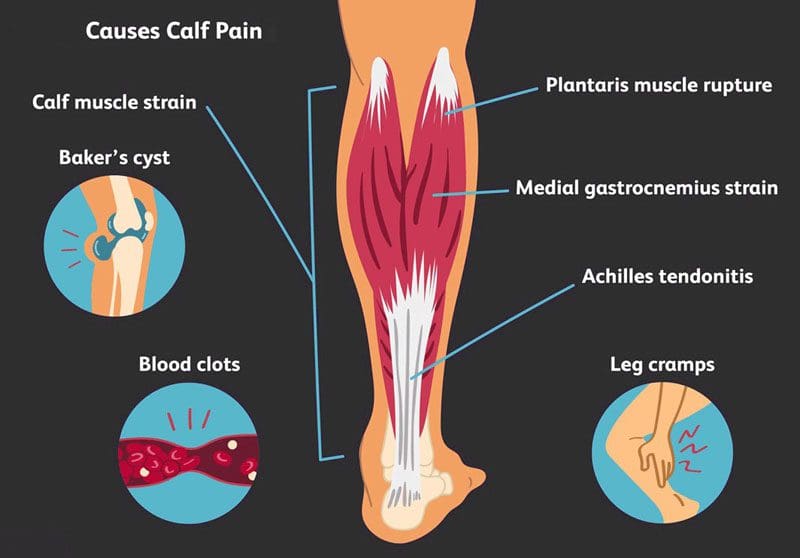
Calf pain is common in individuals who spend a lot of time on their feet, whether standing at work, school, or training athletes. The calf muscle/s take on a tremendous amount of load throughout the day. Climbing stairs, jogging, running, and hiking increase strain on the muscles. In most cases, calf pain results from an overuse injury of the calf muscles. Improper footwear can also contribute to issues around the foot and ankle that include:
- Tightness
- Loss of strength of the foot
- Decreased mobility
Short or tight calves can lead to dysfunctional movement, cramping symptoms, chronic pain, and stiffness. A combination of chiropractic active release treatment and physical therapy can help quickly eliminate calf pain.
Contents
Anatomy
The calves are comprised of two muscles, the gastrocnemius, and soleus.
- The gastroc originates just above the knee.
- The soleus is below the knee.
They both insert on the back of the ankle as they join to form the Achilles tendon. The gastrocnemius is the power muscle used for explosive movements like jumping. The soleus muscle is predominately a slow-twitch muscle. This means it is very active during extended activities, like standing, walking, exercising, and running. When dealing with calf and ankle issues, other muscles can also contribute. These include:
- The posterior tibialis lies deep in the inner portion of the calf and plays a role in foot and ankle function.
- The posterior tibialis is heavily involved with Medial Tibial Stress Syndrome or MTSS, also called shin splints.
Calf Muscle Pain
Most commonly, calf pain is caused by the overuse of the calf muscles. This is often the result of the consistent pounding of the feet and lower legs from standing, walking, and working. Over time, the repetitive pounding can cause tiny tears in the muscles of the lower legs and calves. If detected, early rest and recovery are recommended to allow the muscles to relax, loosen, and heal. However, repeated use can lead to more severe injury without proper treatment, like compartment syndrome. Certain types of calf pain can signify a medical emergency that requires immediate treatment.
Compartment Syndrome
A tough and fibrous covering surrounds the calf called the fascia. During physical activity or exercise, blood flows into these muscles, causing them to increase in size. If the fascia cannot stretch enough when these muscles enlarge, pain and tightness can develop. This is known as chronic posterior compartment syndrome. The discomfort typically goes away when the activity stops but is likely to return without proper treatment.
Calf Overuse Injury
Soreness, tightness, and pain are usually felt along the back or inside of the lower leg. The calf muscles are generally not painful to touch but maybe tender when deep pressure is applied. Calf pain and tightness often come with extended physical activity, exercise and disappear once the activity is stopped. If the injury becomes chronic, calf stiffness can present even when not active, along with numbness and/or tingling in the lower leg or foot.
Treatment
It is recommended not to ignore any discomfort, pain, and stiffness in the calves. Continued overuse can lead to scar tissue formation and chronic pain potential without proper care. Active Release – ART, and chiropractic effectively treat this type of injury. ART breaks up scar tissue, returning normal function to the calf muscles. And chiropractic loosens up stiff joints in the hips, ankles, and feet that may be contributing to wear and tear on the calves. Together they can quickly and eliminate calf pain. Part of a treatment plan includes:
- Joint manipulation or mobilization
- Soft tissue mobilization
- Nutritional recommendations
- Rehab-based exercises and stretches
Body Composition
Metabolic Adaptations
Aerobic exercise substantially impacts the body’s muscles’ energy production system and cardiovascular adaptation. The blood delivers oxygen to the muscle cells to produce energy that powers all the exercise being done. Aerobic exercise primarily relies on oxidative energy production, which takes place within the cells called mitochondria. Aerobic exercise also breaks down fat molecules for energy, which can only happen within mitochondria.
- Aerobic exercise training improves the muscle cells’ ability to burn fat by generating more mitochondria and enhancing their functionality. Specifically, the body burns more fat than usual in the hours following each training session.
- With more precise quality and quantity of fat-burning machinery, aerobic training can increase the resting metabolic rate, resulting in more calories burned.
- High-intensity aerobic exercise also increases the excess post-exercise oxygen consumption – EPOC, resulting in increased calorie burn in addition to what was burned during the exercising.
References
Alfredson, H et al. “Heavy-load eccentric calf muscle training for the treatment of chronic Achilles tendinosis.” The American journal of sports medicine vol. 26,3 (1998): 360-6. doi:10.1177/03635465980260030301
Bright, Jacob Michael et al. “Ultrasound Diagnosis of Calf Injuries.” Sports health vol. 9,4 (2017): 352-355. doi:10.1177/1941738117696019
Campbell, John T. “Posterior calf injury.” Foot and ankle clinics vol. 14,4 (2009): 761-71. doi:10.1016/j.fcl.2009.07.005
Green, Brady, and Tania Pizzari. “Calf muscle strain injuries in sport: a systematic review of risk factors for injury.” British journal of sports medicine vol. 51,16 (2017): 1189-1194. doi:10.1136/bjsports-2016-097177
General Disclaimer, Licenses, and Board Certifications *
Professional Scope of Practice *
The information herein on "Calf Muscle Tightness and Injury" is not intended to replace a one-on-one relationship with a qualified health care professional or licensed physician and is not medical advice. We encourage you to make healthcare decisions based on your research and partnership with a qualified healthcare professional.
Blog Information & Scope Discussions
Welcome to El Paso's Premier Wellness and Injury Care Clinic & Wellness Blog, where Dr. Alex Jimenez, DC, FNP-C, a Multi-State board-certified Family Practice Nurse Practitioner (FNP-BC) and Chiropractor (DC), presents insights on how our multidisciplinary team is dedicated to holistic healing and personalized care. Our practice aligns with evidence-based treatment protocols inspired by integrative medicine principles, similar to those on this site and on our family practice-based chiromed.com site, focusing on naturally restoring health for patients of all ages.
Our areas of multidisciplinary practice include Wellness & Nutrition, Chronic Pain, Personal Injury, Auto Accident Care, Work Injuries, Back Injury, Low Back Pain, Neck Pain, Migraine Headaches, Sports Injuries, Severe Sciatica, Scoliosis, Complex Herniated Discs, Fibromyalgia, Chronic Pain, Complex Injuries, Stress Management, Functional Medicine Treatments, and in-scope care protocols.
Our information scope is multidisciplinary, focusing on musculoskeletal and physical medicine; wellness; contributing etiological viscerosomatic disturbances within clinical presentations; associated somato-visceral reflex clinical dynamics; subluxation complexes; sensitive health issues; and functional medicine articles, topics, and discussions.
We provide and present clinical collaboration with specialists from various disciplines. Each specialist is governed by their professional scope of practice and licensure jurisdiction. We use functional health & wellness protocols to treat and support care for musculoskeletal injuries or disorders.
Our videos, posts, topics, and insights address clinical matters and issues that directly or indirectly relate to our clinical scope of practice.
Our office has made a reasonable effort to provide supportive citations and has identified relevant research studies that support our posts. We provide copies of supporting research studies upon request to regulatory boards and the public.
To discuss how these matters can assist in a specific care plan or treatment protocol, please contact Dr. Alex Jimenez, DC, APRN, FNP-BC, or reach out to us at 915-850-0900.
We are here to help you and your family.
Blessings
Dr. Alex Jimenez DC, MSACP, APRN, FNP-BC*, CCST, IFMCP, CFMP, ATN
Email: [email protected]
Multidisciplinary Licensing & Board Certifications:
Licensed as a Doctor of Chiropractic (DC) in Texas & New Mexico*
Chiropractic Licenses:
Texas DC License #: TX5807, Verified: TX5807
New Mexico DC License #: NM-DC2182, Verified: NM-DC2182
Nurse Practitioner Licenses:
Texas APRN License #: 1191402, Verified: 1191402 *
New Mexico CNP License #: 90560, Verified 90560
Florida APRN License #: 11043890, Verified: APRN11043890 *
Colorado License #: C-APN.0105610-C-NP, Verified: C-APN.0105610-C-NP
New York License #: N25929, Verified N25929
Georgia APRN License #: GAA-NP005701
Multi-State Advanced Practice Registered Nurse (APRN*) Texas & Multi-States
Multi-state Compact APRN License by Endorsement (43 States)
Compact Status: Multi-State License: Authorized to Practice in 43 States*
Nursing Licensure Compact: Updated Here
DEA Registration: (Drug Enforcement Agency Registered)
All medical (MDs) and family practice providers (FNP-APRN) are registered and licensed to offer various levels of medication.
Verify Providers Here
License Verification Link: Nursys License Verifier
* Prescriptive Authority Authorized (DEA Registered Providers). Call if Required
Board Certification:
ANCC FNP-BC: Board Certified Nurse Practitioner*
Education:
Graduate with Honors: ICHS: MSN-FNP (Family Nurse Practitioner Program)
Degree Granted. Master's in Family Practice, MSN Diploma (Cum Laude)
Dr. Alex Jimenez, DC, APRN, FNP-BC*, CFMP, IFMCP, ATN, CCST
(Board Certified: Family Practice Nurse Practitioner—Multistate)*
(Licensed Nurse Practitioner & Chiropractor - Multistate)*
Clinical Director
DC & FNP License (Review Above)
Digital Business Card
NPI: 1205907805
Dr. Maria Cardenas, MD
(Board Certified: Internal Medicine)
(Licensed Medical Doctor)
Medical Director, Clinical Director & Collaborative Physician
NPI # 1164426748
MD License #: J2933
Licenses and Board Certifications:
MD: Medical Doctor
DC: Doctor of Chiropractic
APRNP: Advanced Practice Registered Nurse
FNP-BC: Family Practice Specialization (Multi-State Board Certified)
FNP-BC: Family Practice Across Life Span (Neonatal to Geriatrics)
RN: Registered Nurse (Multi-State Compact License)
CFMP: Certified Functional Medicine Provider
MSN-FNP: Master of Science in Family Practice Medicine
MSACP: Master of Science in Advanced Clinical Practice
IFMCP: Institute of Functional Medicine
CCST: Certified Chiropractic Spinal Trauma
ATN: Advanced Translational Neutrogenomics
Family with Primary Care Focus (Family Nurse Practitioner or FNP)
- The Family Nurse Practitioner (FNP) promotes, maintains, and restores health for individuals and families across the lifespan. FNPs also identify health risks, promote wellness, and diagnose and manage acute and chronic illness.
- The FNP focuses on comprehensive primary care, promoting healthy lifestyles for patients across the lifespan in settings such as private practice, physician offices, and community health centers.
Memberships & Associations:
TCA: Texas Chiropractic Association: Member ID: 104311
TNA: Texas Nurse Association: Member ID: 06458222
TNP: Texas Nurse Practitioner Association ID: 2025091511
AANP: American Association of Nurse Practitioners: Member ID: 2198960
ANA: American Nurses Association: Member ID: 06458222 (District TX01)
| Primary Taxonomy | Selected Taxonomy | State | License Number |
|---|---|---|---|
| No | 111N00000X - Chiropractor | NM | DC2182 |
| Yes | 111N00000X - Chiropractor | TX | DC5807 |
| Yes | 363LF0000X - Nurse Practitioner - Family | TX | 1191402 |
| Yes | 363LF0000X - Nurse Practitioner - Family | FL | 11043890 |
| Yes | 363LF0000X - Nurse Practitioner - Family | CO | C-APN.0105610-C-NP |
| Yes | 363LF0000X - Nurse Practitioner - Family | NY | N25929 |
| Yes | 363LF0000X - Nurse Practitioner - Family | NM |
90560 |
| Yes | 363LF0000X - Nurse Practitioner - Family | GA | GAA-NP005701 |
Dr. Alex Jimenez, DC, APRN, FNP-BC*, CFMP, IFMCP, ATN, CCST
(Board Certified: Family Practice Nurse Practitioner—Multistate)*
(Primary Care Across Lifespan—Neonatal / Pediatric / Adult / Geriatrics)
(Licensed Nurse Practitioner & Chiropractor - Multistate)*
Clinical Director
Digital Business Card
NPI: 1205907805
Dr. Maria Cardenas, MD
(Board Certified: Internal Medicine)*
(Licensed Medical Doctor)*
Medical Director, Clinical Director & Collaborative Physician
NPI # 1164426748
MD License #: J2933
📆 Schedule Appointment: Schedule 24/7 (Click Here)